




An income annuity is built to pay you for as long as you live. A bond, or a ladder of bonds, pays interest for a set period and then returns your principal. That one difference drives almost everything else: how much income you get per dollar, how much of your money you can reach, and which risks you carry. Many retirees end up using both, with an annuity covering the bills that must be paid every month and bonds covering flexibility.
Below we walk through how each one pays, where a bond ladder falls short, how taxes differ, and how to decide what share of your savings goes where.
TL;DR
- Bonds pay interest and return principal at maturity. Income annuities pay for life, but the payments are partly a return of your own money.
- A bond ladder gives predictable income for a defined stretch, such as 10 or 30 years, then runs out. A lifetime annuity keeps paying if you outlive that stretch.
- Annuity guarantees rest on the insurer’s ability to pay claims. Bonds carry interest-rate and credit risk, and TIPS add inflation protection.
- Annuities give up liquidity. Bonds keep your principal accessible.
- Many retirees split the job: an annuity for essential expenses, bonds for everything else.
Table of Contents
- How each one actually pays you
- Annuity vs bond ladder: the difference that matters most
- How predictable is each income stream?
- Costs, liquidity and the trade-offs you should price in
- Taxes: where the two differ
- Inflation: the weak spot of most annuities
- Perspective: how we think about it
- When retirees use one, the other, or both
- Questions to ask before you commit
- Talk to a Medicare and retirement income specialist
- FAQ
- Sources
How each one actually pays you
Bonds: interest now, principal later
A bond is a loan to an issuer, whether a government, a corporation or a municipality. The issuer pays fixed periodic interest and returns the principal at maturity. Your income is the interest. Your original money is still there at the end, assuming the issuer pays it back.
Because the principal returns, a bond owner can also sell before maturity, though the price then depends on where interest rates have moved. That access to your money is a real feature, and we will come back to it.
Income annuities: a contract for payments
An income annuity is a contract with an insurance company. You hand over a lump sum, and the insurer agrees to make periodic payments, often for the rest of your life. Lifetime annuities pay as long as the recipient survives, while a ladder of Treasury Inflation-Protected Securities (TIPS) has a specified life span, and its money is spent when that life span is complete.
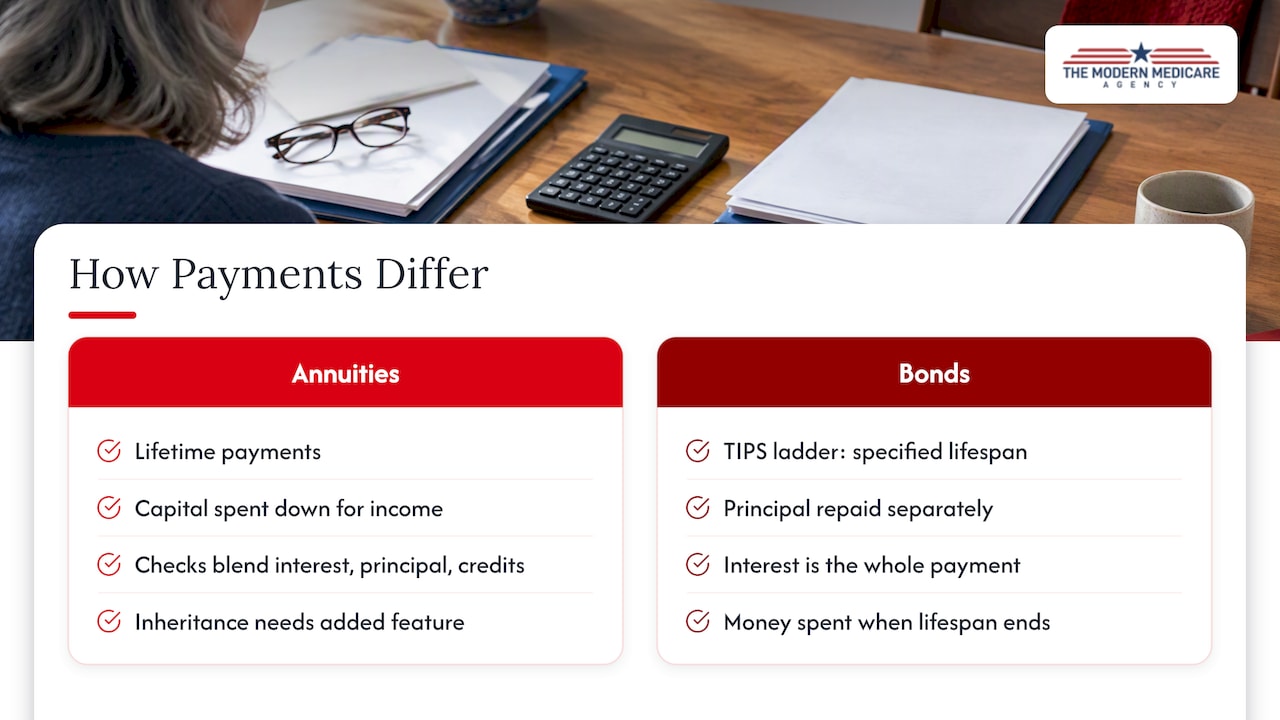
The payment you receive is not just interest. Morningstar contributor John Rekenthaler describes comparing the two as often like comparing apples and oranges: annuities spend down capital to provide lifetime income, while bonds are expected to repay the principal. Each annuity check is a blend of interest, return of your own principal, and what insurers call mortality credits, the benefit of pooling money with people who do not live as long as average.
This is why annuity payments often look larger than bond interest on the same amount. The comparison is not like for like. A bond’s interest is the whole payment, and the principal comes back separately. The annuity payment already includes the slow return of your principal, and the insurer keeps nothing for you to inherit unless you buy a feature that provides it.
A quick side-by-side
| Bond or bond ladder | Income annuity | |
|---|---|---|
| What you hold | Loans to issuers | An insurance contract |
| What pays you | Interest, then principal at maturity | Periodic payments, often for life |
| How long income lasts | A finite period | Can last for life |
| Access to your money | Usually yes, sale price varies | Limited or none after purchase |
| Main risks | Interest-rate, credit, inflation | Insurer’s ability to pay, inflation, lost liquidity |
| Inflation protection | TIPS adjust with the CPI | Most are sold without cost-of-living adjustments |
Annuity vs bond ladder: the difference that matters most
A bond ladder is a portfolio of individual bonds with staggered maturity dates, designed to create a predictable flow of income over a finite period. You might own bonds maturing each year for the next 10 or 30 years. As each rung matures, you spend the cash.
The key feature is that the ladder consumes itself. TIPS ladders are self-liquidating: they use up their principal and run out at the final maturity date. If you build a 30-year ladder at 65 and live to 97, the income stops at 95.
A lifetime annuity addresses exactly that gap. It is designed to cover the risk of outliving your assets. A bond ladder, by contrast, lets you keep control of the principal and liquidate it if you need to.
So the choice is less “which pays more” and more “which risk worries you more”:
- If you fear running out of money at 92, the annuity targets that risk directly.
- If you fear needing a large sum for a surprise bill, or want to leave money to heirs, the ladder keeps that door open.
If you like the ladder idea but want lifetime payments, there is a middle path. We explain how staggering several annuity purchases over time works in our guide to an annuity ladder for retirement income.
A simple way to picture it
Say you want $3,000 a month for housing, food, utilities and insurance, on top of Social Security. With a bond ladder you decide how many years you want covered and buy bonds maturing in each of those years. The longer the period, the more capital it takes, because every dollar of income is spent from principal as well as interest. With an annuity, the insurer prices the payment using your age and life expectancy, so the capital needed per dollar of income can be lower, in exchange for giving up access to that capital. The exact numbers change with interest rates and carrier pricing, so get live quotes rather than trusting a rule of thumb. Our page on annuity rates for retirees explains what drives them.
How predictable is each income stream?
Both can be predictable, but for different reasons.
Certain income annuities provide guaranteed lifetime income under the contract, subject to the insurer’s claims-paying ability. That last phrase matters. The guarantee is only as strong as the company behind it, so choosing a financially strong carrier is part of the decision. An independent agent who can compare many insurers makes this easier than shopping with a single company.
Bonds can provide predictable income for a specified period, but they remain exposed to two risks:
- Interest-rate risk: if rates rise after you buy, the market value of your existing bonds falls. If you hold to maturity, you still receive the stated payments, but you may sell at a loss if you need cash early.
- Credit risk: a corporate or municipal issuer can fail to pay. U.S. Treasuries carry far less of this, which is why many ladders use them.
Rates also affect the annuity side. When bond yields rise, insurance companies can afford to boost payouts for new annuity buyers, while bond investors keep access to their principal. That is why timing and shopping around matter. A quote from a year ago may not match what is offered today.
Costs, liquidity and the trade-offs you should price in
The most important thing to understand about an income annuity is that you are trading flexibility for certainty. Income annuities sacrifice liquidity: once you annuitize, you may have limited or no access to the lump sum. That is the price of the guarantee, and it is the reason we suggest putting only the portion of savings you will not need for emergencies into one.
Bonds are the opposite. They stay liquid, but you carry the market and credit risk, and the income ends when the ladder does.
When you compare costs, look at these points:
- What you are paid per dollar. Ask for quotes at your age, with and without a period-certain or survivor feature.
- How the insurer is paid. Some annuities carry commissions built into the pricing and some are sold with no commission. Ask the agent how they are paid on the product you are considering.
- Features you add. Survivor benefits, guaranteed minimum payout periods and cost-of-living increases all lower the starting payment.
- Bond expenses. If you buy individual bonds, there are small dealer markups. If you use a bond fund instead of a ladder, you pay an expense ratio and lose the fixed maturity date.
A fixed annuity that is not annuitized, such as a multi-year guaranteed rate product, is a different animal from an income annuity. We cover the strengths and limits in fixed annuities for retirement income.
Taxes: where the two differ
Taxes can change which one nets you more, so look at them before you decide.
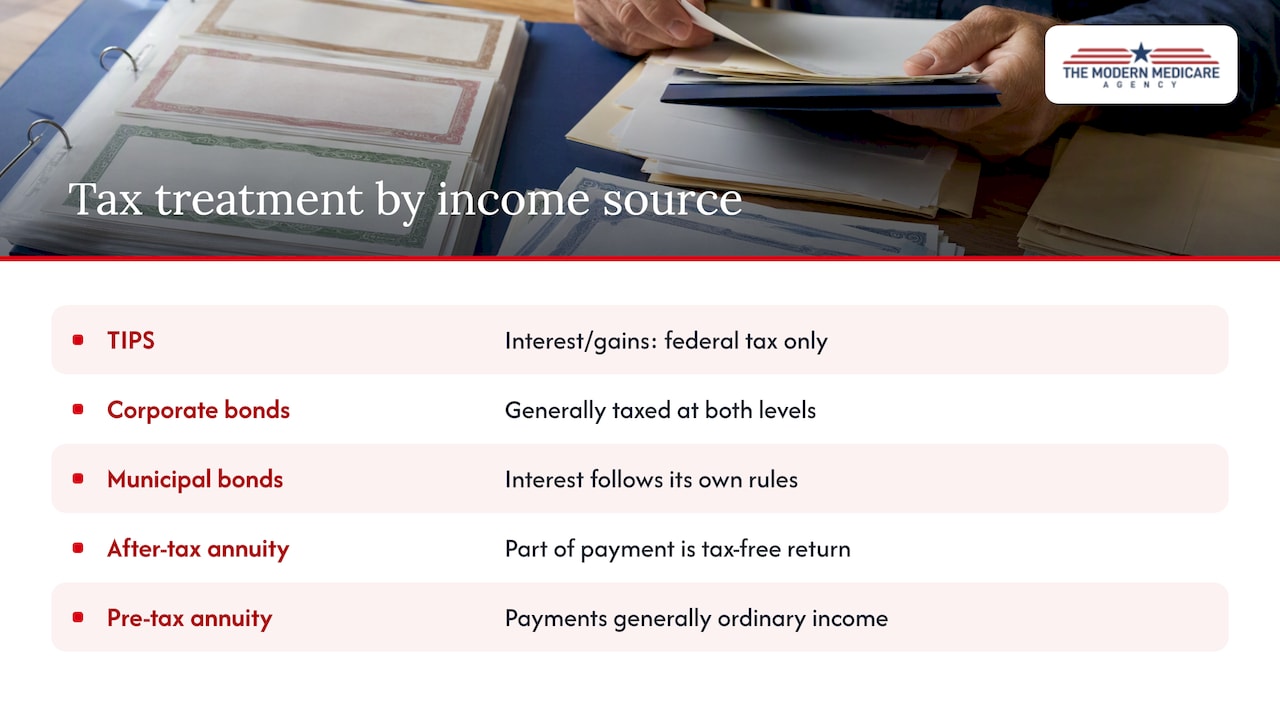
Bonds and TIPS. TIPS interest payments and capital gains are subject to federal income tax but exempt from state and local income taxes. That state exemption helps retirees in high-tax states. Regular corporate bond interest is generally taxed at both levels, and municipal bond interest has its own rules. A tax professional can tell you which applies in your situation.
Annuities. When an annuity is bought with after-tax money outside a retirement account, part of each payment is treated as a tax-free return of your cost, and the rest is taxable. The IRS explains the method, called the exclusion ratio, in Publication 939: your cost divided by the expected return gives a percentage of each payment that is excluded, until your cost has been recovered. If the annuity is bought inside an IRA or other pre-tax account, payments are generally taxable as ordinary income. That is a simple distinction, but the details depend on your contract, so confirm with a CPA or enrolled agent before you buy.
This is one reason an annuity can feel “cheaper” on an after-tax basis than its headline payment suggests, and one reason a bond ladder inside a taxable account can feel heavier. It is not automatic, and it varies by person.
Inflation: the weak spot of most annuities
A payment that looks comfortable at 65 buys less at 85. Almost all annuities are sold without cost-of-living adjustments, according to Morningstar, and the two strategies it lists that contain TIPS combat inflation risk.
TIPS adjust both principal and interest payments based on the Consumer Price Index. That is a real advantage of a TIPS ladder for the years it covers.
A few practical ways retirees handle this:
- Buy an annuity with an annual increase rider, accepting a lower starting payment.
- Stagger annuity purchases so later ones are priced at later rates and ages.
- Keep a growth sleeve of savings for the long run, since the annuity does not need to cover everything.
- Use TIPS for the early years and an annuity for the later ones.
Building that growth sleeve starts well before retirement. If you are still saving, a look at how retirement savings grow with salary, employer match and years shows why the starting balance matters so much to the choice you face later.
Perspective: how we think about it
Most people who come to us are not asking for a product. They are asking whether the money will last. Turning 65, losing employer coverage or retiring all happen at the same time as Medicare decisions, and income questions pile on top.
Our view is that the annuity vs bond question is a question about jobs. Which dollars have to arrive every month no matter what? Those are the dollars an income annuity is designed to handle, and we think it is a strong tool for that role. Which dollars are for emergencies, travel, heirs or growth? Those belong in assets you can reach, such as bonds and other investments.
As independent agents with access to 40+ carriers, we can compare annuity quotes across companies rather than pushing one. We believe in education first, so we would rather you understand the trade-offs than feel rushed. We also review coverage each year, because both your income plan and your Medicare plan should be checked as your life changes.
This is our opinion as agents who have worked with Medicare consumers since 2007, not a promise of results.
Paul
When retirees use one, the other, or both
There is no universal split. Here are patterns that tend to fit particular situations.
Lean toward an annuity when:
- Your guaranteed income (Social Security, a pension) does not cover essential costs.
- You are healthy and have longevity in the family.
- You want to stop thinking about market swings.
Lean toward bonds when:
- You already have enough guaranteed income.
- You want to leave a legacy or keep a reserve for large costs.
- You have a shorter horizon, or a specific liability in a specific year.
Combine them when:
- You want a floor of lifetime income plus a flexible reserve. Retirees can use an income annuity to add certainty and help manage longevity risk, while bonds provide interest income and return principal at maturity, and combining the two is a common option.
A simple framework we walk clients through:
- Add up essential monthly expenses, including Medicare premiums, supplemental coverage, prescription costs and housing.
- Subtract guaranteed income such as Social Security and any pension.
- Get live annuity quotes to cover some or all of that gap.
- Hold the rest in bonds and other investments sized to your comfort with risk.
- Revisit each year.
Health costs belong in step 1. They are among the largest, least predictable lines in a retirement budget. Our guides on managing healthcare costs in retirement with Medicare and using annuities to cover healthcare costs show how the pieces fit.
If you are comparing annuity income with another income source, we also compare it with dividend income. For a fuller side-by-side on this exact question, see our page on annuity vs bonds.
Questions to ask before you commit
Whoever you talk to, ask these:
- How is the financial strength of the insurer rated, and by which agencies?
- What happens to the payments if I die early? Is there a refund or period-certain feature?
- Can the payment increase with inflation, and how much lower is the starting payment if it does?
- Is the payment tied to a fixed interest rate that I lock in today?
- How are you paid on this product?
- How will the income be taxed, given the account it is bought in?
A good answer to each should come in plain language and in writing.
Talk to a Medicare and retirement income specialist
Retirement income and Medicare choices are linked, and we handle both. Our team of independent agents has helped Medicare consumers since 2007, and we compare annuity options across many carriers alongside your Medicare coverage, with no pressure to buy.

If you are ready to see how an income annuity could fit your plan, start with our annuities page or reach us through paulbinsurance.com.
FAQ
Is an annuity better than bonds for retirement income?
Neither is better for everyone. An annuity is designed to pay for life and manage the risk of outliving your money, while bonds keep your principal accessible but pay for a finite period. Many retirees use an annuity for essential costs and bonds for flexibility.
What is the difference between an annuity and a bond ladder?
A bond ladder holds bonds that mature in staggered years, producing predictable income for a defined period such as 10 or 30 years. It then runs out. A lifetime annuity keeps paying as long as you live, but you give up access to the lump sum you paid.
Are annuity payments taxed differently from bond interest?
Yes. TIPS interest is federally taxable but exempt from state and local income tax. For an annuity bought with after-tax money, the IRS lets you exclude part of each payment as a return of your cost, and the rest is taxable. Ask a tax professional how this applies to you.
Do annuities keep up with inflation?
Most do not. Almost all annuities are sold without cost-of-living adjustments. Some offer an increasing-payment option with a lower starting payment, and TIPS can be used to cover inflation risk for a defined period.
Can I use both an annuity and bonds?
Yes, and it is common. An annuity can cover essential expenses with guaranteed lifetime income, and bonds can provide interest income and principal at maturity for the remainder. An independent agent can help you size the split.
Sources
- Annuities vs. Bonds: Key Retirement Investment Differences (Investopedia)
- A Retiree’s Guide to Guaranteed Income (Morningstar)
- 3 Key Retirement Decisions Affected By Higher Yields (Morningstar)
- How to Invest in TIPS: Treasury Inflation-Protected Securities (WTOP)
- Publication 939, General Rule for Pensions and Annuities (IRS)
- Retirement Savings Growth: Salary, Match, and Years (MarketCapLens)