




Medicare prior authorization for durable medical equipment (DME) is a pre-approval step. For a short list of items, your supplier asks Medicare to review the paperwork before the equipment is delivered, instead of waiting for a claim afterward. Your supplier files the request, a Medicare contractor decides it, and you do not fill out forms yourself. Most people only need to know which items are affected, what to ask the supplier, and what to do if the first answer is no.
This guide covers Original Medicare first, then Medicare Advantage, where the rules differ.
TL;DR
- Prior authorization applies only to certain DME items that CMS puts on a Required Prior Authorization List, not to all equipment.
- Your DME supplier normally submits the request and the documentation, and the regional Medicare contractor (the DME MAC) decides it.
- Under CMS’s current operational guide, an initial decision is due within 5 business days, not to exceed 7 calendar days, after complete documentation arrives.
- A non-affirmed request can be fixed and sent again, so a first “no” is often a paperwork problem.
- Medicare Advantage plans run their own authorization rules, so check your plan before you order.
Table of Contents
- What prior authorization means for DME
- Which items need prior authorization
- Who submits the request and what goes in it
- How the process works, step by step
- Does approval guarantee coverage or payment?
- If your request is not approved
- Original Medicare versus Medicare Advantage
- Our perspective
- Choosing coverage that fits your equipment needs
- FAQ
- Sources
What prior authorization means for DME
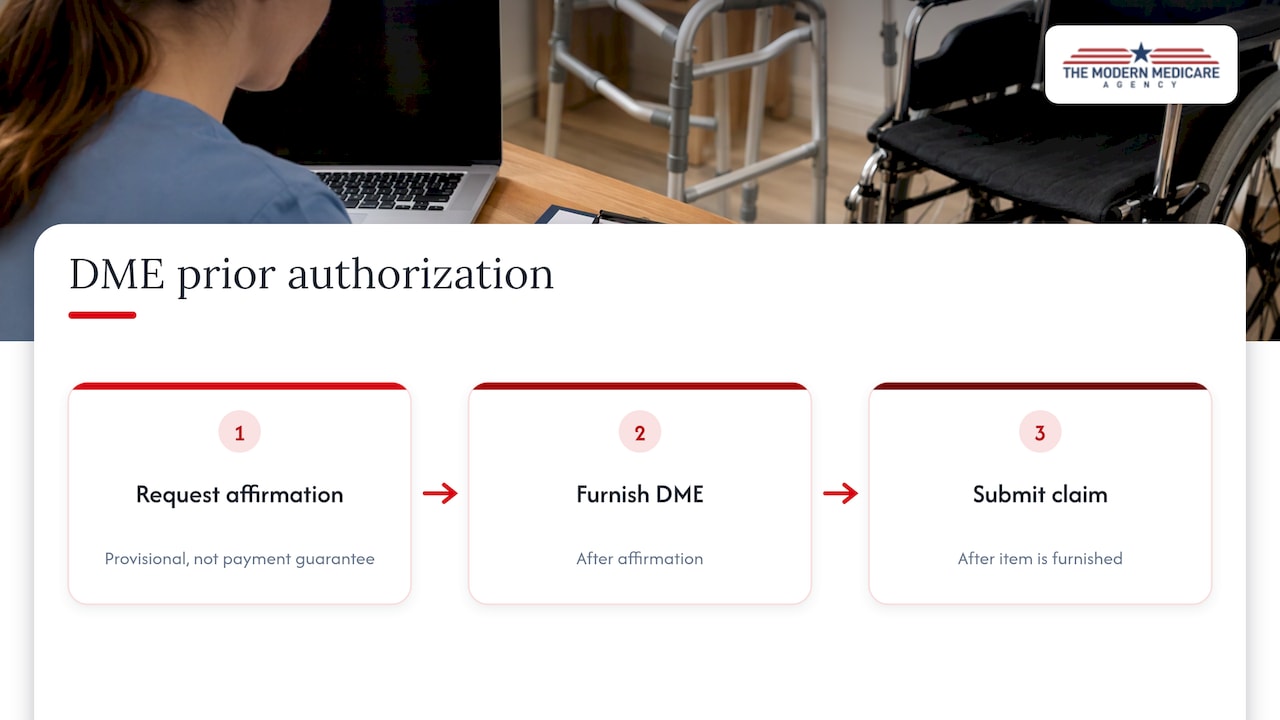
CMS describes prior authorization for durable medical equipment, prosthetics, orthotics and supplies (DMEPOS) as a way to request provisional affirmation of coverage before the item is furnished and before a claim is submitted. The word “provisional” matters. A yes is a preliminary finding that a future claim likely meets Medicare’s coverage, coding and payment requirements. A no means the future claim, as documented, does not.
The program exists because CMS wants to catch problems before payment. HHS says prior authorization is an effective way to reduce or prevent questionable billing practices and improper payments for these items. CMS also frames the program as a way to protect the Medicare Trust Fund while still getting beneficiaries needed equipment in a timely manner.
There is one more point that surprises people. The rule did not add new medical paperwork. CMS said in the final rule that there are no new clinical documentation requirements. It only asks for the documentation that already had to exist earlier in the process.
Which items need prior authorization
Not every wheelchair, walker or hospital bed is on the list. CMS keeps a Master List of DMEPOS items identified as having potentially unnecessary utilization and high costs. A subset of that list becomes the Required Prior Authorization List, under the 6050-F final rule.
To land on the Master List, an item generally has to meet two tests, according to the same CMS FAQ:
- It shows potential for unnecessary utilization, as reported by the HHS Office of Inspector General or the Government Accountability Office.
- It has an average purchase fee of $1,000 or more, or an average rental fee of $100 or more.
In practice that means expensive, frequently misbilled equipment, such as certain power mobility devices and some pressure-reducing support surfaces. The required list changes over time as CMS adds or removes items. Because of that, we do not print a fixed list here. Ask your supplier whether the exact item and billing code are currently on it, and use the CMS prior authorization page for the current list.
If your item is not on the list, Medicare’s usual coverage rules still apply. Your doctor still has to document medical necessity, and the supplier still has to be enrolled in Medicare. You just skip the pre-approval step. For a plain-English look at what Part B pays, see our guide to Medicare DME coverage and what you owe.
Who submits the request and what goes in it
The supplier does the filing. Medicare.gov explains that the DME supplier is generally responsible for sending the prior authorization request and the required documentation to Medicare on your behalf. Your doctor’s role comes before that: the order and the medical record notes are what the supplier submits.
CMS’s 2026 operational guide says a request should include these elements:
- Beneficiary information: name, Medicare Beneficiary Identifier (MBI), date of birth, address, place of service and diagnosis code.
- Supplier information: National Supplier Clearinghouse number, NPI, address and phone.
- Requestor information and the specific HCPCS codes for the items.
- Medical record documentation that supports medical necessity, plus anything else the contractor considers necessary.
Those details come from the DMEPOS prior authorization operational guide. Requests can go in by mail, fax, Electronic Submission of Medical Documentation (esMD), or an internet-based provider portal. That is the supplier’s choice, not yours.
What you can do to speed it up
You cannot file the request, but you can make it easier to get right:
- Ask your doctor’s office to document why you need the item: your diagnosis, what you can and cannot do now, and why a simpler device will not work.
- Use a supplier that is enrolled in Medicare and accepts assignment. Ask them directly whether this item requires prior authorization.
- Keep your Medicare card handy so the supplier has the right MBI the first time.
- Ask for the unique tracking number once a decision is made, and keep a note of the date.
How the process works, step by step
- Your doctor orders the item and documents medical necessity in your record.
- The supplier checks whether the item is on the Required Prior Authorization List.
- The supplier submits a prior authorization request (PAR) to the DME MAC, the regional contractor that handles DME claims.
- The DME MAC reviews it. For initial requests and resubmissions, CMS’s current guide sets a decision within 5 business days, not to exceed 7 calendar days, after it receives complete documentation.
- You get a decision. Either it is provisionally affirmed or non-affirmed, and the supplier is notified (and you, if you ask for notice).
- The supplier delivers the item and bills Medicare. The claim must carry the unique tracking number (UTN) the DME MAC issued with the decision. CMS explains that the UTN verifies the prior authorization process was followed.
Older versions of the guide used longer review windows, so if you read an older article that says 10 business days, it is out of date. The clock also starts only when documentation is complete. An incomplete package is where most delay comes from.
Does approval guarantee coverage or payment?
No. A provisional affirmation is a preliminary finding, not a payment promise. The claim still has to be filed correctly, match what was approved, and meet Medicare’s other requirements. What approval does give you and your supplier is some comfort: CMS says paid claims tied to an affirmed decision receive some protection from future audits.
An approved item is also still subject to your normal cost sharing. Under Original Medicare you generally owe the Part B deductible and 20% coinsurance of the Medicare-approved amount, which we break down in our Medicare DME coverage guide. A Medigap plan can pick up that coinsurance, and we cover how in the section on Medicare Supplement plans.
If you want to compare the price of an item before you commit, it can help to see what similar equipment costs out of pocket. One example is compression therapy costs, which shows how a purchased unit compares with ongoing sessions.
If your request is not approved
A non-affirmative decision is not the end of the road. In CMS’s operational guide, a non-affirmative decision is a preliminary finding that the future claim does not likely meet requirements, and it is treated as an incomplete request. The decision letter explains what was missing. The supplier can submit another complete request with the documentation the letter describes, and that guide states that unlimited submissions are permitted.
Here is a practical way to handle it:
- Read the letter with your supplier. The reason is usually specific: a missing face-to-face note, a diagnosis that does not match the code, or no evidence the item is needed.
- Call your doctor’s office and ask for an updated note or order that addresses exactly that gap.
- Have the supplier resubmit. Resubmissions get the same 5-business-day target under the current guide.
- Ask about your options if you still disagree. If the supplier delivers the item anyway, you may get an Advance Beneficiary Notice that says you might have to pay. Do not sign one until you understand the cost, and call 1-800-MEDICARE (1-800-633-4227) if you want to know what your appeal rights would be on a denied claim.
Original Medicare versus Medicare Advantage
The CMS DMEPOS prior authorization program described above is an Original Medicare process. Medicare Advantage plans work differently. They must cover the same medically necessary categories of DME as Original Medicare, but suppliers and specific costs depend on the plan. Many plans require their own prior authorization, limit you to in-network suppliers, and set their own copays.
That difference is the reason DME is such a common point of confusion for people switching plans. If you are on Original Medicare with a Medigap plan, you can generally use any supplier that accepts Medicare assignment. If you are on Advantage, the first call should be to your plan, and the second should be to an in-network supplier.
| Original Medicare | Medicare Advantage | |
|---|---|---|
| Who sets prior authorization rules | CMS, through the Required Prior Authorization List | Your plan, within Medicare’s coverage requirements |
| Who files the request | The DME supplier | Usually the supplier or your doctor, as your plan directs |
| Supplier choice | Any enrolled supplier that accepts assignment | Typically the plan’s network |
| Cost sharing | Part B deductible and 20% coinsurance | Set by the plan; check your Evidence of Coverage |
If you are on an Advantage plan and a request is denied, our guides to common Medicare Advantage claim denials and to Medicare Advantage prior authorization wait times explain what the process looks like. For prosthetics and orthotics specifically, see what Medicare covers for prosthetics and orthotics.
Our perspective
Most of the DME stress we hear about comes from not knowing who does what. People assume they have to chase approval themselves, or they sign for equipment before anyone has told them whether Medicare will pay.
Our advice is simple. Ask the supplier two questions before delivery: is this item on the prior authorization list, and has a decision with a tracking number been issued? Then check how your own plan treats the item. This is exactly why we believe in education first. It is hard to make a good decision when you do not understand your next step.
As independent agents who have helped Medicare consumers since 2007, we can compare how Original Medicare with a Medigap plan and Medicare Advantage plans handle equipment, suppliers and out-of-pocket costs, so you choose coverage that fits the care you actually expect to need.
Paul
Choosing coverage that fits your equipment needs
If you already use a CPAP machine, a power wheelchair or a hospital bed, or you know you will need one, your plan choice matters more than it does for someone who rarely sees a doctor. Look at three things: whether your preferred suppliers are in network, how the plan handles prior authorization, and what you will owe each month for rental items.
We are an independent agency that works with 40+ carriers, and a plan review is built around your needs rather than a sales pitch. We can walk you through Medicare Advantage plans or Medicare Supplement plans side by side, check your equipment and suppliers against each, and revisit your coverage every year. To start a conversation with our team, visit Paul B Insurance.

For a broader look at the equipment benefit, read our Medicare durable medical equipment guide for 2026.
FAQ
Does Medicare require prior authorization for all DME?
No. It applies only to items on CMS’s Required Prior Authorization List, a subset of a larger Master List of costly, frequently misused equipment. Other DME is covered under normal rules, with no pre-approval step. Your supplier can tell you whether your item is currently on the list.
How long does a Medicare DME prior authorization decision take?
CMS’s current operational guide sets a decision within 5 business days, not to exceed 7 calendar days, after the DME MAC receives complete documentation. Resubmissions follow the same target. Missing records are the usual cause of longer waits.
Do I have to submit the prior authorization request myself?
No. The DME supplier generally submits the request and the supporting documents. Your part is to make sure your doctor has documented why you need the item, and to confirm that the supplier is enrolled in Medicare.
What happens if my DME prior authorization request is not approved?
The decision letter explains what was missing. Your supplier can gather the updated documentation and submit a new complete request, and CMS guidance says unlimited submissions are permitted. Ask your doctor to address the specific gap in the letter before resubmitting.
Is Medicare Advantage prior authorization for DME the same as Original Medicare’s?
No. Advantage plans must cover the same medically necessary DME categories, but the plan sets its own supplier network, authorization rules and costs. Check your plan’s documents or call the number on your member card before you order.
Sources
- DMEPOS Prior Authorization Operational Guide (2026)
- DMEPOS Prior Authorization Operational Guide (2018 version)
- CMS: Prior Authorization Process for Certain DMEPOS Items FAQs
- CMS: DME Prior Authorization 6050 FAQs
- CMS: Prior Authorization Process for Certain DMEPOS (program page)
- HHS: Prior Authorization Process for Certain DMEPOS Items, CMS Final Rule 6050-F
- Medicare.gov: Wheelchairs and scooters
- Medicare.gov: Medicare coverage of DME and other devices