




Medicare coverage for insulin and diabetic supplies depends on how you take insulin and which supplies you need. Covered insulin under Part D or insulin used with an eligible Part B pump costs no more than $35 for a one-month supply. Part B also covers blood sugar monitors, test strips, lancets, and related testing supplies, though you’ll generally pay 20% of the approved cost after meeting the Part B deductible.
It’s understandable to feel unsure about which part of Medicare pays, especially when insulin and its injection supplies follow different coverage rules. This guide explains the $35 monthly insulin cap, how coverage for test strips and lancets works, and when Part D may cover needles, syringes, and alcohol swabs. You’ll also learn where coverage limits apply, so you can better understand what Medicare may pay for the supplies you rely on and how the different benefits fit together.
Key Takeaways
- Learn why the way you use insulin affects whether Part B or Part D may cover it.
- See how the monthly insulin cost cap applies to covered products and different supply lengths.
- Understand which blood sugar testing supplies Medicare Part B covers and what may affect your share of the cost.
- Find out when continuous glucose monitors may be covered and how supply limits can affect test strips and lancets.
- Learn why needles, syringes, and other injection supplies may follow different coverage rules from insulin itself.
Other questions about insulin coverage under Part D?
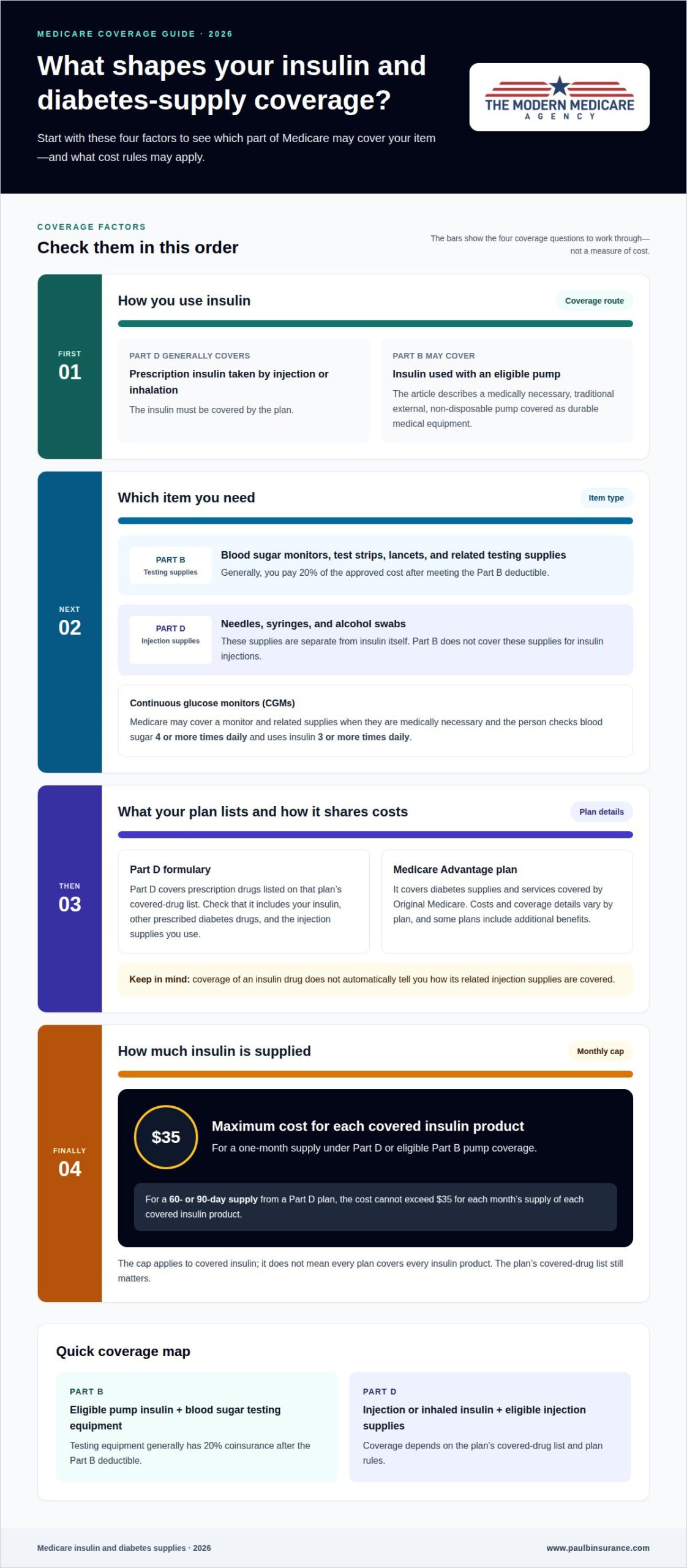
In 2026, the part of Medicare that covers insulin depends on how you use it. Part D generally covers insulin taken by injection or inhalation, while Part B may cover insulin used with an eligible pump.
Injectable and Inhaled Insulin Under Part D
Medicare Part D covers prescription insulin used by injection or inhalation when the plan covers that insulin. This distinction matters because Original Medicare Part B generally doesn’t cover insulin taken with a pen or by injection. If you have neither Part D nor a Medicare Advantage plan with drug coverage, you pay 100% of the out-of-pocket cost for insulin administered by injection or inhalation.
For example, someone using an insulin pen typically looks to Part D for the medicine, while someone using a qualifying pump may have a different coverage route through Part B. The $35 monthly limit applies to covered insulin under Part D and eligible Part B pump insulin.
Part D Drug and Injection Supply Coverage
Part D plans cover prescription drugs listed in each plan’s formulary, or covered-drug list. This matters for insulin and other diabetes medications: one plan may cover a particular medicine while another may not. Before choosing a plan, check whether its formulary includes your insulin, other prescribed diabetes drugs, and the injection supplies you use.
Part D also covers insulin injection supplies, including needles, syringes, and alcohol swabs. These are separate from insulin itself, so coverage of a drug doesn’t automatically tell you how its related supplies are covered. By contrast, Part B doesn’t cover supplies such as syringes, needles, alcohol swabs, or gauze for insulin injections. This distinction can affect which coverage fits your routine.
Plan Differences in Insulin and Supply Coverage
Medicare Advantage plans cover diabetes supplies and services covered by Original Medicare, though costs and coverage details vary by plan. Some plans also include additional benefits, while Part D coverage depends on the plan’s formulary. These differences can affect whether your insulin, diabetes medications, and injection supplies are covered.
Does Medicare cover insulin used with a pump differently from insulin taken by injection? Yes. Part B may cover insulin used with a medically necessary, traditional external, non-disposable pump as durable medical equipment. Part D generally covers insulin taken by injection or inhalation.
What Medicare Advantage and Part D plan differences affect insulin and diabetes supply coverage? The plan’s formulary, covered medicines, and cost-sharing rules matter. A Medicare Advantage plan must cover the diabetic supplies covered by Original Medicare, while its specific costs and any added benefits vary by plan.
The $35 monthly insulin cost cap
In 2026, Medicare caps what you pay for each covered insulin product at $35 for a one-month supply. The protection applies to covered Part D insulin and insulin used with a durable medical equipment pump covered by Part B. It limits your insulin cost, but it doesn’t mean every insulin product is covered by every plan. Your plan’s covered-drug list still matters.
The cap applies separately to each covered insulin product. If a Part D plan supplies insulin for 60 or 90 days, the cost cannot exceed $35 for each month’s supply of each covered insulin.
This insulin limit is separate from Medicare Part D’s broader annual out-of-pocket cap for prescription medication costs. Official updates from the Centers for Medicare & Medicaid Services state that the annual cap is $2,000, beginning in 2025. That annual limit applies to covered prescription medication costs, while the $35 limit sets a monthly maximum for each covered insulin product. Knowing both limits helps explain why insulin charges and other drug expenses may follow different cost rules.
Medigap and Extra Help address costs in different ways. Medigap is supplemental coverage, while Extra Help is a program that may assist people who qualify with Part D costs. Neither changes the need for the insulin to be covered under the person’s plan. A Medigap plan and a Part D plan serve different coverage roles, so it helps to understand which cost each one addresses through The Modern Medicare Agency.
To explore lower-cost options, ask your doctor to review your treatment needs alongside the insulin listed in your plan’s formulary. A different covered insulin may suit some people, but any change must fit your medical needs. If you use an insulin pump, confirm whether its insulin is covered under Part B’s durable medical equipment rules or through Part D. The coverage route can affect which cost protections apply.
For a clearer picture of Part D coverage, review the plan’s covered insulin, other diabetes medications, and cost-sharing details together. This can help you compare how a plan handles the prescriptions you use, rather than focusing only on one insulin’s monthly limit. Explore Medicare Part D coverage with The Modern Medicare Agency as you consider how prescription drug benefits fit your needs.
Does Medicare Cover Diabetic Supplies?
Yes. In 2026, Medicare Part B covers common blood sugar testing equipment, and qualifying people may receive continuous glucose monitors. The coverage route depends on the item: Part B generally handles testing equipment, while Part D covers eligible prescription drugs and injection supplies.
Continuous Glucose Monitor Coverage and Eligibility
A continuous glucose monitor tracks glucose levels throughout the day, rather than relying only on separate finger-stick readings. Medicare may cover a monitor and related supplies for people who check their blood sugar four or more times daily and use insulin three or more times daily.
Medicare began covering therapeutic continuous glucose monitors in 2017. The stated usage criteria help explain when coverage may apply, while the monitor and its supplies must be medically necessary. Someone using insulin several times daily may have a different coverage situation from someone who checks glucose less often.
Getting Covered Insulin and Diabetes Supplies
To get covered supplies, follow the coverage rules for each item. Part B covers blood sugar monitors, test strips, lancet devices, lancets, and glucose control solutions for people with diabetes, whether or not they use insulin. For a pump covered by Part B as durable medical equipment, Part B may also cover the pump and the insulin used with it.
How do you get covered insulin and diabetes supplies, and must you use an enrolled supplier or preferred pharmacy? For Part B equipment and supplies, use a Medicare-enrolled supplier. A supplier that accepts assignment agrees to accept Medicare’s approved amount as full payment. Part D coverage follows the plan’s drug benefit and formulary, which lists covered insulin, diabetes medications, and injection supplies.
Medicare generally pays 80% of the Medicare-approved cost for medically necessary supplies and services after the deductible. These cost rules apply to Part B coverage, not automatically to Part D prescriptions.
Supplies and Services Outside Medicare Coverage
Coverage depends on the Medicare part and how a supply is used. Part B doesn’t cover insulin taken with pens or disposable insulin pumps, or injection supplies such as syringes, needles, alcohol swabs, and gauze. Part D covers injection supplies, including needles, syringes, and alcohol swabs, when the plan includes them.
What diabetes supplies and services are not covered by Medicare? The key distinction is that Part B excludes injection supplies and insulin used with pens or disposable pumps, while Part D may cover those supplies and injectable insulin. An item excluded under Part B isn’t necessarily excluded from Part D, so check the applicable benefit and formulary.
Medicare coverage for diabetes extends beyond equipment. Part B may cover diabetes screening, self-management training, and medical nutrition therapy. Glucose testing supplies and diabetes counseling, for example, follow different coverage rules, so the specific item or service determines which benefit applies.
Coverage limits for test strips and lancets
Medicare Part B covers blood sugar testing supplies, but it can limit how many you receive and how often. According to the Centers for Medicare & Medicaid Services, beneficiaries with diabetes who use insulin may be able to receive up to 300 test strips and 300 lancets every three months. This is the standard quantity limit to understand when planning refills, especially if your daily testing routine uses supplies quickly.
The limit applies to both test strips and lancets within the three-month period. It doesn’t mean every beneficiary automatically receives the full amount; coverage depends on the person’s circumstances and the supplies’ medical need. Part B may cover these testing supplies whether or not you use insulin, but the stated 300-item limit applies to beneficiaries with diabetes who use insulin.
What if you need more than the standard quantity? Additional supplies may be available when your doctor determines they’re medically necessary. For example, a change in blood sugar management may mean your testing routine requires more strips or lancets. Medical need is what matters for an additional quantity, rather than simply requesting extra supplies before the next three-month period.
Original Medicare generally requires beneficiaries to meet the Part B deductible before paying their share for covered testing supplies. After that, beneficiaries generally pay 20% of the cost. This coinsurance is separate from the quantity limit: receiving the covered amount doesn’t remove your share of the approved cost, and paying coinsurance doesn’t automatically increase the number of covered supplies.
A Medicare Advantage plan must cover the diabetic supplies covered by Original Medicare, though costs and coverage details can vary. The Part B quantity limit is a useful starting point, but the plan’s rules may affect how you receive covered supplies. For example, a plan may set specific steps for ordering test strips or lancets. Review your plan’s coverage details to understand what to do.
Keep the timing in mind. If your three-month supply is running low early, track how many strips and lancets you use and discuss the need with your doctor. A doctor’s statement that additional quantities are medically necessary may support coverage beyond the usual limit. Needles for insulin injections are a different category from test strips and lancets, with separate coverage rules.
Coverage of insulin injection supplies
Insulin and the items used to inject it follow different Medicare coverage rules. Part D covers injection supplies such as needles, syringes, and alcohol swabs. Part B generally doesn’t cover those items when they’re used for insulin injections. This distinction matters: coverage for the medicine doesn’t automatically mean the supplies are covered under the same Medicare part.
For someone who injects insulin with a pen, Part B doesn’t cover the insulin or related supplies. Part D may cover the insulin and injection supplies, depending on the plan’s covered-drug list and benefit terms. The formulary shows which insulin products and related supplies the plan covers. Part B also doesn’t cover gauze used for insulin injections.
Part B beneficiaries generally pay 100% of the cost of insulin-related supplies unless they have Part D coverage. This is separate from the monthly cap for covered insulin itself. The insulin cost limit doesn’t mean needles, syringes, or alcohol swabs are also capped at the same amount. Each item follows the rules of its coverage benefit.
A different rule applies to insulin delivered through a traditional external, non-disposable insulin pump. When the pump qualifies as durable medical equipment under Part B, Part B may cover the pump and the insulin used with it. That doesn’t make injection supplies such as syringes and alcohol swabs covered under Part B. The delivery method determines which coverage rules apply.
Testing supplies are a separate category. Part B covers blood sugar monitors, test strips, lancet devices, and lancets for people with diabetes. These items support glucose testing, while needles and syringes deliver insulin. Calling both groups “diabetes supplies” can make the rules confusing, so identify the specific item and how you use it.
For a clear coverage picture, separate the prescription insulin, injection supplies, pump equipment, and testing supplies. Then match each item to Part D or Part B rules. For Part D, the plan’s formulary and benefits determine coverage for insulin and injection supplies. A Medicare Part D plan is the coverage to review for those prescription-related items.
The Modern Medicare Agency
The Modern Medicare Agency helps you compare Medicare plan options when insulin and supply coverage feels difficult to sort out. Its independent guidance can help you understand how Medicare Advantage and Part D plans differ, including how plan formularies affect covered prescriptions and injection supplies. The agency helps eligible individuals compare and select plans from over 40 carriers, with recommendations based on their needs.
If you’re reviewing coverage for 2026 or considering a change, personalized plan guidance can help you weigh your Medicare options alongside your medication needs. The right next step is a clear conversation about the coverage questions you’re facing and the plans available to you. Contact The Modern Medicare Agency to discuss your Medicare coverage questions.
Make Your Next Coverage Choice With Confidence
Choosing coverage is easier when you start with your routine: the medicines you rely on, how you take them, and the supplies you use to manage your health. Understanding Medicare coverage for insulin and diabetic supplies can help you identify your priorities before reviewing plan options. The goal is to find coverage that fits your needs, not to decide based on one benefit alone.
The Modern Medicare Agency offers Medicare Advantage Plans, Medicare Supplement (Medigap) Plans, and Medicare Part D Plans. As an independent brokerage, it can help you understand how these options fit your coverage needs, including prescription drug coverage. In a free Medicare consultation, you can discuss what matters most and compare your options without pressure.
Contact The Modern Medicare Agency today to discuss your Medicare coverage questions. A thoughtful next step can bring greater clarity to your decision, and you don’t have to sort through the options alone.
Frequently Asked Questions
How can I afford insulin on Medicare?
Start by seeing whether your insulin is covered by your Part D plan or through a qualifying Part B pump. Covered insulin costs no more than $35 for a one-month supply. Extra Help may reduce Part D costs for people who qualify. If you’re comparing plans, consider your full prescription list, not insulin alone, because the formulary and other medication costs affect your overall drug spending.
Does Medicare cover CGMs like Dexcom or FreeStyle Libre?
Medicare may cover a continuous glucose monitor and related supplies when the eligibility criteria are met. The stated criteria include checking blood sugar at least four times daily and using insulin at least three times daily. Coverage depends on whether the specific monitor and supplies qualify under the applicable benefit. The brand name alone doesn’t establish coverage, so consider the device and how you use it.
How much does it cost?
Your share depends on whether the item is covered through Part B or Part D and on your plan’s terms. Covered insulin has a separate monthly cost limit. Part D also has a $2,000 annual out-of-pocket cap for covered prescription medication costs.
What brands of glucometers are covered by Medicare?
Medicare Part B covers blood sugar monitors for people with diabetes, but coverage isn’t determined by brand name alone. The monitor must meet the covered testing-supply benefit’s requirements, and Part B rules apply to the equipment and related supplies. If you’re comparing meters, check whether the meter and its test strips work together. Coverage for one item doesn’t automatically establish coverage for another.
Why won’t Medicare pay for my test strips?
Common reasons include reaching a quantity limit, supplies not meeting the applicable coverage rules, or using a supplier that doesn’t meet Medicare requirements. Part B quantity limits may apply, and additional supplies may be covered when a doctor says they’re medically necessary. After the Part B deductible, coinsurance also applies. Review the item, quantity, supplier, and benefit to understand what affected payment.
What does Medicare Part B cover for diabetes supplies, including glucose meters, test strips, lancets, and insulin pumps?
Part B covers blood sugar monitors, test strips, lancet devices, lancets, and glucose control solutions for people with diabetes. When eligible, it may also cover a traditional external, non-disposable insulin pump as durable medical equipment, along with insulin used in that pump. These are separate coverage categories: testing equipment supports glucose checks, while pump coverage depends on whether the pump meets Part B requirements.
What diabetes medications and insulin does Medicare Part D cover?
Part D plans cover prescription drugs listed on their formularies, which can include insulin and other diabetes medications. Covered medicines vary by plan, so a medication covered under one plan may not be covered the same way under another. Part D also covers insulin injection supplies such as needles and syringes when included in the plan’s benefits. The formulary is central to understanding prescription coverage.
What is the Medicare insulin cost-sharing cap, and which insulins qualify?
The cap limits your cost for each covered insulin product to $35 for a one-month supply. It applies to insulin covered under Part D and insulin used with a Part B-covered durable medical equipment pump. The insulin must be covered through the applicable benefit; the cap doesn’t make every insulin product eligible under every plan.

Article by
Paul Barrett
Paul Barrett, CMIP is the founder of The Modern Medicare Agency, an independent Medicare-only brokerage based in Melville, NY. With 18 years of Medicare-exclusive experience, a CMIP designation, and more than 5,000 clients served across 37 states, Paul is one of the most credentialed independent Medicare specialists on Long Island — and one of the most direct.
He represents 40+ carriers with no quotas and no allegiances, which means his recommendations are based entirely on what fits each client's specific situation. He is the author of Medicare Mastery Unlocked and host of the Wise Guys Retirement Talk podcast. His content is grounded in primary sources, real carrier intelligence, and 18 years of watching what happens when people get Medicare right — and when they don't.
📞 631-358-5793 | paulbinsurance.com