




Cremation insurance is a small permanent life insurance policy, also sold as final expense or burial insurance. When you pass away, it pays a cash benefit to the person you name. They can use it for cremation, a memorial, medical bills or anything else. Premiums are set by your age, health and the amount of coverage. For many seniors the main decision is not whether the policy works. It is which type of approval you qualify for and how much coverage matches a realistic cremation in your area.
Below, we walk through what the policy pays for, how simplified issue and guaranteed issue differ, what Medicare and Social Security do and do not cover, and a checklist for choosing well.
TL;DR
- Cremation insurance is a small whole life policy. The benefit goes to your beneficiary as cash, so your family decides how to spend it.
- Most people qualify in one of two ways: simplified issue (a short health questionnaire) or guaranteed issue (no health questions, but a waiting period before the full benefit).
- Original Medicare does not pay for cremation or funeral arrangements, and the Social Security death payment is only $255.
- Match the coverage amount to the real prices from local providers, then compare quotes for the same amount and the same type of approval.
- An independent agent can compare many carriers at once, at no cost to you.
Table of Contents
- What cremation insurance actually is
- What cremation costs in the United States
- How cremation insurance works for seniors
- What affects the premium
- Does Medicare, Medicaid or Social Security pay for cremation?
- Cremation insurance, burial insurance and regular life insurance
- A step-by-step way to choose a policy
- Our perspective
- Get a quote that fits your plan
- FAQ
- Sources
What cremation insurance actually is
Despite the name, there is rarely a policy that pays only for cremation. What the industry calls cremation insurance is almost always a whole life policy with a modest death benefit. It is the same product as burial insurance or final expense insurance. The label simply tells you what most buyers have in mind.
Three features define it:
- Permanent coverage. As long as premiums are paid, the policy stays in force for your whole life.
- Level premiums. The price is set when you buy and is designed not to rise as you age.
- A smaller benefit. Coverage is typically in the thousands of dollars rather than hundreds of thousands, which is why approval is usually simpler than for a large life policy.
Because the money is paid to your beneficiary and not to a funeral home, it is flexible. Your family can cover the cremation provider, a memorial gathering, a final medical bill, travel for relatives or a small leftover balance. Life insurance death benefits are generally not subject to federal income tax for the beneficiary, though you should confirm your situation with a tax professional.
If you want the broader picture, our final expense insurance page explains how these policies fit alongside the rest of a retiree’s plan.
What cremation costs in the United States
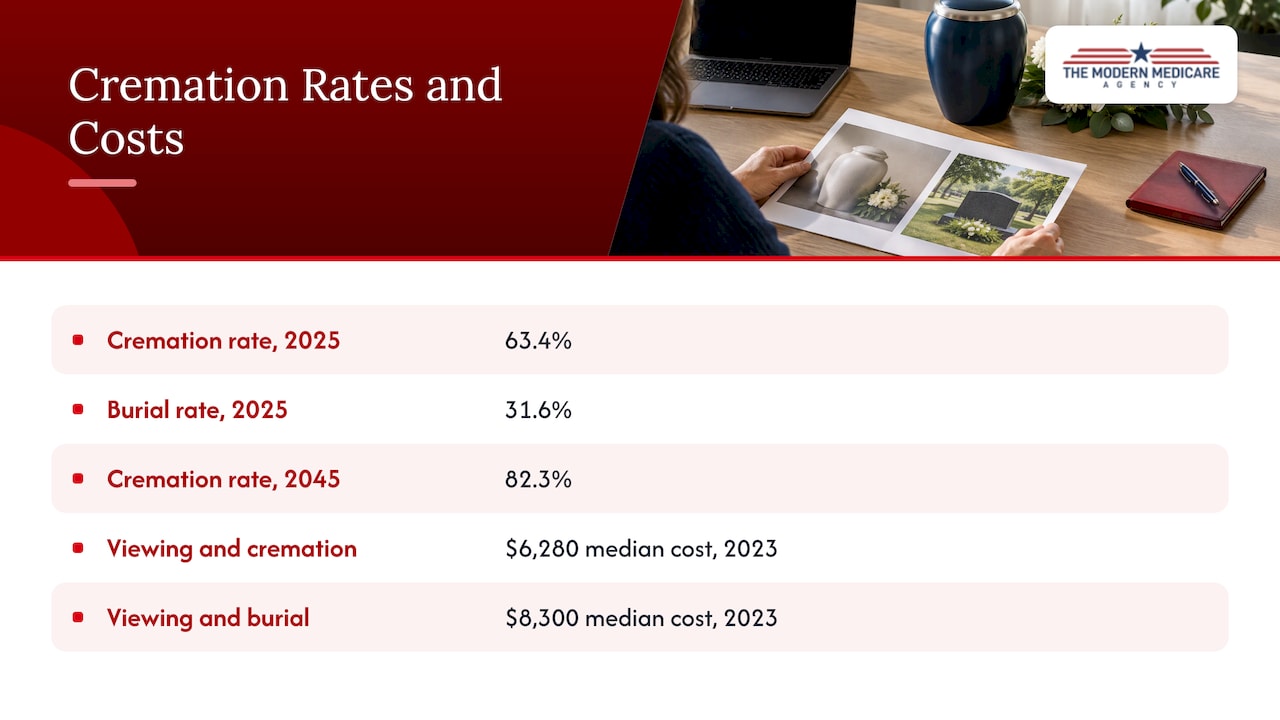
Cremation is now the most common choice in the country. The National Funeral Directors Association projects a 2025 cremation rate of 63.4%, against 31.6% for burial, and expects cremation to reach 82.3% by 2045.
It is usually less expensive than burial, but the range is wide. The same NFDA source reports a median cost of $6,280 for a funeral with viewing and cremation in its 2023 price study, compared with $8,300 for a funeral with viewing and burial. A direct cremation, with no viewing or ceremony, is typically much lower than a cremation with a full service. Prices vary a great deal by state, city and provider.
That gap is the reason to plan the number before you pick a policy. A family that wants a simple direct cremation needs a very different amount than one that wants a service, a reception and a memorial.
Funeral homes are required to give you itemized prices. Under the FTC’s Funeral Rule, providers prepare a General Price List that includes disclosures about your right to choose only the goods and services you want, and about alternative containers for direct cremation. Ask two or three local providers for theirs. Those figures are the most reliable starting point for your coverage amount.
Our own write-up on why $10,000 often falls short for funeral costs walks through how the total adds up once cemetery, memorial and other fees are included.
How cremation insurance works for seniors
Most people who buy this coverage are in their 50s, 60s, 70s and 80s. Many carriers write policies up to about age 85, and age limits vary by company and product. Coverage amounts commonly run from a few thousand dollars up to $50,000 depending on the carrier. There are two ways to be approved.
Simplified issue
You answer a short list of health questions. There is typically no medical exam. If your answers are acceptable, the policy usually starts paying the full benefit from day one for any cause of death. This is generally the lower-cost route, which makes it the natural first choice for seniors in reasonable health.
Guaranteed issue
No health questions at all. Acceptance is built into the product, which makes it a strong option when a health history would make other approval difficult. The tradeoff is a graded or modified benefit. During the first period, commonly two or three years, a death from natural causes usually pays a limited amount, often the premiums paid plus interest. Progressive’s overview of burial insurance describes typical waiting periods of 24 or 36 months, with full benefits generally paid for accidental death.
If you want a plain-language walk-through, our agent Q&A on guaranteed issue final expense covers the five questions seniors ask most.
| Feature | Simplified issue | Guaranteed issue |
|---|---|---|
| Health questions | Short questionnaire | None |
| Medical exam | Typically none | None |
| Full benefit from day one | Usually yes | Usually not, graded period applies |
| Typical cost | Lower | Higher |
| Best fit | Seniors who can answer the health questions | Seniors with health conditions that make other approval hard |
The practical rule: try for simplified issue first, and use guaranteed issue when it is the route that gets you covered. Both give your family a way to pay.
What affects the premium
Three things drive the price of a policy.
- Age when you apply. The older you are, the higher the monthly cost for the same benefit. Applying earlier locks in a lower level premium.
- Health and tobacco use. Simplified issue rates reflect your answers. Guaranteed issue is priced for acceptance with no questions.
- Coverage amount. A larger benefit costs more each month.
Sex and the specific carrier also play a role, and quotes for the same coverage can differ noticeably between companies. That is why comparing several carriers matters more here than in almost any other part of senior insurance. We have laid out ranges and examples in our guide to final expense costs for U.S. retirees, and our page on coverage and key policy features explains how to read a quote.
Because premiums are level, do the lifetime math before you commit. Add up what you would pay in premiums by age 85 or 90 and compare it with the benefit your family would receive. Choose a monthly payment you can keep up comfortably, because a lapsed policy pays nothing.
Does Medicare, Medicaid or Social Security pay for cremation?
Many seniors assume their existing coverage handles end-of-life costs. In most cases it does not.
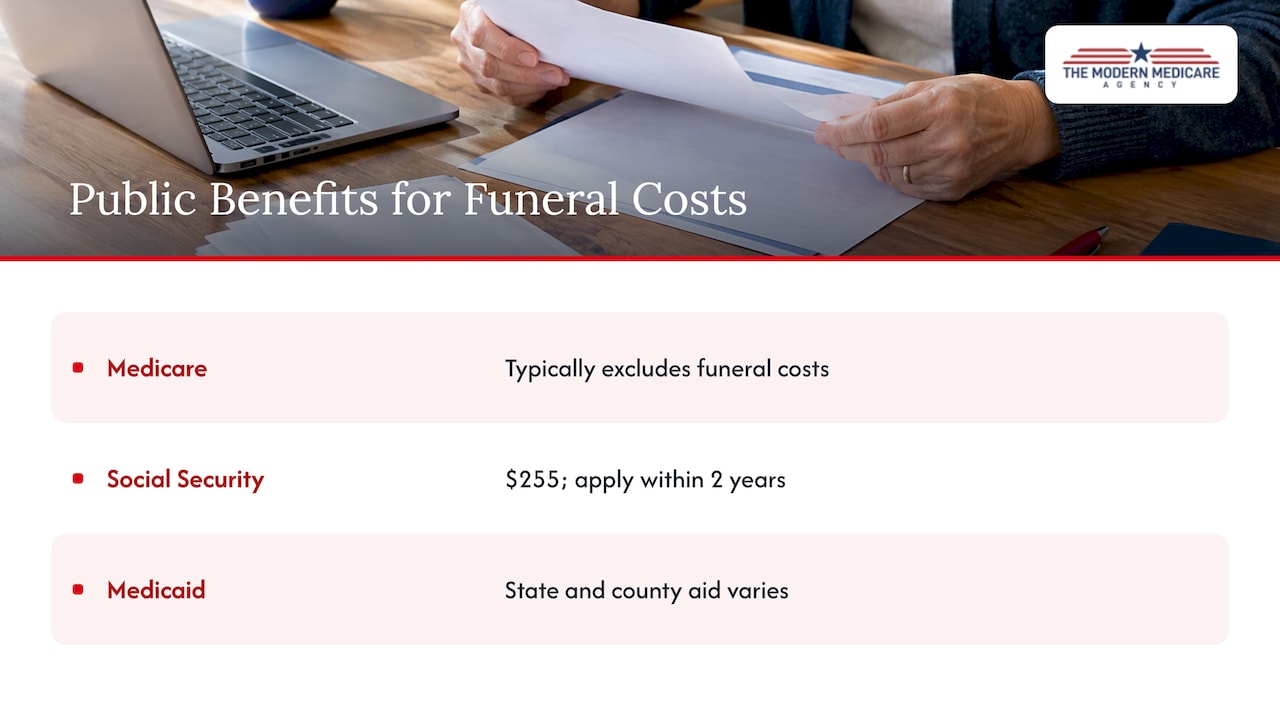
Medicare. Original Medicare, Parts A and B, does not typically cover cremation or funeral arrangements. It pays for medical care and covers hospice, but not funeral or burial costs. Medicare Advantage plans are health plans, and they are not designed to pay for a funeral either.
Social Security. The agency’s lump-sum death payment is a one-time $255 for a spouse, or in some cases certain children. It must be applied for within 2 years of the death. It is a small contribution, not a funeral fund.
Medicaid. Medicaid is a health program and its coverage ends at death. Some states and counties run separate burial or cremation assistance for people with very limited means, and the rules differ by state. Your state or county social services office can tell you what exists where you live.
The takeaway: unless you have set money aside, your family will be paying from their own pockets. A cremation insurance policy exists to close that gap with a known amount.
Cremation insurance, burial insurance and regular life insurance
These terms overlap, and that confuses buyers.
- Cremation insurance, burial insurance and final expense insurance are generally the same kind of product: a small whole life policy with a modest benefit, often sold without a medical exam.
- Traditional life insurance typically offers larger coverage amounts and is designed for broader goals such as replacing income. It may require a medical exam or a more detailed health review.
- Pre-need funeral insurance is different. The Washington State Office of the Insurance Commissioner explains that pre-need funeral insurance pays the funeral provider directly and can lock in today’s prices, while standard funeral insurance pays the beneficiary, who can spend it any way they choose.
For Medicare-age buyers, the real question is often which one fits your health and budget. Our article on burial vs. life insurance for Medicare seniors compares them side by side, and our guide to life insurance to cover final expenses shows when a standard policy is the better match.
If you are 70 or older, our burial insurance guide for seniors over 70 covers the rules that apply to your age group.
A step-by-step way to choose a policy
- Price the cremation you want. Request General Price Lists from a few local providers. Decide between direct cremation and one with a service, and add memorial costs.
- Add a cushion. Include any unpaid medical bills or debts you want covered, and a modest amount for family travel.
- Pick your approval route. Start with simplified issue. Move to guaranteed issue if a health history gets in the way.
- Compare the same thing across carriers. Use the same coverage amount and the same type of approval so the quotes can be compared fairly.
- Read the fine print. Check the waiting period, exclusions and what happens to the benefit if you die during a graded period. Typical exclusions include self-inflicted injury and certain high-risk activities.
- Name your beneficiaries. Choose a primary and, if you wish, a contingent beneficiary, and tell them where the policy is kept.
- Check the premium fits. Pick a monthly amount you can sustain for life.
- Review it every year. Costs, health and family circumstances change, and an annual checkup keeps the plan aligned.
Our perspective
We have helped Medicare consumers since 2007, and the same pattern shows up with final expense planning. People rarely put it off because they do not care. They put it off because nobody explained their options in plain English.
That is why we start with education. A cremation policy is a simple tool when you understand it: a known benefit, a level premium and a family that does not have to scramble. It is a tool that gives you control over what your loved ones face.
Because we are independent, we can look across more than 40 carriers instead of showing you one company’s product. We review your health answers, your budget and the price of the cremation you actually want, then show you the options that fit. No pressure, and no pushing a larger policy than you need.
If you are turning 65, retiring from employer coverage, or reviewing the coverage you already have, bring this question into the same conversation. Medicare handles your healthcare. A final expense policy handles what Medicare does not.
Paul
Get a quote that fits your plan
We are an independent team of agents who specialize in Medicare and senior insurance, and final expense is part of what we do every day. We compare carriers for you, explain simplified and guaranteed issue in plain terms, and help you choose an amount that matches real local costs. Our recommendations are built around your needs, not a quota.

Ready to see your options? Start with our free final expense quote, or learn more on our final expense insurance page. If you also want to review your Medicare coverage, we can look at that during the same conversation.
FAQ
Is cremation insurance different from life insurance?
It is a type of life insurance. Cremation insurance is a small whole life policy sized for end-of-life costs, usually with simpler approval than a large traditional policy. The benefit goes to your beneficiary in cash, so they can use it for any expense, not only cremation.
Can I get cremation insurance if I have health problems?
Often, yes. Guaranteed issue policies ask no health questions, so acceptance is built in. The tradeoff is a waiting period, commonly two or three years, before the full benefit is paid for a natural death. An agent can check whether you may still qualify for simplified issue first.
Does Medicare pay for cremation?
No. Original Medicare does not typically cover cremation or funeral arrangements. It does cover hospice and medical care. The Social Security lump-sum death payment is $255 and goes only to certain family members, so most families rely on savings or a policy.
How much coverage do I need for cremation?
Start with the General Price List from local providers, then add memorial costs, any bills you want covered and a cushion. The national median for a funeral with viewing and cremation was $6,280 in the NFDA’s 2023 study, but your area may differ. Choose an amount close to your real local figure.
Is the payout taxable?
Life insurance death benefits are generally not subject to federal income tax for the beneficiary. Interest earned on the proceeds after death can be taxable. Ask a tax professional about your own situation.
Sources
- NFDA Statistics
- FTC: Complying with the Funeral Rule
- Progressive: What Is Burial Insurance?
- Medical News Today: Does Medicare cover cremation?
- Social Security Administration: Lump-sum death payment
- Washington State Office of the Insurance Commissioner: Funeral insurance