




To understand your rights as a Medicare beneficiary, start with the basics: you’re entitled to fair treatment, privacy for your health information, access to your records, and a say in decisions about your care. These protections also matter when you choose or use a Medicare Advantage plan. Knowing what they cover can help you respond when questions or problems arise.
Medicare rules and plan documents can be difficult to untangle, especially when you’re also managing a care or coverage decision. You may be unsure what you can ask for, what information you can access, or how to raise a concern. Understanding your rights can make the next step clearer.
This guide explains your rights in plain language, including protections against unfair treatment, privacy and access to health records, safe care, and Medicare Advantage plan choices. It also explains where to turn for help understanding coverage or addressing a concern, so you can make informed decisions with greater confidence.
Key Takeaways
- You can take part in care decisions, ask questions, and raise concerns about unfair treatment or unsafe care.
- You generally have the right to access your health records and request copies of personal health information.
- Medicare Advantage members can ask how their plan pays doctors and use the plan’s process to challenge coverage decisions.
- Keep records of care or coverage concerns and explain the issue clearly when seeking help.
- Independent Medicare guidance can help you understand plan choices, including Medicare Advantage, Medigap, and Part D.
Fair treatment and protection from discrimination
Fair treatment means receiving care without unethical treatment or discrimination. Medicare rights and protections help shield beneficiaries from unethical practices. In a hospital, fair treatment also means freedom from physical or mental abuse, corporal punishment, restraints, seclusion, coercion, discipline, and retaliation. A patient who experiences any of these can raise the concern as a grievance. The hospital must have a process for promptly resolving patient grievances, with time frames for review and response under 42 C.F.R. § 482.13(a)(2).
Informed decision-making means you can understand your care options and accept or refuse treatment. Under 42 C.F.R. § 482.13(b)(2), hospital patients have that right, but cannot demand medically unnecessary or inappropriate services. For example, you may ask a clinician to explain a proposed treatment before deciding. You may also refuse it. Ask about the expected benefits, risks, and alternatives so your choice reflects the information available to you.
Taking part in a care plan means helping shape how your hospital care is developed and carried out. Hospital patients have this right under 42 C.F.R. § 482.13(b)(1). Share your priorities and relevant information with the care team. If a plan changes, ask what changed and how that affects the next steps. A clear conversation can help you understand what the team recommends and make your preferences known.
An advance directive records your wishes for future health care decisions. Under 42 C.F.R. § 482.13(b)(3), hospital patients have the right to formulate one and have hospital staff and practitioners comply with it. Tell the hospital if you have an advance directive and ask how staff will include it in your care. This can help keep your stated preferences visible when decisions need to be made.
Provider choice under Original Medicare means you may use a qualified provider who participates in Medicare. Federal Medicare law says beneficiaries may obtain health services from any institution, agency, or person qualified to participate, under 42 U.S.C. § 1395a(a). People with Original Medicare can use any health care provider or specialist, or any Medicare-certified hospital that takes Medicare. Medicare Advantage plan rules differ, so check the plan’s network and coverage terms before arranging care.
A Medicare benefit period is the period used to track certain inpatient hospital and skilled nursing facility care. According to Centers for Medicare & Medicaid Services, a Medicare benefit period ends after 60 consecutive days without inpatient hospital or skilled nursing facility care. If you’re unsure how a benefit period affects your care, ask the hospital or Medicare to explain how your recent stays fit the rule.
How can a Medicare beneficiary file a complaint or grievance? Tell the hospital or plan what happened, when it happened, and what response you’re seeking. Hospitals must have a grievance process with review and response time frames, so ask how to submit your concern through that process.
Privacy and access to personal health information
Privacy means your health information should be kept confidential. Access means you can view or obtain copies of records about your care. Medicare beneficiaries generally have these rights for information held by health care providers who treat and bill Medicare, and by health plans that pay for their care. Hospital patients also have the right to confidential clinical records and access to their own records.
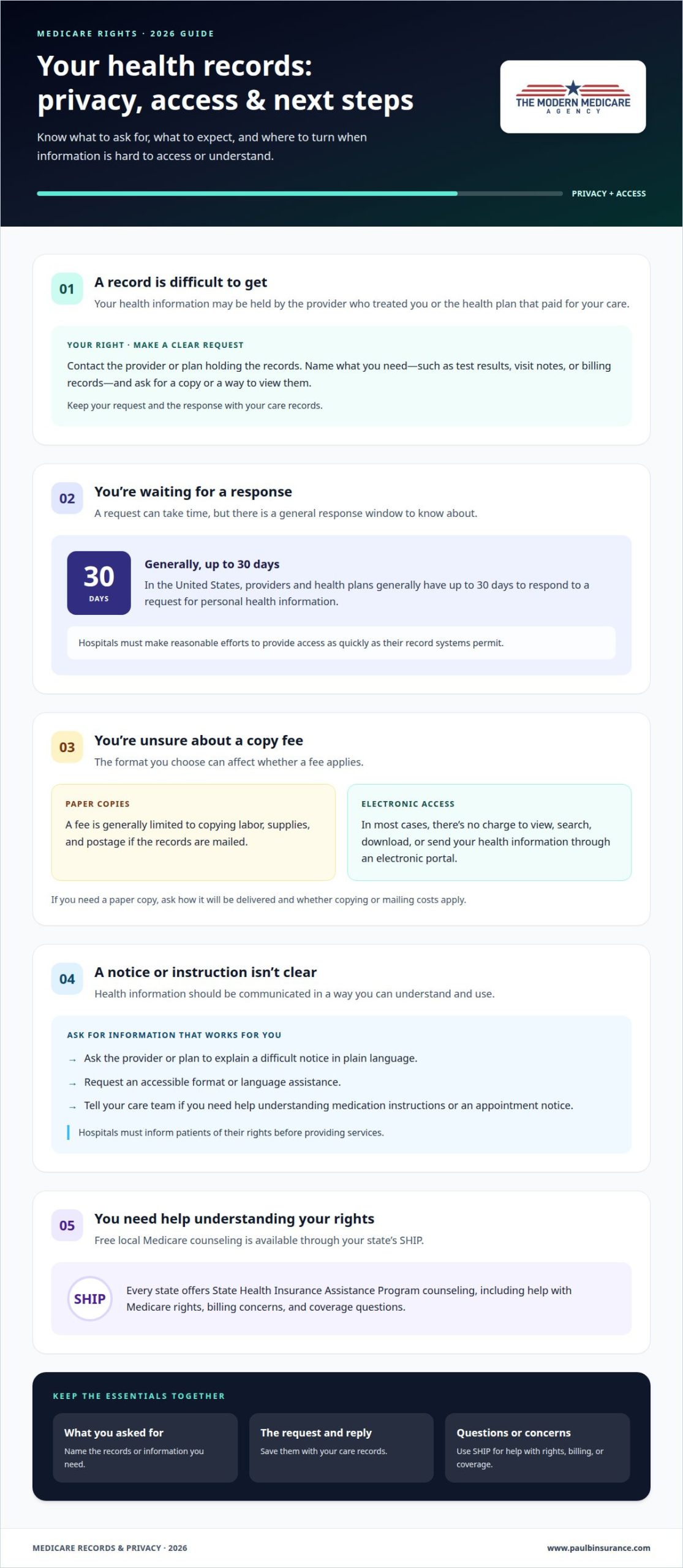
To request records, contact the provider or health plan holding them. Identify the information you need, such as test results, visit notes, or billing records. Ask for a copy or for a way to view the information. In the United States, providers and health plans generally have up to 30 days to respond to a request for personal health information, according to the U.S. Department of Health and Human Services. Hospitals must make reasonable efforts to meet legitimate access requests as quickly as their record systems permit.
A copy fee is generally limited to the cost of copying labor, supplies, and postage if the records are mailed. In most cases, you aren’t charged to view, search, download, or send your health information through an electronic portal. If you need a paper copy, ask how it will be delivered and whether copying or mailing costs apply. Keep your request and the response with your care records.
Accessible information means care details are communicated in a way you can understand and use. If a written notice is difficult to read, ask the provider or plan to explain it in plain language. You can also request an accessible format or language assistance. For example, tell the care team if you need help understanding medication instructions or an appointment notice. Hospitals must inform patients of their rights before providing services.
Access to covered health care services means Medicare rights protect access to services the law says Medicare can provide. If a Medicare drug plan denies coverage for a medicine, it must provide a written explanation of that coverage decision. Read the explanation to understand the plan’s reason and next steps. If you need help making sense of plan terms, Medicare plan information can help clarify how coverage choices relate to your needs.
Medicare beneficiaries’ privacy rights include keeping personal health information confidential and viewing or obtaining copies of medical records. Hospitals must make reasonable efforts to provide access promptly, while providers and plans generally have up to 30 days to respond to requests.
For free local counseling, contact your state’s State Health Insurance Assistance Program, or SHIP. Every state offers SHIP counseling, including help with Medicare rights, billing concerns, and coverage questions.
Medicare Advantage plan rights
Medicare Advantage members have the right to understand plan decisions and question care or coverage outcomes. The plan’s notices and instructions explain the steps that apply.
Medicare Appeals and Filing Deadlines
An appeal asks a plan to review a coverage or care decision. If your plan denies a service or payment, read the written notice for the reason and appeal instructions. Deadlines depend on the decision and notice, so follow the date stated there. Keep a copy of the notice and any records that support your request.
How do Medicare appeals work, and what are the filing deadlines? Start with the plan’s denial notice and follow its appeal process and stated deadline. If a skilled nursing facility discharge is based only on lack of improvement while you still need skilled nursing or therapy, you can appeal the discharge.
Fraud and Abuse Reporting
Reporting fraud means alerting the plan or Medicare to suspicious charges or conduct. Review any unfamiliar bill or service entry, then contact the plan using its member materials. Share the date, provider name, service description, and any related notice. Keep copies of bills and messages so the concern can be reviewed clearly.
How can beneficiaries report Medicare fraud or abuse, and what risks should they watch for? Report suspicious charges or conduct to the plan or Medicare, and keep supporting records. Treat an unexpected service entry, a bill for care you didn’t receive, or pressure to accept a service as a reason to ask for an explanation.
Ask how the plan pays doctors. Medicare Advantage plans must explain their doctor payment arrangements when members ask. This can help you understand how the plan works with its doctors. Ask the plan directly and keep its answer with your plan documents. When comparing plans, review how each handles providers and services, along with its costs and coverage terms.
Separate plan rules from Medicare coverage. Ask the plan to explain whether a benefit or service is covered. The same limit applies to Medicare representatives, SHIP counselors, and providers. If someone says a service will be covered, ask the plan to explain its decision in writing. That explanation helps you see what the plan decided and what you can do next.
Use the right review route. A coverage appeal and a care-quality complaint address different concerns. An appeal challenges a decision about coverage or payment. A quality-of-care concern focuses on the care you received. Medicare’s Beneficiary and Family Centered Care Quality Improvement Organization, or BFCC-QIO, can help with appeals, grievances, quality reviews, and medical-necessity reviews. Keep your plan notice and care records together when explaining your concern.
Before choosing or changing coverage, compare the plan’s written benefits, provider arrangements, and appeal instructions. This gives you a clearer basis for your decision and helps you know where to turn if a service is denied or a charge seems wrong.
Privacy and safe care
Safe care means receiving health services in a setting that protects your well-being. Under 42 C.F.R. § 482.13(c), hospital patients have the right to privacy, a safe care setting, and freedom from abuse or harassment. This applies while you receive hospital care, not just during a procedure. If a room, interaction, or care practice makes you feel unsafe, tell a staff member what happened and what concerns you.
Privacy in a hospital means staff respect your personal space and sensitive care needs. The same rule, 42 C.F.R. § 482.13(c), recognizes hospital patients’ right to privacy. For example, you can raise a concern if a conversation about your health happens where others can hear. You can also ask staff to explain how they’ll protect your privacy during an examination or treatment.
Freedom from abuse means hospital patients must be protected from abuse and harassment. Under 42 C.F.R. § 482.13(c), this protection is part of the right to a safe care setting. If someone’s words or actions make you feel threatened or mistreated, describe the event to hospital staff. Include who was involved, where it happened, and what support you need now.
Prompt notification means the hospital must notify someone you choose after admission. Under 42 C.F.R. § 482.13(b)(4), hospital patients can have a family member or representative notified promptly. Tell staff whom you want contacted and how to reach them. If you choose a representative rather than a family member, make that clear during admission so the hospital knows who should receive notice.
A care representative is someone you choose to be notified about your hospital admission. Naming that person gives you a point of contact if you need help communicating or support. For example, you might ask someone you trust to help explain a concern to staff. You still have the right to raise the concern yourself, and staff should hear your account directly.
To report a safety concern, explain the problem to hospital staff and ask for a response. Describe what happened, when it occurred, and whether you need immediate help. If the first conversation doesn’t address your concern, ask how to submit a formal grievance. Keep any written response or notes about the discussion, including the names of staff members you spoke with.
A grievance is a formal complaint about a hospital concern. Hospitals must maintain a process for resolving patient grievances promptly, including review and response time frames under 42 C.F.R. § 482.13(a)(2). Ask staff how to submit yours and how you’ll receive the response. A clear written account can help the hospital understand the event and the resolution you’re seeking.
How can Medicare beneficiaries get help understanding their coverage and rights?
In 2026, start by matching your question to the right contact. A State Health Insurance Assistance Program, or SHIP, can help you talk through Medicare questions. If you’re figuring out how to understand your rights as a Medicare beneficiary, write down what happened and what you need clarified before the conversation.
Prepare a short summary before calling. Include the date, the provider or plan involved, and the notice or bill you received. State the main issue first, then explain what response you’re seeking. Keep names, call dates, and instructions together. These notes make follow-up easier if you speak with someone else or need to revisit the decision.
Your coverage type guides where to direct benefit and cost questions. With Original Medicare, call 1-800-MEDICARE. If you’re enrolled in a Medicare health or drug plan, contact that plan first. Have your plan card or notice nearby so you can identify the service, charge, or decision clearly. Ask what steps apply and where the plan’s written instructions appear.
A Beneficiary and Family Centered Care Quality Improvement Organization, or BFCC-QIO, reviews Medicare complaints and care quality. If you’re concerned about a care decision, explain what happened in order and keep related notices nearby. The BFCC-QIO can help with appeals, grievances, quality-of-care reviews, and medical-necessity reviews. Clear dates and records help you describe the concern specifically.
The Medicare Beneficiary Ombudsman can receive unresolved Medicare-related concerns. Call 1-800-MEDICARE at 1-800-633-4227 and ask for your inquiry to be submitted to the Ombudsman. People who use a text telephone, also called TTY, can call 1-877-486-2048. Before calling, note which contacts you’ve already tried and what responses you received.
If a bill for a test, item, or service is unexpected, gather the bill and related coverage notice. Ask what the charge refers to and what decision led to it. For plan coverage questions, contact the plan first; Original Medicare benefit or cost questions go to 1-800-MEDICARE. Keep the explanation with the bill so you can refer to it if the issue remains unresolved.
For any conversation with a Medicare representative, plan employee, counselor, or provider, give complete, updated details. Ask for the next step in plain language and record the answer. If you’re still considering how to understand your rights as a Medicare beneficiary while reviewing plan choices, get support reviewing Medicare coverage options.
The Modern Medicare Agency
The Modern Medicare Agency helps eligible individuals compare Medicare coverage options and choose plans suited to their needs. If you understand your rights but feel unsure about plan choices, personalized guidance can help make the differences clearer. The agency helps compare Medicare Advantage, Medicare Supplement (Medigap), and Medicare Part D plans from over 40 carriers, with recommendations based on individual needs.
This guidance can help you assess plan options, but it doesn’t replace Medicare, your plan, or official support for complaints and appeals. For a coverage decision or unresolved concern, use the appropriate Medicare or plan process. If you’d like help reviewing Medicare plan choices, contact The Modern Medicare Agency.
Move Forward With Greater Confidence
Understanding your rights can shape how confidently you take part in future Medicare decisions. In 2026, keep your questions close when your circumstances or coverage needs change. A clear question can help you focus a conversation on what matters to you, without feeling you need to understand every detail at once.
If you’re weighing coverage options, The Modern Medicare Agency offers Medicare Advantage Plans, Medicare Supplement (Medigap) Plans, and Medicare Part D Plans. Personalized comparisons can help you assess options against your priorities. Understanding your rights as a Medicare beneficiary is an ongoing process, and support can be useful as new questions arise.
Contact The Modern Medicare Agency to discuss your Medicare coverage questions. Take the next step at your own pace, with a clearer sense of what you want to understand.
Frequently Asked Questions
What rights do Medicare beneficiaries have under federal law?
Medicare beneficiaries have rights involving care decisions, privacy, records, and complaints. For example, a hospital patient can accept or refuse treatment and participate in care planning. You can also ask to see personal health information held by providers or plans involved in your care. If a concern arises, explain what happened and ask how to raise it through the relevant hospital or plan process.
What protections do Medicare beneficiaries have against discrimination and improper billing?
Medicare rights protect beneficiaries from unethical practices, and hospital patients have protections against abuse, coercion, and retaliation. If a bill lists a test or service you don’t recognize, compare it with the care you received and ask the provider or plan to explain the charge. Keep the bill and related notices together. Clear records can help you describe the concern when seeking a review.
What rights do Medicare beneficiaries have when choosing doctors and hospitals?
People with Original Medicare can use any health care provider or specialist, or any Medicare-certified hospital that takes Medicare. Federal Medicare law also allows beneficiaries to obtain services from qualified institutions, agencies, or people who participate in Medicare. Medicare Advantage follows plan coverage rules, so whether a doctor participates in your plan matters. Before arranging non-urgent care, review the plan’s provider information and ask about coverage.
What can Medicare beneficiaries do if coverage for a service or prescription is denied?
Ask for the denial and its reason in writing, then follow the appeal instructions included with the decision. For a prescription, a Medicare drug plan must provide a written explanation of its coverage decision. Keep that notice, the prescription or service details, and related records together. If you’re unsure what to do next, contact your plan for its instructions or ask a SHIP counselor for Medicare guidance.

Article by
Paul Barrett
Paul Barrett, CMIP is the founder of The Modern Medicare Agency, an independent Medicare-only brokerage based in Melville, NY. With 18 years of Medicare-exclusive experience, a CMIP designation, and more than 5,000 clients served across 37 states, Paul is one of the most credentialed independent Medicare specialists on Long Island — and one of the most direct.
He represents 40+ carriers with no quotas and no allegiances, which means his recommendations are based entirely on what fits each client's specific situation. He is the author of Medicare Mastery Unlocked and host of the Wise Guys Retirement Talk podcast. His content is grounded in primary sources, real carrier intelligence, and 18 years of watching what happens when people get Medicare right — and when they don't.
📞 631-358-5793 | paulbinsurance.com