




Short-term care insurance (also called recovery care insurance) pays a daily or monthly benefit when you need help with everyday activities for a limited time, usually up to a year. It is built for the gap after a surgery, fall or illness, when Medicare covers the skilled part of your recovery but not all the help you need around the house. Here is how it works, what it costs you in terms of limits and exclusions, and how it compares with long-term care insurance.
TL;DR
- Short-term care insurance covers temporary care needs for up to about one year, at home, in assisted living or, with a rider, in a nursing facility.
- Benefits generally start when you cannot do at least two of six daily activities, or when you have a cognitive impairment.
- Underwriting is usually simpler and premiums lower than long-term care insurance, but the benefit ends after the maximum period.
- Medicare covers limited skilled care after a qualifying need, and it does not pay for long-term custodial care, so a gap remains.
- A Medicare-focused independent agent can help you weigh short-term care, long-term care and Medigap side by side.
Table of Contents
- What short-term care insurance is
- How it works: eligibility, triggers and limits
- Short-term care vs. long-term care insurance
- What Medicare covers, and the gap that remains
- Who tends to benefit
- Questions to settle before you apply
- Other ways to cover recovery and care costs
- Our perspective
- Get a plan review before you need care
- FAQ
- Sources
What short-term care insurance is
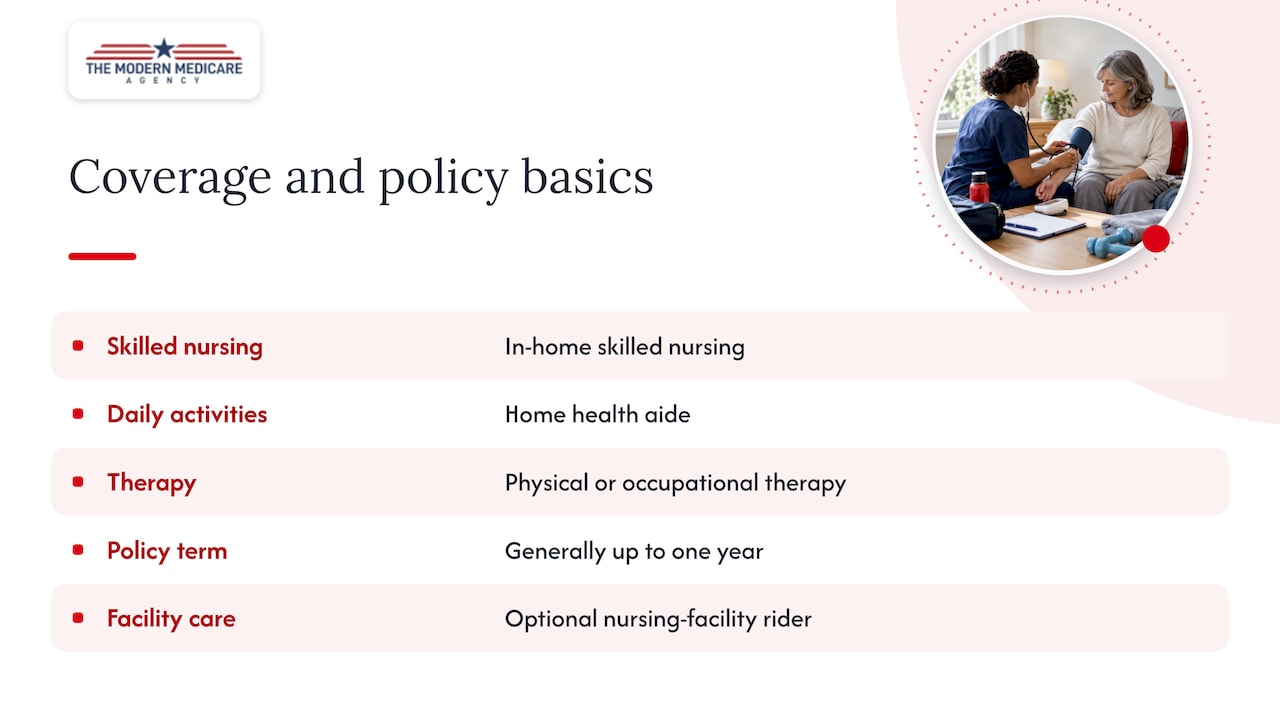
Short-term care insurance is a limited-duration cousin of long-term care coverage. It pays benefits to people who need help recovering from an illness, injury or surgery, with typical benefits for in-home skilled nursing, a home health aide for daily activities, and physical or occupational therapy. Policies generally run up to one year.
Some policies also cover extended care in a facility through an optional rider for nursing-facility care. So the setting depends on the policy you pick: your own home, an assisted living community, or a nursing home.
The product goes by several names: short-term care, STC, STCI, recovery care. They all describe the same idea: a time-limited benefit for a time-limited need.
How it works: eligibility, triggers and limits
Applying
Applicants generally complete a short health questionnaire rather than the extensive medical review common with long-term care policies. That simpler process is a large part of the appeal for people who might struggle to qualify for a traditional policy. Your answers still matter, and the policy will define what it counts as a pre-existing condition.
What triggers benefits
Most policies pay when you cannot perform at least two of six activities of daily living, or when you have a cognitive impairment. The six are bathing, dressing, eating, toileting, transferring (for example, getting from bed to chair) and continence. The U.S. News overview describes this trigger and a maximum benefit period of 360 days.
Many policies also do not require a prior hospital stay to start paying, unlike some long-term care contracts, according to a carrier’s own explainer. Always confirm this in the specific contract.
Daily limits and the benefit clock
Benefits are paid up to a chosen daily amount, and the total runs for a capped number of days, commonly 360. Some contracts restore the benefit once after a full recovery. One carrier’s plan, for example, restores benefits if you fully recover and receive no care for 180 consecutive days. Terms differ by carrier and by state, so read the schedule of benefits, not just the brochure.
Common exclusions
Expect exclusions. According to U.S. News, these commonly include:
- care provided by family members
- pre-existing conditions
- services not considered medically necessary
- custodial care that does not meet the plan’s definitions
- care received outside the United States
Knowing these before you apply is simply part of choosing a policy well. It tells you which questions to bring to your agent.
Short-term care vs. long-term care insurance
Both pay for help with daily living. The difference is how long, how much, and how hard it is to qualify.
| Feature | Short-term care insurance | Long-term care insurance |
|---|---|---|
| Benefit length | Up to about one year (commonly 360 days) | Years, or a pool of benefits that can last much longer |
| Designed for | Recovery and temporary needs | Chronic, ongoing needs |
| Underwriting | Usually simpler, short questionnaire | Often a detailed medical review |
| Waiting period | Often none (zero-day elimination) on the home care portion | Commonly a waiting period before benefits begin |
| Premiums | Generally lower | Generally higher |
That comparison follows U.S. News, which notes simpler underwriting, often zero-day elimination periods and lower premiums for short-term policies. A carrier also says short-term care commonly costs less and has fewer qualification restrictions than long-term care.
There is one more difference that matters for Medicare households. Short-term policies pay benefits in addition to Medicare, while traditional long-term care insurance is sometimes restricted from doing so, per U.S. News.
If you are trying to decide how much protection you need for the long haul, our guide to long-term care insurance and Medicare lays out where each one begins and ends, and the long-term care cost guide shows what premiums look like.
What Medicare covers, and the gap that remains
Medicare pays for medically necessary skilled care, not for ongoing help with bathing, dressing and similar tasks. Here is what that means in practice.
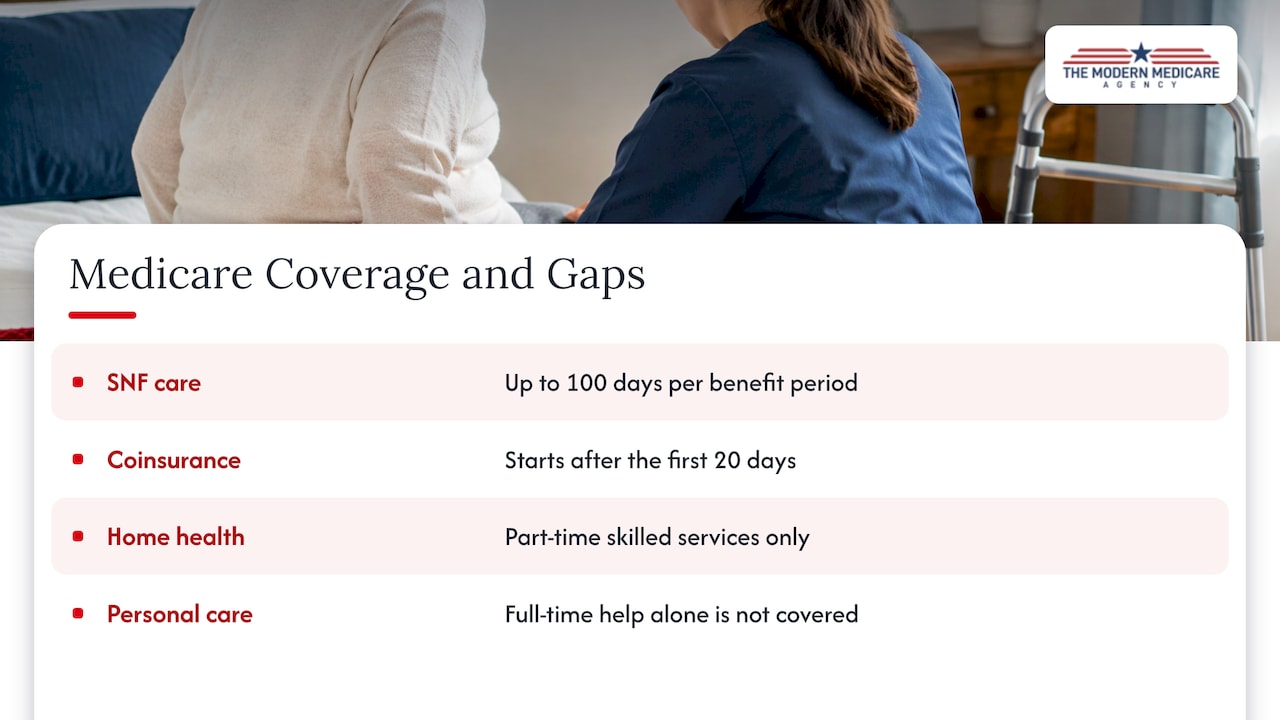
Skilled nursing facility (SNF) care. Medicare covers up to 100 days of SNF care in a benefit period if you are eligible, and the same booklet says Medicare does not cover non-medical long-term care. After the first 20 days, a daily coinsurance applies. Some Medigap policies pay all or part of that SNF coinsurance, which is one reason Medigap is worth a look when you plan your recovery coverage.
Home health care. Medicare can cover part-time skilled services at home when you meet the requirements. It does not pay for full-time home help or for personal care alone. Our pages on whether Medicare pays for in-home care and Medicare home health care in 2026 go through the rules.
Out-of-pocket costs. Part A copays and Part B deductibles still apply, and short-term care insurance can help bridge those costs along with the personal-care help Medicare leaves out.
Notice the pattern. Medicare is strong on the clinical side of recovery. The practical side, someone to help you get dressed, cook and move safely for three months, is where families end up paying out of pocket.
Who tends to benefit
Short-term care insurance fits some situations better than others:
- People in their late 50s to 70s who want some protection but may not qualify for, or want to pay for, long-term care coverage. The simpler application can be a practical door in.
- Households planning a scheduled surgery or recovery. Know the pre-existing condition limitation first, since a known upcoming procedure may be treated differently.
- Medicare beneficiaries who want help in addition to Medicare. Because these policies can pay alongside Medicare, they target exactly the gap described above.
- Caregivers who want a backup. Paid help can relieve a spouse or adult child, although care given by family members is commonly excluded from payment.
A worked example makes the math concrete. Say a policy has a daily benefit and a 360-day maximum. If you break a hip and need six weeks of home aide help and therapy, the benefit is drawn down daily for those 42 days, and the remaining days stay available (or reset under the policy’s restoration terms). Your actual numbers depend on the daily amount you choose, so ask for the benefit schedule in writing.
Questions to settle before you apply
Use this checklist when you compare any short-term care policy:
- Which settings are covered? Home only, or assisted living and nursing facility too? A facility rider can add a separate benefit period.
- What is the daily benefit, and what is the total maximum? Compare it with local costs for a home health aide in your area.
- How is the benefit triggered? Two of six ADLs or cognitive impairment is typical. Check how the policy defines each one.
- Is there a waiting period? Some optional riders carry one, according to U.S. News.
- What does the pre-existing condition limitation say? This is the clause most likely to affect you.
- Can benefits restore? Look for the time you must go without care.
- Which exclusions apply? Family-provided care and care outside the U.S. are common ones.
- Who is the carrier, and is it licensed in your state? Product availability differs by state.
A second opinion from an independent agent costs nothing and often turns up contract details you would otherwise find at claim time.
Other ways to cover recovery and care costs
Short-term care is one tool. Depending on your age, health and budget, you might combine it with others:
- Medicare Supplement (Medigap). Helps with Original Medicare cost sharing, including some SNF coinsurance, as noted above. See our Medigap plans page.
- Long-term care insurance. Better suited if you want to plan for years of care. Underwriting matters here, so read our long-term care underwriting checklist.
- Hospital indemnity coverage. Pays a cash benefit for hospital stays that you can use as you see fit.
- Asset-based planning. If you are weighing self-funding or other approaches, our guide to long-term care alternatives by asset band is a starting point.
No single product solves every scenario, which is why the right mix depends on what you already have.
Our perspective
We have helped Medicare consumers since 2007, and the most common surprise we hear is some version of “I thought Medicare would cover that.” Recovery care is where that surprise lands hardest. Medicare handles the skilled care, then the bills for everyday help arrive, and families scramble.
That is why we put education first. Before anyone buys anything, we want you to understand what Medicare pays, what your current plan pays, and what is left. Only then does it make sense to talk about a product, whether that is a Medigap plan, a Medicare Advantage plan, a hospital indemnity plan or long-term care coverage.
As independent agents with access to 40+ carriers, we are not tied to one company’s product line. We review your situation, explain the trade-offs without pressure, and check in on your coverage each year, because your health and your needs change.
Paul
Get a plan review before you need care
The best time to look at recovery and long-term care options is before a hospital stay is on the calendar. We are independent Medicare specialists, and we can compare Medicare Supplement, Medicare Advantage and long-term care coverage against what you have today, so you see where the gaps are.

Start with our Medicare Supplement and long-term care page or reach us through Paulbinsurance for a personalized review. There is no pressure, and you will leave knowing your next steps.
FAQ
Does Medicare pay for short-term care at home?
Medicare can pay for part-time skilled services at home, such as nursing or therapy, when you meet its requirements. It does not pay for ongoing personal care alone. Short-term care insurance is designed to help with that remaining personal-care need.
How long does short-term care insurance pay?
Policies generally cover up to one year, and a common maximum is 360 days. Some contracts add a separate period for facility care through a rider. Your policy schedule lists the exact limits.
Is short-term care insurance the same as short-term health insurance?
No. Short-term health insurance is temporary medical coverage for doctor and hospital bills. Short-term care insurance pays a benefit for help with daily activities during recovery. They solve different problems, so check which one you are comparing.
Can I buy short-term care insurance if I already have health problems?
The application is usually a short questionnaire, which is simpler than long-term care underwriting. Policies still carry a pre-existing condition limitation, so your history can affect what is paid. An independent agent can explain how a given carrier treats it.
Is short-term care or long-term care better for seniors?
It depends on the need. Short-term care suits temporary recovery needs and tends to cost less. Long-term care is designed for chronic, extended needs. Many households review both with an agent before deciding.
Sources
- What Is Short-Term Home Healthcare Insurance? (U.S. News)
- Short-term Care Insurance (Wellabe)
- The Lowdown on Short-Term Care (Bankers Fidelity)