




What if the best annuity isn’t the one with the biggest monthly payout? If you’re wondering what the best annuity for a 70-year-old is, the answer depends on what matters most to you: steady income for life, payments that can continue to a spouse, or more access to your money. An immediate annuity can provide income sooner, while a deferred annuity is designed to start payments later. The right choice balances income with the flexibility and protection you want.
It’s understandable to feel unsure when payout choices and retirement account rules overlap. This guide explains how to compare annuity types and single-life, joint-life, and guaranteed-period payouts, and what to consider before committing your savings. It also covers required minimum distributions: according to the Internal Revenue Service, required minimum distributions generally begin at age 73 for affected retirement accounts. You’ll see how that rule relates to annuities, so you can weigh the income you want against the withdrawals your account may require.
Key Takeaways
- Match an annuity type to when you need income: immediate annuities start paying sooner, while deferred annuities begin later.
- Compare payout choices by balancing monthly income with whether payments should continue to a spouse or beneficiary.
- Account for required minimum distributions when considering an annuity funded by a retirement account.
- Look closely at fixed index annuity terms, including how interest is credited and when you can access your money.
- Weigh income stability against flexibility before deciding whether an annuity fits your retirement needs.
What’s the Best Retirement Annuity for You?
If you’re asking, “What is the best annuity for a 70-year-old?” start with the job you want the money to do. The right fit depends on how income, access, and protection for loved ones work together in your situation.
Immediate Income at Older Ages
An immediate annuity exchanges a premium for scheduled payments that can start soon after purchase. For an older adult, it may turn a portion of savings into a regular income source instead of leaving that money invested for future growth.
Consider a retiree whose routine bills are covered but who wants help paying a recurring expense. An immediate annuity could be assessed for that purpose. The key question is how its payment schedule fits the expense, not simply whether the initial payment looks attractive.
Purchase Timing and Income Needs
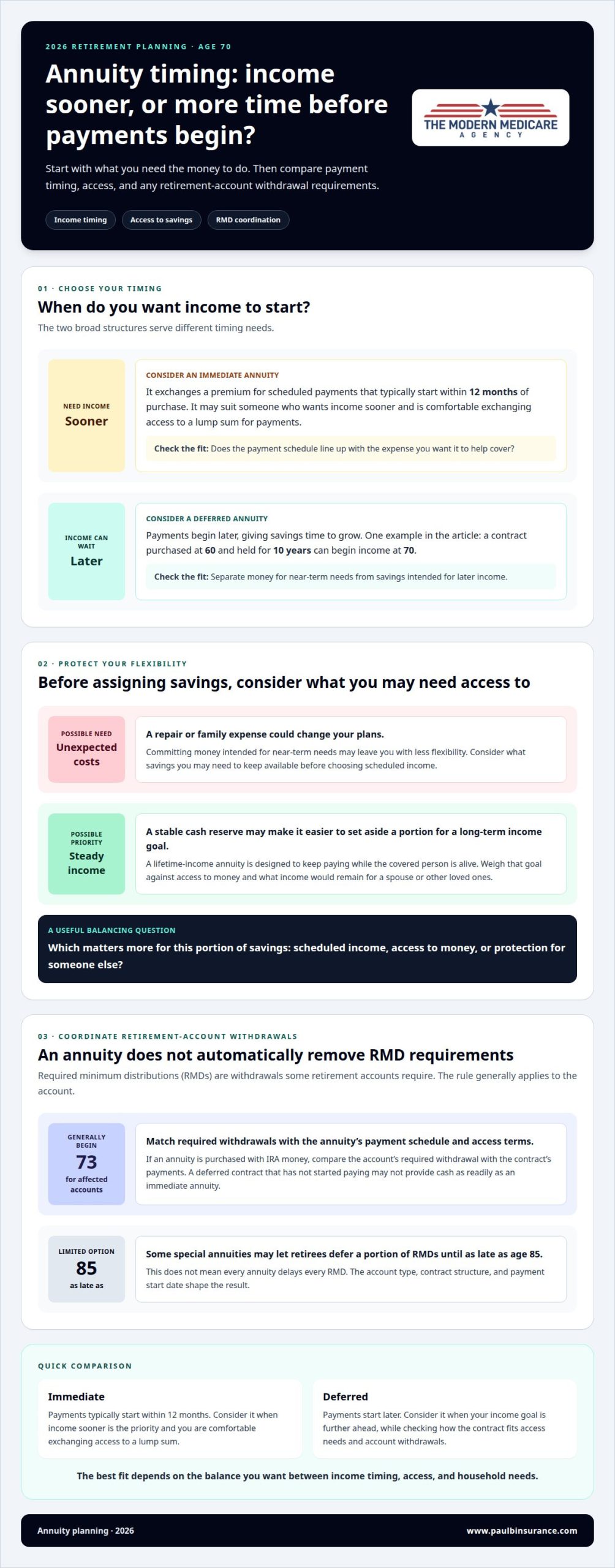
Purchase timing means deciding when a contract should begin serving its intended purpose. At age 70, separate money meant for near-term needs from savings intended for later retirement. That distinction can help prevent committing funds that may be needed for an unexpected home repair or family expense.
For example, someone who expects to use savings for a planned move may value access more than scheduled income. Someone with a stable cash reserve may be comfortable assigning a portion to a long-term income goal. What is the best annuity for a 70-year-old in either situation? It depends on which purpose takes priority.
Lifetime Income and Longevity Protection
A lifetime-income annuity is designed to keep paying while the covered person is alive. It may help address the risk of outliving savings, but that goal needs to be weighed against other household priorities.
Consider who depends on the money and what income would remain if the covered person died. An annuity covering one person’s lifetime serves a different purpose from one designed for two. The choice affects how the income supports a household over time, so weigh it alongside other income sources and any inheritance goals.
State Guaranty Coverage Limits
State guaranty associations provide limited protection for eligible insurance benefits if an insurer becomes insolvent. These protections vary by state, and coverage limits depend on the state and type of benefit. No single nationwide limit applies to every annuity.
For example, people in different states may face different coverage rules for similar contracts. Treat this protection as one consideration, not a substitute for understanding the insurer and contract. Before choosing, identify the applicable state rules, covered benefits, and relevant limit. This puts the protection in context without assuming every dollar is covered.
Do RMDs affect annuities purchased at 70?
A 70-year-old can consider immediate or deferred annuities, including fixed, fixed index, and variable designs. Immediate annuities turn a purchase into income sooner; deferred annuities postpone payouts, allowing time for savings to grow. The useful comparison is how each structure fits your income timing, access needs, and retirement-account withdrawals.
Required minimum distributions (RMDs), the withdrawals some retirement accounts require, can affect how you use an annuity inside a retirement account. The RMD rule generally applies to the account, so buying an annuity does not automatically remove the withdrawal requirement. Coordinate the account’s required withdrawal with the annuity’s payment schedule and withdrawal terms.
Immediate or Deferred: What Changes?
An immediate annuity typically starts paying within 12 months of purchase. It may suit someone who wants income sooner and is comfortable exchanging access to a lump sum for scheduled payments. The payout depends on the selected income option and the purchaser’s details.
A deferred annuity starts income later. For example, a deferred annuity purchased at age 60 and held for 10 years can begin income at age 70. At 70, the choice is less about an abstract product label and more about whether you need payments now or prefer to defer them.
Estimated Immediate-Annuity Payouts
March 2026 estimates show how payout choices change monthly income from a $100,000 purchase.
These examples make the tradeoff clear: adding a period or refund feature can change the monthly payment. Compare the protection each option provides with the income you need, not just the largest initial payment.
RMDs and Annuity Payments
For an annuity purchased with money from an IRA, compare the required withdrawal with the annuity’s payment schedule and access provisions. A deferred contract that has not started paying income may not provide cash as readily as an immediate annuity. Access to your money matters if you need to meet an account withdrawal without using other savings.
A special annuity purchased with retirement-account money can allow retirees to defer a portion of RMDs until as late as age 85. That option may help with later-life income planning, but it does not mean every annuity delays every RMD. The account type, contract structure, and payment start date shape the result. Compare those details before committing retirement funds.
For help weighing annuity income choices alongside your retirement-account needs, explore annuity guidance.
Fixed index annuity choices for retirees over 65
A fixed index annuity may suit a retiree seeking principal protection and interest linked to an index. Review the contract terms: they explain how interest is credited, what limits apply, and when you can access your premium.
How Fixed Index Annuities Protect Principal
A fixed index annuity credits interest using a formula tied to an index, rather than placing your premium directly in that market index. In one example, a 0% floor means the account does not lose value from a market drop during the measured period. A 6% cap limits credited interest in that example, even if the index gains more.
Those figures describe an illustration, not every contract. A floor may protect principal from index losses, but it does not guarantee growth or remove contract restrictions. Read the interest-crediting terms alongside the surrender schedule and withdrawal rules. Protection from market losses is different from immediate access to the full premium.
Interest Rates and Fixed Annuities
Fixed annuities credit interest at a stated rate under the contract. Rate examples listed for annuities include 6.30% for a 3-year term and 6.55% for a 7-year term. Fixed annuity rates were also reported as high as 5.75%. These are distinct figures, not a promise that every retiree or contract receives those rates.
Compare the interest rate with the contract term and when you may need the money. A higher rate may look appealing, but a longer commitment can reduce flexibility. For retirement income, also consider whether the contract builds account value or converts savings into scheduled payments.
Fixed and Variable Annuities
Fixed annuities offer interest terms set by the contract. Variable annuities invest through separate accounts, so account value and potential payments can rise or fall with those investments. Fixed index annuities take a different approach, linking interest credits to an index formula subject to contract limits.
For a 70-year-old, the difference is practical: stable crediting terms, index-based interest, and investment-linked value expose savings to different risks. Compare how each contract handles loss, growth, income, and access before choosing.
Evaluating an Accumulation Example
An illustration shows how time can affect accumulation. A 65-year-old investing $100,000 in a deferred annuity earning 5% interest compounded annually for 10 years could have approximately $162,889 at age 75. This is a hypothetical example, not a fixed index annuity quote or a guaranteed result for every contract.
Use examples to understand how an annuity works, then focus on the actual contract’s premium terms, interest-crediting method, and access limits. The right fit should support your retirement needs without relying on growth assumptions alone.
Male, female, and joint-life payout options
At age 70, payout choices affect both monthly income and what happens after the person receiving payments dies. Compare single-life income with joint-life coverage and survivor guarantees before selecting an option.
Life and Joint-Life Payout Choices
A single-life annuity pays income based on one person’s life, while a joint-life annuity can cover two people. This distinction matters when savings need to support a spouse as well as the person buying the contract.
These figures illustrate how the covered lives and payment design affect income.
Compare the payment with household expenses and other income sources. The key question is whether the savings need to provide income for one person’s lifetime or two.
Survivor Guarantees and Payouts
A survivor guarantee continues payments to a named beneficiary or surviving spouse under the selected contract terms. It matters when a household depends on the annuity and wants payments to continue after the first person dies.
Some options guarantee payments for a set period, while joint-life designs base payments on two lives. A 10-year certain option, for example, provides a stated payment period even if the person receiving payments dies sooner. That added protection can reduce the initial monthly payout compared with a single-life-only choice.
A cash-refund option can return the remaining value to a beneficiary if the person receiving payments dies before receiving payments equal to the purchase amount. The figures illustrate the tradeoff between guaranteed income and survivor protection.
Age also shapes the payout calculation: a 70-year-old male buying a single-premium immediate annuity (SPIA), which provides scheduled payments soon after purchase, may receive approximately 17% more per month than if he bought at age 65. Waiting changes the accumulation and payout phases. During accumulation, value builds under contract terms; during payout, the annuity delivers scheduled income. Weigh longevity, savings, and the household’s situation together. A higher individual payment may not serve a couple as well as continued payments for a surviving spouse.
Should a 70-Year-Old Buy an Annuity?
An annuity may fit if its income and access terms support your retirement plan. At age 70, compare contract costs, limits on withdrawals, and how payments work alongside Social Security.
Variable and Indexed Annuity Fees
Variable and indexed annuities can have costs that affect account value or income, so compare charges before buying. Variable annuity costs may include investment expenses, contract administration charges, and fees for optional benefits. An indexed annuity may have a different fee structure, along with its own limits on interest and withdrawal terms.
Look beyond a headline premium bonus. For example, a 10% bonus may be spread across a 14-year surrender schedule, which limits access to money for a long period. A surrender schedule lasting 10 years would leave a 70-year-old waiting until age 80 for full access. A larger bonus does not erase that tradeoff.
Check the contract’s free-withdrawal provision, surrender period, and any optional-benefit charges. The free-withdrawal provision sets how much money you can take out without a surrender charge. The surrender period is the time when charges may apply if you withdraw more than the allowed amount or close the contract. A 10% free-withdrawal provision may not provide enough access to meet an IRA owner’s required minimum distribution. For fixed index annuities, a useful comparison is a surrender period of 7 years or less, with 10% free withdrawals starting in year one. These are comparison criteria, not a promise that every contract has those terms.
Index caps and participation rates also affect credited interest. A cap limits the interest credited under the contract’s index formula; a participation rate is the share of an index increase used to calculate interest. Compare both with fees and access rules. A strong index result does not mean your account will earn that amount.
Comparing Quotes and Insurer Strength
To compare quotes fairly, use the same premium, age, state, payout option, start date, and guarantee period. Change one feature at a time, then compare the resulting monthly income and contract terms. For example, a single-life quote is not directly comparable to a joint-life quote unless you account for the different coverage.
Review the insurer’s financial strength using ratings from established rating agencies, and consider more than one rating. A strong rating assesses the insurer’s ability to meet obligations, but it does not guarantee future performance or replace a careful review of contract terms.
For a 70-year-old, the buying decision should also reflect the role of Social Security and other retirement income. If the annuity is meant to cover essential monthly expenses, prioritize how payments are guaranteed and whether a spouse needs continuing income. If access to money is the main concern, a long surrender period may conflict with that need.
Compare annuity choices and their income terms with get help reviewing annuity options.
The Modern Medicare Agency
The Modern Medicare Agency helps clients compare annuity options when weighing income, access to savings, and payout terms. Its guidance can clarify how an annuity fits alongside other retirement coverage while keeping the tradeoffs in view.
If Medicare costs are also part of your retirement-income decisions, the agency can help you review Medicare Advantage Plans, Medicare Supplement (Medigap) Plans, and Medicare Part D Plans. It also offers life insurance for people considering broader household protection.
You don’t need to have every detail settled before seeking guidance. To discuss your annuity questions and related coverage needs, contact The Modern Medicare Agency.
Choose a Next Step That Fits Your Retirement
Deciding what the best annuity for a 70-year-old is starts with the role you want the money to play. Think about the kind of retirement you’re building, the income you rely on, and the flexibility you want to keep. A decision made with those priorities in view can feel clearer than one driven by a single payout figure.
Before moving forward, consider how the choice fits your wider financial picture. Your need for access to savings, the people who may depend on you, and your plans for future income all matter. There is no single right answer for every household, but a thoughtful comparison can help you choose with confidence.
The Modern Medicare Agency can talk through annuity options in light of the priorities that matter to you. Contact The Modern Medicare Agency to discuss your next step. You can move forward at a pace that feels right.
Frequently Asked Questions
Can I buy a fixed index annuity (FIA) at age 75?
Yes, a fixed index annuity may be available at age 75. Insurers commonly set maximum issue ages between 75 and 95, depending on the product, and many carriers issue fixed index annuities to buyers up to age 80 or 85. At 75, the important question is how the contract’s interest-crediting formula, surrender schedule, and payout options fit your needs. Eligibility and terms vary by product.
How Can an Annuity Help You?
An annuity can turn savings into scheduled income or hold money for potential future income, depending on its design. Someone with a gap between regular expenses and reliable income, for example, might use payments to help cover it. An annuity can also provide income for life if that payout is selected. Consider how much flexibility you need, since contract restrictions can limit access to the money.
Is a 10-year FIA too long for a retiree?
A 10-year surrender schedule can be restrictive for a retiree who may need the premium before the term ends. At age 70, it can mean waiting until age 80 for full access. A shorter schedule may better suit someone who expects near-term expenses. A longer period may be considered when the contract’s income terms fit the retiree’s needs and accessible savings are sufficient.
Is it too late to buy an annuity at 70?
No, age 70 is not automatically too late. Immediate annuities can provide income at older ages, while a deferred contract may suit someone who expects to begin payments later. The practical test is whether the payment start date, access limits, and payout design fit your plans. Compare the annuity’s role with other income and keep enough accessible savings for expenses the contract will not cover.
Should I Wait Until Age 75?
Waiting until 75 may produce a higher starting payout, but it also means giving up payments you could have received during the five-year wait. The better choice depends on whether you need income at 70, how you would fund expenses while waiting, and how much flexibility you want to preserve. Compare the value of income received sooner with the larger payment you may receive later.
Should You Buy a fixed index annuity (FIA) at 70?
A fixed index annuity at 70 may fit someone who wants interest credits tied to an index formula and accepts the contract’s limits. Before buying, consider whether the surrender period leaves enough access for expected expenses and account withdrawals. Also look at how the contract calculates credited interest. A fixed index annuity may be a poor fit if you need unrestricted access or prefer investment choices without contract limits on interest credits.
What Are the Best Annuities for Seniors?
The best annuity depends on what you want it to do. If you need payments soon, compare immediate-income options; if you’re focused on income later, consider a deferred design. A retiree who prioritizes predictable interest may compare fixed contracts, while an index-linked formula may suit someone comfortable with its limits. Start with your need, then compare access, payout, and guarantee terms.
How do fixed, variable, and indexed annuities compare for a 70-year-old?
Fixed annuities credit interest under contract terms. Variable annuities place value in investment options, so results can change with those investments. Fixed index annuities use an index-linked formula with contract limits. For a 70-year-old, compare the kind of growth exposure you’re comfortable with, the charges, and when you may need the money. The labels alone don’t show which contract best suits your situation.

Article by
Paul Barrett
Paul Barrett, CMIP is the founder of The Modern Medicare Agency, an independent Medicare-only brokerage based in Melville, NY. With 18 years of Medicare-exclusive experience, a CMIP designation, and more than 5,000 clients served across 37 states, Paul is one of the most credentialed independent Medicare specialists on Long Island — and one of the most direct.
He represents 40+ carriers with no quotas and no allegiances, which means his recommendations are based entirely on what fits each client's specific situation. He is the author of Medicare Mastery Unlocked and host of the Wise Guys Retirement Talk podcast. His content is grounded in primary sources, real carrier intelligence, and 18 years of watching what happens when people get Medicare right — and when they don't.
📞 631-358-5793 | paulbinsurance.com