




A QLAC, or qualified longevity annuity contract, is a deferred income annuity you buy with money from a traditional retirement account. In exchange for a lump sum now, an insurer promises a guaranteed income for life that starts later, no later than the first day of the month after you turn 85. Because the IRS leaves the QLAC out of your required minimum distribution (RMD) calculation, it can lower the withdrawals you must take in the meantime. In 2026 you can put up to $210,000 into QLACs.
We are independent Medicare and senior insurance agents, and retirees ask us about QLACs because they want to know how a late-life income fits next to Medicare premiums and out-of-pocket health costs. This guide covers what a QLAC is, who can buy one, the rules, the tax effects and how to decide.
TL;DR
- A QLAC is a fixed deferred income annuity funded with traditional IRA or workplace plan money, paying a guaranteed lifetime income that must start by age 85.
- The 2026 premium limit is $210,000 per person across all your QLACs. The old 25% account-balance cap no longer applies to new purchases.
- The QLAC’s value is excluded from the balance used for RMDs until payments begin. Payments are generally taxed as ordinary income when you receive them.
- A QLAC is built to cover the risk of outliving your savings. The money is committed once you buy, so it works best as one piece of a larger plan.
- You cannot buy a QLAC with a Roth IRA.
Table of Contents
- What a QLAC is and how it works
- Who can buy a QLAC, and with which accounts
- The 2026 QLAC limit
- The rules a contract must meet
- How a QLAC affects RMDs and taxes
- QLAC vs. a qualified annuity
- What a QLAC does well
- What to know before you buy
- Is a QLAC a fit for you?
- A short buying routine
- Our perspective
- Talk to an independent agent about annuities
- FAQ
- Sources
What a QLAC is and how it works
Start with the plain version. A longevity annuity is a fixed annuity you fund with a large upfront payment, and in return you get a guaranteed monthly payout for life beginning at a future age. The SEC’s Investor.gov describes a QLAC as one type of longevity annuity that meets additional IRS requirements and is bought with retirement-account money.
The mechanics run in two phases:
- Deferral. You pay the premium from a qualifying account. The insurer holds it and you take no income. During this period the insurer, not you, bears the market risk, while the contract fixes what you will be paid later.
- Payout. At the start date you chose, income begins and continues for life. The payment depends on the premium, your starting age and the options you select, such as continuing payments to a surviving spouse, according to the same Financial Planning Association description.
The later you start, the larger the payment for a given premium. That is why deferred longevity annuities can pay more than immediate annuities: Investor.gov explains that the buyer gives up access to the lump sum and delays income, and that trade is what funds the higher payout.
A simple example shows the idea. Suppose you are 70 with a traditional IRA and enough other savings and income to live comfortably for the next 15 years. You put a portion of the IRA into a QLAC that begins paying at 85. Those dollars no longer sit in the account that drives your RMDs, and at 85 a check arrives each month for as long as you live. The figures here are illustrative only. Actual payouts depend on the insurer, your age and the options you choose.
Who can buy a QLAC, and with which accounts
A QLAC must be purchased with retirement money, not with after-tax savings. The IRS’s Form 1098-Q instructions say a QLAC may be bought under:
- a 401(a) plan,
- a 403(a) annuity plan,
- a 403(b) plan,
- a traditional IRA under section 408, or
- an eligible governmental 457(b) plan.
A Roth IRA is not on the list. If most of your savings sit in a Roth, a QLAC is not available with those dollars. If your money is in a 401(k) you left at a former employer, a conversation about rolling it over to an IRA is a normal first step, because many workplace plans do not offer QLACs directly.
This matters for the readers we meet most often: people turning 65 or retiring from employer coverage who are sorting out Medicare and, at the same time, deciding what to do with the 401(k) they are leaving behind.
The 2026 QLAC limit
The cap on what you can put into QLACs is a dollar figure that applies to you personally. For 2026 it is $210,000 per person, the amount a QLAC can remove from RMD-subject assets.
Three points trip people up:
- It is cumulative. The limit covers all your QLACs together, across every eligible account you own. It is not a fresh allowance for each IRA or plan.
- The 25% cap is gone. For contracts purchased or received on or after December 29, 2022, the IRS says the 25% limit is repealed and the dollar limitation is adjusted for inflation. Before that change, a QLAC could not exceed 25% of your account balance, which kept it far below the dollar figure for many people.
- Couples each have a limit. If each spouse buys with his or her own eligible retirement assets, each has a separate personal limit. It cannot be transferred from one spouse to the other. Two spouses could therefore place up to $420,000 combined, as long as each uses his or her own account.
Because the figure is indexed, it can change from year to year. Confirm the current number on the IRS site or with an agent before you buy.
The rules a contract must meet
Not every deferred annuity is a QLAC. The IRS requires the contract to satisfy a list of conditions, summarized in its Form 1098-Q instructions:
- It is funded from an eligible plan or traditional IRA.
- Premiums stay within the dollar limit.
- Payments start no later than the first day of the month after you reach 85. They can start earlier.
- After payments begin, the contract follows the annuity distribution rules.
- It has no commutation or cash-surrender feature, meaning you cannot cash it out.
- Any death benefit is of a permitted type.
- The contract states that it is intended to be a QLAC.
- It is generally not a variable or indexed annuity.
In practice, this means a QLAC is a fixed contract with a guaranteed payout schedule. You see the terms before you sign: the start date, the monthly income, and whether a spouse continues to be paid after your death.
The age-85 deadline is a ceiling. You can pick a start at 80, 82 or any age you like within the contract’s terms. A earlier start generally means smaller payments per dollar of premium, so the right date depends on what gap you are trying to cover.
How a QLAC affects RMDs and taxes
This is the reason most people look at QLACs. Before payments start, the IRS says the QLAC’s value is excluded from the account balance used to calculate RMDs. If you move $200,000 of a traditional IRA into a QLAC, the RMD formula applies to a smaller account, so the required withdrawals shrink. Morningstar notes a QLAC may reduce RMD-related tax bills before the payments begin.
Two cautions about taxes, both about planning rather than avoiding the product:
- A QLAC defers tax, it does not erase it. Payments are generally taxable as ordinary income when you receive them.
- The outcome depends on your situation: your other income, bracket now and later, and your spouse’s picture. Morningstar recommends getting tax advice, and we agree. Bring your CPA or tax preparer into the conversation before you fund a QLAC.
Income, in turn, can affect healthcare costs. Medicare Part B and Part D premiums can rise at higher income levels, so the timing of taxable income is worth looking at as a whole. Our guide on financial planning for healthcare in retirement walks through how those costs fit into a budget.
QLAC vs. a qualified annuity
People often confuse the two, and the search engines show the question often. “Qualified” in “qualified annuity” just means the annuity is held inside a tax-advantaged account such as an IRA. Payments from an annuity bought with IRA or other tax-deferred money are fully taxable at ordinary income rates, unlike nonqualified annuity payments, which generally use an exclusion ratio for after-tax basis.
A QLAC is a specific kind of qualified annuity with extra features. The difference that counts:
| Feature | Conventional annuity inside an IRA | QLAC |
|---|---|---|
| Funded with | Traditional IRA or plan money | Traditional IRA or eligible plan money (not Roth) |
| Counts toward RMD balance before payments | Yes | No, excluded until payments begin |
| Premium limit | None set by the QLAC rules | $210,000 per person in 2026 |
| Latest payout start | Set by the contract | No later than the month after age 85 |
| Typical design | Immediate or deferred, fixed or variable | Fixed deferred income, generally not variable or indexed |
Morningstar draws the same line: a conventional annuity inside a tax-deferred account stays in RMD calculations, whereas a QLAC can be excluded before payments begin.
What a QLAC does well
The case for a QLAC rests on a few clear strengths.
A paycheck you cannot outlive. The Financial Planning Association presents a QLAC as a hedge against longevity risk: it can provide an income floor late in life, when other resources may be running low. If you live to 95, the contract keeps paying.
Lower RMDs in the meantime. Excluding the QLAC from the RMD balance can shrink required withdrawals during the deferral years.
Higher payouts per dollar. Since you delay income and commit the premium, deferred longevity annuities can pay more than immediate annuities.
Market risk sits with the insurer. During the deferral period, your payout does not move with stocks or bonds.
A planning anchor. Knowing a guaranteed income begins at a set age lets you spend the rest of your portfolio with more confidence in the years before.
These strengths are why a QLAC pairs well with a ladder of other income sources. If you want to see how a QLAC could sit alongside shorter-term contracts, our piece on an annuity ladder for retirement income shows how staggered contracts can work together.
What to know before you buy
A QLAC is a commitment, so it pays to go in with eyes open. These are the features of the contract to plan around.
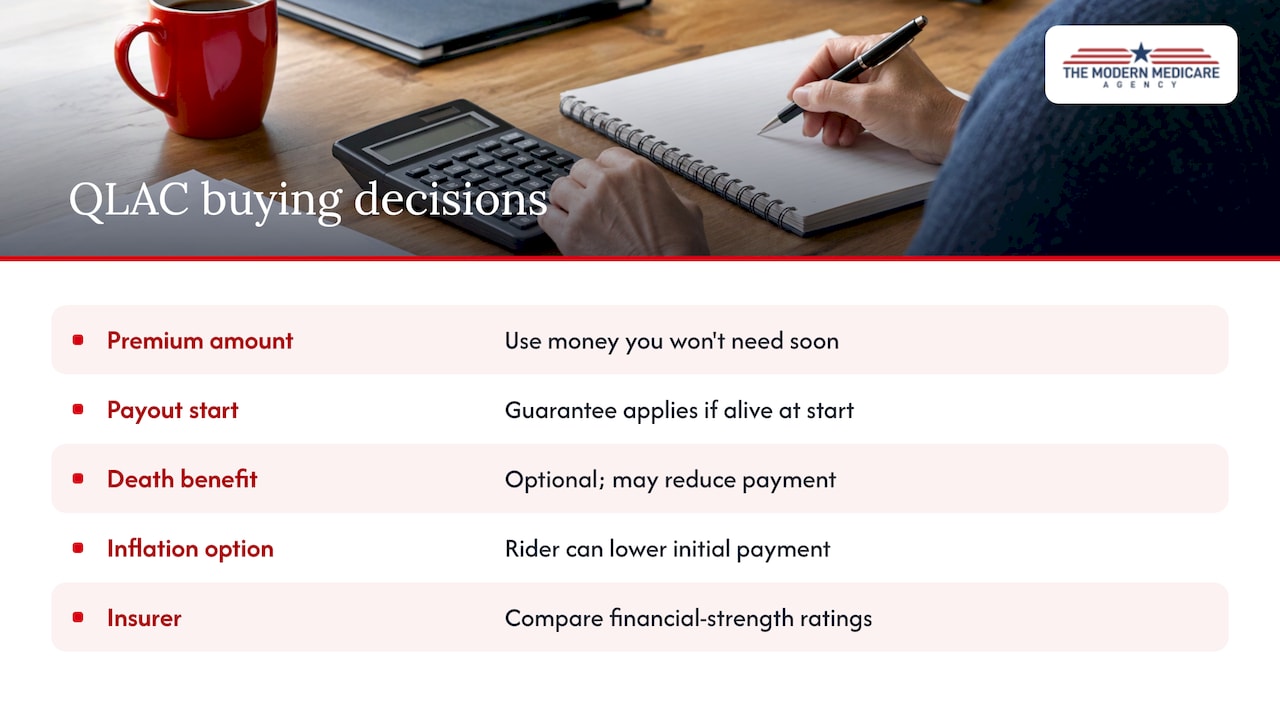
The money is committed. After you buy, you generally cannot access the upfront amount. That is why financial planners suggest funding a QLAC only with dollars you will not need for emergencies, healthcare surprises or near-term spending. Keep liquid savings for those separately.
The guarantee depends on being alive at the start date. Investor.gov notes the guarantee applies if you are alive at the payout start date, and that you may receive no death benefit unless you add an optional feature. Many contracts offer a return-of-premium or similar death benefit and a spouse-continuation option, usually in exchange for a somewhat lower payment. Because the permitted death benefits are defined by the IRS rules, the options are worth comparing line by line. For families who care about passing cash to heirs, estate liquidity planning is a useful companion topic, since a QLAC is designed to deliver income rather than a lump sum.
Payments are level unless you choose otherwise. QLACs are fixed annuities, and Morningstar points out that inflation protection riders can reduce the initial payment. Deciding how much to trade for a rising payment is one of the key choices when you compare quotes. Because the income begins late, its purchasing power in the year it starts is something to model, not guess.
Insurer strength matters. The promise is only as good as the company making it, so compare carriers’ financial strength ratings from the major rating agencies.
Tax advice is part of the process. The right amount depends on your tax bracket, your other income and your plan for RMDs.
Seen this way, the list is a buying checklist rather than a set of drawbacks: how much, which start age, which death benefit, which inflation option, which carrier.
Is a QLAC a fit for you?
A QLAC tends to suit someone who:
- has a sizable traditional IRA or 401(k) and expects RMDs to push them into a higher bracket;
- already has enough liquid savings, Social Security and possibly a pension to cover the next 10 to 15 years;
- has a family history of long life or simply wants protection against outliving savings;
- wants a known income at 80 to 85, when healthcare and care costs can rise.
It tends to be less relevant if your retirement money is mostly in a Roth IRA, if you have a small account where RMDs are modest, or if you need all of your savings available for near-term needs.
Healthcare is often the deciding factor. Medicare does not cover everything, and costs like Medigap premiums, Part D drugs, dental and long-term care can grow with age. A guaranteed income starting at 85 is one way people plan for those years. Our guides on using annuities to cover healthcare costs in retirement and fixed annuities for retirement income go deeper on that link.
A short buying routine
- Map your income and expenses for ages 65 to 85 and beyond, including Medicare premiums and out-of-pocket costs.
- Identify the accounts you could use. Only traditional IRAs and eligible plans qualify.
- Choose an amount within the $210,000 limit, leaving ample liquid savings outside the contract.
- Pick a start age between your first need for income and the age-85 deadline.
- Select options: spouse continuation, death benefit, inflation adjustment.
- Compare quotes from several carriers on payout, options and financial strength. Our guide to annuity rates for retirees explains how rates are shaped.
- Review with your tax professional before you sign.
Our perspective
We have helped Medicare consumers since 2007, and one pattern repeats: people spend months choosing between a Medigap plan and Medicare Advantage, then almost no time on how they will pay for the years after 80. A QLAC speaks to exactly that gap.
We believe in education first. Before anyone talks about a product, we want you to understand your options, what each one commits you to and what you give up in return. A QLAC is a good example: the rules are specific, the limit is specific, and the decision is easier once you see them laid out.
As independent agents with access to 40+ carriers, we are not tied to one company’s contract. We can review how an annuity fits with your Medicare coverage, your drug costs and your long-term plans, and we offer annual coverage checkups so the picture stays current. Our job is to match the plan to your needs, without pressure.
Paul
Talk to an independent agent about annuities
If you are weighing a longevity income alongside your Medicare choices, we can help you see the whole picture. We are independent agents who specialize in Medicare and senior insurance, and we help clients with annuities as well as Medicare Supplement, Medicare Advantage and Part D plans. Our approach is education first, with personalized plan reviews and year-round support.

Start on our annuities page, or reach us through paulbinsurance.com to talk through your situation.
FAQ
How much can you invest in a QLAC?
For 2026 the limit is $210,000 per person, counted across all of that person’s QLACs. The old rule capping premiums at 25% of your account balance was repealed for contracts purchased on or after December 29, 2022. Each spouse has a separate limit when buying with his or her own retirement assets.
What is a qualified annuity?
It is an annuity held inside a tax-advantaged retirement account, such as a traditional IRA. Its payments are fully taxable as ordinary income. A QLAC is a special kind of qualified annuity that is excluded from RMD calculations before payments begin.
Can you use a Roth IRA to buy a QLAC?
No. The IRS lists 401(a), 403(a), 403(b), traditional IRA and eligible governmental 457(b) plans as the accounts that can purchase a QLAC, and a Roth IRA is not one of them. If your savings are in a traditional account, a QLAC may be an option.
When must QLAC payments begin?
Income can begin earlier, but no later than the first day of the month after you turn 85, per the IRS requirements. A later start generally produces a larger payment for the same premium.
Does a QLAC pay anything to my family if I die?
Only if the contract includes a permitted death benefit or a spouse-continuation option. Investor.gov notes you may receive no death benefit without an optional feature, so compare these options when you request quotes.
Sources
- Qualified Longevity Annuity Contract (QLAC), Investor.gov
- Instructions for Form 1098-Q (04/2025), Internal Revenue Service
- How to Buy an Annuity, Morningstar
- Creating Guaranteed Income with QLACs, Financial Planning Association
- Can a Qualified Longevity Annuity Contract Aid Your Retirement Plan?, Morningstar
- Estate Liquidity: Getting Cash to Your Family