




Yes, you can have VA health care and a Medicare Advantage plan at the same time. The two programs do not coordinate, so each time you get care you choose which one to use. The VA covers care it provides or authorizes. Your Medicare Advantage plan covers Medicare-covered care from doctors and hospitals in its network. The decisions that matter are whether to keep Part B, how to handle prescriptions, and which plan fits the care you will get outside the VA. We are independent agents who help veterans and other Medicare consumers sort this out, and the sections below give you the same walkthrough.
TL;DR
- VA benefits and Medicare Advantage can be held together. You pick which one pays for each visit, and neither pays for a service the other covered.
- VA does not bill Medicare, and VA benefits do not pay Medicare deductibles, copays or coinsurance.
- Having VA coverage does not stop the Part B late enrollment penalty. The VA itself encourages veterans to sign up for Medicare when first eligible.
- VA drug coverage counts as creditable coverage for Part D, but only for the veteran, not for family members.
- A Medicare Advantage plan gives you Medicare-covered care in the community, and the VA stays your option for VA care.
Table of Contents
- How VA health care and Medicare Advantage fit together
- Who pays for what: a side-by-side view
- Why veterans pair the two
- What happens when care crosses over
- Part B: the decision that carries a lifetime cost
- Prescriptions: VA drug coverage and Part D
- A worked example
- Mistakes to avoid
- Choosing a Medicare Advantage plan as a veteran
- Getting a plan reviewed with an independent agent
- Our perspective
- FAQ
- Sources
How VA health care and Medicare Advantage fit together
Start with what each program is.
VA health care is a medical benefits package for eligible veterans. According to the VA’s 2026 Health Care Benefits Overview, it has no enrollment fees, monthly premiums or deductibles, and it is delivered through more than 1,700 VA facilities. Whether you qualify depends on your service history, disability status and income, and some veterans pay small copayments depending on their priority group, as the VA explains on its About VA Health Benefits page.
Medicare Advantage (Part C) is a different animal. These are Medicare-approved private HMOs or PPOs that provide your Part A and Part B coverage. Medicare.gov’s enrollment publication notes that they often add benefits, generally require you to see doctors in the plan, and most include Part D drug coverage. Costs vary by plan.
The key point is that these are two separate payers with separate networks. The VA’s page on VA health care and other insurance says you can use both, but you must decide which benefit to use each time you get care. Medicare will not pay for a service the VA authorized, and the VA will not pay for a service Medicare covered. Medicare Interactive, a Medicare counseling resource, adds that Medicare does not pay for care at a VA facility, and VA coverage generally requires you to be treated at a VA facility.
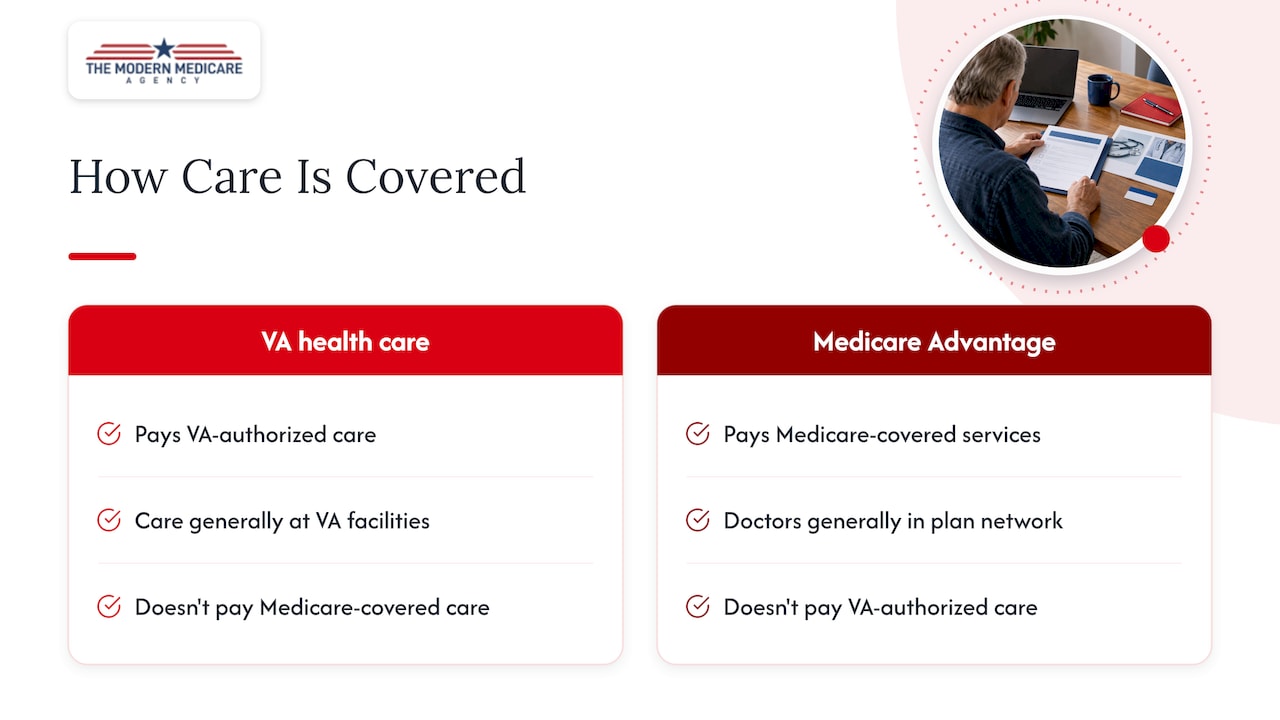
The practical result: think of the VA as one door and your Medicare Advantage plan as another. You walk through whichever door fits the care you need that day.
Who pays for what: a side-by-side view
| Situation | VA health care | Medicare Advantage |
|---|---|---|
| Care at a VA medical center or clinic | Covered, based on your eligibility and priority group | Not used |
| Care at a doctor or hospital in your plan’s network | Generally not covered unless the VA authorizes it | Covered as Medicare-covered care under the plan’s rules |
| Premiums | No monthly premiums for VA health care | Vary by plan |
| Deductibles, copays, coinsurance under Medicare | VA does not pay these | Set by your plan |
| Prescription drugs | VA pharmacy benefit for veterans | Most plans include Part D coverage |
| Dependents and family | VA does not normally provide care for dependents | Each person needs their own coverage |
The last row comes from the VA’s 2025 Health Care Benefits Overview, which says the VA does not normally provide care for veterans’ dependents. If your spouse needs coverage, your VA eligibility does not help them.
Why veterans pair the two
The VA’s own materials give the reason. Funding for VA priority groups is set by Congress, and the VA’s 2026 overview says there is no guarantee every group will be funded in future years, so a second source of coverage such as Medicare is often in a veteran’s best interest. The VA’s benefits page likewise encourages enrolling in Medicare as soon as you are eligible, because priority groups, wait times and your own health needs can change.
Several everyday situations make the combination useful:
- Distance. The nearest VA facility may be far from home, and a plan with a local network gives you a closer option for routine care.
- Wait times. If you need a specialist sooner than the VA can schedule, you can use your plan’s network for Medicare-covered care.
- Family doctors and hospitals you already trust. A Medicare plan lets you keep seeing them.
- Extras. Many Medicare Advantage plans add benefits such as dental, vision and hearing, according to Medicare.gov. The plan’s benefits differ from county to county and carrier to carrier, so the details matter.
The VA’s community care network is the other path. Eligible veterans may get care from non-VA providers when VA services are not available nearby or quickly enough, per the VA’s benefits page. That is VA-authorized care paid by the VA. It is not the same as using your Medicare Advantage plan, and it helps to know which route a given appointment is on before you book it.
What happens when care crosses over
Two scenarios cause most of the confusion.
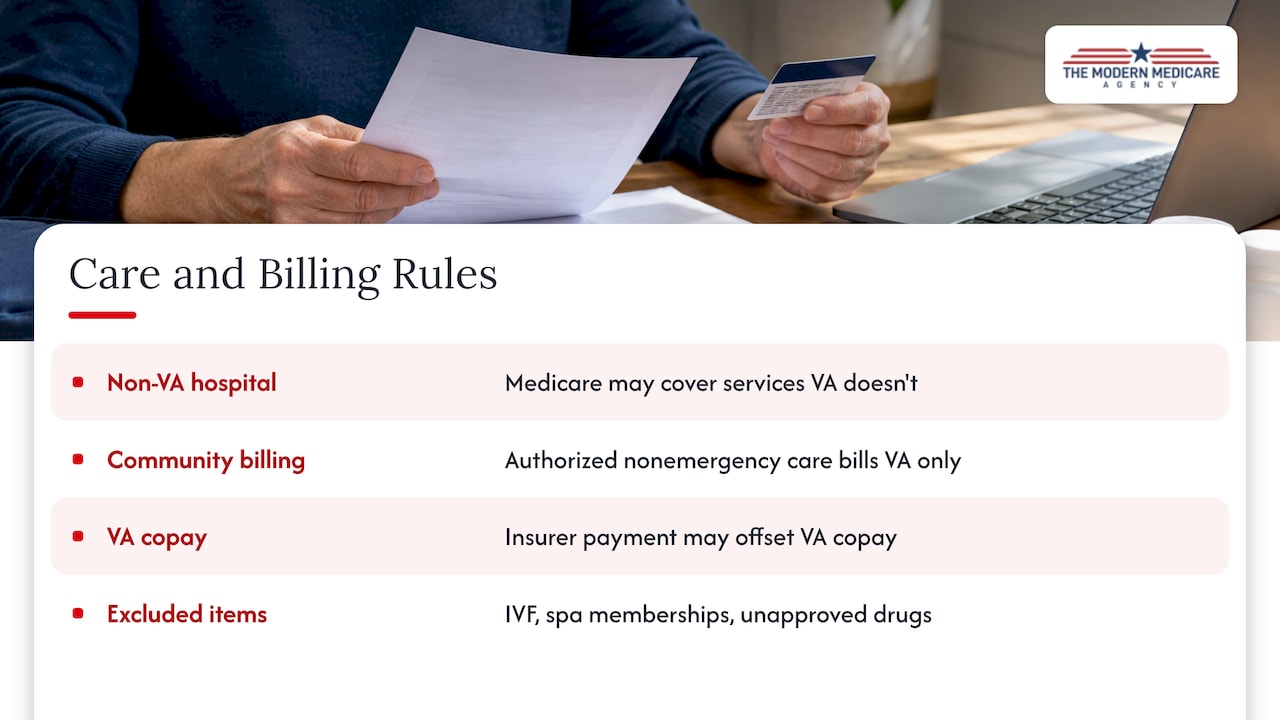
VA-authorized care at a non-VA hospital. If the VA authorizes a stay at a non-VA hospital but does not pay for every service during it, Medicare may pay for Medicare-covered services the VA does not, according to Medicare Interactive. Community providers should bill only the VA for authorized non-emergency care, the VA’s 2026 overview explains.
Your private plan and VA copays. When you give the VA your health plan information, the VA can bill your insurer for non-service-connected conditions. The VA says on its other insurance page that your insurer’s payment can offset part or all of your VA copayment, and the charges may count toward your annual deductible. A priority-group copay for non-service-connected care may still apply. This is why the VA asks every applicant for their health plan information, including coverage under a spouse’s policy. Keeping that information current is a simple task that avoids billing problems.
Also know what the VA package leaves out. Under 38 CFR 17.38, the VA medical benefits package excludes items such as abortions, in vitro fertilization, gender alterations, spa or health club memberships, and drugs or devices not approved by the FDA outside of clinical trials or compassionate use. Your Medicare plan is built around Medicare-covered services, so it is worth checking how any outside care you expect to need would be handled.
Part B: the decision that carries a lifetime cost
Medicare Advantage sits on top of Medicare, so the timing of your Medicare enrollment matters more than any plan choice. Veterans often hear that VA coverage means they can skip Part B. The VA does not say that.
- The VA’s other insurance page encourages veterans to sign up for Medicare as soon as they are eligible, and warns that delaying Part B means a penalty that grows each year and lasts for life.
- According to Medicare.gov, the penalty is 10% of the standard Part B premium for each full 12-month period you could have had Part B but did not. If you miss your window you may have to wait for the General Enrollment Period, January 1 to March 31, with coverage starting July 1.
- The VA’s Sheridan Health Care page for veterans turning 65 says your enrollment window runs from 3 months before to 3 months after the month you turn 65.
- Medicare Interactive notes there is no Part B Special Enrollment Period for veterans who delayed because they had VA benefits.
If you are still working at 65 on an employer plan, that is a different situation, and the VA suggests asking your employer’s benefits office before delaying Part B. For more on how the rules play out, see our guides on the Part B late enrollment penalty and how to avoid it.
The advantage of enrolling on time is flexibility. Medicare Interactive points out that Part B during your Initial Enrollment Period gives you the freedom to get care outside the VA system, while you keep VA benefits for items Medicare does not cover, such as over-the-counter medications, annual physicals and hearing aids.
One more warning from the VA’s 2025 overview: the VA does not recommend cancelling Medicare because you are in VA care, and veterans who cancel Part B cannot get coverage again until January of the following year.
Prescriptions: VA drug coverage and Part D
Prescriptions follow their own rules. The VA’s 2026 overview states that VA health care counts as creditable coverage for Medicare Part D, which means the VA drug benefit is as good as Part D coverage. That creditable coverage applies to the veteran only, not to a spouse or dependents.
If you choose to add a Medicare drug plan, whether a standalone Part D plan or the drug coverage built into a Medicare Advantage plan, Oregon’s state Medicare counseling program (SHIBA) explains in its VA coverage and Medicare guide that some veterans use both for drugs the VA may not cover. It also cautions that when you use a Medicare drug plan, the VA does not reimburse your out-of-pocket costs and is not a secondary payer. So before you pick a plan, list your medications and note which ones you fill at the VA and which you would fill at a retail pharmacy.
A worked example
Here is an illustration, not a real client. Say a veteran turns 65, lives 45 minutes from a VA clinic, and uses the VA for primary care and a prescription for a blood pressure medication. His wife has no VA eligibility and no other coverage.
- He enrolls in Part A and Part B in the window around his 65th birthday so no penalty accrues.
- He compares Medicare Advantage plans for his county, checking that his preferred local hospital and a cardiologist are in the network.
- He keeps his VA enrollment for primary care and the VA pharmacy, and gives the VA his plan information.
- His wife compares her own plans separately, since VA coverage does not extend to her.
- Each year he reviews the plan to see whether his doctors, drugs and the plan’s benefits still line up.
The point is that nothing here is either/or. The decisions are which plan wins for the care he will receive in the community, and whether anything is left to cover for his spouse.
Mistakes to avoid
The VA’s guidance points to the same mistakes repeatedly:
- Skipping or delaying Part B because VA coverage seems sufficient. VA coverage does not prevent the late enrollment penalty.
- Cancelling Part B after enrolling in VA care, then finding you are locked out until January of the next year.
- Not updating the VA with your Medicare and insurance information, which affects billing and copay offsets.
- Assuming the VA will pay Medicare cost-sharing. It will not pay Medicare deductibles, copays or coinsurance.
- Assuming family is covered. VA drug coverage counts as creditable only for the veteran, and VA care does not normally extend to dependents.
- Picking a plan on premium alone, without checking networks, drug lists and where you will actually go.
If you want a plain-language overview of the combination, we also cover how Medicare and VA benefits work together and whether a veteran needs Medicare at all.
Choosing a Medicare Advantage plan as a veteran
Use these questions to narrow the choice:
- Which doctors and hospitals will you use outside the VA? Check they are in the plan’s network.
- How will you handle drugs? Decide whether you fill them at the VA, through the plan, or both.
- What extras matter? Dental, vision and hearing can be part of the plan, and VA coverage for them depends on your eligibility.
- What would you pay in a year? Look at premium, copays and the plan’s out-of-pocket limit, not the premium alone.
- Does your spouse need a separate plan? Plan for it together.
Our guides on Medicare Advantage plans for veterans and the veterans buying guide go deeper on these points.
Getting a plan reviewed with an independent agent
We are a team of independent Medicare agents with access to 40+ carriers. Paul Barrett has been helping Medicare consumers since 2007. We start with education so you understand your options, then compare plans against your doctors, your prescriptions and your VA care. We also offer year-round support and an annual coverage checkup. For veterans, that means one conversation can cover Medicare Advantage plans, Medicare Supplement plans and Part D drug plans, without pressure to pick any one of them.

If you are turning 65, leaving employer coverage, or unhappy with the plan you have, visit our site to start a plan review.
Our perspective
Veterans often tell us they were never sure whether VA coverage was “enough.” The honest answer is that it depends on where you live, what you need and how your priority group may change. That is why we put education first.
We would rather you understand the rules than guess at them. VA care and Medicare run side by side, and the decision at each appointment is yours. A Medicare Advantage plan gives you Medicare-covered care in your community while the VA stays available for the care it provides. We help you compare plans against the doctors you want to see and the drugs you take, and we check in each year because networks, drug lists and health needs change.
Whatever you decide, do not let the Part B window pass without a plan. We work with 40+ carriers and focus on your needs, not on a particular product.
Paul
FAQ
Can I use my VA benefits and Medicare Advantage together?
Yes. The VA says you can use both, but you choose which benefit to use each time you receive care. Neither pays for a service the other has already covered. VA care happens at VA facilities or through VA-authorized community care, while your plan covers Medicare-covered care in its network.
Does Medicare Advantage cover care at a VA hospital?
No. Medicare Interactive states that Medicare does not pay for care received at a VA facility. The VA also does not bill Medicare. Your VA care stays under VA benefits, and your plan applies elsewhere.
Do I still need Part B if I get my care at the VA?
The VA encourages veterans to enroll in Medicare as soon as they are eligible. Skipping Part B can bring a lifelong penalty of 10% of the standard premium for each full 12 months of delay, and you may have to wait for the January to March General Enrollment Period. If you are still working at 65, ask your employer’s benefits office about your coverage first.
Does the VA pay my Medicare Advantage copays?
No. VA benefits do not pay Medicare deductibles, copays or coinsurance, according to Medicare Interactive. Your plan sets those costs, so compare them when you choose a plan.
Is VA prescription coverage good enough that I can skip Part D?
The VA says its drug coverage is creditable for Part D, which matters for late enrollment penalties on drug coverage. Only the veteran gets that credit. Some veterans also add a Medicare drug plan for medications the VA may not cover, and an agent can match your drug list against plans in your county.
Sources
- VA Health Care Benefits Overview 2026
- VA Health Care Benefits Overview 2025
- About VA Health Benefits
- VA Healthcare and Other Insurance
- Turning 65? Veterans Benefits and Medicare, VA Sheridan Health Care
- Medicare Interactive: Making Part B enrollment decisions with VA benefits
- Medicare.gov: Enrolling in Medicare Part A and Part B
- Oregon SHIBA: VA Coverage and Medicare
- eCFR: 38 CFR 17.38 Medical benefits package