



The standard Medicare Part B premium in 2026 is $202.90 a month, and the Part B deductible is $283 for the year. Most people pay $0 for Part A. Those are the two numbers behind most Medicare budgets. Your own bill can be higher if your income is above certain thresholds, if you have fewer than 40 work quarters, or if you sign up late. This guide walks through each cost in plain terms. It also shows where the numbers can still move, and how the plan you choose on top of Original Medicare changes the total. Figures come from CMS’s 2026 fact sheet unless noted. As independent Medicare agents, we use them every day to help people line up the right coverage with the right budget.
TL;DR
- Part B costs $202.90 a month in 2026, up $17.90 from 2025, with a $283 annual deductible and then usually 20% coinsurance.
- About 99% of people pay no Part A premium. Part A’s deductible is $1,736 per benefit period.
- Higher earners pay $284.10 to $689.90 a month for Part B, based on their 2024 tax return.
- Original Medicare has no yearly out-of-pocket cap. Medigap, Medicare Advantage and Part D are where you control the rest of your costs.
- The official 2027 Part B amounts are normally announced in November. Check CMS before you finalize any 2027 budget.
Table of Contents
- Part B: the premium and deductible most people ask about
- Part A: usually $0, but know the hospital deductible
- Who pays more: income-related surcharges (IRMAA)
- The late enrollment penalties
- Part D and Medicare Advantage: premiums that depend on the plan
- What is the highest premium you could pay in 2026?
- What changed from 2025 to 2026
- What to expect for 2027
- How to keep your total Medicare cost predictable
- Our perspective
- Get a plan comparison built around these numbers
- FAQ
- Sources
Part B: the premium and deductible most people ask about
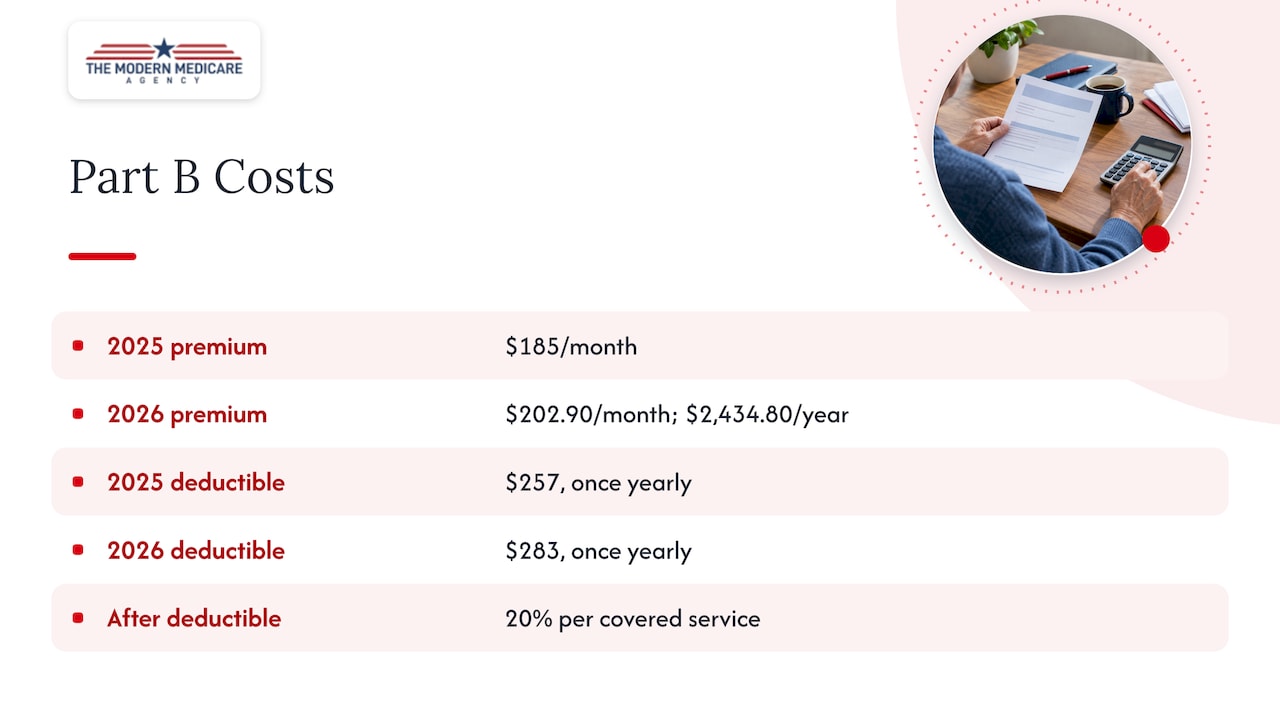
Part B covers doctor visits, outpatient care and many preventive services. In 2026 the standard monthly premium is $202.90, which is $2,434.80 a year. In 2025 it was $185.00. The Part B deductible is $283, up $26 from $257. You pay it once a year. After that, you usually pay 20% of the cost of each covered service.
For most people the Part B premium comes out of the Social Security check before it arrives. If you are not yet collecting benefits, you are billed instead.
CMS says the increase is driven mainly by projected price changes and higher use of services. For a deeper look at this one premium, see our guide to the Part B premium in 2026, and our walkthrough of the 2026 Part B deductible.
A worked example
Say you are single, retired, with income below the surcharge thresholds, and you have a $1,500 outpatient procedure in 2026 under Original Medicare alone:
- You pay the first $283 (the deductible).
- You pay 20% of the remaining $1,217, which is $243.40.
- Your cost for that procedure is $526.40, on top of your $202.90 premium that month.
There is no yearly ceiling on that 20%. That is why Original Medicare has no out-of-pocket limit unless you add supplemental coverage such as Medigap, Medicaid or employer or retiree coverage.
If you are also weighing what a screening such as a bone density test costs with or without insurance, this DEXA scan cost breakdown gives a sense of typical self-pay prices.
Part A: usually $0, but know the hospital deductible
Part A covers inpatient hospital stays, skilled nursing facility care, hospice and some home health. About 99% of beneficiaries pay no Part A premium because they or a spouse earned at least 40 quarters (about ten years) of Medicare-covered work. The rest pay:
| Work history | Part A premium in 2026 |
|---|---|
| 40 or more quarters | $0 |
| 30 to 39 quarters (or spouse with 30+) | $311 a month |
| Fewer than 30 quarters | $565 a month |
The more common Part A cost is what you pay when you are admitted. The 2026 inpatient hospital deductible is $1,736 per benefit period, up $60 from $1,676. A benefit period starts when you are admitted and ends after you have been out of the hospital or a skilled nursing facility for 60 days in a row. So it is not a once-a-year charge. Two separate hospital stays in one year can mean paying it twice.
Part A daily costs in 2026, per Medicare.gov’s 2026 costs publication:
| Service | 2026 cost |
|---|---|
| Hospital days 1 to 60 | $0 after the deductible |
| Hospital days 61 to 90 | $434 a day |
| Lifetime reserve days (up to 60 in your life) | $868 a day |
| Skilled nursing days 1 to 20 | $0 |
| Skilled nursing days 21 to 100 | $217 a day |
After day 100 in a skilled nursing facility, you pay all costs. These daily amounts are what Medigap plans and many Medicare Advantage plans are built to absorb.
Who pays more: income-related surcharges (IRMAA)
If your income is higher, you pay more for Part B and Part D. The extra amount is called the income-related monthly adjustment amount, or IRMAA. Social Security explains that most people pay about 25% of the true Part B cost, while higher earners pay 35% to 85%, depending on income reported to the IRS.
Social Security uses your tax return from two years back. For 2026 it generally uses 2024 (or 2023 if 2024 is not available), per the Railroad Retirement Board. The thresholds are modified adjusted gross income of more than $109,000 for a single filer or $218,000 for joint filers. Roughly 8% of Part B enrollees pay a surcharge.
| Total Part B premium in 2026 | Part D surcharge added to your plan premium |
|---|---|
| $202.90 (standard) | $0 |
| $284.10 | $14.50 |
| $405.80 | $37.50 |
| $527.50 | $60.40 |
| $649.20 | $83.30 |
| $689.90 | $91.00 |
The top tier applies at $500,000 or more for an individual and $750,000 or more for a married couple filing jointly. Married people who file separately follow a different, narrower schedule: $649.20 above $109,000 and under $391,000, and $689.90 at $391,000 or above.
If you recently retired or had another life-changing event, your income today may be much lower than the 2024 return Social Security is using. Medicare.gov says you can ask Social Security to adjust the amount by using the lower-IRMAA request. Our guides to what IRMAA is and to the Part D surcharge cover the details.
The late enrollment penalties
Both penalties come from missing your window.
- Part B: an extra 10% of the premium for each full 12-month period you could have signed up but did not. It is added for as long as you have Part B. It is generally waived if you were covered by a job-based plan and qualify for a Special Enrollment Period, per Medicare.gov.
- Part A (only if you pay a premium): a 10% increase applied for twice the number of years you delayed. KFF gives the example of someone paying $311 who delayed two years: $342.10 a month.
The most common trap is a person turning 65 who keeps working and assumes their employer plan counts. Whether it does depends on the employer’s size and the type of coverage. Checking this before your Initial Enrollment Period ends is cheaper than discovering a penalty afterward.
Part D and Medicare Advantage: premiums that depend on the plan
Prescription drug and Advantage premiums are set by the plan, not by one national figure. KFF reports the 2026 average stand-alone Part D premium at about $36 a month. The Part D portion of the average Medicare Advantage drug plan is about $8. The same KFF analysis says 75% of Advantage enrollees in individual plans pay no Part D premium.
Part D also has a yearly out-of-pocket cap of $2,100 in 2026, and the old coverage gap is gone. Averages hide wide ranges. The drug list (formulary) and your pharmacy matter more than the headline premium, because a low premium means little if your medicine is not covered.
Medicare Advantage plans bundle Part A, Part B and usually drug coverage. You still pay the Part B premium, and the plan may add its own premium. Unlike Original Medicare, they have a yearly limit on out-of-pocket costs for Part A and B services. Our Medicare Advantage guide and Part D page go through how plans differ.
What is the highest premium you could pay in 2026?
The top Part B premium is $689.90 a month. A person in the top Part D tier adds $91.00 on top of the plan premium. Someone without premium-free Part A adds up to $565. Few people hit all three. For most beneficiaries, the real budget is $202.90 plus a Part D or Advantage premium plus a Medigap premium if they choose one.
What changed from 2025 to 2026
| Cost | 2025 | 2026 |
|---|---|---|
| Part B premium | $185.00 | $202.90 |
| Part B deductible | $257 | $283 |
| Part A hospital deductible | $1,676 | $1,736 |
| Hospital coinsurance, days 61 to 90 | $419 | $434 |
| Lifetime reserve days | $838 | $868 |
| Skilled nursing, days 21 to 100 | $209.50 | $217 |
For a person on a fixed income, the $17.90 Part B increase matters most. It can absorb a good share of a Social Security cost-of-living adjustment.
What to expect for 2027
The Part B amounts for 2027 come from CMS, which normally publishes them in November. The 2026 Trustees Report projected a Part B premium of $209.50 for 2027, but a projection is not the final figure. Look for the CMS fact sheet and your Social Security notice.
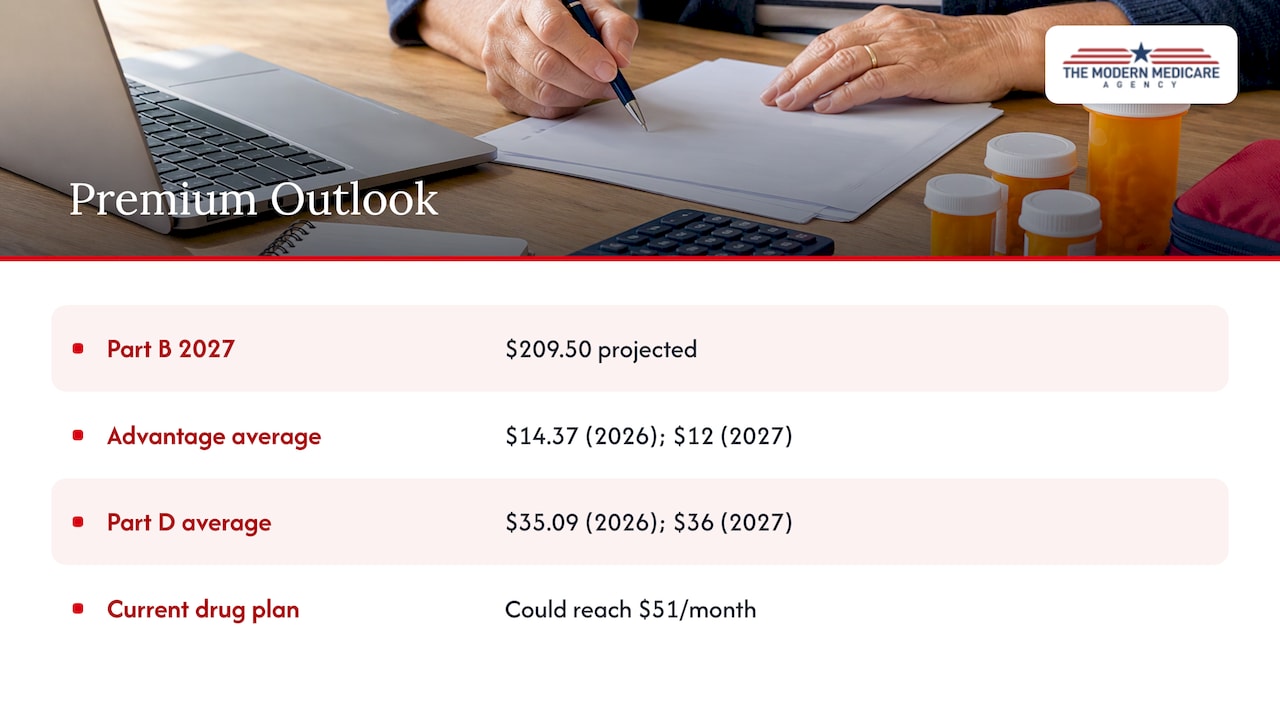
On the plan side, CMS projects the average Medicare Advantage premium to fall from $14.37 in 2026 to $12.00 in 2027. It projects the average stand-alone Part D premium to rise from $35.09 to $36. KFF estimates that stand-alone drug plan premiums could reach about $51 a month for people who keep their current plan, because a federal premium-stabilization program ends after 2026. Averages are not your plan’s premium, so the annual review matters.
How to keep your total Medicare cost predictable
- List your real costs. Add the Part B premium, any Part A premium, a drug plan or Advantage premium, and the cost of the care you expect to use.
- Decide how to cover the 20% and the hospital deductible. The main routes are a Medigap plan or a Medicare Advantage plan. Medigap adds a premium but is built to fill the cost-sharing gaps. Advantage plans cap yearly spending but use networks.
- Match drugs to the plan. Enter every prescription and your pharmacy before choosing, not just the premium.
- Review your income. If it dropped because of retirement or another qualifying event, request an IRMAA adjustment.
- Re-check every fall. Plans change premiums, drug lists and networks each year, so an annual review during the fall enrollment period keeps you from paying for coverage that no longer fits.
If cost is the main worry, see our page on help when you can’t afford Medicare premiums and our list of low-income assistance programs.
Our perspective
Premiums get the headlines, but the surprise bills usually come from what Original Medicare leaves open: the 20%, the hospital deductible and no yearly cap. We believe in education first. It is hard to make a good choice when you do not understand your options, so we start by explaining how the costs fit together.
We are independent agents who specialize in Medicare, and I have been helping Medicare consumers since 2007. Because we work with 40+ carriers, we compare Medigap, Medicare Advantage and Part D side by side instead of steering you toward one company. We also review your coverage each year, because the best plan this year may not be the best next year.
Paul
Get a plan comparison built around these numbers
Knowing the 2026 figures is the first step. The next is seeing how a Medicare Supplement plan, a Medicare Advantage plan and a Part D drug plan would work for your doctors, your prescriptions and your budget. Our team offers personalized plan reviews and year-round support. You can start at paulbinsurance.com.

FAQ
What is the Medicare Part B premium in 2026?
The standard Part B premium is $202.90 a month, up $17.90 from $185.00 in 2025. If your income is above $109,000 (single) or $218,000 (joint), you pay between $284.10 and $689.90, based on your 2024 tax return.
What is the Medicare deductible in 2026?
There are two. The Part B deductible is $283 a year. The Part A hospital deductible is $1,736 per benefit period, so you can owe it more than once in a year if you have separate hospital stays.
Do I pay a Part A premium?
Most people do not. About 99% of beneficiaries have at least 40 quarters of Medicare-covered work. With 30 to 39 quarters the premium is $311 a month, and with fewer than 30 it is $565.
What is the average Medicare premium for a 65-year-old?
There is no single average, because it depends on the plans you add. Everyone with Part B pays at least $202.90 a month in 2026. A stand-alone drug plan averages about $36 a month, and Advantage and Medigap premiums vary by plan and location.
Sources
- 2026 Medicare Parts A & B Premiums and Deductibles | CMS
- What does Medicare cost? | Medicare.gov
- Get Ready for Medicare | Medicare.gov
- 2026 Medicare Costs | Medicare.gov
- Medicare Premiums | Social Security Administration
- Medicare for Railroad Workers and Their Families | RRB.gov
- How Much Do People with Medicare Pay for Coverage? | KFF
- Navigating Your Medicare Coverage Options | NCOA
- Medicare Advantage and Prescription Drug Programs Expected to Remain Stable in 2027 | CMS
- Medicare Part D Premiums and Cost Sharing in 2027 | KFF
- What Will You Pay for Medicare Part B in 2027 and Beyond | MOAA