




Tax deferral can postpone a tax bill, but it does not erase it. If you’re asking what the tax implications of annuities are, the answer depends mainly on whether the contract is qualified or nonqualified and whether you take withdrawals or receive payments. Growth is generally taxed when distributed. Pretax qualified annuity payouts are usually taxable as ordinary income, while nonqualified payouts may include both a tax-free return of your contributions and taxable earnings.
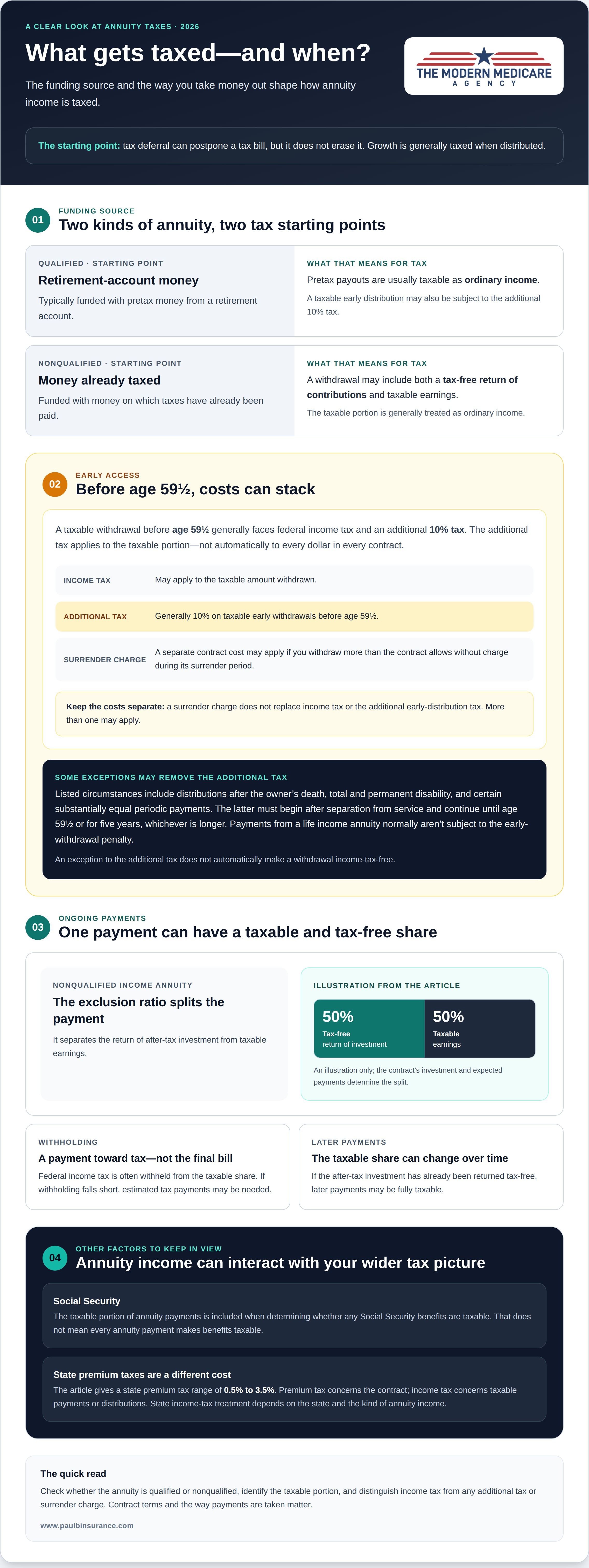
It’s understandable if those differences feel confusing. The basic distinction is simple: qualified annuities are funded with money from a retirement account, while nonqualified annuities are funded with money that has already been taxed. Early access can add another cost: according to the Internal Revenue Service, taxable annuity withdrawals made before age 59½ generally incur an additional 10% tax.
This guide explains how taxes apply to growth, withdrawals and ongoing payments in 2026, including how early-withdrawal rules and potential tax advantages fit into the picture. You’ll also see the trade-offs to consider, so you can understand what may be taxed and when before making a decision.
Key Takeaways
- Identify whether an annuity is qualified or nonqualified to understand how its contributions and payouts may be taxed.
- Learn how an exclusion ratio can separate the taxable earnings from the tax-free return of contributions in certain income payments.
- Understand why the order of withdrawals from a nonqualified deferred annuity can affect the tax bill.
- Consider how tax-deferred growth may help, and what trade-offs can arise when you take money out.
- Review the rules that may affect early access before deciding when and how to receive annuity funds.
What are the tax implications of early withdrawals from a deferred annuity?
Before age 59 ½, taxable annuity withdrawals generally face an additional 10% IRS penalty, according to the Internal Revenue Service. The Internal Revenue Service also identifies age 59 ½ as the general threshold for this early-withdrawal penalty. Federal income tax may apply as well, so the amount you receive can be less than the amount withdrawn.
Early Distribution Taxes and Penalties
An early distribution is money taken from a deferred annuity before the general age threshold, and it can trigger income tax and an additional tax. The taxable portion matters: a penalty is not automatically calculated on every dollar in every contract. Knowing which portion is taxable can help you understand the potential effect on retirement income before withdrawing money.
How much of a withdrawal is taxable depends partly on how the annuity was funded. With a pretax qualified annuity, the entire distribution may be subject to the early-withdrawal penalty. With a nonqualified annuity, the penalty typically applies only to withdrawn earnings. In either case, taxable amounts are generally treated as ordinary income, not long-term capital gains.
The federal penalty and a contract’s surrender charge are separate costs. A surrender charge may apply if you withdraw more than the contract allows without charge during its surrender period. The terms vary by product. A surrender charge does not replace income tax or the additional early-distribution tax, so these costs may apply together.
Exceptions to Early Distribution Tax
Exceptions can remove the additional early-distribution tax in specific circumstances, even when a distribution is taxable. An exception to the penalty does not automatically make the withdrawal tax-free. The taxable portion may still count as income, so both your reason for withdrawing money and the contract’s tax treatment matter.
Listed exceptions include distributions after the owner’s death and those resulting from total and permanent disability. A series of substantially equal periodic payments may also avoid the additional tax if it begins after separation from service and continues until age 59½ or for five years, whichever is longer. Payments from an income annuity paid for life normally aren’t subject to the early-withdrawal penalty.
For example, a taxable withdrawal taken before age 59 ½ may bring ordinary income tax plus the additional 10% tax. If an exception applies, the additional tax may not apply, but ordinary income tax can remain due. A surviving spouse who continues an annuity contract may still face the 10% additional tax on distributions taken before age 59½.
Before taking money out, separate the possible costs: income tax, the additional tax, and any surrender charge. Retirement income changes can also affect coverage decisions; a Medicare Advantage coverage guide addresses a separate part of retirement planning.
Are taxes automatically taken out of annuity payments?
Federal income tax is often withheld from the taxable portion of annuity payments, but withholding does not settle your final tax bill. The amount withheld depends on the payment’s taxable share and the withholding information on file. If withholding falls short during the tax year, you may need estimated tax payments to avoid underpaying.
For a nonqualified income annuity, an exclusion ratio separates each payment into a return of your after-tax investment and taxable earnings. The return of your investment isn’t taxable; the earnings are generally taxed as ordinary income. In one illustration, the ratio makes 50% of each payment tax-free and 50% taxable. Your contract’s investment and expected payments determine the split.
This approach can make a payment partly taxable rather than fully taxable. For instance, an immediate annuity funded with after-tax money may return principal alongside earnings. If the after-tax investment has already been returned tax-free in earlier years, later payments may be fully taxable. The taxable share matters for withholding and your yearly income tax calculation.
Fixed, variable, and indexed annuities differ in how they credit growth, but those labels alone do not determine tax treatment. The key factors are whether the contract is qualified or nonqualified, how it was funded, and whether money is accumulating or being paid out. During accumulation, growth is generally tax-deferred; distributions can make taxable income due.
Taxes can also affect Social Security. The taxable portion of annuity payments counts when determining whether any Social Security benefits are taxable. That doesn’t mean every annuity payment makes benefits taxable; it means the payment is included in that calculation. Include both income sources when estimating your overall tax situation for 2026.
State rules add another layer. State income tax treatment depends on the state and the kind of annuity income received. Separately, state premium taxes on annuity contracts range from 0.5% to 3.5%. A premium tax concerns the contract, while income tax concerns taxable payments or distributions, so they’re different costs.
Withholding is a payment toward taxes, not a guarantee that the final amount is covered. If payments don’t withhold enough, estimated payments may help address the difference during the year. The right amount depends on your taxable annuity income and other income sources. If you’re considering an annuity and want to understand how payment choices affect your income, explore annuity options.
Tax treatment of qualified and nonqualified annuities
The funding source determines whether an annuity is qualified or nonqualified, and that difference shapes its tax treatment. A qualified annuity is held through a retirement account, so distributions follow that account’s tax rules. A nonqualified annuity is funded with after-tax money outside a qualified retirement account. Its growth and payouts are taxed under different rules.
How are nonqualified annuities funded with after-tax money taxed? The original contributions are not deductible, and the taxable portion of withdrawals is generally taxed as ordinary income. When an income payment returns part of the owner’s after-tax investment, that portion is not taxable. The remaining earnings are taxable. The contract’s investment and payment structure determine how each payment is divided.
How are annuities taxed when held in an IRA or 401(k)? Distributions from a qualified deferred annuity follow the tax rules of the retirement account that holds it. Pretax contributions and earnings are generally taxable when withdrawn. Payments from a qualified employer plan may be fully or partly taxable, unless they’re qualified distributions from a designated Roth account.
That account connection matters even when the annuity itself has familiar features. A qualified annuity doesn’t create a separate tax-free layer simply because it grows inside an insurance contract. For example, a $6,000 annual payment from a non-Roth qualified annuity funded with pretax dollars is fully taxable as income. A designated Roth account can receive different treatment when its distribution qualifies.
For a nonqualified contract, the investment amount and accumulated earnings need to be distinguished. One illustration uses a $200,000 contract value, with $100,000 representing the original investment and the other half representing earnings. The earnings portion is generally subject to ordinary income tax when withdrawn. Premium payments for nonqualified annuities aren’t tax deductible, so the initial contribution doesn’t reduce taxable income.
Tax treatment also matters when money moves between contracts. A qualifying Section 1035 exchange can transfer an annuity without treating the transfer itself as a taxable withdrawal at that time. The exchange must meet the relevant requirements; taking money out rather than transferring the contract can change the result. This distinction affects the owner’s ability to replace a contract without immediate recognition of gain.
Annuity companies typically report taxable distributions to the IRS on Form 1099-R. That form helps identify the taxable amount, but the contract type and account holding it explain why that amount is taxable. In 2026, keep those two details in view: whether funds began as pretax or after-tax money, and whether the annuity sits inside an IRA or 401(k).
LIFO taxation of nonqualified annuity withdrawals
Nonqualified deferred annuities generally use last-in, first-out taxation for withdrawals. This ordering can make earnings taxable before you receive your original contributions.
LIFO Treatment of Withdrawals
Last-in, first-out, or LIFO, treats a nonqualified annuity’s earnings as withdrawn before its original investment. This matters because earnings are generally taxable as ordinary income, while returned after-tax contributions are not taxable. If a contract has accumulated earnings, an early withdrawal can therefore produce taxable income even when you have not withdrawn the full amount you contributed.
For example, imagine a nonqualified deferred contract with original contributions and growth. Under LIFO, a partial withdrawal comes from the growth portion first, making that amount generally subject to federal income tax. After the earnings have been withdrawn, later withdrawals can return contributions. The specific taxable amount depends on the contract’s accumulated earnings when you withdraw money.
Tax deferral means growth generally is not taxed while it remains inside the annuity. Tax is typically due when that growth is distributed. This can allow earnings to accumulate without annual taxation, but the benefit changes when withdrawals begin. Investment performance does not change the basic ordering rule: earnings come out before the owner’s after-tax investment.
Accumulation Annuity Withdrawals
An accumulation annuity is designed to build value before payments begin, so a withdrawal can draw on both earnings and contributions. For a nonqualified contract, LIFO generally makes the earnings portion taxable first. This distinction matters when choosing a withdrawal amount, because receiving cash does not mean every dollar represents tax-free principal.
Consider a contract whose value has grown beyond its original investment. A partial withdrawal may be treated as taxable earnings until those earnings are depleted. The remainder can then represent the owner’s investment. This differs from an income annuity, where payments may divide principal and earnings over time through an exclusion ratio.
Death does not automatically make an annuity’s accumulated earnings tax-free. Transferring the contract to a beneficiary is not itself taxable, but distributions the beneficiary receives may be taxable under applicable rules. For an inherited nonqualified annuity, a five-year payout option can spread distributions over five years. The timing affects when taxable earnings are recognized, not whether those earnings may be taxable.
A beneficiary may also use a Section 1035 exchange to transfer an inherited nonqualified annuity to another annuity without recognizing gain or loss during the transfer. That transfer differs from taking a withdrawal: a distribution can trigger tax on earnings, while a qualifying exchange preserves the contract’s tax-deferred treatment at that point. The distinction helps clarify whether funds remain invested or become taxable income.
Annuity tax advantages and trade-offs
What are the tax implications of annuities when growth stays invested? Tax is generally due when money is distributed, rather than while it remains in the contract. This tax deferral can leave more of an investment growing during the accumulation period. But it changes when tax is due, not whether taxable earnings are eventually taxed. The potential advantage is timing, not an automatic reduction in tax owed.
That timing can be useful if you do not need the funds immediately. For example, growth can remain in a deferred annuity without annual tax on that growth. When you take distributions, taxable earnings are generally treated as ordinary income rather than receiving long-term capital-gains treatment. The amount you eventually pay depends on the taxable distribution and your tax situation in that year.
Income level can add another consideration. For 2026, the 3.8% federal Net Investment Income Tax may apply to net investment income, including income from a nonqualified annuity. The 2026 thresholds are $200,000 in modified adjusted gross income for single filers and $250,000 for married couples filing jointly. This tax is an additional possible cost, not a benefit of deferral.
Qualified annuities can follow the tax rules of the retirement account funding them, while nonqualified contracts use after-tax contributions. This difference affects which portion of a distribution may be taxable. Before choosing an annuity, consider how it will be funded, when you expect to take income, and whether those payments could raise your taxable income during a particular period.
A qualified longevity annuity contract, or QLAC, can offer a distinct tax-planning feature. It may exclude up to $200,000 of an IRA balance from required minimum distributions. In exchange, money allocated to a QLAC is set aside for later income, so access and payment timing matter. The potential benefit is most relevant when delayed income fits your retirement needs.
There is no age exemption from paying tax on annuity income. Tax deferral may suit someone who can leave funds invested and wants income later. It may be less useful when access to funds is important in the near term, because distributions can create taxable income and contract withdrawals may have other consequences. The decision depends on expected growth, funding source, payout timing, and your need for flexibility.
Knowing what the tax implications of annuities are can help you connect a contract’s tax treatment to your retirement plans. Explore annuity options and consider how each structure may affect when you pay taxes.
The Modern Medicare Agency: Annuities
The Modern Medicare Agency offers annuities for people considering how guaranteed income may fit into retirement. Understanding how funding, withdrawals, and payments affect taxes can help you frame a conversation about the type of annuity and income structure you’re considering. Annuities are not a substitute for tax advice, but understanding their features can help you weigh how they may fit your needs.
If you’re ready to explore annuity options, The Modern Medicare Agency can help you discuss available choices and how they align with your priorities. Bring questions about timing, access to funds, and the kind of income you want. Contact The Modern Medicare Agency to talk through annuity options.
Make Your Next Retirement Decision With Clarity
Knowing what the tax implications of annuities are can help you make a more deliberate retirement decision. Consider when you may want income, how much flexibility matters, and how an annuity would fit alongside your other retirement resources. These priorities can guide a focused conversation rather than a decision based on tax treatment alone.
Retirement planning also includes health coverage. The Modern Medicare Agency offers Medicare Advantage Plans, Medicare Supplement (Medigap) Plans, and Medicare Part D Plans. You can discuss these coverage choices alongside your broader retirement considerations, with your needs guiding the conversation.
Bring the questions that matter most to you, including your preferred timing and income priorities. To talk through annuity options and related coverage questions, Contact The Modern Medicare Agency. A clear next step can make a complicated decision feel more manageable and help you move forward with confidence.
Frequently Asked Questions
What is an annuity?
An annuity is an insurance contract that can turn money paid into the contract into future payments. Depending on its structure, it may build value before payments begin or start providing income sooner. For example, someone planning for retirement might use an annuity to create a stream of payments later. The funding source and payout design shape how taxes apply.
Do you have to report annuity payments on your tax return?
Generally, you must report the taxable portion of annuity payments as income on your federal tax return. An annuity company typically sends Form 1099-R reporting taxable distributions, which can help with tax preparation. Withholding doesn’t remove the need to report taxable income. Keep the form with your other tax records, and distinguish the amount reported as taxable from any nontaxable return of your investment.
Does an annuity count as income for Social Security?
The taxable portion of annuity payments is included when determining whether your Social Security benefits are taxable. This is a tax calculation, not a change to the amount of Social Security benefits you receive. For example, a taxable annuity payment may affect the calculation when considered alongside other income. The result depends on your overall situation, so do not assume every annuity payment makes Social Security taxable.
How are retirement distributions from accumulation annuities taxed?
Tax treatment depends on whether the accumulation annuity is qualified or nonqualified. For a nonqualified contract, a withdrawal generally draws taxable earnings first, before returning the original investment. If the annuity is held in an IRA or another qualified account, that account’s distribution rules apply. The account type and the contract’s gains help determine how much of a retirement distribution is taxable.
Is cashing out an annuity considered income?
Cashing out can create taxable income, but the full amount is not always taxable. A nonqualified annuity may include both taxable earnings and the return of after-tax contributions. A qualified annuity funded with pretax money generally has distributions taxed as ordinary income. This distinction matters because a complete surrender may bring accumulated taxable amounts into one tax year rather than spreading distributions over time.
Is changing ownership on an annuity a taxable event?
A gift or sale of a nonqualified annuity contract is taxable to the original owner. This differs from transferring an annuity to a beneficiary: the transfer itself is not taxable, though later beneficiary distributions may be. For example, an owner who gives a contract to another person can face a tax result at transfer, while a beneficiary generally faces tax as money is distributed under applicable rules.
What if I avoid early withdrawals or lump-sum payments?
Leaving money in a deferred annuity generally allows its growth to remain tax-deferred until distribution. Choosing scheduled payments instead of taking a lump sum may spread taxable income across different tax years, depending on the contract and account. That doesn’t erase tax obligations. Also, according to the Internal Revenue Service, required minimum distributions from non-Roth qualified retirement accounts must begin annually after age 73.
How are annuity payments taxed in the United States?
In the United States, payments from a qualified annuity funded with pretax dollars are generally taxed as ordinary income. Payments from a nonqualified annuity may include a nontaxable return of the owner’s investment and taxable earnings. For income payments, an exclusion ratio determines those shares. Federal withholding may be taken from the taxable portion, but the amount withheld may not match your final tax obligation.

Article by
Paul Barrett
Paul Barrett, CMIP is the founder of The Modern Medicare Agency, an independent Medicare-only brokerage based in Melville, NY. With 18 years of Medicare-exclusive experience, a CMIP designation, and more than 5,000 clients served across 37 states, Paul is one of the most credentialed independent Medicare specialists on Long Island — and one of the most direct.
He represents 40+ carriers with no quotas and no allegiances, which means his recommendations are based entirely on what fits each client's specific situation. He is the author of Medicare Mastery Unlocked and host of the Wise Guys Retirement Talk podcast. His content is grounded in primary sources, real carrier intelligence, and 18 years of watching what happens when people get Medicare right — and when they don't.
📞 631-358-5793 | paulbinsurance.com