




The better choice in an Aetna vs. EmlemHealth senior care comparison depends on the specific Medicare Advantage plan available where you live, not just the company name. In 2026, compare each plan’s costs, prescription drug coverage, and pharmacy services against your needs before deciding.
It’s understandable to feel unsure when two plan names seem to promise similar coverage. The details that matter most are what you’ll pay for care, whether your medicines are covered, and how the plan handles pharmacy access.
This guide explains what to compare, why plan details can vary by location, and how to assess prescription coverage and pharmacy services alongside costs. You’ll have a clearer framework for weighing your options and identifying the questions that matter as you consider senior care coverage.
Key Takeaways
- Compare each plan’s premiums and out-of-pocket costs together to understand how your choice may affect your healthcare budget in 2026.
- Check whether the doctors, hospitals, and specialists you rely on are included in the plan’s network.
- Review prescription coverage and pharmacy services alongside medical benefits, especially if you take ongoing medications.
- Understand coverage limits and prior authorization rules so you know when approval may be needed before care.
- An independent Medicare broker can help you compare Medicare Advantage, Medigap, and Part D options based on your needs.
Medicare Advantage premiums and out-of-pocket costs
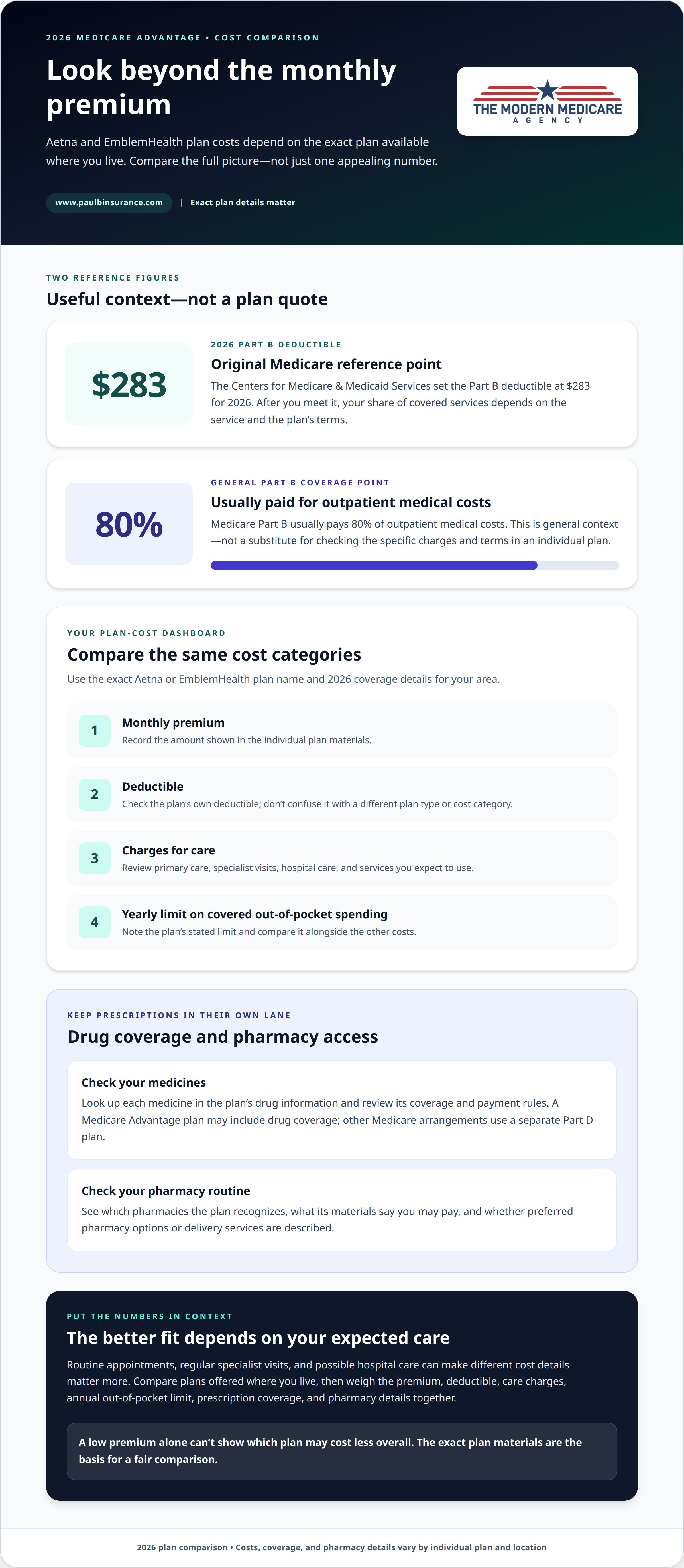
In 2026, comparing Aetna and EmblemHealth senior care plans means looking beyond the monthly premium. A premium is only one part of what you may pay. Deductibles, visit charges, and the plan’s yearly limit on covered costs also matter. The exact amounts depend on the individual plan, so the insurer’s name alone can’t tell you which option may cost less. Compare the full plan details for your area.
Start with Original Medicare’s Part B deductible. The Centers for Medicare & Medicaid Services sets it at $283 for 2026. After you meet it, your share of covered services depends on the service and your plan’s terms. An Aetna or EmblemHealth Medicare Advantage plan may set its own charges for care. Review the summary of benefits for primary care, specialist visits, hospital care, and services you expect to use.
GHI Senior Care is another name you may see in Medicare materials. That figure describes the stated relationship involving the GHI Senior Care deductible. It is not the premium or annual cost of an Aetna or EmblemHealth Medicare Advantage plan. Keep the plan type and cost category in view so you don’t compare unlike amounts.
For each available plan, compare the same types of care. Note the monthly premium, deductible, charges for visits, and annual limit on covered out-of-pocket spending. Then consider how often you use each service. Someone who mainly has routine appointments may weigh costs differently from someone expecting hospital care or regular specialist visits. Your expected care needs put the plan figures in context, rather than letting one appealing number decide the comparison.
Use this sequence to organize your review:
- Write down the exact Aetna or EmblemHealth plan name and coverage year.
- Record its monthly premium and deductible from the plan materials.
- Compare charges for the care you expect to use.
- Note the plan’s yearly limit on covered out-of-pocket spending.
- Review prescription drug coverage and pharmacy details separately.
Prescription coverage deserves its own review. Medicare Part D plans cover prescription drugs, but each plan’s drug list and payment rules show how coverage applies to your medicines. A Medicare Advantage plan may include drug coverage, while other Medicare arrangements use a separate Part D plan. Look up each medicine you take and read the plan’s terms. A Medicare Part D plan comparison can help clarify these choices.
Pharmacy details matter for convenience as well as spending. Compare which pharmacies the plan recognizes and what its materials say you may pay for each prescription. Look for any preferred pharmacy options or delivery services described in the plan, then focus on what fits your routine. For example, someone who fills a regular prescription close to home may value that location differently from someone who relies on another pharmacy.
Availability also shapes the decision. Aetna and EmblemHealth options can differ by location and coverage year, so compare plans offered in your area for 2026. The Medicare Advantage plan details can help you understand what each option covers. If a premium looks appealing, weigh it alongside the deductible, care charges, drug coverage, and pharmacy details before deciding which plan fits your needs.
For outpatient care, Medicare Part B usually pays 80% of outpatient medical costs. Treat that as a general coverage point, not a substitute for checking the charges shown in an individual plan. Compare the plan’s terms with the care you expect to use, and keep drug spending separate from medical costs when reviewing your likely expenses. This can help you assess the different cost categories without assuming that one percentage describes every service or every plan.
Check the applicable plan materials to understand how these stages relate to the medicines you take and the payments you may face. Aetna’s Clinical Policy Bulletins source their CPT codes from the American Medical Association’s Current Procedural Terminology, copyrighted in 2015. That coding reference is distinct from a plan’s premium, deductible, visit charges, and yearly limit, so keep it separate from your cost comparison. Review the relevant benefit and drug information together before deciding which coverage best fits your expected needs.
Which doctors, hospitals, and specialists are in each plan’s network?
The Aetna and EmblemHealth names alone don’t tell you whether your doctor is covered. Medicare Advantage networks are tied to specific plans and locations, so compare the exact plan options available to you in 2026. A doctor may appear in one plan’s network but not another’s, even when both plans carry the same insurer’s name.
Start with the people and places you rely on now. Write down your primary care doctor, specialists, preferred hospital, and any clinic where you receive regular treatment. For example, someone seeing a cardiologist and using a particular hospital should look up both providers under each specific plan, rather than relying on a general insurer search. Names can be similar, so match each provider’s full name and location.
Use each plan’s provider directory as a starting point. Search for the doctor by name, then confirm the office location and specialty listed. A physician may work at more than one clinic, and network participation can vary by location. If you use a medical group or clinic, search for that organization too. Compare results plan by plan, not just Aetna and EmblemHealth as company names.
Check hospitals separately. A hospital’s presence in a directory does not establish that every affiliated doctor or service is covered under the same terms. Search for the hospital and the individual specialists you expect to see. If you receive care through an outpatient department, clinic, or specialist group, include those names in your comparison. This gives you a clearer picture than checking only the hospital’s main name.
Consider how often you travel for care. A nearby office may be convenient for routine visits, while a specialist elsewhere in your area may matter more for ongoing treatment. Compare the actual locations listed for each plan. If you split care between two clinics, check both. If a caregiver helps arrange appointments, include the locations they use in your list.
Network rules can also affect how you access care. Some plans use a primary care doctor to coordinate services, while others may offer different ways to see specialists. Read the specific plan’s member materials for referral and out-of-network rules. Don’t assume Aetna and EmblemHealth plans follow identical processes. The plan name and its written terms matter more than a general description of the company.
- List the doctors, specialists, hospitals, and clinics you use.
- Search each exact 2026 plan directory for those names and locations.
- Compare the provider results and any stated access rules across plans.
- Mark providers whose continued access is especially important to you.
Then weigh the results against your care priorities. If your established specialist appears in only one plan’s directory, that difference may matter more than a minor convenience elsewhere. If both plans include your key providers, compare locations and how each plan describes specialist access. Keep the directory results with the plan documents so you can relate network choices to the costs and coverage details you reviewed earlier.
For a structured look at how plan design and provider access fit together, use this Medicare Advantage plan guide as you compare your options. A careful provider-by-provider review can help you spot important differences before choosing coverage.
Review your network alongside the care you expect to use and the prescriptions you take. The comparison also states that most Part D vaccines are covered at no cost under each of the three plans. These details can help you compare expected expenses, but they do not replace confirming whether your doctors, clinics, and hospitals are in the specific plan’s network. Keep your provider list and medication questions together as you review each option.
For prescriptions, note the insulin product and vaccines you expect to need, then use plan materials or contact the plan to confirm how the stated coverage applies to you. The comparison’s figures describe coverage across the three plans; they do not establish that a particular doctor or facility participates. Keep the provider’s exact office location beside your medication notes, and resolve any uncertain network listing before choosing a plan. This helps you account for both access to care and the covered items described.
What are the disadvantages, coverage limits, and prior authorization requirements for each plan?
In 2026, the main drawback of any Medicare Advantage plan is that its rules may shape how you access care. Aetna and EmblemHealth options can differ by plan, location, and covered service. The insurer name alone doesn’t establish which services need approval or which limits apply. Compare the documents for each exact plan before weighing its drawbacks.
Coverage limits explain what a plan covers and under what conditions. For example, a plan may set terms for a particular service, treatment, or supply. Those terms appear in plan materials, not in the company name. Look for the rules that apply to care you expect to use, such as a specialist’s recommended treatment or a medical service you receive regularly.
Prior authorization means the plan reviews certain care before it is provided. The review may consider whether the requested service meets the plan’s coverage rules. The process can affect timing, especially when a clinician needs approval before scheduling treatment. Covered services and review steps depend on the specific plan, so don’t assume Aetna and EmblemHealth use identical requirements.
For each plan, find the section on prior authorization and utilization review. Note which services require approval, who submits the request, and what the plan says about its decision process. For a planned procedure, for example, find out whether advance review is required and what steps the plan describes. This helps you understand what may need attention before arranging care.
Also distinguish approval from coverage. A service may require review, while the plan’s coverage rules determine whether it is covered and under what terms. Approval requirements may apply to specific services, not every visit or treatment. Use the member materials to understand both: whether advance approval is required and which conditions govern coverage.
Network restrictions can be another drawback. If your regular doctor, hospital, or specialist isn’t included under a plan’s rules, access may be less convenient or subject to different terms. For example, someone whose treatment depends on a particular specialist should weigh access alongside authorization requirements. A plan with familiar providers may still have coverage conditions that deserve careful attention.
Prescription coverage has its own details. Review the plan’s drug information for coverage categories, restrictions, and stated approval requirements. A medicine you take regularly may have conditions that differ from those for another drug. Compare the exact medication with the plan documents rather than assuming coverage works the same across Aetna and EmblemHealth options.
Use this checklist to compare the practical limits:
- Identify services that require prior authorization under each plan.
- Note who submits the request and the steps the plan describes.
- Review coverage terms for treatments, supplies, and prescriptions you use.
- Compare those terms with the providers and facilities you rely on.
Keep your comparison tied to the plan year and exact plan name. Materials for one Aetna or EmblemHealth option may not describe another option’s rules. When reviewing a planned treatment, consider its coverage terms, approval steps, and provider access together. This gives you a clearer picture of possible trade-offs than focusing on one rule alone.
If these details feel difficult to weigh, get help comparing Medicare Advantage plan rules with your care needs. A careful review can bring the plan’s restrictions and approval process into focus before you decide.
The Modern Medicare Agency
The Modern Medicare Agency can help you compare Medicare options after weighing Aetna and EmblemHealth plan details. As an independent brokerage, it offers personalized guidance across plans from more than 40 carriers, so the comparison can focus on your doctors, prescriptions, costs, and coverage priorities rather than one insurer alone.
Turn to the agency when you want support sorting through Medicare Advantage, Medigap, or Part D choices, or when you’re unsure which details matter most. The agency provides year-round support to clients across more than 34 states. Its guidance can help make a complicated decision easier to understand, without pressure to choose a particular plan.
For help comparing your options, contact The Modern Medicare Agency.
Choose coverage that fits your next chapter
Choosing between Aetna and EmblemHealth senior care options is a personal decision. Focus on what matters most to you, such as keeping familiar providers or finding coverage that feels manageable. Start with the priorities that would help you feel comfortable moving forward, then use them to guide your comparison.
If you’re still weighing your options, a conversation can help organize the decision. The Modern Medicare Agency offers personalized, independent guidance and plan comparisons based on your needs, without pressure. Schedule a free consultation to discuss your Medicare choices and decide on a next step.
Contact The Modern Medicare Agency to talk through your next step. You can move forward with greater clarity, one decision at a time.
Frequently Asked Questions
Which prescription drugs are covered, and how do formularies and pharmacy costs compare?
Coverage depends on the exact Aetna or EmblemHealth plan and its 2026 drug list, called a formulary. Compare each medicine by name, strength, and form, since a tablet and liquid version may have different coverage terms. Then review any listed restrictions and the pharmacies available under that plan. For example, check a regular prescription and a backup pharmacy together, so convenience and coverage fit your routine.

Article by
Paul Barrett
Paul Barrett, CMIP is the founder of The Modern Medicare Agency, an independent Medicare-only brokerage based in Melville, NY. With 18 years of Medicare-exclusive experience, a CMIP designation, and more than 5,000 clients served across 37 states, Paul is one of the most credentialed independent Medicare specialists on Long Island — and one of the most direct.
He represents 40+ carriers with no quotas and no allegiances, which means his recommendations are based entirely on what fits each client's specific situation. He is the author of Medicare Mastery Unlocked and host of the Wise Guys Retirement Talk podcast. His content is grounded in primary sources, real carrier intelligence, and 18 years of watching what happens when people get Medicare right — and when they don't.
📞 631-358-5793 | paulbinsurance.com