




Yes, Medicare covers pulmonary rehab. Medicare Part B covers a comprehensive pulmonary rehabilitation program if you have moderate to very severe COPD, or if you have lasting breathing problems after confirmed or suspected COVID-19. What you actually pay depends on the setting where you get the program and on the kind of Medicare coverage you carry alongside Part B. That second piece is where people get surprised, and it is a choice you can make before you need the care.
This guide explains who qualifies, what a covered program includes, how many sessions you get, what the bill looks like and how your plan choice changes it.
TL;DR
- Part B covers pulmonary rehab for moderate to very severe COPD (GOLD stages II, III and IV) and for persistent respiratory symptoms after confirmed or suspected COVID-19. The physician treating your lung disease must refer you.
- Coverage is up to 36 sessions over up to 36 weeks, with a possible additional 36 if your Medicare contractor approves.
- With Original Medicare, the Part B deductible applies and you pay 20% of the Medicare-approved amount in a doctor’s office. A hospital outpatient department also charges a copayment per session.
- Medicare Advantage plans, Medigap plans and Part D each handle the cost around rehab differently, so match your plan to your health needs.
- You can compare all of it with an independent Medicare agent before you enroll or switch.
Table of Contents
- Who qualifies for Medicare pulmonary rehab
- What a covered program includes
- How many sessions Medicare covers
- Where you can get it
- What pulmonary rehab costs you
- How to get started, step by step
- Why your plan choice decides your rehab bill
- Work with an independent agent on your plan
- Our perspective
- FAQ
- Sources
Who qualifies for Medicare pulmonary rehab
Pulmonary rehabilitation is a supervised program that combines exercise, breathing education and support, designed to help people with chronic lung disease stay active and manage symptoms. Medicare does not cover it for every lung condition. The federal rule, 42 CFR 410.47, sets two groups.
Moderate to very severe COPD. COPD is chronic obstructive pulmonary disease, the umbrella term for emphysema and chronic bronchitis. Doctors stage it with the GOLD scale, and Medicare covers rehab for stages II, III and IV. Your doctor sets your stage largely from a breathing test called spirometry.
Lasting symptoms after COVID-19. If you had confirmed or suspected COVID-19 and still have respiratory dysfunction (trouble breathing) for at least four weeks, you may qualify. CMS, the federal agency that runs Medicare, put this in place effective January 1, 2022.
The rule also says other conditions could be added through a national coverage determination, which is a formal CMS decision. For now, CMS has said that local Medicare contractors, the private companies that process claims in each region, make coverage decisions for this benefit. That is one reason two people with similar diagnoses can see slightly different paperwork requirements.
The referral requirement
You need a referral from the physician treating your chronic respiratory disease. That is usually your pulmonologist or primary care doctor. If you were recently diagnosed or just joined Medicare, ask for the referral at your next visit and ask which staging result supports it, so the program can document that you meet the criteria.
CMS guidance treats coverage as a matter of the whole package. Part B pays only when you, the program, the setting and the supervising physician all meet the requirements. A diagnosis alone does not trigger payment.
What a covered program includes
Under the same federal rule, a program must include each of these:
- Physician-prescribed exercise during each session.
- Education or training tailored to you, including managing your respiratory problem and, if appropriate, brief smoking cessation counseling.
- A psychosocial assessment, which looks at how your condition affects your mood and daily life.
- An outcomes assessment, so progress is measured.
- An individualized treatment plan that a physician establishes, reviews and signs every 30 days.
The exercise portion is the one Medicare insists on. Medicare requires exercise in every session, although the amount and type are not specified in the payment rules. Your care team tailors it to what your lungs can handle.
CMS billing guidance also notes that education, counseling, pulse oximetry (a fingertip oxygen reading) and the six-minute walk test are part of the program rather than separately billed extras when the component codes are used. You should not see them as individual line items for the same visit.
How many sessions Medicare covers
The limits are easy to state:
| Rule | What Medicare allows |
|---|---|
| Sessions per day | Up to 2 one-hour sessions |
| Total sessions | Up to 36 |
| Time frame | Up to 36 weeks |
| Extra sessions | Another 36 if approved by the Medicare contractor |
These figures come from the federal rule and from CMS billing article A56152, which says the maximum applies when all program requirements are documented. The same article says a single session must last at least 31 minutes to be reported, and two sessions in one day require at least 91 minutes of total treatment.
In practice, most programs schedule two or three visits a week, so 36 sessions fit comfortably inside the 36-week window. If you miss weeks because of illness, ask the program early how it counts your timeline.
A second condition can mean a second set
CMS billing guidance says a patient may need an additional 36 sessions for a second covered condition, for example COVID-19 after COPD or the reverse. The provider flags those later sessions with a billing modifier. You do not handle that, but it explains why a program may ask your doctor for documentation again.
Where you can get it
Medicare.gov says you can get these services in a doctor’s office or a hospital outpatient setting that offers pulmonary rehab. CMS billing rules describe the allowed settings as a physician’s office, an off-campus outpatient hospital department or an on-campus outpatient hospital department, with a physician immediately available for consultations and emergencies.
Medicare.gov also notes that for hospital outpatients, pulmonary rehab can be received at home by real-time audio-video through December 31, 2027, under the Consolidated Appropriations Act, 2026. Because telehealth rules for Medicare have been extended in short windows before, confirm the current status with the program and on Medicare.gov before you plan around it.
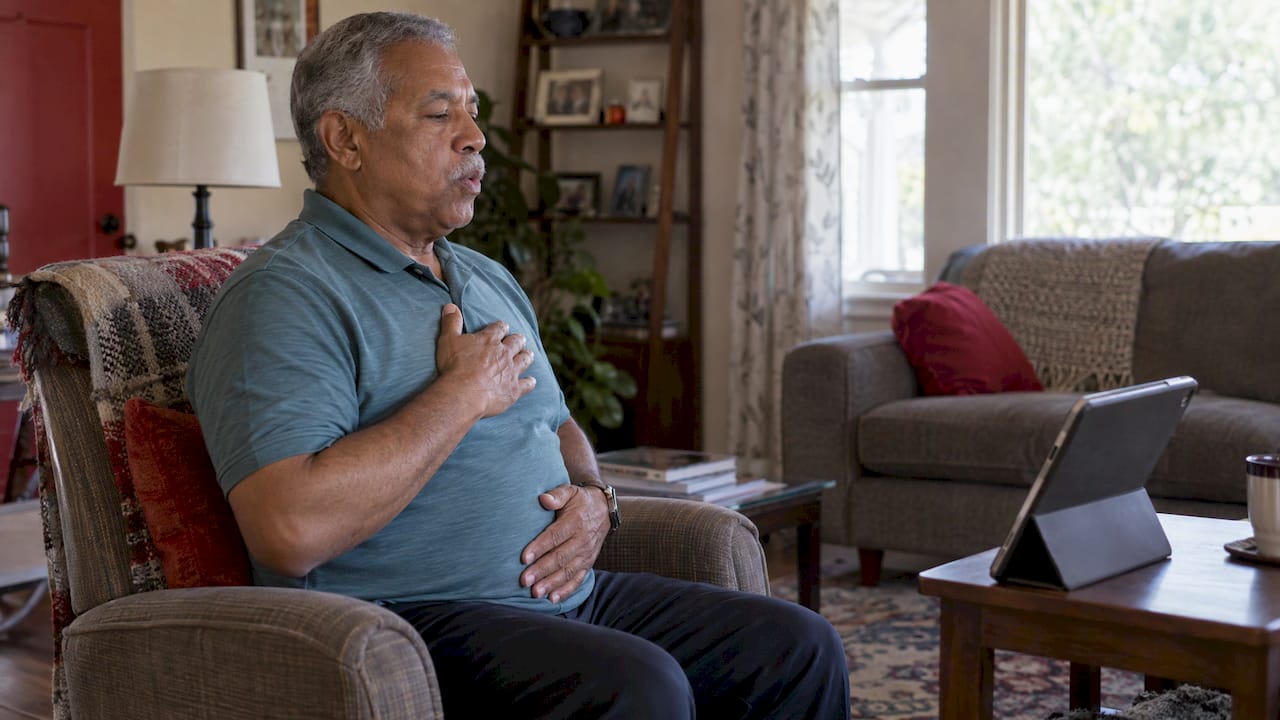
A practical point: access is uneven. A nationally representative study of Medicare beneficiaries found that about two-fifths of older adults with COPD have poor access to a program. If the nearest program is far away, ask your doctor about every hospital-based and office-based option in your network before you give up on the benefit.
What pulmonary rehab costs you
Under Original Medicare (Parts A and B), Medicare.gov states that the Part B deductible applies. After that you pay 20% of the Medicare-approved amount when the program is in a doctor’s office. In a hospital outpatient setting you also pay a copayment for each session.
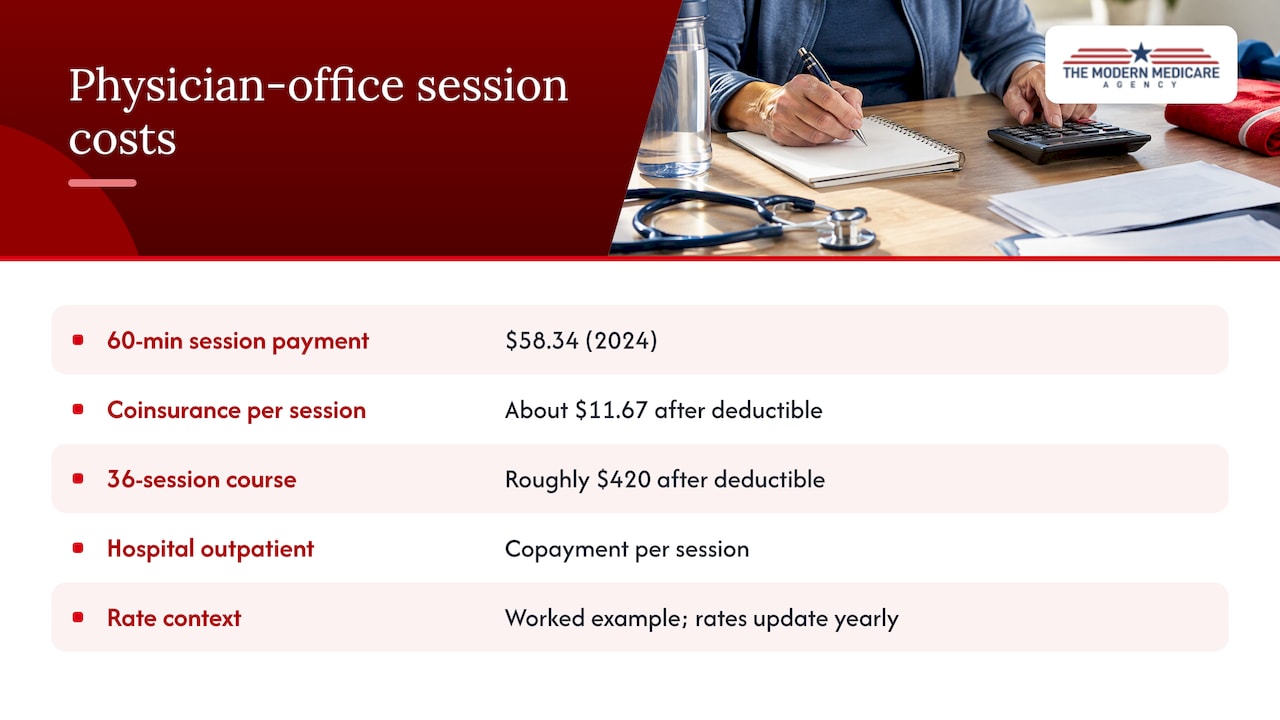
To see what that can look like, take the American Thoracic Society’s 2024 reimbursement update. It lists a Medicare payment of $58.34 for a 60-minute session billed under code 94626. Twenty percent of that figure is about $11.67 per session, so a full course of 36 sessions in a physician’s office would run roughly $420 in coinsurance once the deductible is met. Payment rates are updated by CMS each year and your actual bill depends on the setting, so treat this as a worked example and not a quote.
What changes with each kind of coverage
The 20% is where your other coverage matters.
- Original Medicare alone. You carry the deductible and coinsurance yourself, with no annual cap on what you can owe for Part B services.
- Original Medicare plus a Medigap plan. Medigap, also called Medicare Supplement, is private insurance that is designed to help pay Part B costs like coinsurance. How much it covers depends on the plan letter. Our Medicare Supplement page walks through the options.
- Medicare Advantage. These plans replace Original Medicare with a private plan, and copayments, prior authorization rules and provider networks vary from plan to plan. If you are on one, read your plan’s Evidence of Coverage and ask whether the program you want is in network. Our Medicare Advantage guide explains how these plans are structured.
- Part D. Rehab itself falls under Part B, but inhalers and other COPD medications are a Part D issue. Our Part D page covers how plans differ on drug lists.
How to get started, step by step
- Confirm your diagnosis and stage. Ask your doctor whether your spirometry results put you in GOLD stage II or higher, or whether your post-COVID symptoms meet the four-week test.
- Get the written referral. It must come from the physician treating your respiratory disease.
- Find programs that accept Medicare. Ask the program whether it is in a physician’s office or a hospital outpatient department, because that decides your copayment structure. Medicare Advantage members should also confirm network status.
- Ask about the cost before session one. Request the expected per-session amount and whether your supplement or plan covers it.
- Plan the calendar. Thirty-six sessions over 36 weeks fits most schedules, but know your program’s pace.
- Keep the 30-day plan review in mind. The physician signs your treatment plan every 30 days. If a signature is late, claims can be delayed, so mention it if you hear nothing.
If you want more background on COPD and coverage, our page on COPD and Medicare covers the condition itself. People managing ventilator needs can also read our piece on Medicare ventilator coverage.
Why your plan choice decides your rehab bill
People usually pick a Medicare plan based on premiums or the doctors they see today. Pulmonary rehab shows why that is incomplete. A diagnosis like COPD can arrive years after you enroll, and by then the structure of your coverage determines whether 36 sessions cost you a few hundred dollars, a flat copay each visit or something you must get approved first.
The cleanest way to protect yourself is to review the whole picture once a year: Part B costs, supplement or Advantage structure, network, and drug list. If you are turning 65, leaving employer coverage or unhappy with what you have, that review is worth doing before an enrollment window closes, not after a referral lands in your hands.
Work with an independent agent on your plan
Paulbinsurance is a team of independent Medicare agents. Our principal agent, Paul Barrett, has helped Medicare consumers since 2007, and we work with 40+ carriers, so we can compare Medicare Supplement, Medicare Advantage and Part D options side by side for your situation. We start with education: you should understand your options and your next steps before you choose. We also offer year-round support and annual coverage checkups.

If you or someone you are helping has COPD or lingering breathing problems and you want to know how a plan would treat rehab, start with our Medicare Advantage guide or the Medicare Supplement overview, or reach us from the Paulbinsurance home page.
Our perspective
Most of the Medicare questions we hear start the same way: someone gets a diagnosis and then asks what their plan does about it. We would rather you ask before.
Pulmonary rehab is a good example. The benefit is real and Part B covers it, but the 20% coinsurance, the hospital copayment and the network rules of a Medicare Advantage plan all land on you, session after session. A plan that looked fine at 65 can look very different once you need 36 sessions.
That is why we believe in education first. We are independent, we work with many carriers, and we are paid by the carrier only when you enroll, so our job is to help you understand the trade-offs between a Medigap plan and a Medicare Advantage plan while you can still choose calmly. If you have a lung condition, bring your doctor list and your medication list, and we will review both against the plans available to you.
Paul
FAQ
Does Medicare cover pulmonary rehab?
Yes. Part B covers a pulmonary rehabilitation program for moderate to very severe COPD and for persistent respiratory symptoms after confirmed or suspected COVID-19, with a referral from the physician treating your lung disease. Coverage is up to 36 sessions under the program rules described above. Medicare Advantage plans must be checked individually for copayments and networks.
How many pulmonary rehab sessions will Medicare pay for?
Medicare pays for up to two one-hour sessions per day, up to 36 sessions over up to 36 weeks. An additional 36 sessions may be approved by your Medicare contractor. Your program documents the sessions and your physician signs your treatment plan every 30 days.
Do I pay anything for Medicare pulmonary rehab?
With Original Medicare, the Part B deductible applies and you pay 20% of the Medicare-approved amount in a doctor’s office. A hospital outpatient department adds a copayment per session. A Medigap plan may cover some or all of the coinsurance depending on the plan letter, and a Medicare Advantage plan sets its own copayments.
Can I do pulmonary rehab at home with Medicare?
Medicare.gov says hospital outpatients can receive pulmonary rehab at home by real-time audio-video through December 31, 2027. Because that window is set by law and can change, confirm it with your program and on Medicare.gov before you rely on it.
Sources
- Pulmonary rehabilitation coverage, Medicare.gov
- 42 CFR 410.47, Pulmonary rehabilitation program, eCFR
- CMS transmittal R11426BP, effective January 1, 2022
- NCD, Pulmonary Rehabilitation Services (240.8), CMS
- CMS Billing and Coding Article A56152
- CMS Billing and Coding Article A52770
- Pulmonary Rehabilitation US Reimbursement Update 2024, American Thoracic Society
- Access to pulmonary rehabilitation among Medicare beneficiaries, PMC