



Older man reviewing a hospital statement at home

Medicare Part A Deductible 2026: $1,736 Per Benefit Period

The Medicare Part A deductible for 2026 is $1,736 per benefit period, up $60 from $1,676 in 2025. It is not a yearly bill. You owe it each time you are admitted to the hospital and start a new benefit period, so two separate hospital stays in one year can cost you the deductible twice. Once you have paid it, days 1 through 60 of that stay cost nothing more.

That is the number. What matters for your budget is when it is triggered, what comes after day 60, and which kind of supplemental coverage can take it off your shoulders. This guide covers all three in plain terms.

Paulbinsurance
Understand Your Medicare Coverage Options
Paulbinsurance’s independent agents specialize in Medicare and help consumers understand their options, including Medicare supplements and Medicare Advantage plans.

Visit

TL;DR

  • The 2026 Part A inpatient hospital deductible is $1,736 per benefit period, and it applies to Medicare-covered hospital stays that start in 2026.
  • A benefit period ends only after you have gone 60 days in a row without inpatient hospital or skilled nursing care, so you can owe the deductible more than once a year.
  • After the deductible, days 1 to 60 cost $0. Days 61 to 90 cost $434 a day, and lifetime reserve days cost $868 a day.
  • Most people pay no monthly Part A premium. The deductible is a separate cost that Medigap or Medicare Advantage may handle in different ways.
  • CMS has already published the 2027 figure: $1,776.

Table of Contents

What the Part A deductible is and what it covers

Medicare Part A is hospital insurance. It pays for inpatient hospital care, some skilled nursing facility care after a hospital stay, hospice and some home health care. If you want the full tour of what it includes, our guide to what Medicare Part A covers walks through it.

The deductible is the amount you pay before Medicare starts paying for a hospital stay. In 2026 it covers your share of the costs for the first 60 days of Medicare-covered inpatient hospital care in a benefit period. Think of it as a single entry fee for the stay: pay it once and the first 60 days are covered in full.

Two things are easy to confuse:

  • The Part A deductible ($1,736) applies to hospital stays.
  • The Part B deductible applies to doctor visits and outpatient care, and it is a separate amount paid once a calendar year. We cover it in our Part B deductible guide.

How the benefit period works

This is the part that surprises new enrollees. Part A does not reset on January 1. It runs on benefit periods.

Per Medicare.gov, a benefit period begins the day you are admitted as an inpatient to a hospital or skilled nursing facility. It ends when you have not received inpatient hospital or skilled nursing care for 60 days in a row. There is no limit to how many benefit periods you can have in a year, and each new one brings a new deductible.

Three examples

One short stay. You are admitted in March for four days and go home. You pay $1,736. You are not readmitted for 60 days, so the benefit period closes. If you are admitted again in September, that is a new benefit period and a second $1,736.

A readmission within 60 days. You are discharged after a week, then readmitted 20 days later with a complication. You are still in the same benefit period, so you do not pay a second deductible.

A stay that crosses New Year’s Day. Benefit periods can span calendar years. The deductible that applies is the one in effect on the day the benefit period begins, while coinsurance is based on the deductible for the calendar year in which the coinsurance days fall, according to a CMS transmittal to Medicare contractors. A long December admission can therefore mix two years’ rates.
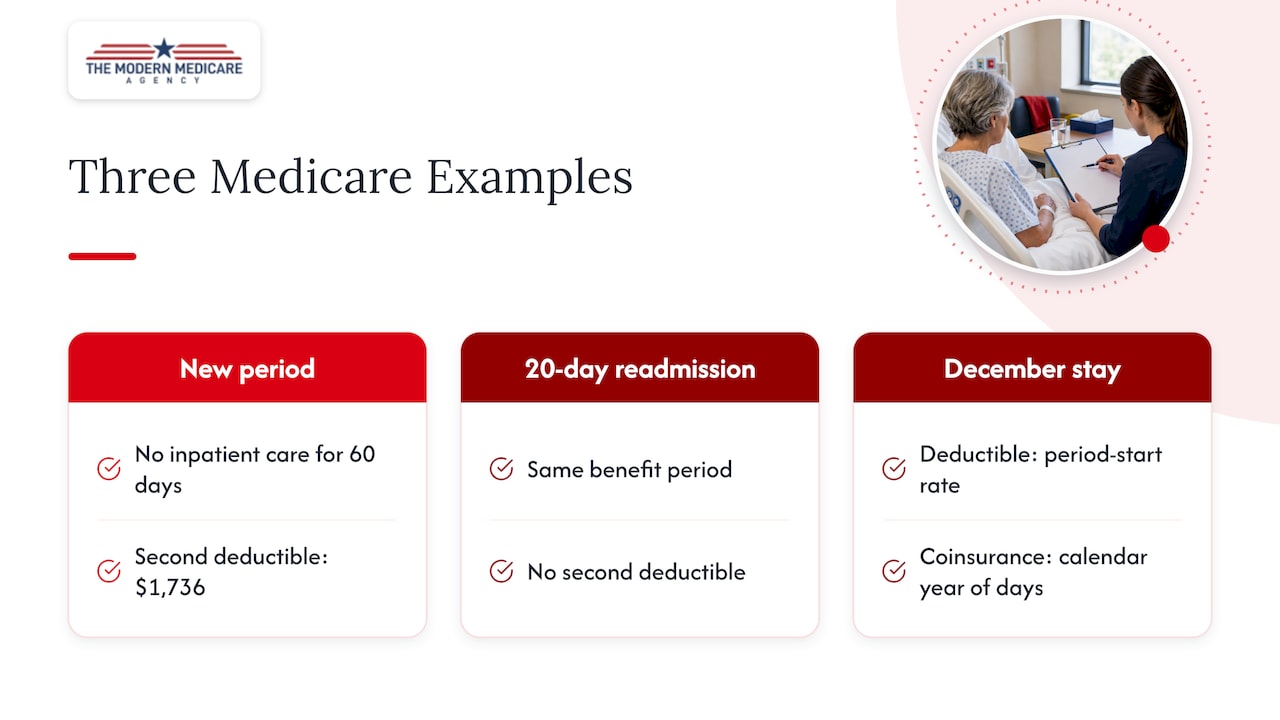
Three timelines showing Part A benefit period rules

Why it matters

Because a benefit period only closes after 60 days free of inpatient care, someone with a chronic condition who goes in and out of the hospital can pay the deductible several times in a year. KFF notes the same point: the amount applies per benefit period, not per year.

What you pay after the deductible in 2026

The deductible only buys the first 60 days. After that, daily coinsurance begins. These are the 2026 amounts for a hospital stay, as shown on Medicare.gov:

Hospital days in a benefit period What you pay in 2026
Deductible, once per benefit period $1,736
Days 1 to 60 $0 a day after the deductible
Days 61 to 90 $434 a day
Days 91 to 150 (lifetime reserve days) $868 a day
Day 151 and beyond All costs

The coinsurance amounts are tied to the deductible by law. Under section 1813 of the Social Security Act, $434 is one-fourth of the deductible and $868 is one-half. That is why all of them rise together each year.

A worked example

Say you have a serious illness and spend 75 days in the hospital in one benefit period in 2026.

  • Deductible: $1,736
  • Days 1 to 60: $0
  • Days 61 to 75: 15 days at $434, which is $6,510
  • Total: $8,246

That is for the hospital portion only. Doctor services during the stay fall under Part B, and they have their own cost sharing.

Lifetime reserve days

If you stay beyond day 90, you can draw on 60 lifetime reserve days at $868 a day. They are a one-time pool: the CMS Office of the Actuary’s summaries describe them as non-renewable. Once used, they are gone for good. Our page on how lifetime reserve days work explains when it makes sense to use them.

Skilled nursing facility stays

The deductible also connects to skilled nursing facility (SNF) care after a hospital stay. You do not owe a second Part A deductible for the SNF if you already paid it for the hospital in the same benefit period. For 2026, per Medicare.gov:

  • Days 1 to 20: $0 a day
  • Days 21 to 100: $217 a day
  • Day 101 and beyond: all costs

The SNF coinsurance was $209.50 in 2025. Medicare covers SNF care only under specific conditions, and long-term custodial care in a nursing home is a different matter. See our guides to skilled nursing facility coverage and nursing home care for the details.

The Part A premium is a separate cost

Many new enrollees wonder whether they pay anything just to have Part A. About 99% of beneficiaries have at least 40 quarters of Medicare-covered employment and pay no Part A premium. If you have fewer quarters, the 2026 monthly premium is:

Work history 2026 monthly Part A premium
40 or more quarters $0
30 to 39 quarters (yours or your spouse’s) $311
Fewer than 30 quarters $565

The premium and the deductible do not offset each other. Even with a $0 premium, you owe the deductible when you are admitted.

Why the number changes every year

The deductible is not set arbitrarily. The law requires CMS to adjust the prior year’s amount by the average hospital payment-rate increase plus a casemix adjustment. For 2026 that meant a 2.62% rate increase and a 0.9% casemix adjustment, applied to $1,676 and rounded to the nearest multiple of $4, giving $1,736.

CMS announces the next year’s amounts each fall. The 2027 amounts were released on November 17, 2026: the Part A deductible will be $1,776, an increase of $40. The 2026 figure of $1,736 applies to benefit periods that begin in 2026. For a hospital stay that begins in 2027, plan around the new amount.

Why the number changes every year

Ways to handle the deductible

Original Medicare has no yearly cap on what you can owe for hospital care. The deductible, the daily coinsurance and the costs past day 150 are all yours unless other coverage steps in. There are two main routes, and they work differently.

Medicare Supplement (Medigap)

A Medicare Supplement plan is sold by private insurers and pairs with Original Medicare. Depending on the lettered plan, it can pick up the Part A deductible, the daily hospital coinsurance, or both. Plans differ in how much of the deductible they cover, which is why comparing the letters side by side matters. Our page on Medicare Supplement plans shows the options we work with.

Medicare Advantage

Medicare Advantage plans replace Original Medicare with a plan from a private insurer. These plans set their own hospital cost sharing, so the Part A deductible as you see it here may not apply in the same way. Instead, you would see the plan’s own copays or daily hospital charges. Our Medicare Advantage overview explains how to read those numbers.

Which route fits you depends on how often you expect to use the hospital, the doctors you want to keep and your monthly budget. This is where an independent agent earns their keep: the same hospital stay can cost very different amounts under different plans.

What this means if you are new to Medicare

If you are turning 65, retiring from an employer plan or enrolled because of a disability, the deductible is one of three numbers to have in your head before you choose coverage:

  1. The hospital deductible ($1,736 in 2026), which applies to each benefit period.
  2. The Part B deductible, which applies yearly to outpatient care.
  3. What your supplemental plan covers, which decides how much of the first two you actually pay.

If you are already enrolled and unhappy with your coverage, an annual review of how your plan treats a hospital stay is a good habit. A plan that looked fine when you were healthy may look different after a hospital admission.

Our perspective

Most people hear “Part A is free” and relax. It is free in premium terms for nearly everyone, but the first real bill often arrives with a hospital admission, and it arrives all at once.

We have helped Medicare consumers since 2007, and we believe in education first. It is hard to make a good decision when you do not understand your next step. So we start by showing people the deductible, the daily coinsurance and the benefit period rule, and only then talk about plans.

As independent agents with access to 40+ carriers, we compare options on what you need rather than what one company sells. We also check in on your coverage each year, because your health, your doctors and the plan rules can all change.

Paul

Talk through your options with us

If you want to see how a Medicare Supplement or Medicare Advantage plan would treat a hospital stay for you, our team of independent agents can run a personalized comparison and support you year round. Start on our Medicare Supplement page or visit Paulbinsurance.

Paulbinsurance

FAQ

Is the Part A deductible charged every year?

No. It is charged per benefit period, not per calendar year. You could pay it once, several times or not at all in a year, depending on how many separate hospital admissions you have. A new benefit period starts only after 60 days in a row without inpatient hospital or skilled nursing care.

Do I pay the Part A deductible for a skilled nursing facility stay?

Not if you already paid it for the hospital stay in the same benefit period. After that, the 2026 SNF coinsurance is $0 for days 1 to 20 and $217 a day for days 21 to 100. You pay all costs from day 101.

Is the Part A deductible the same as the Part B deductible?

No. The Part A deductible applies to inpatient hospital stays and is charged per benefit period. The Part B deductible applies to outpatient and doctor services and is charged once a calendar year. You can owe both in the same year.

What will the Part A deductible be in 2027?

CMS has set it at $1,776 for 2027, up $40 from $1,736. Your cost depends on the year in which your benefit period begins.

Sources

What Is Medicare Part B and What Does It Actually Cover?

The complete guide to Medicare’s medical insurance — every service it covers, exactly what it costs in 2026, how it works with group insurance and VA benefits, and the excess charges most people have never heard of until they get a surprise bill.

The Short Answer

Medicare Part B is medical insurance — it covers doctor visits, outpatient care, preventive services, durable medical equipment, and more. Unlike Part A, Part B is not premium-free for anyone: everyone pays a monthly premium (202.90in2026formostpeople),anannualdeductible(283), and 20% coinsurance on most covered services, with no yearly cap on that 20% under Original Medicare alone. Whether you need to enroll at 65, and whether delaying is safe, depends heavily on your employment status and your employer’s size — getting this wrong is one of the most consequential and permanent mistakes in all of Medicare.

Key Takeaways

  • Part B is never premium-free — everyone pays a monthly premium, and higher earners pay significantly more through IRMAA.
  • The 20% coinsurance under Original Medicare alone has no yearly cap — this is the single biggest financial risk in Medicare, and it’s the reason Medigap and Medicare Advantage exist.
  • Whether you can safely delay Part B without a penalty depends on your employer’s size: 20+ employees generally allows delay; fewer than 20 generally does not.
  • Missing your enrollment window triggers a permanent 10% penalty for every 12-month period you went without coverage.
  • Veterans can and generally should enroll in Part B even with VA benefits, since Medicare and VA coverage don’t coordinate — each only pays for care received within its own system.
  • “Excess charges” from non-participating providers can add up to 15% on top of what Medicare approves, and only some Medigap plans protect you from them.

What Part B Actually Covers

While Part A handles hospital room and board, Part B is the half of Original Medicare that covers medical care and most services delivered outside a hospital admission — doctor visits, outpatient procedures, and ongoing medical needs.

What’s covered

  • Doctor visits — primary care and specialists
  • Outpatient surgeries and procedures
  • Diagnostic lab work, X-rays, and MRIs
  • Emergency room visits
  • Ambulance services
  • Outpatient mental health care
  • Physical, occupational, and speech therapy
  • Chemotherapy and radiation received in an outpatient clinic
  • Durable Medical Equipment (DME) — wheelchairs, oxygen equipment, blood sugar monitors, walkers, and similar equipment
  • Ambulatory surgical center services

Preventive services: the part Medicare gets genuinely right

Most preventive services are covered at 100%, with no deductible and no copay, as long as your provider accepts Medicare assignment. This includes:

  • Your one-time “Welcome to Medicare” wellness visit, available within your first 12 months on Part B
  • Annual wellness visits after that
  • Flu shots and most other recommended vaccines
  • Mammograms
  • Colonoscopies and other cancer screenings
  • Diabetes and cardiovascular screenings
  • Many other screenings recommended by the U.S. Preventive Services Task Force

Paul’s Honest Take: This is one of the most underused parts of Medicare, full stop. I’ve had clients who paid for a private physical every year out of habit and never realized their annual wellness visit through Medicare was completely free. If you haven’t used your Welcome to Medicare visit or your annual wellness visit, that’s real value sitting on the table.

What’s NOT covered

  • Routine dental care — cleanings, fillings, dentures, extractions
  • Routine vision exams and eyeglasses
  • Hearing aids (though diagnostic hearing tests ordered by a doctor may be covered)
  • Long-term custodial nursing home care — help with daily living activities, as opposed to short-term skilled or medical care
  • Routine prescription drugs you pick up at a retail pharmacy — that’s Part D’s job, not Part B’s
  • Cosmetic surgery, unless medically necessary (such as reconstruction after an accident or mastectomy)
  • Most care received outside the United States, with very limited exceptions
  • Routine foot care, such as nail trimming, in the absence of a qualifying medical condition
  • Acupuncture, except for a narrow, specific chronic low back pain benefit
  • Concierge medicine fees and membership-style charges some practices add on top of standard care
  • Long-term care insurance-style services, including most home-based personal care that isn’t tied to a skilled medical need

Paul’s Honest Take: The dental and vision exclusions are the ones that surprise people most, especially since they’re such routine parts of healthcare for most adults. This is exactly why so many Medicare Advantage plans build dental, vision, and hearing benefits into their coverage — Original Medicare was simply never designed to include them, and that gap doesn’t go away on its own.

What Part B Costs in 2026

Part B has three separate cost components, and understanding all three matters:

Cost Component

2026 Amount

Standard monthly premium

$202.90

Annual deductible

$283

Coinsurance on most covered services

20%

The premium is deducted automatically from your Social Security check if you’re already collecting benefits. If you’re not yet collecting Social Security, you’ll receive a bill, typically every three months.

The deductible works differently than Part A’s — it’s a straightforward annual figure. You pay the first $283 of Medicare-approved outpatient costs each calendar year, and then Medicare’s cost-sharing kicks in.

The coinsurance is where the real risk lives. After your deductible is met, Medicare pays 80% of the Medicare-approved amount for most covered services, and you’re responsible for the remaining 20%. There is no yearly cap on this 20% under Original Medicare alone. If you have a $100,000 course of cancer treatment, your 20% share is $20,000 — unless you have a Medigap policy or Medicare Advantage plan absorbing that cost.

Paul’s Honest Take: I put this in bold because it’s genuinely the single most important number in this entire guide. That uncapped 20% is the whole reason Medigap and Medicare Advantage exist as products in the first place. Original Medicare by itself was never designed to protect you from a truly expensive year — it was designed to cover 80% of it and leave the rest to you.

IRMAA: What Higher Earners Actually Pay

If your income is above certain thresholds, you’ll pay more for Part B through the Income-Related Monthly Adjustment Amount (IRMAA) — based on your tax return from two years prior. For 2026, that means your 2024 income determines your premium tier.

2024 Income (Individual)

2024 Income (Married, Joint)

Total Part B / Month

$109,000 or less

$218,000 or less

$202.90

$109,001 – $137,000

$218,001 – $274,000

$284.10

$137,001 – $171,000

$274,001 – $342,000

$405.80

$171,001 – $205,000

$342,001 – $410,000

$527.50

$205,001 – $499,999

$410,001 – $749,999

$649.20

$500,000 and above

$750,000 and above

$689.90

At the top tier, you’re paying more than three times the standard premium. If your income has recently dropped — retirement, the loss of a spouse, or certain other life-changing events — you can appeal your IRMAA determination using Form SSA-44.

Do You Have to Enroll? And What Happens If You Don’t?

Technically, Part B is optional — Medicare won’t force you into it. But opting out without a valid alternative is genuinely risky, because of how the penalty structure works.

If you don’t sign up during your Initial Enrollment Period (the 7-month window around your 65th birthday) and you don’t have qualifying employer coverage, you’ll face a permanent 10% penalty added to your premium for every full 12-month period you went without Part B. That penalty doesn’t expire — you pay it for as long as you have Part B, which for most people means for the rest of your life.

Example: If you delayed enrollment by 24 full months without a valid exception, you’d pay an extra 20% on top of the standard $202.90 premium in 2026 — roughly $40.58 more, every month, permanently.

How Part B Works with Group Insurance

Just like Part A, whether you can safely delay Part B without penalty comes down to one specific number: how many employees your company has.

Companies with 20 or more employees: If you or your spouse are actively working and covered by a genuine group health plan, your workplace insurance is primary, and you can legally delay Part B without any penalty. When that employment or coverage eventually ends, you get an 8-month Special Enrollment Period to enroll in Part B penalty-free.

Companies with fewer than 20 employees: Medicare automatically becomes your primary insurer at 65, regardless of your employment status. You need to enroll in Part B right on schedule. If you don’t, your small employer’s plan can legally refuse to pay claims that Medicare should have covered first — potentially leaving you responsible for the full cost.

Paul’s Honest Take: I say this in nearly every guide I write, because it’s genuinely one of the costliest misunderstandings I encounter: “I have good coverage at work” and “I’m protected from Medicare’s enrollment deadlines” are two completely different statements, and whether the second one is true depends entirely on your employer’s size — not how generous the coverage feels. Confirm the actual employee count before you decide to delay anything.

Retiree Coverage Is Not the Same as Active Employer Coverage

This is a distinction that catches a genuinely large number of people off guard: the “20 or more employees” exception only applies to active employment. If you retire and your former employer offers you retiree health benefits — sometimes a genuinely good, comprehensive plan — that coverage does not create a Special Enrollment Period the way active group coverage does, and it does not exempt you from enrolling in Part B on time.

Paul’s Honest Take: I’ve seen this mistake more than once, and it’s an especially painful one because it happens to people who did everything right during their working years. Someone retires with a strong retiree health plan from a large employer, assumes it works the same way their active coverage did, and delays Part B — only to find out later that retiree coverage was never a valid reason to delay in the first place. The moment you stop actively working, that clock starts, regardless of how good your retiree plan looks on paper. If you’re retiring and keeping employer retiree benefits, treat enrolling in Part B as something to handle right on schedule, not something retiree coverage lets you postpone.

Why You Need Both Part A and Part B for Medigap or Medicare Advantage

Here’s a foundational requirement worth understanding clearly, since it shapes every other coverage decision in Medicare: you must be enrolled in both Part A and Part B before you can buy a Medigap policy or enroll in a Medicare Advantage plan. Neither product exists as a standalone substitute for Original Medicare — both are built specifically to work alongside it.

  • Medigap fills the cost-sharing gaps left by Original Medicare (Parts A and B) — it has nothing to fill in if you’re not enrolled in both parts to begin with.
  • Medicare Advantage legally must provide at least the same coverage as Parts A and B combined, which is only possible because you’re required to be enrolled in both before a Medicare Advantage carrier can enroll you.

Paul’s Honest Take: This surprises people who assume they can somehow “skip” Part B and go straight into a Medicare Advantage plan to avoid the extra premium. It doesn’t work that way — Part B enrollment, and its premium, is a prerequisite either way, whether you end up on Original Medicare with Medigap or on a Medicare Advantage plan. There’s no path through Medicare that avoids the Part B premium once you’re actually using the system.

Does Medicare Work If You’re a Veteran?

Yes — and if you have VA health benefits, understanding how the two systems relate is genuinely important, because they work differently than most people assume.

Medicare and VA benefits do not coordinate. These are two entirely separate systems that each pay only for care received within their own network. Medicare doesn’t pay for care you receive at a VA facility, and VA benefits don’t pay for care you receive from a non-VA doctor or hospital. You, the veteran, choose which system to use each time you seek care.

Here’s the critical point: having VA benefits does not exempt you from Medicare’s enrollment deadlines. VA coverage is not considered a qualifying reason to delay Part B without penalty. If you don’t enroll in Part B during your Initial Enrollment Period and you’re relying solely on VA benefits, you can still trigger the permanent late enrollment penalty.

Why the VA itself recommends enrolling in Medicare anyway:

  • It gives you access to civilian doctors and hospitals outside the VA system
  • VA healthcare funding depends on annual Congressional appropriations, which isn’t guaranteed to remain stable
  • If VA authorizes only part of your needed care at a non-VA facility, Medicare can help cover the rest
  • Having both gives you meaningfully more flexibility and security than relying on either system alone

Paul’s Honest Take: This is one of the most common misconceptions I run into with veterans specifically, and it’s an expensive one to get wrong. Good VA coverage feels like it should be enough, and it might genuinely handle most of your care — but it doesn’t protect you from the Part B enrollment clock the way employer coverage from a large company can. The VA itself actively encourages enrolling in Medicare Parts A and B for exactly this reason. If you have VA benefits and are approaching 65, this is worth a direct conversation before you assume you’re covered.

Veterans who enroll in Part B can also purchase a Medigap policy, which can be particularly valuable if you use non-VA providers regularly — though if you primarily rely on VA facilities for most of your care, the value of an added Medigap policy may be more limited, and worth weighing carefully.

How Long Does It Actually Take to Get Part B Approved?

This is one of the most practical, and most overlooked, pieces of planning — especially if you’re leaving a job after 65 and coordinating your Part B start date around the end of your employer coverage. Applying isn’t instant, and the timeline depends heavily on which enrollment window you’re using.

Enrollment Situation

Typical Processing Time

When Coverage Actually Starts

Initial Enrollment Period (around 65)

2–4 weeks, sometimes up to 6

1st of your birthday month (if applied in the 3 months before) or 1st of the month after you apply (if applied during or after your birthday month)

Special Enrollment Period (leaving employer coverage)

4–8 weeks, sometimes longer

1st of the month after your application is submitted

General Enrollment Period (Jan 1–Mar 31, missed window)

4–6 weeks

1st of the month after you apply

Why the Special Enrollment Period takes longer: applying after leaving employer coverage requires two forms, not one — Form CMS-40B (the actual Part B application) and Form CMS-L564 (Request for Employment Information), which your employer needs to complete to verify you had qualifying coverage. Social Security has to manually review both, which is exactly why this route consistently takes longer than a standard Initial Enrollment Period application.

Paul’s Honest Take: This timeline question comes up constantly with clients who are retiring or leaving a job after 65, and it deserves real attention — not just because of the penalty risk we’ve already covered, but because a slow approval can leave you with an actual gap in coverage if you time it too tightly. My standard advice: start this process at least 2 to 3 months before you need Part B to actually begin, not the week your employer coverage ends. If your former employer is slow to complete their portion of Form CMS-L564, that alone can hold up the entire application — so it’s worth following up with your HR or benefits department directly rather than assuming it’s been submitted.

Practical tips to avoid delays

  • Apply online through SSA.gov whenever possible. It’s consistently the fastest method — mailed or faxed forms are more prone to getting lost or delayed.
  • If you’re on a Special Enrollment Period, submit Form CMS-L564 alongside Form CMS-40B, not separately. They need to arrive together, and one incomplete form can stall the whole application.
  • Expect a short intake lag even with online applications. It can take several business days for an online submission to actually appear on a local Social Security agent’s screen — don’t panic if you call shortly after applying and they say they don’t see it yet.
  • Once approved, you don’t have to wait for your physical card. Your Medicare Beneficiary Identifier typically appears in your online Social Security or Medicare.gov account within a day or two of approval, and you can print a temporary card from there — the physical card generally arrives by mail within about 30 days.

Excess Charges: The Cost Almost Nobody Knows to Ask About

Here’s a detail that surprises even people who’ve been on Medicare for years: not every doctor who accepts Medicare agrees to accept Medicare’s approved amount as full payment.

Providers fall into three categories:

  • Participating providers accept Medicare assignment, meaning they agree to accept the Medicare-approved amount as payment in full. This covers the vast majority of providers — roughly 98% of doctors nationally.
  • Non-participating providers still accept Medicare patients but haven’t agreed to accept the standard rate. They can charge an excess charge of up to 15% above the Medicare-approved amount.
  • Opted-out providers have left the Medicare system entirely and can charge whatever they want under a private contract — Medicare pays nothing at all for care from these providers, except in emergencies.

How excess charges actually work: if the Medicare-approved amount for a service is $300 and you see a non-participating provider, they can legally charge up to an additional $45 (15%) on top, for a total bill of $345 — and that excess amount doesn’t count toward your Part B deductible.

Eight states currently prohibit or limit excess charges entirely: Connecticut, Massachusetts, Minnesota, New York, Ohio, Pennsylvania, Rhode Island, and Vermont. If you live in one of these states, you’re generally shielded from excess charges from providers within your state — though you could still face them if you receive care from a non-participating provider elsewhere.

Paul’s Honest Take: This is exactly why Medigap Plan G matters so much for people who want maximum flexibility. Plan G covers excess charges in full — Plan N does not. If you’re the kind of person who wants the freedom to see any doctor without worrying about billing surprises, that distinction is worth understanding clearly before you pick between the two. And regardless of which plan you choose, it’s always worth asking a new provider directly whether they accept Medicare assignment before your first appointment.

The HSA Rule: Part B Closes the Door Too

If you’re hoping to keep contributing to a Health Savings Account, know this clearly: enrolling in Part B — or any part of Medicare — ends your ability to make new HSA contributions. This isn’t unique to Part B; it applies the moment you enroll in Medicare in any form, including premium-free Part A.

If keeping your HSA active matters to you, the only way to legally delay both Part A and Part B is through qualifying employer coverage — which, as covered above, generally requires an employer with 20 or more employees. And because Part A enrollment can be backdated up to 6 months once you do enroll, it’s smart to stop HSA contributions 6 months before you plan to sign up for Medicare or file for Social Security, whichever comes first.

Frequently Asked Questions

Is there a cap on what I’ll pay for Part B services in a year? Not under Original Medicare alone — the 20% coinsurance has no yearly limit. A Medigap policy or Medicare Advantage plan is what actually caps your exposure.

What happens if I don’t sign up for Part B on time? You’ll generally face a permanent 10% penalty on your premium for every 12-month period you went without coverage, unless you qualify for a Special Enrollment Period through active employer coverage.

Do I need Part B if I have good coverage through a small employer? Almost certainly yes. If your employer has fewer than 20 employees, Medicare becomes your primary insurer at 65 regardless of your job coverage, and not enrolling can leave you exposed to unpaid claims and a lifelong penalty.

Do veterans need Medicare Part B if they have VA benefits? Generally, yes. Medicare and VA benefits don’t coordinate — each only pays for care within its own system — and VA coverage doesn’t exempt you from Medicare’s enrollment deadlines or penalties.

What is a Part B excess charge? An additional charge, up to 15% above the Medicare-approved amount, that a non-participating provider can legally bill you. It doesn’t count toward your deductible, and only Medigap Plan G (among current plans) covers it in full.

Can I keep contributing to my HSA if I enroll in Part B? No. Enrolling in any part of Medicare, including Part B, ends your HSA contribution eligibility going forward.

How long does it take to get approved for Part B? It depends on the enrollment window. Initial Enrollment Period applications typically process in 2–4 weeks. Special Enrollment Period applications, used when leaving employer coverage, generally take 4–8 weeks since Social Security must manually verify your prior coverage using Form CMS-L564. Start the process at least 2–3 months before you need coverage to begin, especially when coordinating around a job ending.

The Bottom Line

Part B is the half of Medicare that covers your everyday medical care — and it’s also where the real financial exposure of Original Medicare lives, thanks to that uncapped 20% coinsurance. Whether you should enroll at 65, whether you can safely delay, and how much of that exposure you’re carrying all depend on details specific to your situation: your employer’s size, your income, your VA status, and which doctors you actually see.

If you want help sorting out exactly how Part B applies to your specific circumstances — or want to understand how Medigap or Medicare Advantage could close that uncapped coinsurance gap — that’s exactly the conversation I have with clients every day, at no cost to you.

Call 631-358-5793 or visit paulbinsurance.com to set up a time to talk it through.

Paul Barrett, CMIP, is the founder of The Modern Medicare Agency, based in Melville, NY, and has spent 18+ years exclusively helping people navigate Medicare — never life insurance, never annuities, just Medicare. He’s licensed in 37 states, represents more than 40 carriers, and has personally helped over 5,000 clients choose coverage that actually fits their lives.

Figures current as of 2026 and sourced from CMS, Medicare.gov, and the Social Security Administration. Individual circumstances vary, especially around employer coverage, VA benefits, and income-based premiums — always verify your specific situation before making enrollment decisions.

Sources

Related Post

Scroll to Top