



What Questions Should I Ask My Doctor About Medicare Coverage

What Questions Should I Ask My Doctor About Medicare Coverage

The plan that seems simplest may not be the one that best fits your care. If you’re asking, “What questions should I ask my doctor about Medicare?” start with the prescriptions, services, and specialists you rely on. Then find out how Original Medicare and Medicare Advantage handle access to that care.

It’s understandable to feel unsure. Your doctor knows your health needs, but your plan’s rules affect where you can receive care and what it covers. Clear questions can help you distinguish the two and identify what to review.

In this guide, you’ll find practical questions about prescription drugs, upcoming care, referrals, provider networks, and costs. You’ll also learn what to ask when comparing Original Medicare with Medicare Advantage, including whether your doctors and specialists participate in a plan’s network. Your doctor can help identify the care you need and discuss treatment options. For plan-specific benefits and network rules, the plan’s materials can help fill in the details. With both perspectives, you can make a more informed choice for your needs in 2026.

Key Takeaways

  • Bring a current list of prescription and over-the-counter medicines to your appointment, including any side effects you’re experiencing.
  • Ask which services your care may involve and how coverage can differ between Original Medicare and Medicare Advantage.
  • If you travel, ask how your plan handles routine care away from home and what to do if you need urgent or emergency care.
  • Before choosing a Medicare Advantage plan, ask whether your doctors and specialists participate and whether referrals are required.
  • Compare how each option handles prescriptions, provider access, and out-of-pocket costs so you can focus on the coverage that fits your needs in 2026.

1. Are my prescription drugs covered by Medicare?

Bring a complete medication list, including prescriptions, over-the-counter medicines, vitamins, and supplements. Tell your doctor the dose, when you take each medicine, and any side effects. For example, mention dizziness after starting a prescription or trouble swallowing a tablet. These details help your doctor assess whether a medicine still suits your needs and discuss possible alternatives.

Ask, “Is this medicine on my plan’s formulary, and is there a covered alternative?” A formulary is a plan’s list of covered prescription drugs. Formularies differ, so a medicine your doctor prescribes may not receive the same coverage under every plan. Ask whether the drug’s name, strength, or form affects coverage, and whether a similar treatment could meet your needs.

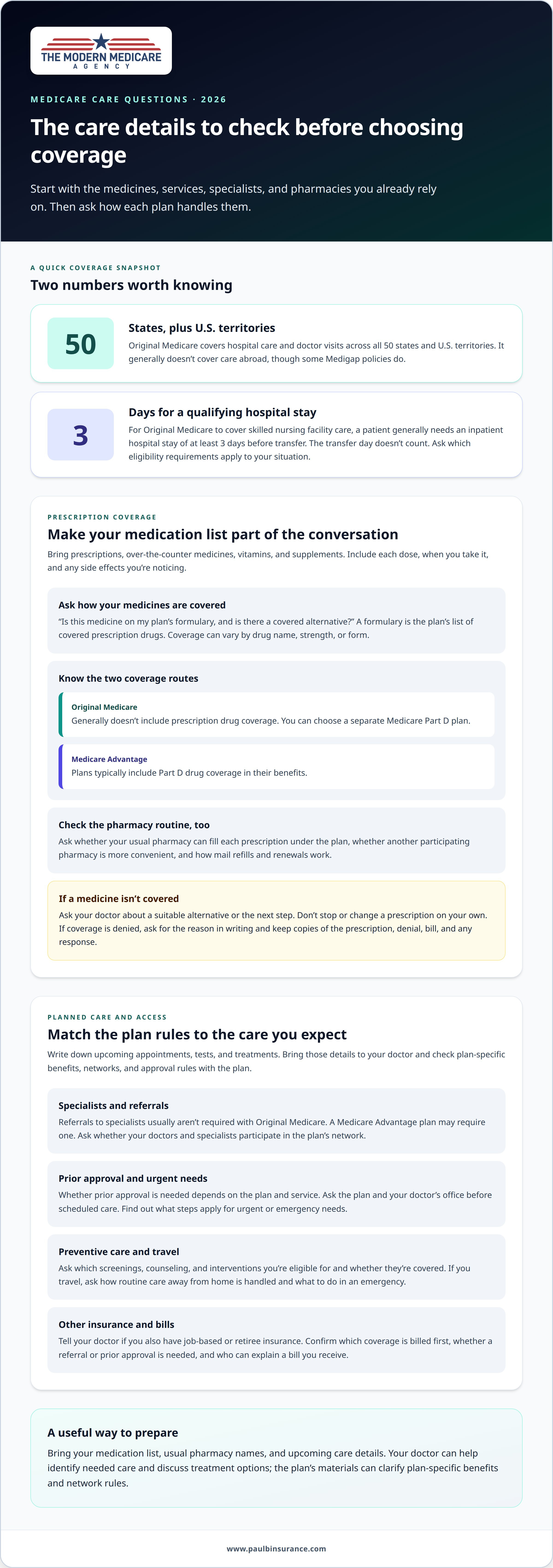
Medicare Part D provides prescription drug coverage. Original Medicare generally doesn’t include prescription drug coverage, so people can choose a separate Part D plan. Medicare Advantage plans typically include Part D drug coverage in their benefits. Ask your doctor which medicines you’re likely to need, then compare those names with each plan’s formulary. A Medicare Part D plan may help cover prescriptions alongside Original Medicare.

Pharmacy choice matters, too. Ask whether your regular pharmacy can fill each prescription under your plan and whether another participating pharmacy would be more convenient. If you use mail delivery, ask how refills and renewals work. Bring the names of your usual pharmacies so you can discuss your actual routine, not just your medication list.

Ask how your plan handles medicines that need extra approval or have limits. If a prescription isn’t covered, ask your doctor whether another medicine on the formulary could meet the same treatment goal. Don’t stop or change a prescription on your own. Instead, explain the coverage concern and any side effects, then discuss a safe next step with your doctor.

Medicare drug coverage can also affect what you pay over the year. Ask how your medicines are covered and whether your plan’s preferred pharmacy options matter. The answer depends on the specific drug and plan.

If Medicare or your plan denies coverage, ask for the reason in writing. Your doctor can explain the medical need or suggest an appropriate alternative. For a billing problem, compare the bill with your plan’s explanation of the service, then follow the instructions on the plan’s notice. Keep copies of the prescription, denial, bill, and any response.

Before leaving, repeat the agreed medication plan in your own words. Confirm which prescriptions to continue, whether your doctor will submit supporting information, and what to do if symptoms worsen or an emergency arises. A clear plan connects your treatment needs with your Medicare coverage and pharmacy routine.

2. Does my Medicare plan cover the services I need?

Make a list of planned appointments, tests, and treatments, then ask how your Medicare plan covers each one. Original Medicare covers hospital care and doctor visits across all 50 states and U.S. territories. Original Medicare generally doesn’t cover care abroad, though some Medigap policies do. For a trip outside the country, ask how your insurance would handle routine care and what to do during an emergency.

Ask about skilled nursing facility care before a hospital discharge makes the question urgent. For Original Medicare to cover this care, a patient generally needs an inpatient hospital stay of at least three days before transfer. The transfer day doesn’t count. Ask your care provider which eligibility requirements apply to your situation.

Use a Welcome to Medicare Visit or Annual Wellness Visit to discuss preventive care for the coming year. Ask which screenings, counseling, and interventions you’re eligible for and whether they’re covered. Medicare covers basic preventive care and screening services. Mentioning a specific concern, such as a change in vision, helps your primary care provider connect the discussion to appropriate preventive services.

For prescription drug costs, ask how your plan covers the medicines your treatment may involve, including any restrictions or approval steps. Bring the names of your regular pharmacies and ask whether they can fill your prescriptions under the plan. Both drug coverage and pharmacy access matter to your care. If a recommended medicine isn’t covered, ask your doctor about a suitable alternative and the next step.

If you have job-based or retiree insurance alongside Medicare, tell your doctor and ask how each plan should be billed. Confirm which coverage is billed first, whether referrals or prior approval are needed, and who can explain any bill you receive. The answer depends on your coverage arrangement, so include the plan names when discussing a scheduled test or specialist visit.

With Original Medicare, referrals to specialists usually aren’t required, while a Medicare Advantage plan may require one. Whether prior approval is needed depends on the plan and service, so ask the plan and doctor’s office before scheduled care. For urgent or emergency needs, ask what steps apply and where to seek care under your plan.

When your care includes specialists, tests, or travel, compare those needs with the plan’s rules. A Medicare Advantage plan’s coverage and referral rules can help frame what to ask about network access and approvals. Bring the answers to your next appointment, so you and your doctor can discuss care with fewer surprises.

3. What Should I Ask My Doctor About Medicare?

Ask your doctor how a recommended service may affect your out-of-pocket expenses, then compare the answer with your plan documents. A premium is what you pay to keep coverage active. A deductible is what you pay for covered care before the plan begins sharing costs. Copayments are set amounts for services, while coinsurance is a percentage. These terms describe different expenses, so ask which apply to a planned test, visit, or treatment.

According to the Centers for Medicare & Medicaid Services, after meeting the Part B deductible, people with Original Medicare generally pay 20% of the Medicare-approved amount for Part B services. Ask whether a service falls under Part B and what amount Medicare approves.

Ask how the deductible applies to your hospital care and what costs to expect. Ask your doctor whether a planned hospital service is inpatient care, since that can affect which Medicare part applies. A hospital stay under observation differs from an inpatient admission, so clarify your status with the care team.

Ask for an estimate of your share before scheduled care. For example, ask whether a specialist visit has a copayment, whether a test is subject to the deductible, and whether coinsurance applies afterward. Some Medicare plans charge only a copayment for primary care visits before you meet the deductible. The plan’s rules and the service you receive determine which cost applies.

If you have Medicare Advantage, ask about the plan’s yearly out-of-pocket limit for covered services. Ask which expenses count toward that limit and which services or providers affect your share. Original Medicare doesn’t have an annual out-of-pocket maximum, so ask how you can manage costs across the year.

A Medicare Supplement plan can help pay certain out-of-pocket costs associated with Parts A and B, such as deductibles, copayments, and coinsurance. Ask how a supplement would fit alongside Original Medicare and which expenses it may help address. Keep the plan name and service details handy so your questions about treatment focus on your actual coverage.

Before you leave, write down the expected service, the Medicare part involved, and each cost-sharing term your doctor mentions. Then ask the plan to explain any estimate you don’t understand. A clear breakdown helps you distinguish premiums from visit costs and see how one treatment may affect your budget for 2026.

4. Checking Medicare Advantage network participation

Before choosing a Medicare Advantage plan, ask whether your primary care doctor, specialists, preferred hospital, and nearby clinics are in its network. Original Medicare has no provider networks, and almost all doctors and hospitals in the United States accept it. Medicare Advantage plans may require you to use network providers for routine care, so confirm participation for the specific plan you’re considering for 2026.

Does your doctor accept Original Medicare or Medicare Advantage plans? Almost all U.S. doctors and hospitals accept Original Medicare, while Medicare Advantage participation depends on the plan’s network. Ask the doctor’s office about the exact plan name, not just whether it accepts Medicare. Online directories can be outdated, so confirm directly with the office before enrolling.

Check each specialist separately. Your primary care doctor may participate even if a specialist or hospital you rely on does not. Ask the office to confirm the plan’s network for routine visits, tests, and referrals. Medicare Advantage plans generally have lower costs for in-network care; out-of-network visits may mean higher out-of-pocket expenses.

Ask how your doctor coordinates care with Medicare specialists and hospitals. Find out who sends referrals, shares test results, and follows up after a hospital visit. For example, confirm whether your primary care office receives a specialist’s notes and knows whom to contact about a new treatment. Medicare Advantage plans may have referral rules, so ask how those fit your care.

Ask about urgent and emergency care, too. Original Medicare and Medicare Advantage plans are required to cover emergency and urgent care nationwide without restrictions. For planned visits while away from home, ask how the plan treats routine care and which network providers are available at your destination. This distinction can help prevent confusion during travel.

Where can you get local Medicare enrollment help and compare plans accepted by your doctor? An independent Medicare broker can help compare available Medicare Advantage plans against your doctors and hospitals. Bring the exact provider names, locations, and plan options. Ask the broker to review network participation for each plan, then confirm the specific plan with the doctor’s office before enrolling.

Before choosing a plan, list your essential providers and the hospitals you would want for planned care. Compare those names with each plan, confirm directly with the offices, and ask about referral requirements and out-of-network costs. A clear provider list makes it easier to weigh network access alongside premiums and other plan features.
What Questions Should I Ask My Doctor About Medicare Coverage

5. Comparing Original Medicare with Medicare Advantage

For 2026, compare how each option fits your doctors, prescriptions, travel, and likely care. Medicare Parts A and B together are called Original Medicare. Medicare Advantage plans must cover at least the same Part A and Part B benefits, but may organize access and extra benefits differently. Start by asking your doctor which services you expect to use and which providers deliver them.

Original Medicare has no provider networks. Medicare Advantage plans may require you to use in-network doctors for routine care. List your primary care doctor, specialists, and preferred hospital, then compare those names with each plan. Ask the doctor’s office about the exact plan, since participation can differ between Medicare Advantage plans.

Consider how you want to manage prescriptions. Original Medicare doesn’t include prescription drug coverage, so people may choose a separate Part D plan. Medicare Advantage plans may include prescription coverage with their other benefits. Ask your doctor which medicines are part of your care, then consider whether the plan’s drug coverage and pharmacy choices fit your routine.

Look beyond the monthly premium when comparing costs. Original Medicare doesn’t have an annual out-of-pocket maximum. Medicare Advantage plans have a yearly limit for covered services, and some plans may set lower limits. Ask which expenses count toward the plan’s limit and how costs could change if you receive care outside its network. Your expected visits and treatments make the comparison more personal.

Ask about access rules before settling on either option. Some Medicare Advantage plans require you to choose a primary care doctor and get a referral before seeing a specialist. Others let you see specialists without choosing a primary care doctor or getting a referral. If you see several specialists, ask how each plan handles visits and care coordination.

Medicare Advantage may include benefits beyond Parts A and B, such as prescription, vision, hearing, or dental coverage. Compare those benefits with services you expect to use rather than choosing based on a benefit you may not need. Ask your doctor which screenings, specialist visits, or treatments matter most to your care in the coming year.

To make the comparison clear, write down your must-have providers, medicines, and likely services. Then weigh network access, referral rules, extra benefits, and how each option handles costs. If you want help reviewing Medicare Advantage options alongside your doctors and care needs, compare Medicare Advantage plan choices.

The Modern Medicare Agency

The Modern Medicare Agency helps you compare Medicare coverage options against the care you and your doctor discuss. If you’re weighing provider access, prescription coverage, or out-of-pocket costs, its independent guidance can help you understand how Medicare Advantage, Medicare Supplement (Medigap), and Part D plans differ. Bring your questions and priorities, such as keeping a particular doctor or covering regular prescriptions, to make the discussion relevant to your needs in 2026.

When you’re ready to review your options, contact The Modern Medicare Agency to discuss your Medicare questions.

Take Your Next Step With Confidence

Your next conversation can turn uncertainty into a practical plan. Before your next appointment, write down the decision you need to make, the care you expect, and what matters most to you. If you’re still asking what questions should I ask my doctor about Medicare, focus on what could affect your choice, such as keeping a trusted provider or planning for ongoing treatment. Ask your doctor to explain the care involved, then use those details to compare Medicare options.

You don’t have to make that comparison alone. The Modern Medicare Agency can help you review plan choices in light of your priorities and the questions you’re bringing to your doctor. Take the time you need to understand the trade-offs and choose a path that feels right for your circumstances in 2026.

Start a conversation with The Modern Medicare Agency when you’re ready to explore your options. A clear next step can make Medicare decisions feel more manageable.

Frequently Asked Questions

Does my Medicare plan cover the services I need?

Coverage depends on the service, your plan, and how care is provided. Before a scheduled appointment, ask what the service is called, where it will take place, and whether another provider will be involved. Those details help you ask a more precise coverage question. If a service is part of a treatment plan, ask your doctor what alternatives may be available if your plan handles it differently.

What should I ask my doctor about Medicare?

Ask how your health needs could shape your coverage choices. If you’re wondering what questions you should ask your doctor about Medicare, start with the care you expect, including ongoing treatment, specialist visits, and medicines you take regularly. Ask what services your doctor anticipates and whether your care may involve other clinicians. Before leaving, repeat the next step in your own words so you can follow the plan at home.

Where can I ask questions about Medicare?

Your doctor can explain your health needs and care options, while your plan can explain its benefits and payment rules. For help comparing Medicare plans, The Modern Medicare Agency offers personalized guidance. Match each question to the person who can answer it: bring treatment concerns to your doctor, benefit questions to the plan, and comparison questions to a Medicare broker. That keeps each conversation focused and useful.

Are my prescription drugs covered by Medicare?

Prescription coverage depends on whether you have a Part D plan or a Medicare Advantage plan that includes drug coverage. If your doctor prescribes a new medicine after a hospital visit, ask whether it replaces an existing prescription or should be taken alongside it. Then ask how the medicine fits your plan’s coverage. Share any side effects or difficulty taking it before changing your medication routine.

Not sure where to start?

Start with the decision that feels most urgent, such as keeping a doctor, managing a new diagnosis, or understanding a prescription. Write it down and bring it to your next appointment. Ask your doctor to explain the care involved in plain language, then direct plan-benefit questions to your insurer. You don’t need to solve every Medicare question in one conversation; a clear first step can guide the next one.

What Medicare questions should I ask my doctor before enrolling?

Before enrolling, ask which doctors, specialists, and facilities are likely to be involved in your care. If you have a planned procedure or regular specialist visits, ask what follow-up care may be needed and who would provide it. Use that information when comparing plan options. Also ask whether your doctor expects changes to your care routine, since continuity may matter when weighing access and coverage.

Is my doctor in network with my Medicare Advantage plan?

Network participation depends on the specific Medicare Advantage plan. Give the doctor’s office the plan’s full name and ask whether the doctor participates in that exact option. If you see clinicians at more than one location, ask about each office and affiliated facility. Plan directories can change or lag behind, so confirming directly with the office can help you make a better-informed enrollment decision.

How can I check whether Medicare covers a test, treatment, or prescription?

Start by getting the exact name of the test, treatment, or medicine from your doctor. Ask what clinical purpose it serves and whether it is part of a broader care plan. Then ask your plan how that specific service or prescription is handled, including any approval steps. For a prescription, provide the drug’s exact name and form. Specific details make it easier to get an answer that applies to your situation.

Paul Barrett

Article by

Paul Barrett

Paul Barrett, CMIP is the founder of The Modern Medicare Agency, an independent Medicare-only brokerage based in Melville, NY. With 18 years of Medicare-exclusive experience, a CMIP designation, and more than 5,000 clients served across 37 states, Paul is one of the most credentialed independent Medicare specialists on Long Island — and one of the most direct.

He represents 40+ carriers with no quotas and no allegiances, which means his recommendations are based entirely on what fits each client's specific situation. He is the author of Medicare Mastery Unlocked and host of the Wise Guys Retirement Talk podcast. His content is grounded in primary sources, real carrier intelligence, and 18 years of watching what happens when people get Medicare right — and when they don't.

📞 631-358-5793 | paulbinsurance.com

What Is Medicare Part B and What Does It Actually Cover?

The complete guide to Medicare’s medical insurance — every service it covers, exactly what it costs in 2026, how it works with group insurance and VA benefits, and the excess charges most people have never heard of until they get a surprise bill.

The Short Answer

Medicare Part B is medical insurance — it covers doctor visits, outpatient care, preventive services, durable medical equipment, and more. Unlike Part A, Part B is not premium-free for anyone: everyone pays a monthly premium (202.90in2026formostpeople),anannualdeductible(283), and 20% coinsurance on most covered services, with no yearly cap on that 20% under Original Medicare alone. Whether you need to enroll at 65, and whether delaying is safe, depends heavily on your employment status and your employer’s size — getting this wrong is one of the most consequential and permanent mistakes in all of Medicare.

Key Takeaways

  • Part B is never premium-free — everyone pays a monthly premium, and higher earners pay significantly more through IRMAA.
  • The 20% coinsurance under Original Medicare alone has no yearly cap — this is the single biggest financial risk in Medicare, and it’s the reason Medigap and Medicare Advantage exist.
  • Whether you can safely delay Part B without a penalty depends on your employer’s size: 20+ employees generally allows delay; fewer than 20 generally does not.
  • Missing your enrollment window triggers a permanent 10% penalty for every 12-month period you went without coverage.
  • Veterans can and generally should enroll in Part B even with VA benefits, since Medicare and VA coverage don’t coordinate — each only pays for care received within its own system.
  • “Excess charges” from non-participating providers can add up to 15% on top of what Medicare approves, and only some Medigap plans protect you from them.

What Part B Actually Covers

While Part A handles hospital room and board, Part B is the half of Original Medicare that covers medical care and most services delivered outside a hospital admission — doctor visits, outpatient procedures, and ongoing medical needs.

What’s covered

  • Doctor visits — primary care and specialists
  • Outpatient surgeries and procedures
  • Diagnostic lab work, X-rays, and MRIs
  • Emergency room visits
  • Ambulance services
  • Outpatient mental health care
  • Physical, occupational, and speech therapy
  • Chemotherapy and radiation received in an outpatient clinic
  • Durable Medical Equipment (DME) — wheelchairs, oxygen equipment, blood sugar monitors, walkers, and similar equipment
  • Ambulatory surgical center services

Preventive services: the part Medicare gets genuinely right

Most preventive services are covered at 100%, with no deductible and no copay, as long as your provider accepts Medicare assignment. This includes:

  • Your one-time “Welcome to Medicare” wellness visit, available within your first 12 months on Part B
  • Annual wellness visits after that
  • Flu shots and most other recommended vaccines
  • Mammograms
  • Colonoscopies and other cancer screenings
  • Diabetes and cardiovascular screenings
  • Many other screenings recommended by the U.S. Preventive Services Task Force

Paul’s Honest Take: This is one of the most underused parts of Medicare, full stop. I’ve had clients who paid for a private physical every year out of habit and never realized their annual wellness visit through Medicare was completely free. If you haven’t used your Welcome to Medicare visit or your annual wellness visit, that’s real value sitting on the table.

What’s NOT covered

  • Routine dental care — cleanings, fillings, dentures, extractions
  • Routine vision exams and eyeglasses
  • Hearing aids (though diagnostic hearing tests ordered by a doctor may be covered)
  • Long-term custodial nursing home care — help with daily living activities, as opposed to short-term skilled or medical care
  • Routine prescription drugs you pick up at a retail pharmacy — that’s Part D’s job, not Part B’s
  • Cosmetic surgery, unless medically necessary (such as reconstruction after an accident or mastectomy)
  • Most care received outside the United States, with very limited exceptions
  • Routine foot care, such as nail trimming, in the absence of a qualifying medical condition
  • Acupuncture, except for a narrow, specific chronic low back pain benefit
  • Concierge medicine fees and membership-style charges some practices add on top of standard care
  • Long-term care insurance-style services, including most home-based personal care that isn’t tied to a skilled medical need

Paul’s Honest Take: The dental and vision exclusions are the ones that surprise people most, especially since they’re such routine parts of healthcare for most adults. This is exactly why so many Medicare Advantage plans build dental, vision, and hearing benefits into their coverage — Original Medicare was simply never designed to include them, and that gap doesn’t go away on its own.

What Part B Costs in 2026

Part B has three separate cost components, and understanding all three matters:

Cost Component

2026 Amount

Standard monthly premium

$202.90

Annual deductible

$283

Coinsurance on most covered services

20%

The premium is deducted automatically from your Social Security check if you’re already collecting benefits. If you’re not yet collecting Social Security, you’ll receive a bill, typically every three months.

The deductible works differently than Part A’s — it’s a straightforward annual figure. You pay the first $283 of Medicare-approved outpatient costs each calendar year, and then Medicare’s cost-sharing kicks in.

The coinsurance is where the real risk lives. After your deductible is met, Medicare pays 80% of the Medicare-approved amount for most covered services, and you’re responsible for the remaining 20%. There is no yearly cap on this 20% under Original Medicare alone. If you have a $100,000 course of cancer treatment, your 20% share is $20,000 — unless you have a Medigap policy or Medicare Advantage plan absorbing that cost.

Paul’s Honest Take: I put this in bold because it’s genuinely the single most important number in this entire guide. That uncapped 20% is the whole reason Medigap and Medicare Advantage exist as products in the first place. Original Medicare by itself was never designed to protect you from a truly expensive year — it was designed to cover 80% of it and leave the rest to you.

IRMAA: What Higher Earners Actually Pay

If your income is above certain thresholds, you’ll pay more for Part B through the Income-Related Monthly Adjustment Amount (IRMAA) — based on your tax return from two years prior. For 2026, that means your 2024 income determines your premium tier.

2024 Income (Individual)

2024 Income (Married, Joint)

Total Part B / Month

$109,000 or less

$218,000 or less

$202.90

$109,001 – $137,000

$218,001 – $274,000

$284.10

$137,001 – $171,000

$274,001 – $342,000

$405.80

$171,001 – $205,000

$342,001 – $410,000

$527.50

$205,001 – $499,999

$410,001 – $749,999

$649.20

$500,000 and above

$750,000 and above

$689.90

At the top tier, you’re paying more than three times the standard premium. If your income has recently dropped — retirement, the loss of a spouse, or certain other life-changing events — you can appeal your IRMAA determination using Form SSA-44.

Do You Have to Enroll? And What Happens If You Don’t?

Technically, Part B is optional — Medicare won’t force you into it. But opting out without a valid alternative is genuinely risky, because of how the penalty structure works.

If you don’t sign up during your Initial Enrollment Period (the 7-month window around your 65th birthday) and you don’t have qualifying employer coverage, you’ll face a permanent 10% penalty added to your premium for every full 12-month period you went without Part B. That penalty doesn’t expire — you pay it for as long as you have Part B, which for most people means for the rest of your life.

Example: If you delayed enrollment by 24 full months without a valid exception, you’d pay an extra 20% on top of the standard $202.90 premium in 2026 — roughly $40.58 more, every month, permanently.

How Part B Works with Group Insurance

Just like Part A, whether you can safely delay Part B without penalty comes down to one specific number: how many employees your company has.

Companies with 20 or more employees: If you or your spouse are actively working and covered by a genuine group health plan, your workplace insurance is primary, and you can legally delay Part B without any penalty. When that employment or coverage eventually ends, you get an 8-month Special Enrollment Period to enroll in Part B penalty-free.

Companies with fewer than 20 employees: Medicare automatically becomes your primary insurer at 65, regardless of your employment status. You need to enroll in Part B right on schedule. If you don’t, your small employer’s plan can legally refuse to pay claims that Medicare should have covered first — potentially leaving you responsible for the full cost.

Paul’s Honest Take: I say this in nearly every guide I write, because it’s genuinely one of the costliest misunderstandings I encounter: “I have good coverage at work” and “I’m protected from Medicare’s enrollment deadlines” are two completely different statements, and whether the second one is true depends entirely on your employer’s size — not how generous the coverage feels. Confirm the actual employee count before you decide to delay anything.

Retiree Coverage Is Not the Same as Active Employer Coverage

This is a distinction that catches a genuinely large number of people off guard: the “20 or more employees” exception only applies to active employment. If you retire and your former employer offers you retiree health benefits — sometimes a genuinely good, comprehensive plan — that coverage does not create a Special Enrollment Period the way active group coverage does, and it does not exempt you from enrolling in Part B on time.

Paul’s Honest Take: I’ve seen this mistake more than once, and it’s an especially painful one because it happens to people who did everything right during their working years. Someone retires with a strong retiree health plan from a large employer, assumes it works the same way their active coverage did, and delays Part B — only to find out later that retiree coverage was never a valid reason to delay in the first place. The moment you stop actively working, that clock starts, regardless of how good your retiree plan looks on paper. If you’re retiring and keeping employer retiree benefits, treat enrolling in Part B as something to handle right on schedule, not something retiree coverage lets you postpone.

Why You Need Both Part A and Part B for Medigap or Medicare Advantage

Here’s a foundational requirement worth understanding clearly, since it shapes every other coverage decision in Medicare: you must be enrolled in both Part A and Part B before you can buy a Medigap policy or enroll in a Medicare Advantage plan. Neither product exists as a standalone substitute for Original Medicare — both are built specifically to work alongside it.

  • Medigap fills the cost-sharing gaps left by Original Medicare (Parts A and B) — it has nothing to fill in if you’re not enrolled in both parts to begin with.
  • Medicare Advantage legally must provide at least the same coverage as Parts A and B combined, which is only possible because you’re required to be enrolled in both before a Medicare Advantage carrier can enroll you.

Paul’s Honest Take: This surprises people who assume they can somehow “skip” Part B and go straight into a Medicare Advantage plan to avoid the extra premium. It doesn’t work that way — Part B enrollment, and its premium, is a prerequisite either way, whether you end up on Original Medicare with Medigap or on a Medicare Advantage plan. There’s no path through Medicare that avoids the Part B premium once you’re actually using the system.

Does Medicare Work If You’re a Veteran?

Yes — and if you have VA health benefits, understanding how the two systems relate is genuinely important, because they work differently than most people assume.

Medicare and VA benefits do not coordinate. These are two entirely separate systems that each pay only for care received within their own network. Medicare doesn’t pay for care you receive at a VA facility, and VA benefits don’t pay for care you receive from a non-VA doctor or hospital. You, the veteran, choose which system to use each time you seek care.

Here’s the critical point: having VA benefits does not exempt you from Medicare’s enrollment deadlines. VA coverage is not considered a qualifying reason to delay Part B without penalty. If you don’t enroll in Part B during your Initial Enrollment Period and you’re relying solely on VA benefits, you can still trigger the permanent late enrollment penalty.

Why the VA itself recommends enrolling in Medicare anyway:

  • It gives you access to civilian doctors and hospitals outside the VA system
  • VA healthcare funding depends on annual Congressional appropriations, which isn’t guaranteed to remain stable
  • If VA authorizes only part of your needed care at a non-VA facility, Medicare can help cover the rest
  • Having both gives you meaningfully more flexibility and security than relying on either system alone

Paul’s Honest Take: This is one of the most common misconceptions I run into with veterans specifically, and it’s an expensive one to get wrong. Good VA coverage feels like it should be enough, and it might genuinely handle most of your care — but it doesn’t protect you from the Part B enrollment clock the way employer coverage from a large company can. The VA itself actively encourages enrolling in Medicare Parts A and B for exactly this reason. If you have VA benefits and are approaching 65, this is worth a direct conversation before you assume you’re covered.

Veterans who enroll in Part B can also purchase a Medigap policy, which can be particularly valuable if you use non-VA providers regularly — though if you primarily rely on VA facilities for most of your care, the value of an added Medigap policy may be more limited, and worth weighing carefully.

How Long Does It Actually Take to Get Part B Approved?

This is one of the most practical, and most overlooked, pieces of planning — especially if you’re leaving a job after 65 and coordinating your Part B start date around the end of your employer coverage. Applying isn’t instant, and the timeline depends heavily on which enrollment window you’re using.

Enrollment Situation

Typical Processing Time

When Coverage Actually Starts

Initial Enrollment Period (around 65)

2–4 weeks, sometimes up to 6

1st of your birthday month (if applied in the 3 months before) or 1st of the month after you apply (if applied during or after your birthday month)

Special Enrollment Period (leaving employer coverage)

4–8 weeks, sometimes longer

1st of the month after your application is submitted

General Enrollment Period (Jan 1–Mar 31, missed window)

4–6 weeks

1st of the month after you apply

Why the Special Enrollment Period takes longer: applying after leaving employer coverage requires two forms, not one — Form CMS-40B (the actual Part B application) and Form CMS-L564 (Request for Employment Information), which your employer needs to complete to verify you had qualifying coverage. Social Security has to manually review both, which is exactly why this route consistently takes longer than a standard Initial Enrollment Period application.

Paul’s Honest Take: This timeline question comes up constantly with clients who are retiring or leaving a job after 65, and it deserves real attention — not just because of the penalty risk we’ve already covered, but because a slow approval can leave you with an actual gap in coverage if you time it too tightly. My standard advice: start this process at least 2 to 3 months before you need Part B to actually begin, not the week your employer coverage ends. If your former employer is slow to complete their portion of Form CMS-L564, that alone can hold up the entire application — so it’s worth following up with your HR or benefits department directly rather than assuming it’s been submitted.

Practical tips to avoid delays

  • Apply online through SSA.gov whenever possible. It’s consistently the fastest method — mailed or faxed forms are more prone to getting lost or delayed.
  • If you’re on a Special Enrollment Period, submit Form CMS-L564 alongside Form CMS-40B, not separately. They need to arrive together, and one incomplete form can stall the whole application.
  • Expect a short intake lag even with online applications. It can take several business days for an online submission to actually appear on a local Social Security agent’s screen — don’t panic if you call shortly after applying and they say they don’t see it yet.
  • Once approved, you don’t have to wait for your physical card. Your Medicare Beneficiary Identifier typically appears in your online Social Security or Medicare.gov account within a day or two of approval, and you can print a temporary card from there — the physical card generally arrives by mail within about 30 days.

Excess Charges: The Cost Almost Nobody Knows to Ask About

Here’s a detail that surprises even people who’ve been on Medicare for years: not every doctor who accepts Medicare agrees to accept Medicare’s approved amount as full payment.

Providers fall into three categories:

  • Participating providers accept Medicare assignment, meaning they agree to accept the Medicare-approved amount as payment in full. This covers the vast majority of providers — roughly 98% of doctors nationally.
  • Non-participating providers still accept Medicare patients but haven’t agreed to accept the standard rate. They can charge an excess charge of up to 15% above the Medicare-approved amount.
  • Opted-out providers have left the Medicare system entirely and can charge whatever they want under a private contract — Medicare pays nothing at all for care from these providers, except in emergencies.

How excess charges actually work: if the Medicare-approved amount for a service is $300 and you see a non-participating provider, they can legally charge up to an additional $45 (15%) on top, for a total bill of $345 — and that excess amount doesn’t count toward your Part B deductible.

Eight states currently prohibit or limit excess charges entirely: Connecticut, Massachusetts, Minnesota, New York, Ohio, Pennsylvania, Rhode Island, and Vermont. If you live in one of these states, you’re generally shielded from excess charges from providers within your state — though you could still face them if you receive care from a non-participating provider elsewhere.

Paul’s Honest Take: This is exactly why Medigap Plan G matters so much for people who want maximum flexibility. Plan G covers excess charges in full — Plan N does not. If you’re the kind of person who wants the freedom to see any doctor without worrying about billing surprises, that distinction is worth understanding clearly before you pick between the two. And regardless of which plan you choose, it’s always worth asking a new provider directly whether they accept Medicare assignment before your first appointment.

The HSA Rule: Part B Closes the Door Too

If you’re hoping to keep contributing to a Health Savings Account, know this clearly: enrolling in Part B — or any part of Medicare — ends your ability to make new HSA contributions. This isn’t unique to Part B; it applies the moment you enroll in Medicare in any form, including premium-free Part A.

If keeping your HSA active matters to you, the only way to legally delay both Part A and Part B is through qualifying employer coverage — which, as covered above, generally requires an employer with 20 or more employees. And because Part A enrollment can be backdated up to 6 months once you do enroll, it’s smart to stop HSA contributions 6 months before you plan to sign up for Medicare or file for Social Security, whichever comes first.

Frequently Asked Questions

Is there a cap on what I’ll pay for Part B services in a year? Not under Original Medicare alone — the 20% coinsurance has no yearly limit. A Medigap policy or Medicare Advantage plan is what actually caps your exposure.

What happens if I don’t sign up for Part B on time? You’ll generally face a permanent 10% penalty on your premium for every 12-month period you went without coverage, unless you qualify for a Special Enrollment Period through active employer coverage.

Do I need Part B if I have good coverage through a small employer? Almost certainly yes. If your employer has fewer than 20 employees, Medicare becomes your primary insurer at 65 regardless of your job coverage, and not enrolling can leave you exposed to unpaid claims and a lifelong penalty.

Do veterans need Medicare Part B if they have VA benefits? Generally, yes. Medicare and VA benefits don’t coordinate — each only pays for care within its own system — and VA coverage doesn’t exempt you from Medicare’s enrollment deadlines or penalties.

What is a Part B excess charge? An additional charge, up to 15% above the Medicare-approved amount, that a non-participating provider can legally bill you. It doesn’t count toward your deductible, and only Medigap Plan G (among current plans) covers it in full.

Can I keep contributing to my HSA if I enroll in Part B? No. Enrolling in any part of Medicare, including Part B, ends your HSA contribution eligibility going forward.

How long does it take to get approved for Part B? It depends on the enrollment window. Initial Enrollment Period applications typically process in 2–4 weeks. Special Enrollment Period applications, used when leaving employer coverage, generally take 4–8 weeks since Social Security must manually verify your prior coverage using Form CMS-L564. Start the process at least 2–3 months before you need coverage to begin, especially when coordinating around a job ending.

The Bottom Line

Part B is the half of Medicare that covers your everyday medical care — and it’s also where the real financial exposure of Original Medicare lives, thanks to that uncapped 20% coinsurance. Whether you should enroll at 65, whether you can safely delay, and how much of that exposure you’re carrying all depend on details specific to your situation: your employer’s size, your income, your VA status, and which doctors you actually see.

If you want help sorting out exactly how Part B applies to your specific circumstances — or want to understand how Medigap or Medicare Advantage could close that uncapped coinsurance gap — that’s exactly the conversation I have with clients every day, at no cost to you.

Call 631-358-5793 or visit paulbinsurance.com to set up a time to talk it through.

Paul Barrett, CMIP, is the founder of The Modern Medicare Agency, based in Melville, NY, and has spent 18+ years exclusively helping people navigate Medicare — never life insurance, never annuities, just Medicare. He’s licensed in 37 states, represents more than 40 carriers, and has personally helped over 5,000 clients choose coverage that actually fits their lives.

Figures current as of 2026 and sourced from CMS, Medicare.gov, and the Social Security Administration. Individual circumstances vary, especially around employer coverage, VA benefits, and income-based premiums — always verify your specific situation before making enrollment decisions.

Sources

Related Post

Scroll to Top