




You qualify for a Medicare Chronic Condition Special Needs Plan (C-SNP) when you have Medicare Part A and Part B, live in the plan’s service area, and have a severe or disabling chronic condition that your doctor confirms. Income does not matter. The part that trips people up is not the rule itself but the paperwork: which conditions count, who has to verify yours, and whether a C-SNP is even sold in your county. As independent Medicare agents, we walk people through exactly that before they enroll.
TL;DR
- You need Medicare Part A and Part B, a home address inside the plan’s service area, and U.S. citizenship or lawful presence.
- You also need a qualifying chronic condition from the federal list, confirmed by your doctor, physician assistant or nurse practitioner.
- Each C-SNP covers one condition or a CMS-approved group of conditions. If the plan covers a group, one qualifying condition is enough.
- Income does not decide eligibility. That is the difference from a D-SNP, which is tied to Medicaid.
- Plans are offered county by county, so availability is the first thing to check.
Table of Contents
- What a C-SNP is and who it is built for
- The four requirements, in plain terms
- Which conditions qualify
- How your condition gets confirmed
- When you can enroll
- C-SNP or D-SNP: which eligibility fits you
- What a C-SNP can offer once you are in
- Is a C-SNP sold where you live?
- Our perspective
- Talk to an independent Medicare agent
- A short checklist before you apply
- FAQ
- Sources
What a C-SNP is and who it is built for
A C-SNP is a type of Medicare Advantage plan. Medicare Advantage (Part C) is the private-plan alternative to Original Medicare. A C-SNP restricts enrollment to people with specific severe or disabling chronic conditions, as defined in federal regulation 42 CFR 422.2. Because membership is limited to people with a particular condition, the plan can shape its provider network, care coordination and drug list around that condition.
Medicare.gov notes that SNPs are HMO or PPO plans that must include Part D drug coverage. So a C-SNP is a package: medical coverage, prescription coverage and extra care management in one plan.
Three kinds of people usually come to us asking about this:
- People turning 65 who already live with diabetes, heart failure or lung disease.
- People leaving employer coverage who want a plan built around an existing condition.
- People already on Medicare, including those who qualified through disability, who are unhappy with their current coverage and have a condition a C-SNP is designed for.
If you want the broader picture of how special needs plans fit together, our simple guide to Medicare special needs plans covers all three types.
The four requirements, in plain terms
CMS’s CY 2026 enrollment guidance sets the baseline for any Medicare Advantage plan, C-SNPs included. In everyday language, you must:
- Have Medicare Part A and Part B. Part A is hospital insurance and Part B is medical insurance. A C-SNP is not available if you have only one of them.
- Live in the plan’s service area. That means a county or group of counties for a local plan, or a CMS-approved region for a regional plan. The rules ask for permanent residence there.
- Be a U.S. citizen or lawfully present in the United States.
- Submit a completed enrollment request during a valid enrollment period and agree to follow the plan’s rules.
The same guidance says plans may not add eligibility requirements of their own beyond these. On top of those four, a C-SNP adds the fifth: the qualifying condition. The regulation also says you can be in only one Medicare Advantage plan at a time (42 CFR 422.50), so enrolling in a C-SNP replaces your current Advantage plan rather than adding to it.
Which conditions qualify
This is the question most readers type into Google. The regulation defines a severe or disabling chronic condition as one that is life-threatening or significantly limits your health or function, carries a high risk of hospitalization, and requires intensive care coordination. Under 42 CFR 422.2 (eCFR, September 30, 2024 edition), that definition is spelled out as 22 categories:
| Category | Examples named in the rule |
|---|---|
| Cardiovascular and heart | Cardiovascular disorders (including valvular heart disease), chronic heart failure, stroke |
| Metabolic | Diabetes mellitus, overweight, obesity and metabolic syndrome |
| Lung | Chronic lung disorders, including COPD and cystic fibrosis |
| Kidney | Chronic kidney disease, with or without dialysis |
| Cancer | Cancer |
| Brain and nerves | Dementia, neurologic disorders (including fibromyalgia, chronic fatigue syndrome, spinal cord injuries), conditions associated with cognitive impairment |
| Mental health and substance use | Chronic and disabling mental health conditions (including PTSD, eating disorders, anxiety disorders), chronic alcohol use disorder and other substance use disorders |
| Immune and blood | HIV/AIDS, autoimmune disorders (including dermatomyositis, psoriatic arthritis, scleroderma), immunodeficiency and immunosuppressive disorders, severe hematologic disorders |
| Digestive | Chronic gastrointestinal disease |
| Transplant | Post-organ transplantation care |
| Function and senses | Conditions with functional challenges, conditions impairing vision, hearing, taste, touch or smell, conditions requiring continued therapy services |
The category names are broad on purpose. If your diagnosis is not named word for word, ask whether it falls under one of these categories. That is a question for the plan and your doctor, and we are glad to help sort it out.
Plans cover one condition or a group
No single C-SNP accepts everyone on that list. Each plan is built around one condition or a grouping. Since the 2024 rule changes, CMS has approved eight multi-condition groupings:
- Diabetes and chronic heart failure
- Chronic heart failure and cardiovascular disorders
- Diabetes and cardiovascular disorders
- Diabetes, chronic heart failure and cardiovascular disorders
- Stroke and cardiovascular disorders
- Anxiety associated with COPD
- Chronic kidney disease and post-renal organ transplantation
- Substance use disorder and chronic mental health disorders
The reassuring detail: in a grouped plan, you need only one of the qualifying conditions to be eligible. If you have diabetes but no heart disease, a diabetes-and-heart-failure plan can still be open to you.
How your condition gets confirmed
A diagnosis you remember is not enough. Under 42 CFR 422.52(f), the condition must be confirmed by your current physician, physician assistant or nurse practitioner. The confirmation can come in one of two ways:
- Before you enroll. The CMS Managed Care Manual says the plan must contact your existing provider to verify the condition. It may do so with a fax or dated document on which the provider selects your diagnosis from the plan’s qualifying list. Plans for end-stage renal disease can also use a physician-signed CMS Form 2728.
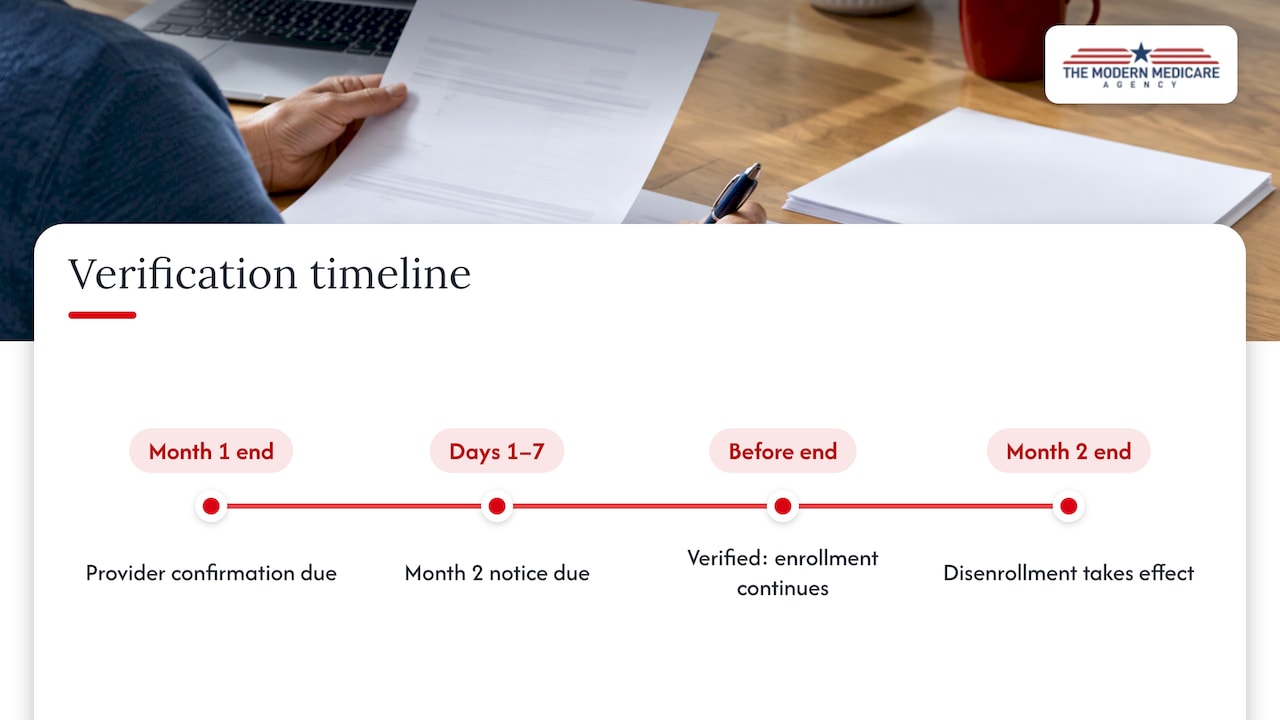
- Shortly after you enroll. A plan may use a CMS-approved Pre-enrollment Qualification Assessment Tool, a short questionnaire that lets you start. Your provider must then verify the condition within the first month of enrollment.
The Manual adds that the contact with your provider also helps start the exchange of health information and a smooth handoff of your care to the plan. In practice, that means a good doctor’s office makes the process easy.
What happens if verification does not arrive
When a plan enrolls you on a questionnaire and cannot get provider verification by the end of the first month, it must disenroll you as of the end of the second month. It has to send notice within the first seven calendar days of that second month, and your enrollment continues if verification arrives before the second month ends. Plans must also reconfirm eligibility at least once a year.
If you are found not to have the condition after enrolling, you are not left stranded. A special enrollment period opens when the plan notifies you and runs through the end of that month plus two more calendar months, ending sooner if you choose a new plan. That window lets you move into another Medicare Advantage plan.
The practical lesson is to talk to your doctor’s office before you apply. Ask who will complete the form and how quickly, so the verification clock never becomes a worry.
When you can enroll
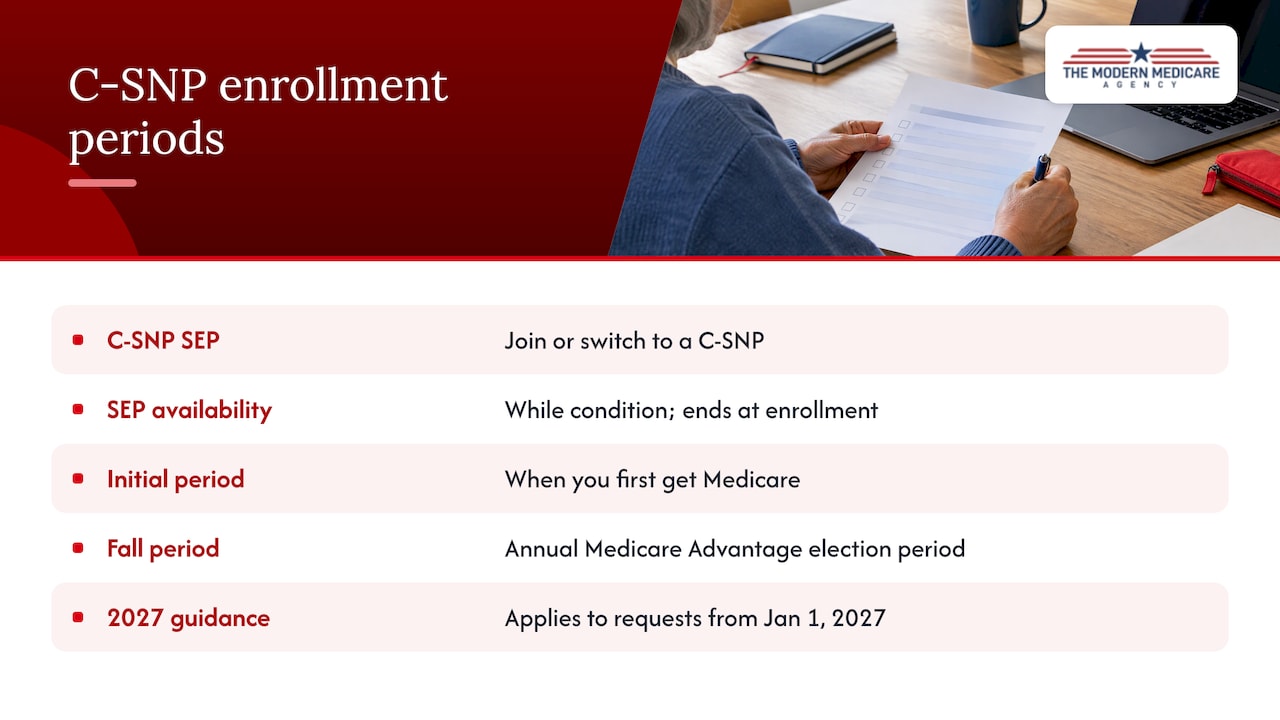
People with a qualifying condition have their own special enrollment period. Under 42 CFR 422.62(b)(13), you can use it to join a C-SNP designed for your condition, or to switch to a C-SNP focused on a different qualifying condition. It is available while you have the condition and ends when you enroll in the plan.
The standard Medicare Advantage election periods also apply, including the initial enrollment period when you first get Medicare and the annual fall enrollment period. CMS lists them on its managed care eligibility and enrollment page, where it also notes that updated enrollment guidance for 2027 was released on August 25, 2026. Plans use that guidance for requests received on or after January 1, 2027. Check that page for the current schedule instead of relying on a date you read elsewhere.
The CY 2027 guidance repeats the key point for this topic: for C-SNP enrollments, the plan must confirm that you have the qualifying condition, with the verification details in 42 CFR 422.2.
C-SNP or D-SNP: which eligibility fits you
The two names sound alike, and the eligibility tests are completely different.
| C-SNP | D-SNP | |
|---|---|---|
| Who it serves | People with specific severe or disabling chronic conditions | People who are also entitled to Medicaid |
| What decides eligibility | A confirmed qualifying condition | Medicaid status |
| Income test | None | Tied to the Medicaid category |
The CMS Managed Care Manual states that a D-SNP exclusively serves Medicare beneficiaries who are also entitled to Medicaid. The Washington State Department of Social and Health Services’ Medicare 101 training from March 2026 adds that anyone with a qualifying chronic condition diagnosis can join a C-SNP regardless of income.
Some people could fit either one, for example someone with diabetes who also has Medicaid. If that is you, our six questions for choosing between a C-SNP and a D-SNP lay out how to decide.
What a C-SNP can offer once you are in
Because a C-SNP is built around one condition, it can include items and drug coverage aimed at it. The Washington State training lists examples such as diabetic shoes, glucose monitors, oxygen equipment and nebulizers, along with targeted drug lists. Benefits vary by plan and county, so the plan’s own materials are what to read for specifics.
CMS has also said that since January 1, 2026, SNP members need a documented qualifying chronic condition to access certain food and utility benefits. That is one more reason to keep your doctor’s confirmation on file.
Is a C-SNP sold where you live?
Eligibility on paper does not help if no plan exists in your county. Medicare.gov explains that different types of SNPs are available in different parts of the country because insurance companies decide where they do business. A C-SNP may also cover only one condition, so a plan in your county for heart failure does not help if your condition is COPD.
This is where working with an independent agent saves real time. We have access to 40+ carriers, so we can check which chronic condition plans are offered in your county, which condition each one covers, and whether your doctors and prescriptions fit.
Our perspective
Most people who call us about a C-SNP already know their diagnosis. What they do not know is the order of operations: confirm the plan exists in your county, confirm it covers your condition, then make sure your doctor’s office is ready to verify it.
We believe in education first. It is hard to choose well when the next step is unclear, so we explain the rules before we talk about plans. We are independent agents who specialize in Medicare, and Paul Barrett has been helping Medicare consumers since 2007. Our approach is to avoid pressure and focus only on what you need.
A C-SNP can be a strong fit when your condition drives most of your care. We also review your coverage every year, because plans, networks and drug lists change, and a good fit in one year deserves a checkup the next.
Paul
Talk to an independent Medicare agent
If you are new to Medicare, leaving employer coverage, or unhappy with the plan you have, we can compare chronic condition plans alongside other Medicare Advantage options and explain what each requires from you and your doctor. Our team works with more than 40 carriers and offers personalized plan reviews, year-round support and annual coverage checkups. See our Medicare Advantage plans page to get started.

If you are earlier in the process and still deciding how Part C works, our step-by-step guide to applying for Medicare Part C walks through the application.
A short checklist before you apply
- Confirm you have both Medicare Part A and Part B.
- Write down your qualifying diagnosis and the name of the doctor, physician assistant or nurse practitioner who manages it.
- Find out which C-SNPs are sold in your county and which condition or group each one covers.
- Check that your doctors and prescriptions work with the plan.
- Ask your provider’s office to be ready for the plan’s verification request.
- Plan to review the coverage again each year.
FAQ
What conditions qualify you for a C-SNP?
The federal definition in 42 CFR 422.2 lists 22 categories, including diabetes, chronic heart failure, cancer, chronic kidney disease, COPD, dementia, HIV/AIDS, stroke and certain autoimmune, digestive, mental health and neurologic conditions. Each plan accepts only the condition or group it was designed for. Your doctor confirms the diagnosis.
Can I join a C-SNP if I have a low income or a high income?
Yes. Income is not part of C-SNP eligibility. If you have a qualifying condition confirmed by your doctor, you can join regardless of income. Medicaid status is what matters for a D-SNP, which is a different plan type.
Do I need a referral from my doctor to enroll?
You do not need a referral, but your provider must confirm the condition. The plan contacts your current doctor before enrollment, or uses a CMS-approved questionnaire and gets provider verification within your first month. Telling your doctor’s office to expect the request helps keep things on track.
What if I have more than one chronic condition?
If a plan covers a group of conditions, you need only one of them to qualify. If you have several conditions, a plan built around the one that drives most of your care is usually the natural place to start. We can compare the options in your county.
Sources
- Chronic Condition Special Needs Plans (C-SNPs), CMS
- Special Needs Plans (SNP), Medicare.gov
- Medicare Advantage and Part D Enrollment and Disenrollment Guidance, CY 2026, CMS
- Medicare Advantage and Part D Enrollment and Disenrollment Guidance, CY 2027, CMS
- 42 CFR Part 422, eCFR (September 30, 2024)
- 42 CFR Part 422, eCFR (current)
- 42 CFR Part 422 Subpart B, eCFR
- 42 CFR 422.52, eCFR
- Special Needs Plans Frequently Asked Questions, CMS
- Medicare Managed Care Manual, Chapter 16-B, CMS
- Medicare Managed Care Manual, Chapter 16-B (verification section), CMS
- Medicare Managed Care Eligibility and Enrollment, CMS
- Medicare 101: MA, D-SNP, C-SNP, I-SNP, Washington State DSHS (March 2026)