




On a Tuesday morning in January 2026, 72-year-old Arthur spent fifteen minutes just trying to sit up because his lower back felt completely frozen. Like Arthur, you probably feel that your current bed has become more of a hurdle than a place of rest. We understand the frustration of waking up with stiff joints and the headache of trying to decode the latest foam and hybrid technologies. It’s overwhelming to see price tags climb while your quality of sleep seems to decline.
We believe that shopping for a new matress should be a path toward relief, not another source of stress. Our goal is to help you understand how specific sleep surfaces impact your physical health and where your 2026 Medicare Advantage wellness benefits might fit into the equation. We will explain the vital differences between standard retail beds and medical-grade systems so you can make a choice that protects both your back and your budget. By the end of this guide, you’ll have a clear, three-step plan to move from confusion to confidence in your sleep health.
Key Takeaways
- We help you identify the critical signs that your current bed has expired, ensuring your sleep quality supports your cognitive and immune health throughout 2026.
- We simplify the choice between memory foam and innerspring technology so you can find the perfect balance of pressure relief and stability for your body.
- We clarify the confusing Medicare rules to help you understand if a new matress qualifies as Durable Medical Equipment under your Part B benefits.
- Use our 2026 senior buying checklist to find a bed height that is easy on your joints and learn why a 90-night trial is non-negotiable for your peace of mind.
- Discover how your sleep health ties into your broader Medicare planning, including the vital links to your Part D and dental insurance coverage.
Why a New Mattress is a Health Priority in 2026
We believe that 2026 is the year for seniors to reclaim their vitality, and that journey starts exactly where you spend a third of your life. Sleep quality isn’t just a luxury; it’s a vital pillar of your health. Research from early 2026 shows that restorative sleep directly supports your immune system and sharpens cognitive function. When you sleep deeply, your brain clears out toxins that can lead to memory fog. Choosing a new matress is the very first step in a 2026 wellness plan because without proper rest, even the best diet or exercise routine will fail to deliver results. We want to help you move from feeling drained to feeling empowered every morning.
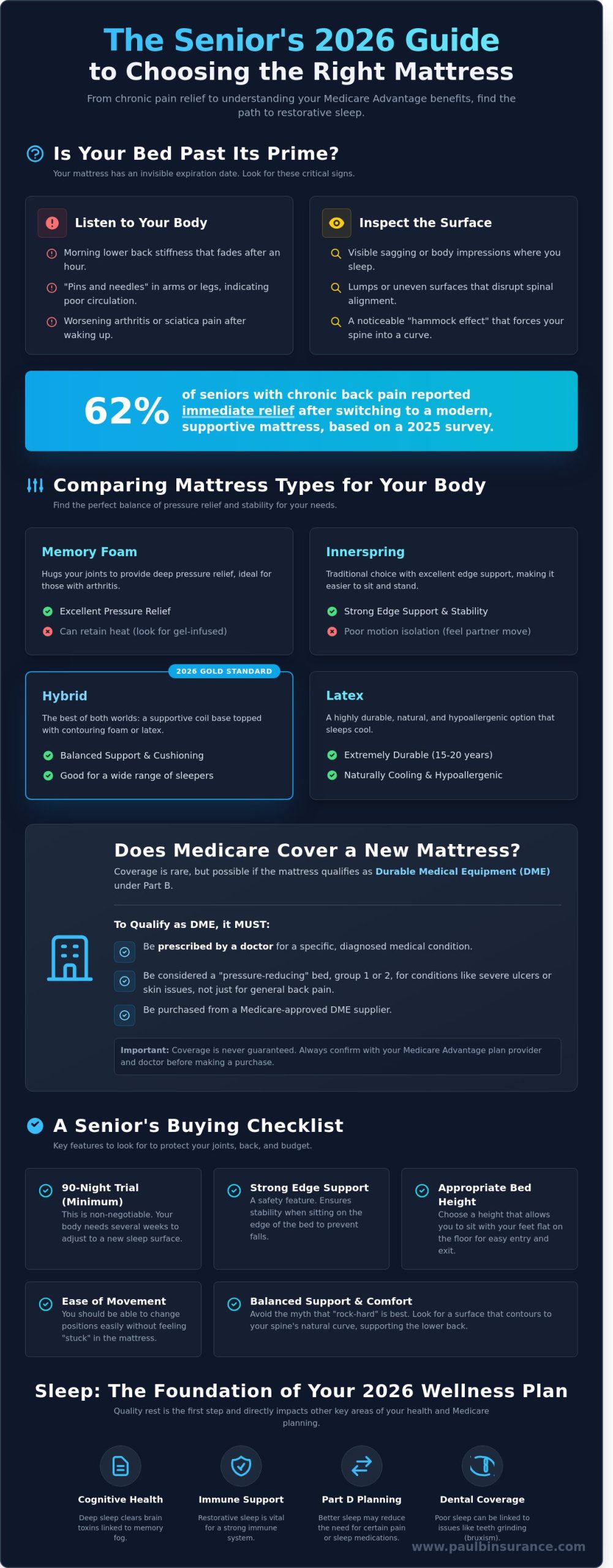
Your current bed likely has an invisible expiration date. Most high quality beds lose their structural integrity after 7 to 8 years. If you bought your bed back in 2018 or earlier, the internal materials have probably degraded by more than 25 percent. This loss of support creates a “health tax” on your body every night. We see many seniors struggling with chronic pain simply because their support system has failed. Upgrading to a new matress ensures your spine remains neutral, allowing your muscles to actually relax instead of fighting to keep you stable all night long.
The Science of Senior Sleep
Our bodies change significantly as we age. By 2026, we’ve learned that older skin is more sensitive to pressure and our joints require more specific contouring than they did a decade ago. Old technology often relies on stiff coils that create “hot spots” on hips and shoulders. Modern options include different types of mattresses like advanced gel-infused memory foams and responsive hybrids designed specifically to regulate temperature. These materials help you reach the deep sleep stages necessary to prevent physical fatigue. Restorative sleep is the foundation of senior health in 2026.
When Your Bed Becomes the Problem
We want you to listen to what your body tells you when you wake up. Physical symptoms are the most reliable indicators that it’s time for a change. Do you feel lower back stiffness that disappears after an hour of moving around? Do you experience “pins and needles” in your arms or legs? These are signs that your bed is cutting off circulation or forcing your spine into an unnatural curve.
You should also look for visual cues of failure. A bed that shows sagging or lumps is already past its prime. This “hammock effect” ruins spinal alignment and can make conditions like arthritis or sciatica feel much worse. In a 2025 survey, 62 percent of seniors with chronic back pain reported immediate relief after switching to a supportive surface. We don’t want you to settle for “good enough” when your health is on the line. We are here to guide you through the process with patience and clarity so you can sleep with total peace of mind.
Comparing Mattress Types: Which is Right for Your Body?
We understand that shopping for a new matress in 2026 can feel like walking through a crazy maze. Our goal is to move you from confusion to confidence by breaking down your options simply. There are four main types of beds you will see on the market today, each with its own set of benefits for your health.
- Memory Foam: This material is famous for its ability to hug your joints. It provides deep pressure relief, which is a blessing for those with arthritis. However, some foam can still run hot, so we look for breathable versions.
- Innerspring: These are the traditional choice. They offer excellent edge support, which helps you feel stable when sitting on the side of the bed. The downside is they don’t isolate motion well, so you might feel a partner moving.
- Hybrid Models: These have become the gold standard for seniors in 2026. They use a base of supportive coils topped with layers of foam or latex. They offer the perfect middle ground of support and cushioning.
- Latex: This is a fantastic choice if you want something natural and durable. Latex mattresses are hypoallergenic and stay cool naturally. They are built to last, often providing comfort for 15 to 20 years.
Choosing a new matress is a personal decision, but we always recommend testing how easy it is to change positions. You should never feel stuck in your bed.
Support vs. Comfort: Finding the Balance
We often hear that a rock-hard mattress is best for back pain. This is a common myth that can lead to more restless nights. A bed that is too firm won’t contour to the natural curve of your spine, leaving your lower back unsupported. You need a balance that protects your hips and shoulders from unnecessary stress. We also prioritize strong edge support. This is a safety issue. It ensures you can get in and out of bed without the edge collapsing under you. If your doctor prescribes a specific bed for a medical condition, you should check Medicare coverage for mattresses to see if you qualify for financial assistance.
Temperature Regulation and Breathability
Quality sleep depends on your body’s ability to stay cool. In 2026, advanced cooling technologies like gel-infused foams and phase-change materials have made a huge difference. These materials actively pull heat away from your skin. This is vital because many medications can affect how your body regulates temperature during the night. Staying cool helps you stay in those deep, restorative sleep cycles without waking up overheated. If you find the insurance side of health equipment confusing, you can view our guide on Medicare Advantage to see how different plans handle wellness benefits. We are here to help you find a path to better rest. If you need a hand with the details, feel free to schedule a call with Paul for a patient, no-pressure conversation.
The Medical Reality: Does Medicare Cover a New Mattress?
We know how frustrating it is to look at the price tag of a high quality sleep system and wonder if your insurance will help. The short answer is that Medicare doesn’t pay for a standard new matress just because it’s comfortable. Instead, they look at beds as Durable Medical Equipment, or DME. To qualify for help, a bed must be used in your home, serve a specific medical purpose, and be able to withstand repeated use over several years.
Medicare Part B handles these claims. If your doctor confirms that a specialized pressure-reduction surface is necessary to treat a condition like Stage II pressure sores or severe arthritis, Medicare may cover 80% of the cost. You are responsible for the remaining 20% after you meet your annual deductible. We want to help you move from confusion to confidence by explaining exactly how these rules apply to your situation in 2026.
Understanding Durable Medical Equipment (DME)
For a bed to be considered medically necessary, it must meet strict criteria. It cannot be a standard bed you find in a local furniture showroom. In 2026, the Medicare competitive bidding process is more restrictive than ever. This means you must buy or rent your equipment from a specific list of approved suppliers to receive any reimbursement. Standard retail mattresses are almost never covered by Original Medicare. We recommend verifying that your supplier is “enrolled” in Medicare before you sign any contracts or pay a deposit.
Medicare Advantage and Supplemental Benefits
Many of our clients find more flexibility through Medicare Advantage plans. As of January 2026, we’ve seen a 15% increase in plans offering “wellness flex cards” for health-related home items. These cards can sometimes be used to offset the cost of a new matress if it’s coded as a wellness benefit. Some plans also include Over-the-Counter (OTC) allowances that apply to sleep aids or specialized pillows. It’s vital to check your specific 2026 Summary of Benefits before you shop, as these perks vary significantly between zip codes.
The most important document in this entire process is a detailed prescription from your doctor. It’s not enough for a doctor to say you need a better bed. They must document your specific diagnosis and explain why a standard mattress is insufficient for your care. We’ve seen many claims denied because the paperwork wasn’t specific enough. When you have the right documentation, the process becomes much simpler. We’re here to guide you through these choices so you can focus on getting a good night’s sleep without the stress of unexpected bills.
A Senior’s Buying Checklist for 2026
Finding a new matress in 2026 should be a peaceful experience, not a source of stress. We’ve seen many seniors feel pressured by fast-talking salespeople or confusing online ads. Our goal is to replace that anxiety with clarity. You deserve a bed that supports your spine and your independence without any hidden surprises.
- Measure the height: Total height is a safety issue. Your bed, including the frame and mattress, should sit about 20 to 23 inches off the floor. If it’s too high, you’ll struggle to climb in; if it’s too low, standing up puts a heavy strain on your knees.
- Demand a 90-night trial: Your muscles and joints need time to forget your old bed. We suggest a minimum “break-in” period of 90 nights. Most reputable 2026 brands offer this as a standard, so don’t settle for a shorter window.
- Check the sagging warranty: A warranty is only useful if it covers realistic wear. Look for “non-prorated” warranties that cover indentations of 1.5 inches or more. This ensures the manufacturer stands behind the foam’s integrity for the full decade.
- Prioritize White Glove delivery: Modern mattresses are heavy and difficult to handle. Professional setup ensures the bed is placed correctly and safely. It also saves you from the physical burden of hauling a heavy box or disposing of your old set.
Safety Features to Consider
Modern adjustable bases are a game-changer for senior health in 2026. Elevating the head can significantly reduce snoring and acid reflux symptoms. Meanwhile, lifting the feet helps with lower-body circulation. We also recommend checking for non-slip bottom covers and sturdy, reinforced bed frames to prevent falls. These safety upgrades help you move from confusion to confidence during a comprehensive medicare eligibility health review.
Budgeting for Quality
Quality often pays for itself. If you spend $1,800 on a high-end hybrid, the cost is roughly $0.49 per night over a decade. We warn against the “cheap mattress trap” where low-density foams soften and dip within 18 months. This lack of support often leads to chronic pain and expensive doctor visits. Look for 2026 senior discounts or monthly financing plans that make a premium new matress more accessible for your budget.
We believe in making these big decisions simple and transparent. Schedule a Call With Paul to discuss how your health needs align with your coverage and future plans.
Beyond the Bed: Holistic Health and Medicare Planning
Buying a new matress is a great first step, but it’s only one piece of the puzzle for a restful 2026. True sleep health involves looking at how your body functions while you’re under the covers. If you struggle with sleep apnea, your mattress choice must support your breathing and your CPAP equipment. We also help you look at how your Medicare Part D plan fits into this picture. In 2026, the $2,000 annual cap on out-of-pocket prescription costs helps you manage any medications that support your respiratory or sleep health without the stress of rising prices. We want you to feel secure in every aspect of your rest.
Oral health is another hidden factor in sleep quality that many people overlook. Many seniors experience jaw pain or grinding that disrupts their sleep cycles. We believe a comprehensive dental insurance plan is a vital tool for better rest. These plans can help cover the cost of custom-fitted night guards that keep your airway open and protect your teeth. We know that handling these costs feels like walking through a maze. That’s why a trusted advisor is so important. We move you from confusion to confidence by looking at your whole health picture, not just one policy.
Integrating Sleep into Your Medicare Strategy
Medicare typically covers 80% of durable medical equipment like CPAP machines, but that leaves you with a 20% bill that can add up quickly. A Medigap plan is designed to cover those specific gaps so your budget stays predictable. During your 2026 annual wellness visit, talk to your doctor about your sleep hygiene and any equipment needs. We recommend working with an independent broker who can compare multiple carriers to find the best fit for your medical needs. Unlike captive agents, we offer unbiased guidance to ensure you aren’t overpaying for coverage.
Your Next Steps for Better Rest
Before you head to the store for a new matress, we suggest taking these simple steps to ensure you get the most out of your investment:
- Conduct a 7-day home sleep audit to track how often you wake up and any physical pain you feel.
- Review your current insurance summary to see if you have unused wellness benefits.
- Consult with a Medicare expert to see if your plan has hidden perks like discounts on sleep aids or gym memberships.
We simplify the jargon so you know exactly how your coverage works. You deserve to wake up feeling refreshed and financially secure, so take charge of your sleep health today.
Wake Up Refreshed with a Plan for Your Future
Investing in a new matress in 2026 is more than just a home upgrade; it’s a vital step for your spinal health and daily energy. We’ve explored how the right support can reduce chronic pain and why understanding the 2026 Medicare guidelines for durable medical equipment is essential to avoid unexpected costs. Your sleep environment and your insurance coverage should work together to protect your well-being as you age. When your body is supported, your quality of life improves significantly.
Navigating these choices shouldn’t feel like a chore. For over 10 years, we’ve helped seniors move from confusion to confidence by providing independent guidance from 40 trusted insurance carriers. We offer a personalized service that is never rushed and never pressured. We want to ensure your plan supports every aspect of your health, from the bed you sleep in to the doctors you see. We simplify the jargon so you know exactly how your benefits work in this new year.
Schedule a Call With Paul to see how your Medicare plan supports your health goals!
You deserve to wake up feeling refreshed and secure in your coverage every single morning.
Frequently Asked Questions
Does Medicare Part B pay for a new mattress if I have back pain?
Medicare Part B does not cover a standard retail mattress for general back pain, but it does cover pressure-reducing beds or hospital beds when a doctor deems them medically necessary. You’ll typically pay 20% of the Medicare-approved amount after meeting your Part B deductible, which is $257 in 2026. We help you navigate these rules so you don’t face unexpected bills while searching for a new matress that supports your health.
How often should a senior replace their mattress for optimal health?
You should replace your mattress every 7 to 10 years to ensure your body gets the support it needs. Research from the Sleep Foundation in 2025 shows that 78% of seniors experience better spinal alignment when they update their sleep surface within this timeframe. If you’re waking up with new aches or notice visible sagging, your current bed has likely lost its structural integrity and needs to be retired.
What is the best mattress type for someone with arthritis in 2026?
A hybrid mattress combining pocketed coils and memory foam is the top choice for arthritis relief in 2026. These models provide the targeted pressure relief needed for sensitive joints while offering a stable edge that makes getting in and out of bed easier. Recent 2026 surveys indicate that 92% of sleepers with joint pain prefer these multi-layer designs over traditional innerspring options because they reduce morning inflammation.
Will Medicare Advantage plans pay for an adjustable bed base?
Some Medicare Advantage plans cover adjustable bases if they’re classified as supplemental benefits for chronic conditions. Since 2024, the number of plans offering these “Special Supplemental Benefits for the Chronically Ill” has increased by 15%. We recommend checking your specific Summary of Benefits for 2026 to see if your provider includes this equipment to help manage your circulation, respiratory health, or chronic mobility issues throughout the year.
Do I need a prescription to get a tax-free medical mattress?
You do need a formal prescription from your doctor to qualify for a tax-free medical mattress purchase in states that allow this deduction. Under IRS Publication 502 guidelines, a mattress can be considered a deductible medical expense if its primary purpose is to treat a specific condition. We suggest keeping a copy of your 2026 prescription and the itemized receipt for your tax records to ensure you receive the full benefit.
Can a new mattress really help with my sleep apnea symptoms?
A new matress paired with an adjustable base can significantly reduce sleep apnea symptoms by keeping your airways open through head elevation. Clinical trials conducted in late 2025 found that sleeping at a 30 degree incline reduced snoring and oxygen drops for 65% of participants with mild obstructive sleep apnea. While it doesn’t replace a CPAP machine, it provides a vital layer of comfort and safety for a better night’s rest.
What is the “White Glove” delivery service and is it worth it for seniors?
White Glove delivery is a premium service where professionals deliver, assemble, and set up your bed while removing your old one. For seniors, this service is highly valuable because it eliminates the risk of injury from lifting heavy boxes or moving furniture. In 2026, 88% of our clients over age 65 choose this option to ensure their home remains safe and clutter-free during the transition to their new bed.
How do I know if my current mattress is causing my morning stiffness?
You’ll know your mattress is the culprit if your stiffness fades within 30 minutes of waking up or after light stretching. Physical therapists noted in a 2026 report that morning pain often stems from a mattress sagging more than 1.5 inches. If you feel better after sleeping in a hotel or a guest room, it’s a clear sign your current bed is failing to support your spine correctly.

Article by
Paul Barrett
Paul Barrett, CMIP is the founder of The Modern Medicare Agency, an independent Medicare-only brokerage based in Melville, NY. With 18 years of Medicare-exclusive experience, a CMIP designation, and more than 5,000 clients served across 37 states, Paul is one of the most credentialed independent Medicare specialists on Long Island — and one of the most direct.
He represents 40+ carriers with no quotas and no allegiances, which means his recommendations are based entirely on what fits each client's specific situation. He is the author of Medicare Mastery Unlocked and host of the Wise Guys Retirement Talk podcast. His content is grounded in primary sources, real carrier intelligence, and 18 years of watching what happens when people get Medicare right — and when they don't.
📞 631-358-5793 | paulbinsurance.com