




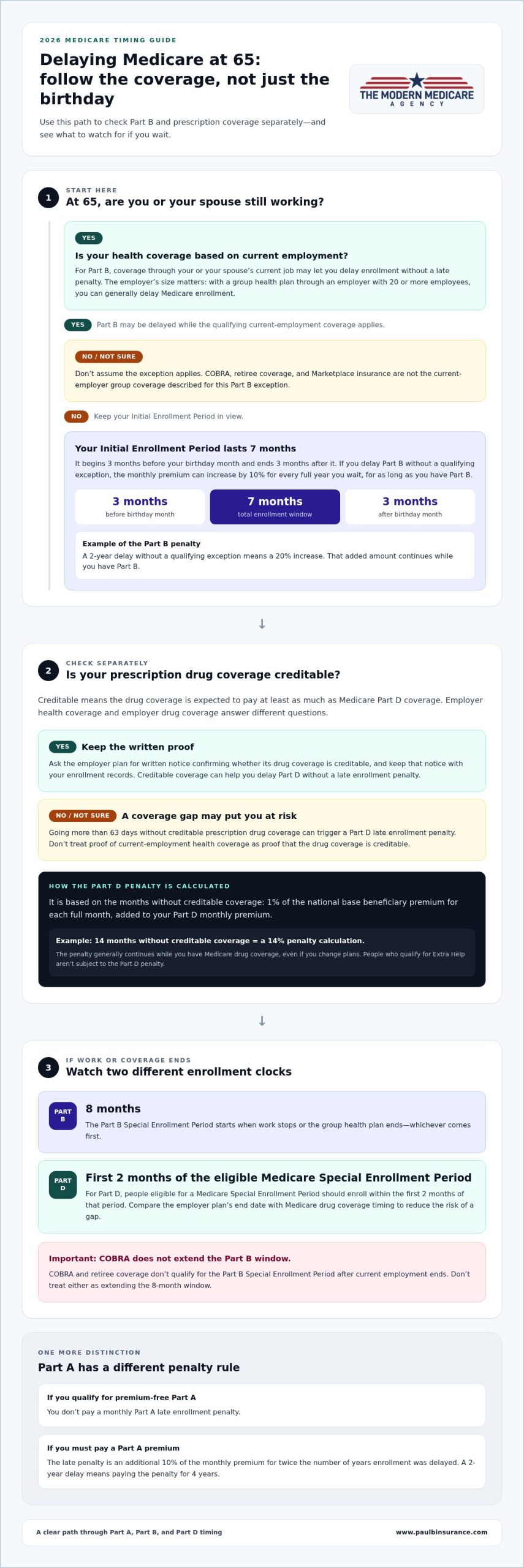
The consequences of not enrolling in Medicare at 65 depend on which parts you delay and whether you have qualifying coverage. According to the Centers for Medicare & Medicaid Services, delaying Part B without an exception can raise your monthly premium by 10% for every full year you wait, for as long as you have Part B. A gap of 63 days or more without creditable prescription drug coverage may also lead to a Part D penalty, according to the Centers for Medicare & Medicaid Services.
It’s understandable to feel unsure about whether turning 65 means you must enroll right away. Your Initial Enrollment Period lasts seven months, beginning three months before your birthday month and ending three months after it. But qualifying coverage through your or your spouse’s current job may allow you to delay Part B without a late penalty.
This article explains when to enroll, how employer coverage affects your timing, and what penalties may apply if you wait. You’ll also learn why the type of coverage you have matters, so you can understand your options and avoid an unexpected gap or lasting extra costs.
Key Takeaways
- Before delaying Part B, distinguish coverage through current employment from COBRA or retiree coverage, which may not protect you from a late penalty.
- Keep the enrollment window tied to your 65th birthday in view, even if you expect to keep other insurance.
- Consider Parts A, B, and D separately. The rules and possible penalties differ, especially if you must pay a Part A premium.
- Find out whether your prescription drug coverage is creditable and keep its written proof to help protect against a Part D penalty.
- When employer coverage ends, pay attention to the separate enrollment timing for Part B and prescription drug coverage.
Creditable prescription drug coverage
At 65, the key question is whether your existing drug plan is creditable, meaning it’s expected to pay at least as much as Medicare drug coverage. For Part B timing, coverage through your or your spouse’s current job may qualify for a Special Enrollment Period; drug coverage must be assessed separately for Part D.
Creditable Drug Coverage and Part D Penalties
Creditable prescription drug coverage is coverage expected to pay at least as much as Medicare Part D coverage. It matters because keeping it can help you delay Part D without a late enrollment penalty. According to the Centers for Medicare & Medicaid Services, in the United States, going more than 63 days without creditable prescription drug coverage can trigger the Medicare Part D late enrollment penalty.
Employer drug coverage may be creditable, but don’t assume every plan qualifies. Ask the employer plan for written notice stating whether its drug coverage is creditable, and keep that notice with your enrollment records. If the coverage isn’t creditable, a gap may put you at risk of a penalty when you later enroll in Part D.
The Part D penalty is based on the months you went without creditable drug coverage after becoming eligible. It is calculated using 1% of the national base beneficiary premium for each full month without coverage, then added to your Part D monthly premium. For example, a 14-month gap can produce a 14% penalty calculation. The penalty generally continues while you have Medicare drug coverage, even if you change plans.
Employer health coverage and employer drug coverage answer different questions. Current employment may create a Part B Special Enrollment Period, while the drug plan’s creditable status affects Part D. If you turn 65 while working, review both notices rather than treating one as proof for both parts of Medicare.
Avoiding Coverage Gaps After Employer Insurance
A coverage gap is a period after employer insurance ends when neither that plan nor Medicare drug coverage protects you. To reduce the risk, compare the employer plan’s end date with your Medicare enrollment timing, and arrange Part D coverage to start when the old drug coverage stops.
When work or employer coverage ends, the Part B Special Enrollment Period lasts 8 months, starting when work stops or the group health plan ends, whichever comes first. COBRA does not extend that Part B window. For Part D, people eligible for a Medicare Special Enrollment Period should enroll within the first 2 months of that period.
What counts as creditable employer health coverage for delaying Medicare? For Part B timing, it generally means group health coverage based on your or your spouse’s current employment. For Part D, the employer’s drug coverage must be expected to pay at least as much as Medicare drug coverage.
How do COBRA, retiree coverage, or Marketplace insurance affect Medicare enrollment penalties? COBRA and retiree coverage don’t qualify for the Part B Special Enrollment Period after current employment ends. Don’t treat either as extending the 8-month window; Marketplace coverage also isn’t the current-employer group coverage described for that exception.
Part B late enrollment penalty
Are you or your spouse still working at 65? Current employer group health coverage may let you delay Part B without a late penalty. The employer’s size and whether coverage is based on current employment matter. If work or that coverage ends, the Special Enrollment Period described in the previous section gives you a limited window to enroll.
According to the Centers for Medicare & Medicaid Services, for every full year a person delays Medicare Part B enrollment, their monthly premium increases by 10 percent for as long as they have Part B. This applies when someone could have enrolled but lacked an exception. The penalty is based on full years of delay, not simply the number of months since turning 65.
A two-year delay without a qualifying exception means a 20% penalty. That added amount continues while the person has Part B, so a delay can affect more than the first year of coverage.
Part A has a different rule. Most people qualify for premium-free Part A through their own or a spouse’s work history. For every full year a person delays Medicare Part B enrollment, their monthly premium increases by 10 percent for as long as they have Part B. If you qualify for premium-free Part A, you don’t pay a monthly Part A late enrollment penalty.
According to the Centers for Medicare & Medicaid Services, Medicare Part A’s late enrollment penalty is an additional 10% of the monthly premium for twice the number of years enrollment was delayed, if the person must pay a Part A premium. Unlike the Part B penalty, this increase lasts for a limited penalty period. For example, a two-year delay means paying the Part A penalty for four years.
Part D has its own penalty rules. A penalty may apply if you enroll late without creditable prescription drug coverage. People who qualify for Extra Help aren’t subject to the Part D penalty. The parts work differently: Part A’s penalty is temporary, while Part B’s generally lasts as long as you remain enrolled.
For people still working, employer coverage through their own job or a spouse’s job can affect Part B timing. At age 65, a person covered by a group health plan through an employer with 20 or more employees can generally delay Medicare enrollment, according to the Centers for Medicare & Medicaid Services. COBRA or retiree coverage isn’t the same as coverage from current employment for this exception.
If you’re comparing prescription coverage while planning your Medicare timing, a Medicare Part D plan may help address drug coverage needs once employer coverage ends.
Delaying Part B enrollment with employer group health insurance
Employer insurance decisions involve more than whether you remain covered. Separate the rules for medical enrollment from those for prescription coverage, and keep the dates and documents for each part organized.
The Part B Special Enrollment Period
This enrollment opportunity lets eligible people sign up for Part B after qualifying coverage connected to current employment ends. It provides a way to enroll after a change in work or coverage, rather than relying on the usual age-based window.
Ask the employer benefits office to document when active employment ends and when the group plan ends. Those dates can differ. Keep written proof of the coverage period and the employee’s work status, especially if coverage is through a spouse. These records help explain why you delayed and support a smoother application.
Who Can Delay Medicare Without a Penalty
People covered through their own or a spouse’s current job may qualify to delay Part B without a late penalty. The key is the source of coverage: insurance tied to active employment differs from coverage that continues after work ends.
Before deciding, ask the benefits office whether the plan is based on current employment and how it coordinates with Medicare. If you’re covered through a spouse, use the working spouse’s employment and plan documents, not just your insurance card. This distinction can help you avoid assuming that any continuing insurance automatically qualifies for an exception.
Coverage Start After Special Enrollment
For coverage timing, use the effective date provided after your completed Part B enrollment is processed. Compare that date with the employer plan’s termination date, and keep the enrollment confirmation with your benefits records. This helps you spot a possible transition gap instead of assuming coverage begins when you submit the paperwork.
Part D requires a separate review. If you decline a drug plan, you won’t have prescription coverage through Part D. Ask the employer plan for written confirmation of its creditable-coverage status and keep the notice with your records. Extra Help can remove the Part D late enrollment penalty for eligible people, but it doesn’t replace the need to understand what drug coverage you have.
Part A is a separate enrollment choice, too. Check whether you qualify for premium-free Part A and consider how enrolling could affect other benefits you use. For example, Medicare enrollment affects Health Savings Account contributions, including employer contributions. Review your HSA arrangements before choosing an enrollment date.
Keep a record of your employment status, health plan dates, drug coverage notice, and Medicare enrollment confirmation. This paper trail can make it easier to explain your coverage history and coordinate each part of Medicare with the insurance you already have.
Initial enrollment period
Your first Medicare enrollment window is a chance to make separate choices about hospital, medical, and prescription coverage. Review each part against the insurance you already have, rather than treating “Medicare” as one all-or-nothing decision.
Start with a clear inventory. Write down who provides your current health insurance, whether it’s tied to active employment, and what it covers. Then note whether prescription drugs are included and whether the plan has provided a creditable-coverage notice. These details help you compare your existing coverage with the Medicare parts you may choose.
For Part A, consider whether your work history or a spouse’s work history qualifies you for premium-free coverage. For Part B, focus on whether you have insurance based on current employment and whether delaying enrollment fits your situation. Assess prescription coverage separately for Part D. A decision about one part doesn’t automatically settle the others.
A simple comparison can make the choices easier to discuss:
- List the services and medicines your current insurance covers.
- Note who holds the policy and whether employment is ongoing.
- Keep the plan’s written information about prescription drug coverage.
- Record which Medicare parts you are considering and why.
People with Marketplace coverage have another detail to handle. When you become eligible for Medicare at 65, sign up for Medicare and notify your Marketplace plan. If you receive Marketplace financial assistance during months when you also have Medicare, you may have to repay some or all of that assistance. If you plan to end Marketplace coverage, wait until Medicare has started before cancelling, so you don’t create a gap.
Also consider any Health Savings Account before enrolling. Once you’re enrolled in Medicare, including Part A alone, you can’t contribute to an HSA. You and your employer should stop HSA contributions 6 months before retirement or applying for Social Security or Railroad Retirement Board benefits to avoid a tax penalty. That timing can affect when you choose to begin Medicare enrollment.
Keep the decision focused on your own coverage. Someone with active employer insurance may face different considerations from a person relying on Marketplace coverage or paying for care without insurance. Record your current plan, drug coverage, and HSA status. This gives you a practical starting point for deciding which Medicare parts fit your circumstances and which enrollment questions to address first.
Medicare eligibility at age 65
In the United States, Medicare eligibility generally begins at age 65. That milestone makes it important to review your health coverage, but eligibility and enrollment are separate decisions. You may qualify for Medicare without needing to enroll in every part immediately. The deciding details include your current insurance, work situation, prescription drug coverage, and whether you qualify for premium-free Part A.
Start by identifying what coverage you already have and who provides it. Insurance through your own or your spouse’s current employer can affect when Part B enrollment makes sense. Retiree or Marketplace coverage works differently from insurance tied to current employment. Don’t assume an insurance card means every Medicare deadline or penalty rule is covered.
Eligibility doesn’t mean every part serves the same purpose. Part A covers eligible inpatient hospital care, Part B covers eligible medical services, and Part D covers prescription drugs. Medicare Advantage is another coverage path to consider when reviewing your options. Comparing these needs separately helps you see what your existing insurance pays for and where a coverage gap could arise.
In 2026, people with a Health Savings Account should account for Medicare enrollment before making contributions. People enrolled in Medicare, including those enrolled only in Part A, cannot contribute to an HSA. The rule can affect both your own contributions and employer contributions. If you’re approaching 65 with an HSA, include it in your enrollment planning instead of focusing only on monthly premiums.
The timing can matter before Medicare starts. People with an HSA and their employers should stop contributions 6 months before retirement or applying for Social Security or Railroad Retirement Board benefits to avoid a tax penalty. This means the date you apply for benefits or retire may affect your HSA contribution schedule. A clear timeline can prevent an overlooked contribution from creating a tax issue.
Marketplace coverage also needs a separate review. If you enroll in Medicare Part A and keep a Marketplace plan, you must pay the full Marketplace plan price, and Medicare becomes the primary payer. If you receive Marketplace financial assistance while covered by Medicare, you may have to repay some or all of that assistance for overlapping months. When leaving Marketplace coverage, wait until Medicare begins before cancelling to avoid a gap.
Age 65 is a useful point to compare eligibility, enrollment timing, and the coverage you need. If a Medicare Advantage plan is part of your review, compare Medicare Advantage options alongside your existing insurance and prescription drug needs.
The Modern Medicare Agency: Medicare Advantage Plans
The Modern Medicare Agency can help you compare Medicare Advantage Plans when you’re weighing coverage options after reviewing your enrollment timing. Its guidance can also help you consider whether a Medicare Supplement (Medigap) Plan or Medicare Part D Plan fits your needs. These are different coverage choices, so it helps to know what you want covered before selecting a plan.
If you’re approaching 65, leaving employer coverage, or reviewing your Medicare choices in 2026, The Modern Medicare Agency can help you compare options and make a more informed decision. You can also explore its Medicare Advantage plan information as you consider your next step.
Contact The Modern Medicare Agency to discuss your Medicare plan options.
Make your next Medicare decision with confidence
Understanding the consequences of not enrolling in Medicare at 65 can help you make a choice that fits your circumstances, rather than relying on assumptions. Take a moment to write down the coverage questions you still have and the decision you want to make next. A focused conversation can help turn uncertainty into a clearer path forward.
If you’d like support comparing Medicare plan options, contact an independent Medicare guide and talk through what matters to you.
You can take this one decision at a time. A little clarity now can help you move forward with greater confidence.
Frequently Asked Questions
Do I need to sign up for Medicare when I turn 65?
Not everyone needs to enroll in every Medicare part immediately at 65. If you have qualifying coverage through your or your spouse’s current job, you may be able to delay Part B. If you don’t have that coverage, delaying may bring penalties or leave medical costs uncovered. Check your insurance source and enrollment dates before your birthday month, then decide separately about hospital, medical, and prescription coverage.
What if I want or need to keep working past 65?
You may be able to keep working and delay Part B if you have qualifying group coverage through your current employer or your spouse’s current employer. According to the Centers for Medicare & Medicaid Services, someone covered through an employer with 20 or more employees can generally delay Medicare enrollment. When employment or group coverage ends, the Part B enrollment window begins, so coordinate dates with your employer’s benefits office.
Will I have to pay a premium for Part A?
Most people don’t pay a monthly premium for Part A. A person or spouse who worked and paid Medicare taxes for at least 10 years generally qualifies for premium-free Part A. If you don’t meet that work-history requirement, you may need to buy Part A.
What happens if you don’t enroll in Medicare at 65?
The consequences of not enrolling in Medicare at 65 depend on your coverage and which parts you delay. Without other insurance, you may have to pay medical and prescription costs yourself. Delaying Part B without a qualifying exception can lead to a lasting premium penalty, while a Part D penalty may apply after a gap in creditable drug coverage. Premium-free Part A has different rules from premium-bearing Part A.
What is the Medicare Part B late enrollment penalty and how is it calculated?
The Part B penalty adds 10% to your monthly premium for each full 12-month period you delayed enrollment without qualifying coverage. It generally continues for as long as you have Part B. For example, a two-year delay produces a 20% penalty.
What is the Medicare Part D late enrollment penalty and how much does it cost?
The Part D penalty is based on each full month you lacked creditable prescription drug coverage after becoming eligible. It generally continues while you have Part D coverage.
When can you enroll in Medicare after missing your initial enrollment period?
If you missed your Initial Enrollment Period and don’t qualify for a Special Enrollment Period, you can use the General Enrollment Period from January 1 to March 31. Coverage starts July 1 of that year. If you delayed Part B because of qualifying coverage through current employment, a Special Enrollment Period may apply after work or group coverage ends. The reason for delaying determines which window fits.
What health care costs might you face without Medicare coverage at 65?
Without Medicare or other insurance, you may be responsible for the full cost of covered care you receive, including hospital stays, medical services, and prescription drugs. The amount depends on the care, medicines, and providers involved. For example, someone who needs a hospital stay and ongoing prescriptions may face separate bills for each. Employer or other insurance can change what you pay, so review what it covers.

Article by
Paul Barrett
Paul Barrett, CMIP is the founder of The Modern Medicare Agency, an independent Medicare-only brokerage based in Melville, NY. With 18 years of Medicare-exclusive experience, a CMIP designation, and more than 5,000 clients served across 37 states, Paul is one of the most credentialed independent Medicare specialists on Long Island — and one of the most direct.
He represents 40+ carriers with no quotas and no allegiances, which means his recommendations are based entirely on what fits each client's specific situation. He is the author of Medicare Mastery Unlocked and host of the Wise Guys Retirement Talk podcast. His content is grounded in primary sources, real carrier intelligence, and 18 years of watching what happens when people get Medicare right — and when they don't.
📞 631-358-5793 | paulbinsurance.com