As you plan for retirement, one of the biggest sources of stress can be unexpected healthcare costs-especially when it comes to your teeth. You’ve paid into the system for years, but now you’re navigating a confusing maze of rules with one nagging question at the center of it all: does medicare cover dental? It’s a concern that leaves many retirees worried about facing high, unexpected bills for essential care and feeling overwhelmed by the different insurance options available.
The short answer is, unfortunately, not what most people hope to hear. But that doesn’t mean you’re out of options or have to go without the care you need. In this straightforward 2026 guide, we will provide the clear, simple answers you deserve. We’ll walk you through exactly what Medicare does and does not cover, explore your best options for comprehensive dental coverage-from cleanings to dentures-and give you the trusted guidance to choose a plan that protects both your smile and your savings.
Key Takeaways
- The direct answer to does medicare cover dental is no for routine care, but there are critical exceptions for medically necessary procedures you should know about.
- While Original Medicare falls short, you have three excellent pathways to get the affordable dental coverage you need and deserve.
- Discover the key differences between getting dental benefits bundled in a Medicare Advantage plan versus purchasing a more flexible standalone policy.
- Learn the simple questions to ask yourself before enrolling, ensuring you choose a dental plan that truly fits your budget and healthcare needs.
The Direct Answer: What Original Medicare (Part A & B) Covers
It’s one of the most frequent and important questions we help people navigate: does Medicare cover dental? For millions of Americans, dental health is a crucial part of their overall well-being, so it’s natural to assume it would be included. The straightforward answer, however, is that Original Medicare (Part A and Part B) does not cover routine dental care.
This news can be surprising and frustrating, but understanding the specific rules is the first step toward finding the right solution. Let’s provide some clear guidance on what this means for you and your oral health.
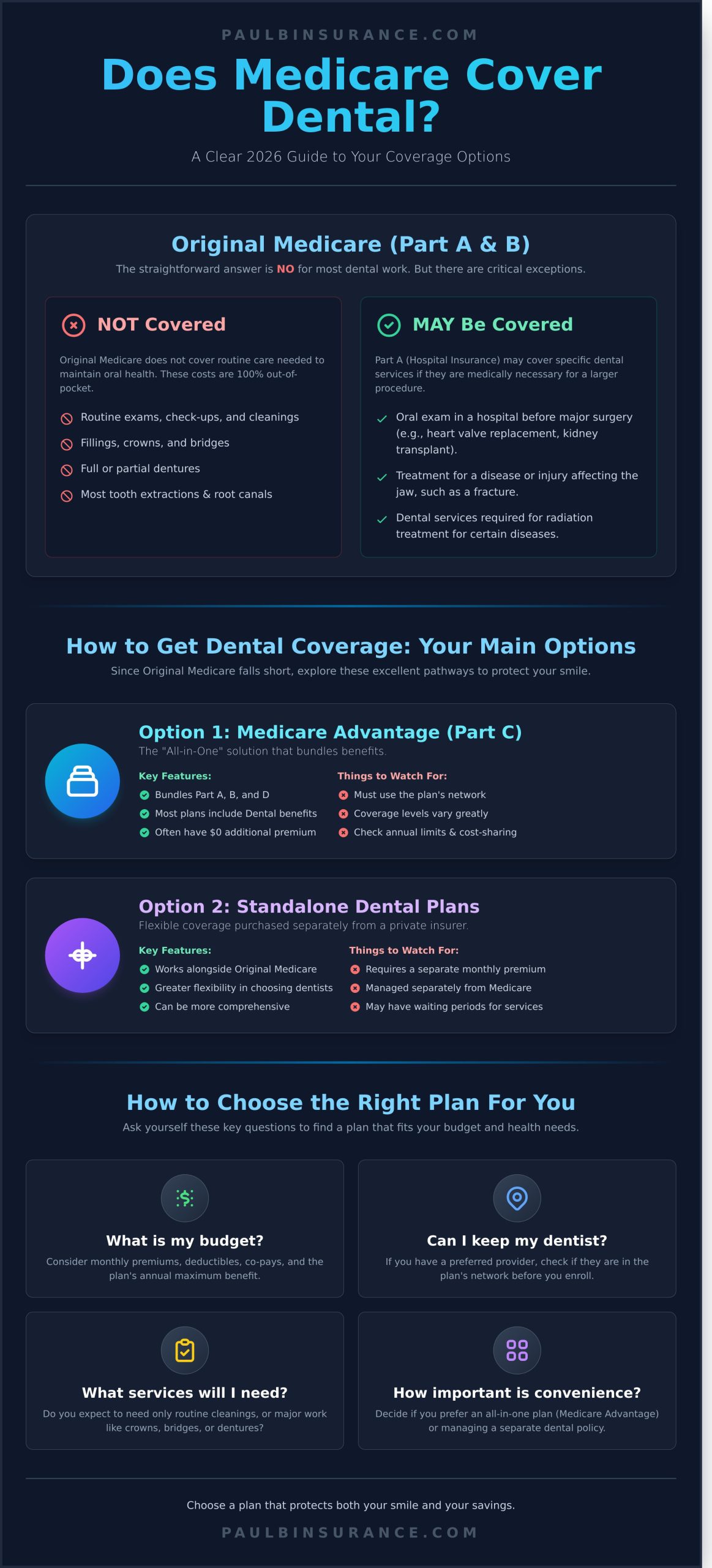
What Original Medicare Does NOT Cover (Most Dental Care)
When Medicare states it doesn’t cover “routine” care, it’s referring to the vast majority of services needed to maintain oral health. Without another form of coverage, these costs are paid entirely out-of-pocket. This is the primary reason why many beneficiaries seek out separate dental insurance plans or Medicare Advantage plans that include dental benefits. Original Medicare will not pay for common procedures such as:
- Routine exams, check-ups, and cleanings
- Fillings, crowns, or bridges
- Full or partial dentures
- Most tooth extractions
- Root canals and other endodontic procedures
When Medicare MIGHT Cover Dental Services (The Exceptions)
While the general rule is no, there are a few very specific and rare exceptions. Medicare Part A (Hospital Insurance) may help pay for certain dental services that you get when you’re in a hospital. These situations are not for routine care but are considered medically necessary as part of a larger covered procedure. Examples include:
- An oral exam in the hospital prior to a major operation like a kidney transplant or heart valve replacement to check for infection.
- Treatment for a disease or injury affecting the jaw, such as a fracture.
- Dental services required for radiation treatment for neoplastic diseases.
It is critical to understand that these are not loopholes for getting regular dental work done; they are tied to a specific, covered medical crisis.
| Routine Care (NOT Covered) | Medically Necessary Exceptions (MAY Be Covered) |
|---|---|
| ❌ Cleanings & Check-ups | ✅ Oral exam in a hospital before major surgery |
| ❌ Fillings & Crowns | ✅ Treatment for a fractured jaw |
| ❌ Dentures & Bridges | ✅ Tooth extraction needed for radiation treatment |
How to Get Dental Coverage: Your 3 Main Options
While the answer to the question “does medicare cover dental” is often ‘no’ for routine care under Original Medicare, the good news is you have several excellent ways to get the coverage you need. Navigating these choices can feel confusing, but we’re here to provide clear, straightforward guidance.
Your best path forward depends on your unique health needs, your budget, and the specific plans available in your area. Let’s break down your three primary options to help you move from confusion to confidence in your decision.
Option 1: Medicare Advantage (Part C) Plans
Often called “all-in-one” plans, Medicare Advantage plans are offered by private insurance companies approved by Medicare. They bundle your hospital (Part A), medical (Part B), and usually prescription drug (Part D) coverage into a single plan. A major benefit is that most MA plans include extra benefits like vision, hearing, and dental at no additional monthly premium. However, it’s crucial to understand that coverage levels vary significantly. A recent KFF analysis of Medicare dental coverage highlights that while access is widespread, you must pay close attention to each plan’s specific network, cost-sharing, and annual limits.
Option 2: Standalone Dental Insurance Plans
If you have Original Medicare or a Medicare Advantage plan with limited dental benefits, a standalone dental insurance policy is another powerful choice. You purchase this policy directly from a private insurer, and it works alongside your primary Medicare coverage. These plans often provide more robust and comprehensive benefits for major services than what’s typically bundled into an MA plan. While you will have a separate monthly premium, this can be a worthwhile investment if you anticipate needing significant dental work.
Option 3: Dental Discount Programs
It’s important to know that this is not insurance, but rather a membership-based program. You pay an annual fee to join and gain access to a network of dentists who have agreed to provide their services at a discounted rate. Key advantages include:
- No annual deductibles
- No waiting periods for major procedures
- No annual coverage maximums
This makes it a great option for those who need immediate savings on dental procedures without the complexities or limitations of a traditional insurance plan.
A Closer Look at Medicare Advantage Dental Benefits
For most beneficiaries, the answer to the question “does medicare cover dental” is found within Medicare Advantage (MA) plans. These are often called “Part C” plans and are offered by private insurance companies approved by Medicare. Unlike Original Medicare, which has very strict rules on dental care as outlined in this detailed Medicare Interactive guide to dental coverage, the vast majority of MA plans bundle in routine dental, vision, and hearing benefits. This all-in-one approach is a primary reason for their popularity.
Common Coverage Tiers in MA Plans
Most Medicare Advantage dental benefits are structured in tiers, which helps you understand your out-of-pocket costs for different types of services. While every plan is different, a typical structure looks like this:
- Preventive Care: Usually covered at 100%. This includes routine services that keep your teeth healthy, like biannual cleanings, exams, and standard X-rays.
- Basic Services: Often requires a fixed copay per service. This tier covers common procedures like fillings, simple tooth extractions, and sometimes deep cleanings.
- Major Services: Typically covered at a lower percentage, meaning you pay coinsurance (e.g., 50%). This includes more complex and expensive procedures like crowns, bridges, dentures, and root canals.
Key Terms to Understand: Networks and Maximums
To get the most from your plan, it’s vital to understand a few key terms. MA plans operate within provider networks, usually an HMO or PPO. This means you must see a dentist who is in-network to receive the highest level of coverage; going out-of-network often means paying much more. Additionally, most plans have an annual benefit maximum-a cap on what the plan will pay for your dental care per year, often between $1,000 and $2,000. Once you reach this limit, you are responsible for 100% of the costs.
Pros and Cons of Bundled Dental Benefits
While convenient, it’s important to weigh the advantages and disadvantages. The primary pros are the convenience of having medical and dental coverage in one plan, often for no additional monthly premium, and robust coverage for preventive care. However, the cons can include limited dentist choice due to networks and annual maximums that may not be high enough to cover extensive dental work. This is a critical detail when determining if a plan truly solves your needs for dental coverage.
Understanding these details is the first step toward making a confident choice. Compare Medicare Advantage plans with dental benefits in your area.
Standalone Dental Plans: When Do They Make Sense?
Since the answer to “does medicare cover dental” is often no for routine care under Original Medicare, many people feel stuck. If the dental benefits in a Medicare Advantage plan don’t meet your needs, or if you have Original Medicare, a standalone dental plan can be an excellent solution. These are private insurance policies you purchase separately to gain predictable, robust coverage for your oral health.
They work alongside your Original Medicare, filling a critical gap and providing peace of mind. The primary advantages are freedom of choice and more comprehensive benefits, allowing you to tailor coverage directly to your anticipated needs.
Who Should Consider a Standalone Plan?
A separate dental plan isn’t for everyone, but it provides tremendous value if you:
- Anticipate extensive dental work. If you know you’ll need procedures like implants, root canals, bridges, or multiple crowns, the robust coverage of a standalone plan can save you thousands of dollars.
- Want to keep your trusted dentist. Many standalone PPO plans offer large networks and out-of-network benefits, giving you the freedom to see the provider you know and trust, even if they aren’t in a Medicare Advantage network.
- Prefer higher annual maximums. If you’re concerned about hitting a low coverage limit, these plans often offer higher annual maximums (e.g., $1,500, $2,000, or more), offering a stronger financial safety net.
Understanding Waiting Periods
One key feature to understand is the waiting period. This is a set amount of time you must be enrolled in the plan before certain benefits kick in-typically for major services like crowns or dentures. Insurance companies use these (often 6-12 months) to prevent individuals from signing up just to have an expensive procedure covered and then immediately canceling. This helps keep premiums stable for all members. If you foresee needing major work, it’s crucial to plan ahead and enroll before you need it.
Navigating these options and finding the right fit for your health and budget is a common challenge. The question of does medicare cover dental care leads to many other choices, but you don’t have to figure it out alone. For clear, unbiased guidance on finding a dental plan that works for you, our team is here to provide trusted support.
How to Choose the Right Dental Coverage for You
Navigating the world of dental plans can feel just as confusing as Medicare itself. But finding the right coverage doesn’t have to be a stressful process. The key is to start with your own unique needs before you even look at a single plan. By asking yourself a few simple questions, you can move from confusion to confidence and choose a plan that truly works for you. This straightforward, three-step approach will provide the clarity you need.
Step 1: Assess Your Dental Health Needs
Before you compare plans, take a moment to look at your personal oral health. An honest assessment today can save you from being underinsured tomorrow. Ask yourself:
- Do I generally only need preventive care like two cleanings a year, or am I expecting more significant work like a crown, bridge, or dentures soon?
- What dental services have I used in the past two or three years?
- Considering my age and overall health, what future needs might arise?
Having a clear picture of your needs helps ensure you don’t pay for robust benefits you’ll never use, or choose a minimal plan that leaves you with major out-of-pocket costs.
Step 2: Check Your Dentist’s Network
For many people, the relationship with their dentist is built on years of trust. If keeping your provider is a priority, this step is critical. Before enrolling in any plan, call your dentist’s office and simply ask which Medicare Advantage or standalone dental plans they accept. This quick phone call can prevent the frustration of discovering your trusted dentist is out-of-network after you’ve already signed up.
Step 3: Compare Your Total Costs
A $0 monthly premium can be very appealing, but it rarely tells the whole story. To understand the true cost of a plan, you must look at the complete financial picture. Consider all the potential out-of-pocket expenses:
- Deductible: How much you must pay before the plan begins to cover services.
- Copays & Coinsurance: The fixed amount or percentage you pay for each visit or procedure.
- Annual Maximum: The absolute most the insurance plan will pay for your care in a year.
A zero-premium plan with high coinsurance could cost you far more than a plan with a modest premium and predictable copays. Instead of just asking “does Medicare cover dental,” the better question is, “how much will I actually pay when I use my benefits?” For unbiased help crunching the numbers, we’re here to provide support. Get a free, personalized comparison of your dental options.
Navigating Your Dental Coverage with Confidence
Understanding your options for dental care with Medicare doesn’t have to be a stressful process. The most important takeaway is that while Original Medicare offers very limited dental benefits, you are not without a solution. Your path to comprehensive coverage lies with either a Medicare Advantage plan that includes dental, or a standalone dental insurance policy. So, while the initial answer to does medicare cover dental can be frustrating, the good news is that strong, affordable options are available.
Choosing the right one, however, can feel like navigating a maze. That’s where expert guidance makes all the difference. With unbiased advice on over 40 insurance carriers, Paul has helped more than 5,000 clients move from confusion to confidence. You can receive this same dedicated support with a no-cost consultation to find the plan that truly fits your needs and budget.
You deserve peace of mind and a healthy smile. Let us help you find it.
Get free, unbiased help finding the right dental coverage. Schedule a call with Paul.
Frequently Asked Questions About Medicare and Dental Coverage
Can I get dental coverage if I have a Medicare Supplement (Medigap) plan?
This is a common point of confusion, and it’s important to clarify. Medicare Supplement (Medigap) plans are designed to help pay for the out-of-pocket costs of Original Medicare, like deductibles and coinsurance. They do not add new benefits. Since Original Medicare doesn’t cover routine dental care, a Medigap plan won’t either. To get coverage for cleanings, fillings, or major work, you will need to purchase a separate, standalone dental insurance plan alongside your Original Medicare and Medigap.
What specific dental services are usually covered by Medicare Advantage plans?
Coverage varies significantly from one Medicare Advantage (Part C) plan to another, so it’s crucial to check the details. Most plans that include dental benefits will cover preventive services like cleanings, routine exams, and annual X-rays at little to no cost. Many also provide coverage for basic services such as fillings and extractions. More comprehensive plans might help pay for major work like root canals, crowns, and bridges, but these often come with higher cost-sharing and annual benefit limits.
How much does a standalone dental insurance plan for seniors typically cost?
The cost of a standalone dental plan can vary quite a bit, but you can typically expect to pay between $20 and $70 per month. The exact premium depends on several factors, including your location and the level of coverage you choose. A basic plan covering only preventive care will be on the lower end, while a more comprehensive plan that helps pay for major services like crowns and dentures will have a higher monthly premium and a higher annual benefit limit.
Can I enroll in a dental plan at any time of the year?
This depends on the type of plan you are considering. For most standalone dental insurance plans that are separate from Medicare, you can enroll at any time throughout the year. However, if you want to get your dental benefits through a Medicare Advantage plan, you must enroll during a designated enrollment period. These include your Initial Enrollment Period when you first become eligible for Medicare, or the Annual Enrollment Period (AEP) each fall, from October 15 to December 7.
Will Medicare pay for dentures or dental implants?
This is one of the most important questions we hear, as these procedures can be costly. Original Medicare (Parts A and B) will not pay for dentures or dental implants. The frequent question, “does medicare cover dental,” often comes from seniors needing this type of major restorative work. To get help paying for these items, you would need to enroll in a Medicare Advantage plan that includes comprehensive dental benefits or purchase a robust standalone dental insurance policy.
Are there any programs that help low-income seniors with dental costs?
Yes, several valuable programs can provide support. In some states, Medicaid offers comprehensive dental benefits for eligible low-income seniors. You can also look into local dental schools or university clinics, which often provide quality care at a significantly reduced cost. Additionally, community health centers funded by the federal government offer dental services on a sliding fee scale based on your income. Non-profit organizations like the Dental Lifeline Network may also be able to help.