




Why does the healthcare system that protects your heart often ignore the teeth you use to nourish your body? If you’ve recently received a high quote for a tooth replacement, you’re likely asking: does medicare cover dental implants in 2026? We know the frustration of “sticker shock” when you realize your standard insurance often stops right at your gumline. It’s stressful to feel like you have to choose between your life savings and your ability to eat and smile comfortably. We’re here to tell you that you don’t have to navigate this complicated system alone.
We’ve built this guide to act as your patient, expert map through the 2026 insurance landscape. We believe you deserve a clear path to health without the anxiety of hidden costs or confusing jargon. We’ll explain exactly where Original Medicare falls short and, more importantly, which specific Medicare Advantage and standalone dental plans offer real solutions this year. We’ll walk you through the benefits, waiting periods, and network rules so you can make a choice that gives you total peace of mind. Your journey from uncertainty to a confident decision starts right here.
Key Takeaways
- Learn why Original Medicare usually excludes dental work and how to identify the rare cases where it might be considered medically necessary.
- Explore the 2026 Medicare Advantage options that offer robust dental benefits to help you avoid massive out-of-pocket costs.
- Find out why your Medigap policy doesn’t answer the question of does medicare cover dental implants and how standalone dental insurance can provide the security you need.
- Discover how we compare over 40 different insurance carriers to find the specific plans that prioritize your oral health and financial stability.
- Get a clear, simple roadmap that takes the stress out of enrollment and ensures you don’t overpay for the care you deserve.
The Reality of Original Medicare and Dental Implants in 2026
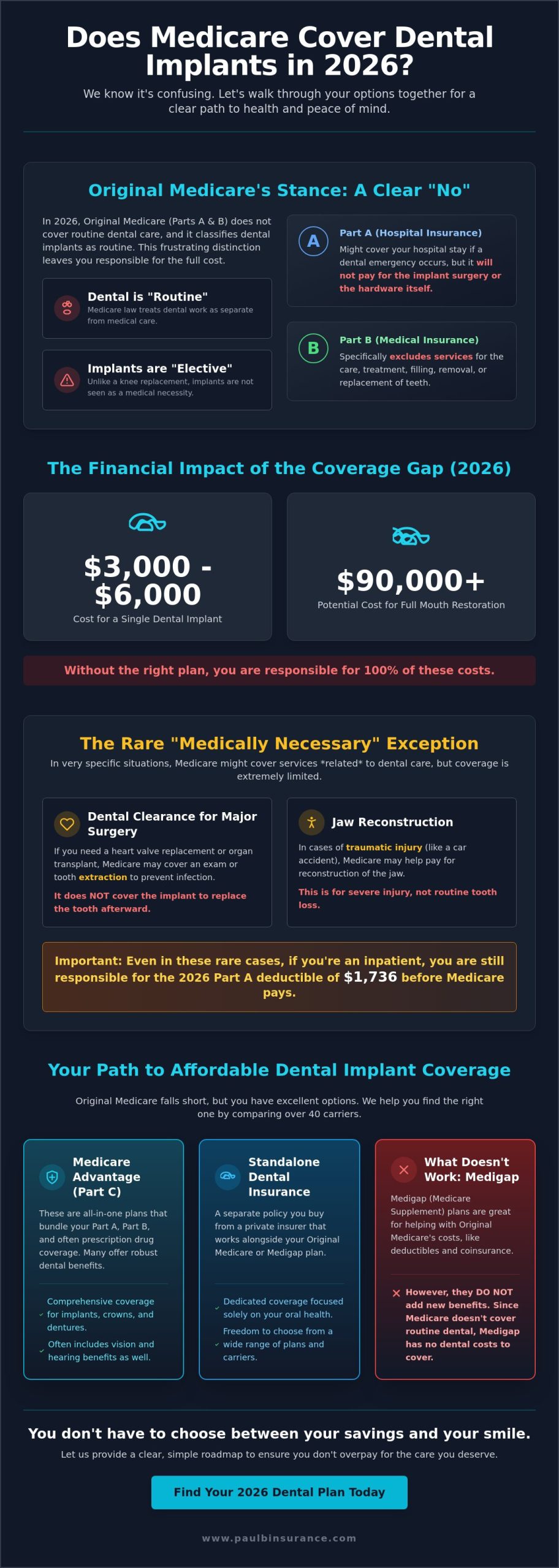
We often speak with people who feel blindsided by their dental bills. A dental implant is a sophisticated surgical procedure where a titanium post is placed into your jawbone to act as a tooth root. While it is a vital health service for many, the answer to the question “does medicare cover dental implants” remains a firm no under Original Medicare in 2026. This gap in coverage exists because the Social Security Act treats dental health as “routine” rather than “medical.” It is a frustrating distinction that leaves many seniors feeling unprotected. We understand that your ability to chew and speak is just as important as your ability to walk. Unfortunately, the system hasn’t caught up to that reality yet.
Why Part A and Part B Say No
Medicare Part A covers your hospital stays. It might pay for a room if you need a dental procedure due to a medical emergency, but it won’t pay for the actual dental hardware or the surgery itself. Medicare Part B covers outpatient medical services, yet it specifically excludes services related to the care, treatment, filling, removal, or replacement of teeth. This exclusion is a major hurdle. Because Medicare classifies implants as “elective” or “routine” dental care, they aren’t treated with the same necessity as a hip or knee replacement. Understanding how dental insurance works in the private sector helps highlight why this gap is so significant. Traditional Medicare simply wasn’t designed to be a dental provider, and that hasn’t changed in 2026.
The Financial Impact of the Coverage Gap
The costs of ignoring this gap can be overwhelming. In 2026, a single dental implant can cost between $3,000 and $6,000 without any coverage. If you need a full mouth restoration, that price can soar toward $90,000. Many people asking “does medicare cover dental implants” are shocked to find they are responsible for the entire bill. Some try to use dental discount cards, but these often fail to cover the high costs of major surgery. They might offer a small percentage off, but you are still left with a massive bill. We believe you shouldn’t have to choose between your savings and your smile. A dedicated dental insurance plan is often the only way to make these procedures affordable. As of 2026, Original Medicare does not provide coverage for dental implants or the related surgical procedures required to place them.
The “Medically Necessary” Exception: When Medicare Might Pay
We often meet people who feel stuck in a difficult spot. They have a major medical procedure scheduled, but their surgeon won’t move forward until their dental health is cleared. You might wonder, in these high-stakes moments, does medicare cover dental implants to help you get the care you need? While the official stance on Original Medicare dental coverage is that routine care isn’t included, there are rare “medically necessary” exceptions. These exceptions are narrow. They focus on protecting your overall health during a crisis rather than restoring your smile for the long term. It’s a subtle distinction that can lead to significant confusion during an already stressful time.
In 2026, if your dental work is tied to a covered medical service, Medicare might pay for the initial exam or the removal of a tooth to prevent infection. However, even in these cases, Medicare rarely pays for the actual implant hardware. If these services happen while you are an inpatient in the hospital, you’ll be responsible for the 2026 Part A deductible of $1,736 before Medicare begins to pay its share. We want to make sure you’re prepared for these costs so they don’t catch you by surprise.
Dental Clearance for Major Surgeries
Surgeons are very careful about infection risks. If you’re preparing for a heart valve replacement or an organ transplant, bacteria from an untreated dental infection can travel through your bloodstream and cause life-threatening complications. Because of this risk, Medicare Part B may cover a dental exam to “clear” you for surgery. It’s important to remember the limitation here. Medicare’s goal is to remove the medical threat. They might pay to extract an infected tooth to keep your heart safe, but they won’t pay for the implant to replace that tooth once you’ve recovered. If you’re feeling overwhelmed by these rules, we can help you look at plans that fill these specific gaps.
Jaw Reconstruction and Traumatic Injury
There are situations where dental work shifts from “routine” to “maxillofacial surgery.” This usually happens after a severe accident or during treatment for oral cancer. If your jaw needs to be reconstructed to function properly, Medicare may cover the surgical components. Because these cases are so complex, they almost always require pre-authorization from Medicare. The focus is on restoring the structure of your jaw rather than the cosmetic appearance of your teeth. Even in these traumatic cases, getting coverage for the final dental implants is a steep uphill climb that requires detailed documentation from your medical team.
How Medicare Advantage (Part C) Changes the Math
We know that hearing a flat “no” from Original Medicare is disheartening. However, Medicare Advantage plans, also known as Part C, offer a much more hopeful story in 2026. These plans are provided by private insurance companies that must follow Medicare rules but can offer extra benefits. So, does medicare cover dental implants through these private options? The answer is often yes, but the level of support depends entirely on which plan you choose. In 2026, we’ve seen insurers compete harder than ever by expanding their “comprehensive dental” benefits to attract new members.
It is important to remember that not every Advantage plan is the same. Some plans might only cover basic cleanings, leaving you with a $0 benefit for major surgery. If a plan doesn’t include implant coverage automatically, you can often add an Optional Supplemental Benefit (OSB). This is a small monthly premium that allows you to “buy up” to higher levels of dental care. While Medicare coverage for dental services remains limited in the public program, these private additions can protect your budget from the full cost of an implant.
Comprehensive vs. Preventive Dental Benefits
We want to help you understand the terminology you’ll see in plan brochures. Preventive dental covers things like routine cleanings and X-rays. Dental implants fall under “comprehensive” or “major” services. When we review plans with you, we look closely at the Evidence of Coverage (EOC) document. This paperwork lists the annual maximum benefit, which is the most the plan will pay for your dental care each year. In 2026, these limits typically range between $1,000 and $3,000, though some premium plans offer up to $5,000. You will also likely pay a coinsurance of 20% to 50% for the procedure after you meet your dental deductible.
Navigating 2026 Network Requirements
Choosing the right dentist is a critical step in this process. Most Advantage plans use either an HMO or a PPO network. An HMO generally requires you to see a dentist on a specific list to receive any coverage at all. A PPO gives you more freedom to see specialists, but going out-of-network usually means you’ll pay a much higher share of the cost. We’ve seen people face unexpected bills because they didn’t realize their oral surgeon was outside their plan’s network. You can learn more about our Medicare Advantage Guide to see how to compare these networks and find a plan that includes your favorite providers.
Standalone Dental Insurance & Medigap Alternatives
We often speak with clients who feel a sense of relief once they sign up for a Medicare Supplement plan. They assume that because they have “the best” coverage, every health need is finally handled. One of the most common questions we hear is: “I have Medigap, so I’m covered for my surgery, right?” We have to be gentle but honest. When it comes to the question of does medicare cover dental implants, a Medigap policy doesn’t change the answer. If Original Medicare doesn’t pay for the procedure, your supplement won’t either. It’s a gap that catches many people off guard, but we’re here to help you bridge it.
Medigap and Dental: The Missing Piece
Medicare Supplement plans are designed to follow the rules of Original Medicare. They are excellent at covering the 20% that Part B leaves behind for doctor visits and hospital stays. However, since Part B excludes most dental work, your Medigap plan has no “bill” to supplement. To solve this, we often help our clients add “Dental Riders” to their strategy. These are small additions that provide a specific bucket of money for your teeth while allowing you to keep the doctors you trust. You can explore our Medigap plan options to see how these pieces fit together to create a complete safety net.
Choosing a Standalone 2026 Dental Plan
If you prefer to stay on Original Medicare but need help with a $5,000 implant quote, a standalone dental insurance policy is your strongest tool. In 2026, these plans offer a level of flexibility that Medicare Advantage sometimes lacks. You aren’t tied to a specific medical network, and you can often find higher annual maximums. When we look at options for you, we prioritize 2026 plans that offer “Day One” coverage for major services. This is vital because many standard policies have a “Waiting Period” trap. This means you might have to pay premiums for 12 to 24 months before the plan pays a single dollar toward an implant. We want to help you avoid that delay. You can find a 2026 Dental Insurance Plan that works for your timeline through our independent search process.
We believe in looking at the math clearly. While a high-quality dental plan has a monthly premium, it is often a fraction of the cost of paying for a single implant out of pocket. By spreading the cost over time, you protect your savings from a sudden, massive bill. If you’re ready to secure your dental health without the stress of hidden rules, let us help you compare plans today. We’ll make sure you understand the fine print so you can move forward with confidence.
Navigating Your 2026 Options with The Modern Medicare Agency
We understand that looking for answers can feel like a second job. You’ve seen the gaps in Original Medicare and the complexity of Advantage networks. You might still be asking, does medicare cover dental implants in a way that actually fits my budget? This is where we step in as your personal advocates. We don’t work for the insurance companies. We work for you. As independent brokers, our only goal is to find the plan that protects your health and your wallet. We believe you deserve an expert who listens to your needs rather than a representative who only has one product to sell.
In 2026, the insurance market is crowded with over 40 different carriers. Each one has different rules for major dental work. We use our expertise to filter through these options to find the specific “implant friendly” plans available in your area. We don’t just sign you up and disappear. We provide year-round support to help you understand your billing and use your benefits correctly. Our mission is to lead you on a journey from a state of distress to one of complete certainty.
Our Step-by-Step Selection Process
We follow a methodical path to ensure you never feel rushed or pressured. First, we check your preferred doctors and dentists to ensure they are in-network for the 2026 plan year. Second, we analyze your monthly budget against the potential out-of-pocket costs of an implant procedure. We want to make sure the math works for you. Third, we present the top three unbiased options available in your specific zip code. This structured approach removes the guesswork and helps you see the clear benefits of each choice.
Why a Local Expert Matters in 2026
Insurance isn’t the same everywhere. Regional differences in New York, Florida, and California significantly affect which plans are available and how much they pay for dental surgery. We understand these local markets deeply. If you are looking for the “Melville Advantage,” you’ll find it in our personal service. We are a team that knows your neighborhood and the specific providers in your community. We are here to serve and protect our clients, acting as the unambiguous champion for your health. Contact The Modern Medicare Agency for a simple, expert review of your 2026 options and let us help you find the peace of mind you deserve.
Secure Your Smile and Your Savings in 2026
We’ve explored how Original Medicare leaves a gap, but private options like Advantage plans and standalone dental insurance provide a solution. By now, you know the answer to does medicare cover dental implants depends entirely on choosing a strategy that fits your specific needs. You shouldn’t have to face these complex 2026 rules alone. We provide access to over 40 top-rated insurance carriers and offer unbiased advice tailored to you. Our team is licensed in over 34 states, including NY, FL, and CA, to ensure you have the best local support possible.
Let us take the stress out of Medicare—get your free 2026 plan comparison today!
Frequently Asked Questions
Is a dental implant considered a “cosmetic” procedure by Medicare?
Medicare classifies dental implants as routine dental care rather than a medical necessity. This means they are viewed similarly to cleanings or fillings, which are excluded from Original Medicare coverage. While you might feel the procedure is essential for your health, the system labels it as elective. We help you look past these labels to find private plans that recognize the true value of your dental health.
How much does Medicare Advantage typically pay for dental implants in 2026?
Most 2026 Medicare Advantage plans that offer comprehensive dental have an annual maximum benefit between $1,000 and $3,000. Some premium plans may even offer up to $5,000. You will typically pay a coinsurance of 50% for the implant after you meet your deductible. Because every plan is different, we compare over 40 carriers to find the one that offers you the most protection.
Can I use my Medicare Part B to pay for the tooth extraction before an implant?
Medicare Part B generally does not cover tooth extractions if the purpose is to prepare for a dental implant. It only pays for extractions in very rare cases, such as when a tooth must be removed to treat a non-dental medical condition like oral cancer. If you are asking does medicare cover dental implants or the prep work involved, the answer for Part B is almost always no.
What happens if I need a dental implant due to an injury or accident?
If you suffer a traumatic injury to your jaw, Medicare Part A or Part B might cover the reconstruction of the jawbone. However, even after an accident, the actual dental implant used to replace a tooth is often still excluded. These cases are very complex and require careful documentation from your doctors. We can help you navigate these specific medical claims to ensure you get every dollar you are owed.
Are there waiting periods for dental implant coverage in 2026 Medicare plans?
Many standalone dental plans and some Medicare Advantage options have waiting periods of 12 to 24 months for major procedures. This means you must be a member for a certain time before they help pay for an implant. We specialize in finding 2026 plans that offer “Day One” coverage for major services. This helps you get the care you need without waiting years for your benefits to start.
Does Medicare Part D cover the prescriptions I might need after dental implant surgery?
Yes, your Medicare Part D plan will typically cover the antibiotics or pain medications your dentist prescribes after surgery. As long as the medication is on your plan’s list of covered drugs, you should only be responsible for your standard copay. We always double check your Part D formulary to make sure your common prescriptions are covered. This gives you one less thing to worry about during your recovery.
What is the best Medicare plan that covers everything, including dental?
There isn’t one single plan that is the “best” for everyone because coverage varies by your zip code and health needs. A plan that works for someone in New York might not be available in Florida. Our role is to act as your guide. We look at your specific dentists and budget to find the most comprehensive 2026 option available to you. We prioritize your peace of mind over any specific insurance company.
Can I get dental coverage if I choose a Medigap plan instead of Medicare Advantage?
Medigap plans do not include dental coverage because they only fill the “gaps” in Original Medicare. Since Original Medicare doesn’t cover implants, Medigap won’t either. However, we can help you set up a standalone dental insurance policy to run alongside your Medigap plan. This gives you the freedom of Original Medicare with the added security of a dedicated dental benefit. It is a very popular strategy for our clients.

Article by
Paul Barrett
Paul Barrett, CMIP is the founder of The Modern Medicare Agency, an independent Medicare-only brokerage based in Melville, NY. With 18 years of Medicare-exclusive experience, a CMIP designation, and more than 5,000 clients served across 37 states, Paul is one of the most credentialed independent Medicare specialists on Long Island — and one of the most direct.
He represents 40+ carriers with no quotas and no allegiances, which means his recommendations are based entirely on what fits each client's specific situation. He is the author of Medicare Mastery Unlocked and host of the Wise Guys Retirement Talk podcast. His content is grounded in primary sources, real carrier intelligence, and 18 years of watching what happens when people get Medicare right — and when they don't.
📞 631-358-5793 | paulbinsurance.com