



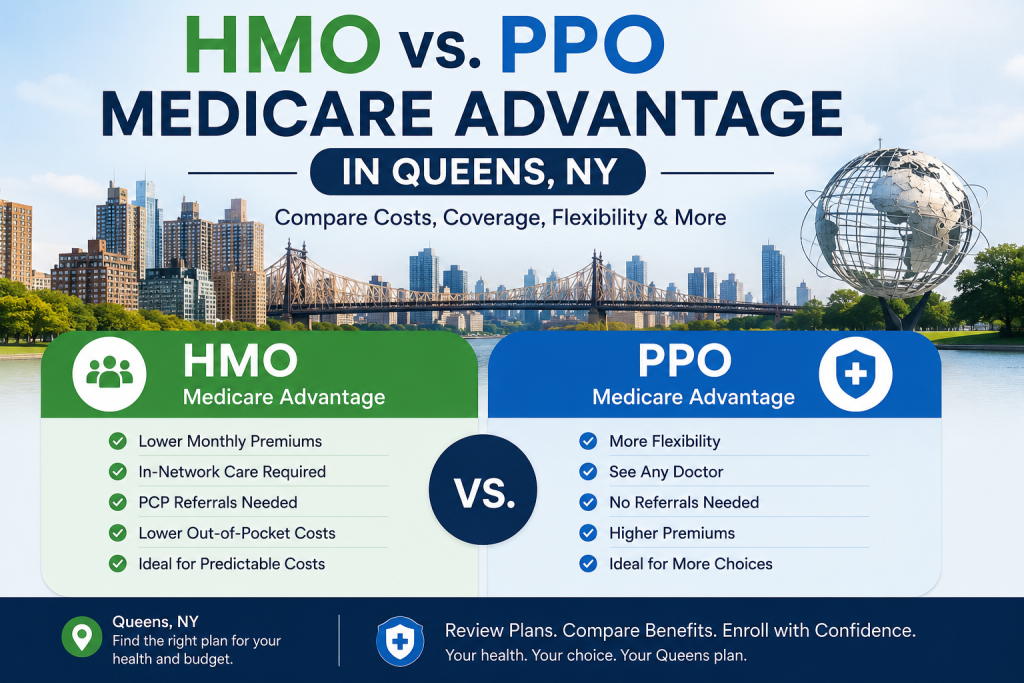
HMO vs. PPO Medicare Advantage in Queens, NY: The Real 2026 Numbers
By Paul Barrett, CMIP | The Modern Medicare Agency | Melville, NY 18+ years Medicare-exclusive experience | Licensed in 37 states | 40+ carriers Last updated: July 2026
When we ran this same analysis for Brooklyn, we found something that surprised a lot of people: PPO plans there average a cheaper premium than HMO plans, the opposite of what most people assume. So the real question for Queens wasn’t “will the same pattern hold here” — it was “by how much.” The answer: even more than Brooklyn. Queens’ PPO plans average nearly 87% less than its HMO plans. That’s not a rounding difference, and it’s not a fluke — this is now a two-borough pattern, and it changes how you should think about “cheap” and “expensive” in this market.
I’m independent — I represent more than 40 carriers, so nothing here is written to steer you toward one plan type over another. It’s written so you can see exactly what you’re choosing between.
KEY TAKEAWAYS
- Queens has 12 HMO plans, 14 PPO plans, and 11 HMO-POS plans in 2026.
- PPO plans average $22.99/month — HMO plans average $42.90/month. That’s an 86.6% premium gap in PPO’s favor, an even wider spread than Brooklyn’s already-surprising 63.9% gap.
- Despite the price gap, HMO and HMO-POS plans together still cover 61% of Queens’ Medicare Advantage enrollment — most people are still choosing the pricier category, likely due to brand recognition and marketing, not because it’s actually the better deal.
- Healthfirst’s largest Medicare Advantage contract — which includes two of Queens’ most-enrolled HMO plans — carries a verified 4.5-star CMS rating, the strongest quality signal available for any single plan in this comparison.
- Queens has two live network situations worth knowing before you choose: an active UnitedHealthcare/NewYork-Presbyterian contract dispute, and a standing gap where Mount Sinai isn’t accepting new Healthfirst Medicare Advantage patients.
HMO AND PPO: WHAT ACTUALLY SEPARATES THEM
HMO (Health Maintenance Organization): You pick a network and generally stay in it. Most HMOs require a referral from your primary care doctor to see a specialist, and out-of-network care typically isn’t covered except in a real emergency.
PPO (Preferred Provider Organization): You still have a network, but you’re not locked into it. You can see specialists without a referral, and you can go out-of-network for care — it costs more when you do, but the option exists.
HMO-POS (HMO Point-of-Service): A hybrid. It runs like an HMO day-to-day, with a limited allowance to step outside the network for certain services at a higher cost.
The theory says HMO = cheaper and more restrictive, PPO = pricier and more flexible. Queens’ actual numbers agree with the second half of that sentence and flatly contradict the first.
QUEENS HMO vs. PPO: FAST FACTS COMPARISON (2026)
|
HMO |
PPO |
HMO-POS |
|
|
Total plans |
12 |
14 |
11 |
|
Beneficiaries enrolled |
38,630 |
33,712 |
14,158 |
|
Average monthly premium |
$42.90 |
$22.99 |
$24.56 |
|
$0-premium plans available |
5 |
9 |
6 |
|
Average out-of-pocket maximum |
$9,192 |
$8,564 |
$8,264 |
|
Plans without Part D coverage |
0 |
2 |
4 |
|
Most enrolled plan |
Healthfirst 65 Plus Plan — 18,957 members |
AARP Medicare Advantage from UHC NY-0012 — 11,218 members |
AARP Medicare Advantage from UHC NY-0005 — 4,861 members |
Figures reflect Queens County, NY 2026 CMS-backed plan data (traditional/non-SNP Medicare Advantage). The overall plan count, MOOP, and Part D deductible figures were independently cross-checked against ConnieHealth and Q1Medicare’s live CMS plan finder; the HMO/PPO/HMO-POS breakdown below comes from medicare.org’s Queens-specific data. Confirm current details for your exact ZIP code at Medicare.gov’s Plan Finder before enrolling.
The premium gap, and why it’s wider here than in Brooklyn
|
HMO Avg. Premium |
PPO Avg. Premium |
Gap |
HMO Premium Compared to PPO |
|
|
Brooklyn |
$37.68 |
$22.99 |
$14.69 |
+63.9% |
|
Queens |
$42.90 |
$22.99 |
$19.91 |
+86.6% |
Notice that PPO premiums are identical between the two boroughs — $22.99 in both. What’s different is the HMO side: Queens’ HMO plans average over $5 more per month than Brooklyn’s. That tells you the gap isn’t about PPOs getting cheaper — it’s about certain HMO carriers pricing more aggressively in Queens, likely tied to network costs with Queens-specific hospital systems.
The enrollment mismatch worth understanding
Here’s the part that should genuinely make you pause: even with a nearly 87% premium gap in PPO’s favor, 61% of Queens Medicare Advantage members are still enrolled in an HMO or HMO-POS plan. Most people are paying more, not less, for the category they’re in. Some of that is inertia — Healthfirst’s 65 Plus Plan alone has close to 19,000 members and happens to be a $0-premium HMO, which softens the math for that specific plan even though the category average runs high. But it’s also a reminder that plan-type decisions in Queens are often made on brand recognition or a mailer, not on a side-by-side premium comparison like this one.
STAR RATINGS: WHAT WE KNOW FOR CERTAIN
Queens’ 37 Medicare Advantage plans break down as: 2 plans at 5 stars, 10 plans at 4 stars or higher (27%), and 27 plans at 3 stars, with an average rating of 3.57. Unlike Brooklyn, where we had exact star ratings for every individual plan, Queens’ public data currently gives us that breakdown at the county level rather than mapped to each specific plan name.
What we do have confirmed, plan-by-plan: Healthfirst’s largest Medicare Advantage contract — which covers the 65 Plus Plan (HMO) and the Increased Benefits Plan (HMO), Queens’ single most-enrolled plan and one of its most popular, respectively — earned a 4.5-star CMS rating for the 2026 Star Program Year, the second consecutive year at that level. That’s a real, sourced quality signal for two of Queens’ largest HMO plans specifically, straight from Healthfirst’s own published announcement, not an estimate.
THE NATIONAL TREND: WHY HMOs ARE GAINING GROUND EVERYWHERE
HMOs still make up the majority — 57% — of plan offerings in the non-SNP Medicare Advantage market nationally, and industry data through mid-2026 shows HMO enrollment growing while PPO enrollment has been flat to declining over the same period. Analysts point to a straightforward reason: insurers are shifting plan designs from PPOs toward narrower-network HMOs for 2026, since HMOs are considered better positioned to absorb the cost pressures the industry is currently facing.
What this means for Queens specifically: the county’s current split — roughly even in plan count, but tilted 61/39 in HMO’s favor by enrollment — shouldn’t be taken for granted going forward. If national carrier strategy continues favoring HMO plan designs, Queens’ PPO options could shrink the way they already have in some other markets. If PPO flexibility matters to you, it’s worth locking that in now and revisiting it every Annual Enrollment Period rather than assuming it’ll still be there.
TWO LIVE NETWORK SITUATIONS WORTH KNOWING BEFORE YOU CHOOSE
This is exactly where the HMO-vs-PPO decision stops being theoretical, and Queens currently has two real situations in play — not one.
UnitedHealthcare and NewYork-Presbyterian. These two are in an active contract dispute, with in-network access extended only through July 31, 2026. NewYork-Presbyterian Queens and its Queens Medical Group practices are explicitly named among the facilities that would go out-of-network if no new agreement is reached. Starting August 1, 2026, those facilities could become out-of-network for most UHC Medicare Advantage members — including AARP Medicare Advantage from UHC NY-0012, Queens’ most-enrolled PPO.
Mount Sinai and Healthfirst. Separately, and on a longer timeline, Mount Sinai’s own published 2026 participation list states that its primary care providers are not currently accepting new Healthfirst Medicare Advantage patients — including the 65 Plus Plan, Queens’ single most-enrolled plan overall.
Here’s why plan type matters in both scenarios: a PPO member facing a network exclusion can still go out-of-network at a higher cost. An HMO member generally cannot, outside of emergency care. If you’re weighing Healthfirst’s HMO against a UnitedHealthcare PPO, and either NYP Queens or Mount Sinai matters to your care, these two situations point in different directions depending on which carrier and which hospital system you’re actually using.
For the full picture on how UnitedHealthcare, NewYork-Presbyterian, Mount Sinai, and Healthfirst fit into Queens’ broader Medicare Advantage landscape, see Medicare Advantage Plans in Queens, NY: The Complete 2026 Guide.
WHO ACTUALLY FITS EACH PLAN TYPE
An HMO tends to make sense if:
- You have a primary care doctor and specialists already within one of Queens’ major networks (Elmhurst Hospital, Long Island Jewish, Jamaica Hospital) and don’t anticipate needing care outside it.
- You’re comfortable getting referrals before seeing specialists.
- The specific plan’s quality rating and $0-premium status outweigh the category-average price gap — Healthfirst’s confirmed 4.5-star rating is a real reason some HMO plans buck the general pattern.
A PPO tends to make sense if:
- Lower average cost genuinely matters to you — Queens’ PPO category is the cheaper one, not the pricier one, contrary to the usual assumption.
- You want direct access to specialists without waiting on a referral.
- You’re currently affected by, or want to hedge against, a network situation like UnitedHealthcare/NewYork-Presbyterian or Mount Sinai/Healthfirst.
- You split time between Queens and another location and want coverage that travels with you at a predictable, if higher, out-of-network cost.
HMO-POS is worth a look if: you want an HMO’s typical cost structure with a limited safety valve for occasional out-of-network care, rather than an all-or-nothing network commitment.
PAUL’S HONEST TAKE
I want to be direct about something: when Brooklyn’s numbers showed PPOs beating HMOs on price, I wondered if it was a one-off quirk of that specific market. Queens just answered that question — the gap isn’t just present here, it’s wider. That tells me this isn’t a Brooklyn anomaly; it’s something happening across how Medicare Advantage is priced in New York City more broadly, and I’d expect to see it again as we cover more boroughs. What I take from that as an agent: the “HMO is the budget plan” assumption that gets repeated constantly in Medicare marketing simply isn’t true here, in either borough I’ve now checked with real numbers. If you’re choosing based on that assumption, you’re choosing with bad information, and it’s costing real money — potentially $240 a year or more, just from the category gap alone.
FREQUENTLY ASKED QUESTIONS
No — Queens’ PPO plans average $22.99 a month, compared to $42.90 for HMO plans, an 86.6% gap in PPO’s favor. This is the opposite of the common assumption, and the same pattern shows up in Brooklyn, though the gap is even wider in Queens.
Queens doesn’t currently have public per-plan star ratings broken out the way Brooklyn does, but we do have a confirmed data point: Healthfirst’s largest contract, which includes its 65 Plus Plan and Increased Benefits Plan (both HMOs), earned a 4.5-star CMS rating for 2026 — a real quality signal for two of Queens’ most-enrolled HMO plans specifically.
HMO and HMO-POS plans combined cover about 61% of Queens’ Medicare Advantage enrollment, even though PPO plans average a significantly lower premium. Plan-type choice in Queens appears to track brand recognition more than price.
Not in either borough we’ve checked with real 2026 data. Brooklyn’s HMO plans average 63.9% more than its PPO plans; Queens’ gap is even wider at 86.6%. Both boroughs contradict the common assumption that HMOs are the budget-friendly option.
Yes, potentially outside the normal enrollment windows. A network termination — like the UnitedHealthcare/NewYork-Presbyterian situation — can qualify you for a Special Enrollment Period, letting you switch plans without waiting for the Annual Enrollment Period.
Yes. Mount Sinai’s primary care providers are not currently accepting new Healthfirst Medicare Advantage patients, which includes the 65 Plus Plan — Queens’ single most-enrolled Medicare Advantage plan overall.
Not sure whether an HMO or PPO actually fits your doctors and prescriptions? Call or text 631-358-5793. No pressure, no cost — just a real answer based on your specific situation.
RELATED READING
- Medicare Advantage Plans in Queens, NY: The Complete 2026 Guide
- Medicare in Queens, NY: The Complete 2026 Guide (Pillar Page)
- Special Needs Plans (D-SNP, C-SNP, I-SNP) in Queens, NY: The Complete 2026 Guide
- HMO vs. PPO Medicare Advantage in Brooklyn, NY: The Real 2026 Numbers
- Medicare Advantage vs. Medigap in Brooklyn, NY: The Real 2026 Cost Comparison
SOURCES
- Medicare.gov Plan Finder
- Medicare.org — Medicare Advantage Plans in Queens County, NY
- CMS.gov — Medicare Advantage State/County Penetration Data
- KFF — Medicare Advantage 2026 Spotlight: A First Look at Plan Offerings
- NewYork-Presbyterian — UnitedHealthcare In-Network Coverage Changes (updated June 29, 2026)
- Mount Sinai — Medicare-Participating Medicare Advantage Plans (updated 12/31/2025)
- Healthfirst — Healthfirst Medicare Advantage Earns 4.5-Star Rating for Second Consecutive Year