




Most hospital indemnity plans will not turn you down because of a health condition, but many will not pay for a hospital stay tied to that condition until a waiting period ends. That waiting period is commonly 12 months, and it starts from your effective date. Knowing how the plan defines a pre-existing condition, how far back it looks and how long it waits is the difference between a policy that pays when you need it and one that surprises you.
This guide explains those three pieces in plain English, shows how they work in real plan language, and walks you through what to check before you enroll, especially if you are on Medicare or about to be.
TL;DR
- A pre-existing condition is generally one you were treated for, or got advice or diagnosis about, during a “look-back” window before your coverage starts. Plans define that window differently.
- Many hospital indemnity plans are guaranteed issue, meaning no health questions, yet they may still limit benefits for pre-existing conditions for the first 12 months.
- Stays unrelated to a pre-existing condition are usually payable from the start, subject to the policy’s terms.
- The exact definition lives in your policy or certificate. Read the pre-existing condition paragraph before you sign, and ask for the disclosure form.
- If a claim is denied, the reason should be on your explanation of benefits and you can appeal to the insurer.
Table of Contents
- How a hospital indemnity plan pays, in one minute
- What counts as a pre-existing condition
- Can you be denied for a pre-existing condition?
- How look-back, waiting periods and exclusions fit together
- What this means if you have Medicare
- Timing your enrollment
- What to check in the policy before you enroll
- If a pre-existing condition exclusion affects your claim
- Our perspective
- Getting help choosing a plan
- FAQ
- Sources
How a hospital indemnity plan pays, in one minute
A hospital indemnity plan is supplemental insurance. It pays a fixed cash benefit when you are admitted to the hospital, rather than reimbursing a specific bill. One widely published carrier description says the plan helps with hospital-related costs your primary insurance does not cover, and pays cash benefits unless you assign them elsewhere. Because the money is not tied to a network, you can generally use it at any hospital or facility, provided the stay meets the policy’s definition of a covered confinement.
That structure matters for pre-existing conditions. The insurer is not paying a claim based on what the hospital charged. It is deciding whether your stay qualifies for the daily or admission benefit. The pre-existing condition clause is one of the tests it applies.
For the full picture of how these plans work, see our guide on how hospital indemnity coverage actually works.
What counts as a pre-existing condition
There is no single national definition for hospital indemnity plans. Each policy writes its own, within what state law allows. Two published examples show the typical shape.
One national carrier’s plan brochure defines it as a sickness, injury or physical condition for which you received medical treatment, consultation, care or services, including diagnostic measures, during the 12 months before your coverage effective date.
A Blue Cross plan sold in Kansas uses a shorter window. If you sought or received diagnosis, treatment or advice about a condition in the 90 days before coverage begins, a 365-day waiting period applies before that condition is covered.
Notice what these definitions have in common:
- Treatment is not the only trigger. Consultation, advice and diagnostic tests count too. A scan that found nothing, ordered because of a symptom, can still place that symptom inside the definition.
- The look-back window varies. It might be 90 days or 12 months. A longer window catches more of your history.
- The condition, not the diagnosis name, is what matters. A stay for a complication of something you were treated for earlier can be treated as related.
A worked example
Suppose you are 66 and your plan starts on January 1. You saw your doctor in the previous October about chest pain and had a stress test.
- Under a 12-month look-back, that visit falls inside the window. A later hospital stay for a heart condition could be limited during the first 12 months.
- Under a 90-day look-back that begins at your effective date, an October visit falls inside the window as well (about 90 days earlier). A visit in the spring would not.
- A hospital stay for a broken wrist from a fall in March is unrelated to that history, so the pre-existing clause would not normally apply. The standard policy terms still do.
This is an illustration of how the clause works, not a ruling on any specific policy. The policy language controls.
Can you be denied for a pre-existing condition?
Usually the answer depends on whether the plan is guaranteed issue or underwritten.
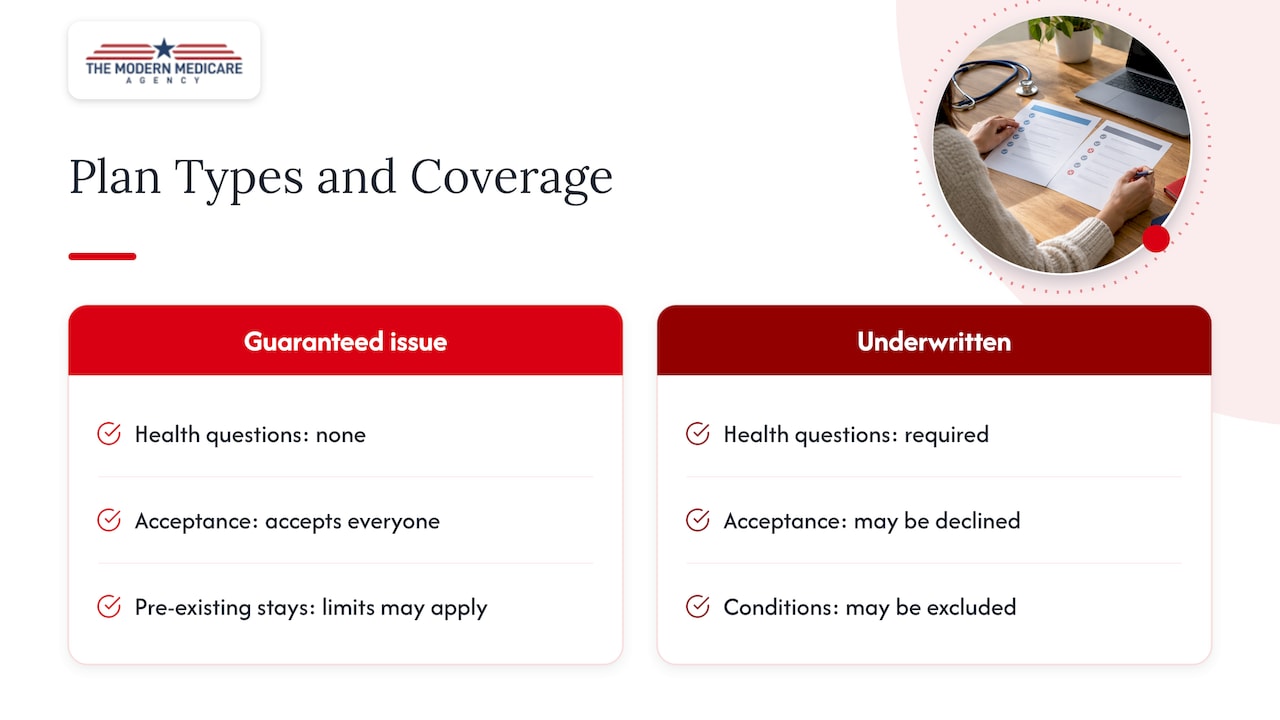
Guaranteed issue plans accept applicants without health questions. One carrier’s plan is issued on a guaranteed-issue basis, but pre-existing condition limitations may apply. Another says no benefits are payable during the first 12 months for a stay due to a pre-existing condition, even though it accepts everyone.
Underwritten plans ask health questions. Depending on your answers, the insurer can decline, charge differently or exclude certain conditions. The upside can be more complete benefits for a healthy applicant. The trade-off is that your history decides your options.
So the honest answer to “can I be denied?” is: sometimes at the application, and often not, but being accepted is not the same as being covered for everything. The two things to compare are acceptance and what the plan actually pays in year one.
How look-back, waiting periods and exclusions fit together
These three terms are easy to blur, so here they are separately.
| Term | What it means | Where you see it |
|---|---|---|
| Look-back period | How far before your effective date the insurer checks for treatment, advice or diagnosis | Definition of pre-existing condition |
| Waiting period | How long after the effective date the limitation lasts | Benefit limitations section |
| Exclusion | A condition or situation the plan never pays for | Exclusions and limitations section |
A pre-existing condition limitation is a temporary exclusion. After the waiting period, a covered stay for that condition is payable. Under the national carrier’s plan above, confinement benefits resulting from a pre-existing condition are not paid during the first 12 months of coverage, and after that, benefits are payable for eligible confinements.
There is one more detail to catch: a stay already in progress. The Kansas plan excludes the first 365 days of a hospital stay that was already in progress when coverage became effective. Timing your effective date around a planned admission will not work, and a plan that begins while you are in the hospital will not pay for that stay.
What this means if you have Medicare
Hospital indemnity is not a substitute for Medicare, Medigap or Medicare Advantage. Forbes Advisor notes it is meant to supplement rather than replace primary health coverage, since it responds to specific triggers like hospitalization rather than routine or diagnostic care. Some states also may require that you keep primary medical coverage as a condition of enrolling, a rule that varies by state and carrier.
In practice, people tend to look at hospital indemnity for these situations:
- Medicare Advantage members who want cash to help with hospital copays and the related costs around a stay. Our guide on hospital indemnity and Medicare gaps covers how that fits together.
- Original Medicare members without a Medigap plan, who may face deductibles and coinsurance on a stay.
- Those under 65 with Medicare through disability, who often have fewer plan choices. We cover that in hospital indemnity benefits for disabled individuals.
If you are still deciding on your core coverage, start there. A Medicare Supplement plan and a Medicare Advantage plan each handle hospital costs differently, and the right hospital indemnity choice depends on which one you have. You can also read how it compares in hospital indemnity vs. Medigap and critical illness plans.
Timing your enrollment
Because the look-back counts back from your effective date, timing can help you in two ways.
- Enroll before a new diagnosis, not after. A condition diagnosed or treated after your effective date is not pre-existing. If you wait until you are sick, the waiting period may apply to exactly what you hoped to cover.
- Let the clock run. A 12-month waiting period begins at your effective date. The sooner it starts, the sooner it ends.
- Line it up with other coverage changes. Turning 65, retiring from employer coverage, or switching Medicare plans are natural moments to review everything at once, rather than adding policies one at a time.
None of this means you must buy. It means the cost of waiting is often a longer stretch with limited benefits for conditions you already have.
What to check in the policy before you enroll
Before you sign, find these items. They are usually in the outline of coverage, the certificate or the disclosure form.
- The definition of pre-existing condition. Does it count advice and diagnostic tests, or only treatment?
- The look-back length. 90 days, 6 months, 12 months?
- The waiting period. How many months before a related stay is payable?
- Whether it is guaranteed issue or underwritten. And if underwritten, what the health questions ask.
- Benefit maximums. Per-day amounts, days per stay and annual limits. One carrier’s materials describe daily inpatient benefits limited to 365 days per plan year, and tell you to check the plan’s terms and limitations.
- Other exclusions. Some plans treat mental health, substance use or outpatient care differently.
- Primary coverage requirements. Some states require you to hold major medical coverage to enroll.
The same carrier suggests consulting your certificate of coverage and any riders, since provisions can differ significantly between plan designs. The Kansas Insurance Department gives the same basic advice: refer to your policy for its exclusions and limitations.
Your state may give you more to read
Some states require clearer disclosure. In Massachusetts, regulation 211 CMR 42.00 requires that pre-existing condition provisions be clearly labeled and appear as a separate paragraph on the first page of the policy. It also calls for disclosure forms with the policy or at application that, where applicable, include pre-existing condition limitations, waiting periods and benefit maximums. Rules in other states differ, so ask the agent which disclosures apply where you live.
If a pre-existing condition exclusion affects your claim
A denial is not always the end. Here is a sensible order of steps.
- Read the denial reason. The Kansas Insurance Department says that if a claim is denied, the reason should appear on your explanation of benefits.
- Compare it to the policy language. Find the definition, the look-back window and the dates of your treatment. Was the condition really within the window? Was the stay really related?
- Appeal to the insurer. Your policy describes its appeal procedure, and the same guide notes that you may appeal to the insurer.
- Gather records. Doctor notes showing the dates of care and the nature of the stay are the most useful evidence.
- Contact your state department of insurance if you believe the plan was applied incorrectly. Your state’s insurance department can explain your options.
If you bought through an agent, bring them in early. An agent who knows the carrier can help you read the clause and prepare the appeal.
Our perspective
Most of the hospital indemnity questions we get come from people who were told “no health questions” and assumed that meant “no limits.” Those are two different things, and you deserve to see both before you decide.
We start every conversation with education, because a good decision is hard to make without understanding your options. With hospital indemnity, that means walking through the look-back period and the waiting period line by line, before you enroll, not after a claim.
As an independent agency with access to 40+ carriers, we are not tied to one company’s definition of a pre-existing condition. We can compare plans on the things that decide how the policy behaves in year one, and fit the choice around your Medicare plan, your health history and your budget.
If you are turning 65, retiring from employer coverage, or unhappy with what you have now, the best time to look is before you need the coverage. A short conversation about timing can save you a long wait.
Paul
Getting help choosing a plan
At Paulbinsurance, we are a team of independent agents who specialize in Medicare, and Paul Barrett has helped Medicare consumers since 2007. We can review your Medicare coverage, explain how a hospital indemnity plan would sit next to it, and show you how the pre-existing condition terms differ across the plans we offer, with no pressure.

If you want to see where your Medicare coverage leaves gaps, start with our Medicare Supplement options or visit Paulbinsurance to talk with an agent. Our broader guide also explains what hospital indemnity covers and excludes.
FAQ
Does hospital indemnity insurance cover pre-existing conditions?
Often, but not right away. Many plans limit or withhold benefits for a stay related to a pre-existing condition during an initial period, commonly 12 months from your effective date. After that period, eligible stays are generally payable under the policy’s terms. Check the specific waiting period in your certificate.
Can I be denied hospital indemnity coverage because of my health?
It depends on the plan. Guaranteed issue plans accept applicants without health questions, though pre-existing condition limitations may still apply. Underwritten plans ask health questions and can decline or limit coverage based on your answers.
Does a hospital indemnity plan pay if I am already in the hospital when it starts?
Not for that stay in most cases. One published plan excludes the first 365 days of a stay already in progress when coverage becomes effective. Enroll before you need care, not during an admission.
Can I use hospital indemnity with Medicare Advantage or Medigap?
Yes, people use it alongside either one, because it is supplemental and pays cash rather than reimbursing bills. It is designed to add to primary coverage, not replace it, and some states may require you to keep primary coverage to enroll.
What should I do if my claim is denied for a pre-existing condition?
Read the reason on your explanation of benefits, compare it with the policy’s definition and look-back window, and appeal to the insurer in writing with your medical records. If you still disagree, contact your state department of insurance.
Sources
- What is Hospital Indemnity Insurance? (carrier overview)
- What Is Hospital Indemnity Insurance? Forbes Advisor
- Hospital Indemnity Insurance plan brochure (2023)
- Beam Hospital Indemnity: what you need to know
- Hospital Indemnity Coverage for Individuals, Blue Cross Kansas
- Hospital Indemnity Benefit Overview, State of Kansas employee health plan
- Be ready: What is Hospital Indemnity Insurance
- Health Insurance shopper’s guide, Kansas Insurance Department
- 211 CMR 42.00, Massachusetts Division of Insurance