




Medigap Plan K and Plan L are the two Medicare Supplement plans that share your costs with Original Medicare instead of covering them in full. Plan L pays a bigger share (75% of most covered costs, against 50% for Plan K) and has a lower yearly out-of-pocket cap ($4,000 against $8,000 in 2026). Plan K usually trades that for a lower monthly premium. Below, we walk through exactly what each plan pays, what you could owe in a bad year, and how to decide.
TL;DR
- Plan K pays 50% of most covered cost-sharing. Its 2026 out-of-pocket limit is $8,000, rising to $8,360 in 2027.
- Plan L pays 75% of the same items. Its 2026 limit is $4,000, rising to $4,180 in 2027.
- Once you reach the limit and pay the Part B deductible, either plan pays 100% of covered services for the rest of the calendar year.
- Plans with the same letter offer the same benefits from every company. Only the price changes, so compare quotes.
- Your best chance to buy without health questions is the six-month Medigap Open Enrollment Period that starts when Part B starts.
Table of Contents
- How Plan K and Plan L work with Original Medicare
- What each plan pays: a side-by-side look
- How the out-of-pocket limits actually work
- Premiums: why Plan K is usually cheaper and why quotes vary
- Which plan fits you: Plan K or Plan L?
- When you can enroll without health questions
- Common mistakes when comparing K and L
- Get a side-by-side quote
- FAQ
- Sources
How Plan K and Plan L work with Original Medicare
Medigap is private insurance that fills some of the gaps in Original Medicare (Part A and Part B). Original Medicare pays its share of an approved bill, and Medigap pays some or all of what is left. Plans K and L follow the same logic but split the leftover bill with you.
Here is the part many people miss: both plans have an annual cap on what you pay. According to Medicare.gov’s plan benefits chart, after you meet your out-of-pocket limit and the yearly Part B deductible, the plan pays 100% of covered services for the rest of the calendar year. That cap is the safety net, and it is the main reason these plans exist as a middle road between a full-coverage Medigap plan and no supplement at all.
Two more basics:
- A Medigap policy covers one person. Spouses each need their own policy, as Medicare’s own guide explains.
- Medigap works only with Original Medicare. Insurers generally cannot sell you a Medigap policy if you have coverage through a Medicare Advantage Plan or Medicaid, per the same Medicare guide.
Because Plans K and L are less commonly sold than the more popular Medigap letters, availability depends on your state and on which companies offer them where you live. An independent agent can see what is actually offered at your ZIP code.
What each plan pays: a side-by-side look
The benefit difference is simple. Plan K covers 50% of a set list of costs, and Plan L covers 75% of the same list. Medicare.gov’s comparison chart shows that Plan K pays 50% and Plan L pays 75% of these items:
- Part A coinsurance and hospital costs
- Hospice care coinsurance or copayment
- The first 3 pints of blood
- Skilled nursing facility care coinsurance
- The Part A deductible
The same chart lists Part B coinsurance or copayment on the same 50% and 75% split. That is the item you will notice most often, since it applies to doctor visits, outpatient care and many tests.
| Feature | Plan K | Plan L |
|---|---|---|
| Share of covered cost-sharing paid by the plan | 50% | 75% |
| Your share until you hit the limit | 50% | 25% |
| 2026 out-of-pocket limit | $8,000 | $4,000 |
| 2027 out-of-pocket limit | $8,360 | $4,180 |
| After the limit and Part B deductible | Plan pays 100% of covered services for the rest of the year | Same |
| Typical monthly premium | Generally lower | Generally higher than K |
The 2026 limits come from Medicare.gov. The 2027 figures come from the CMS announcement of the Plan K and L limits, which also explains that the limits are adjusted every year for inflation, based on estimates of the per capita cost of the Medicare program. Expect them to move again after 2027.
What neither plan changes
Both plans still leave you responsible for the yearly Part B deductible. Also read the benefit chart line by line for anything you expect to use, such as Part B excess charges or care abroad, because the lettered plans differ there. The chart on Medicare.gov is the authority for what each letter includes.
How the out-of-pocket limits actually work
The limit is not a deductible you pay up front. You pay your share of covered costs as bills arrive, and the plan pays the rest. Only when your share reaches the yearly limit does the plan switch to paying 100% of covered services for the remainder of the calendar year.
That means a quiet year costs you very little beyond premiums, and a hard year has a ceiling. The ceiling is where the two plans differ most:
- Plan K: your share can climb to $8,000 in 2026 ($8,360 in 2027).
- Plan L: your share stops at $4,000 in 2026 ($4,180 in 2027).
The limit is a ceiling on your cost-sharing for covered services. Your premiums are separate and do not count toward it.
A simple illustration
This example uses round numbers only to show the mechanics. It is not a quote.
Suppose a year of outpatient care leaves $10,000 of Part B charges after the deductible. Part B coinsurance is 20%, so $2,000 is left for Medigap and you to split.
- With Plan K, the plan pays 50% of that $2,000 ($1,000) and you pay $1,000.
- With Plan L, the plan pays 75% ($1,500) and you pay $500.
Now add a hospital stay that triggers the Part A deductible and coinsurance. Plan K again pays half of those costs and Plan L pays three quarters. Each extra dollar of cost-sharing adds to your share until you hit the cap. In a severe year, Plan K lets your costs climb to twice the Plan L ceiling.
Premiums: why Plan K is usually cheaper and why quotes vary
Medigap premiums reflect how much risk the insurer takes on. A plan that pays a smaller share of your costs generally carries a lower premium, so Plan K typically costs less per month than Plan L. The trade-off is the higher coinsurance and the higher cap described above.
The more important point is how pricing works across companies. Medicare.gov states that price is the only difference between policies with the same letter sold by different companies, that costs can vary widely, and that you should contact more than one company for an estimate. In other words, a Plan L from one company has the same benefits as a Plan L from another, but the monthly bill can be very different.
Three things commonly move the price:
- The company. Same letter, same benefits, different premium.
- Where you live. Premiums and which plans are sold depend on your state.
- How the company sets rates. Companies price policies differently over time, so ask how a quote is set and how it may change as you age.
Because the benefits are standardized, a broker comparing the same letter across many carriers is doing something very practical: finding the lowest price for identical coverage. We cover that process in more detail in our guide on how to compare Medicare Supplement plans effectively.
Which plan fits you: Plan K or Plan L?
There is no universal winner. The right plan depends on how much you expect to use care, and how much of a bad year you could absorb. Ask yourself these questions.
Plan K may fit you if
- You are generally healthy, see doctors a few times a year and want the lowest monthly premium.
- You have savings that could cover a worst-case year up to the $8,000 limit (2026) without hardship.
- You would rather keep monthly costs down and accept more sharing when you do need care.
Plan L may fit you if
- You use care regularly, with specialist visits, outpatient procedures or ongoing treatment.
- You want a lower ceiling ($4,000 in 2026) and more predictable bad years.
- You are willing to pay a higher premium to cut your share of every covered bill from 50% to 25%.
A quick way to decide
Add up your likely year. Take the premium difference between the two quotes, multiplied by 12. That is what Plan L costs you extra for certain. Then estimate your cost-sharing in a typical year and in a bad year under each plan. If the extra premium is larger than the cost-sharing Plan L would save you in a normal year, Plan K may be the better value. If your care needs are heavier or unpredictable, the lower cap on Plan L can be worth the added premium.
Whichever you lean toward, remember the full picture: premiums, plus your share of costs up to the limit, plus the Part B deductible. A cheap premium with a high exposure is only a good deal if you can comfortably afford the exposure.
Our perspective
Most people we meet never ask about Plan K or Plan L until someone points out that the monthly premium on a full-coverage plan is more than they planned for. These two plans are a legitimate middle ground, and for the right person they make a lot of sense.
What we care about is that you choose with your eyes open. Education comes first in our office. Before we talk about a premium, we talk about how often you see doctors, what a bad year could cost you, and how much cushion you have. If the numbers favor Plan K, we will tell you. If they favor Plan L, or a different Medigap letter altogether, we will tell you that too.
Because we are independent and work with 40+ carriers, we are not tied to one company’s price. That matters here, since the same letter can carry very different premiums from one carrier to the next. Our job is to line them up and let you see the difference, with no pressure.
Paul
When you can enroll without health questions
Timing matters more than the letter. Medicare.gov says the best time to buy is when you are 65 or older and first have Part A and Part B. Your six-month Medigap Open Enrollment Period begins when Part B starts. During that window you may be able to buy any Medigap policy sold in your state, even with health problems. After it ends, you might not be able to buy a policy, or it may cost more, though guaranteed issue rights can apply in certain situations.
Two protections are worth knowing:
- Guaranteed renewable. According to Medicare’s guide to choosing a policy, Medigap policies issued since 1992 are guaranteed renewable. The company cannot cancel the policy as long as you stay enrolled and pay your premium.
- Losing employer coverage. The same guide says that if you have Original Medicare and employer coverage that pays after Medicare, and that coverage ends, you may have a guaranteed issue right. State law may add further rights, so check with your State Insurance Department.
If you are choosing between the two plans while you are still in your open enrollment window, you have the most freedom. If you are outside it, your options depend on your state and your circumstances. Our guides on Medigap open enrollment versus guaranteed issue and on whether you can be denied a Medigap policy walk through each situation.
If you are on a Medicare Advantage plan today and thinking about moving to Original Medicare with a supplement, see our step-by-step guide on switching from Medicare Advantage to Medigap before you cancel anything.
Common mistakes when comparing K and L
Comparing only the premium. The cheapest monthly bill is not the cheapest year. Look at the premium and your likely share of costs together.
Forgetting the cap is yours to cover. If a bad year hit, could you pay the Plan K limit from savings? If the answer is no, Plan L’s lower ceiling is worth a hard look.
Assuming every company charges the same. Medicare says costs vary widely for the same letter, so one quote is not a comparison. Get several.
Buying for one spouse and assuming both are covered. A Medigap policy covers one person. Each spouse needs a policy.
Ignoring next year’s limit. The 2027 limits are $8,360 and $4,180, so budget for the higher figures if you are buying now for coverage that continues into next year.
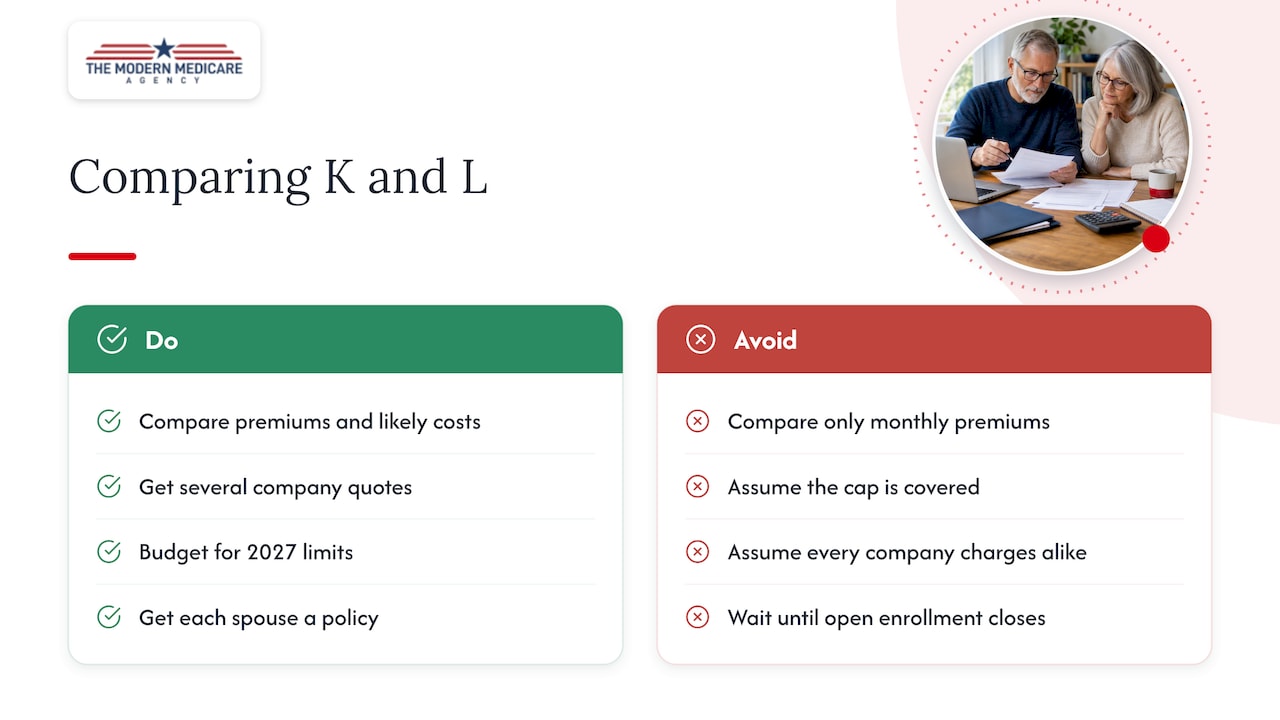
Waiting too long. Once your open enrollment window closes, a company may be able to ask health questions or charge more in many situations.
Get a side-by-side quote
If you are weighing Plan K against Plan L, the quickest way to see the real difference is to compare actual quotes for your age, ZIP code and state. We are independent Medicare specialists, and Paul Barrett has helped Medicare consumers since 2007. We compare Medigap plans across 40+ carriers, explain what each letter covers, and support you year-round, including annual coverage checkups.

Start with our Medicare Supplement (Medigap) plans page to see how we work and ask for a personalized comparison. There is no pressure, and we start with education so that the choice is yours.
FAQ
Is Plan L better than Plan K?
Plan L pays more of your costs (75% against 50%) and has a lower out-of-pocket limit, so it protects you better in a heavy-use year. Plan K generally has a lower monthly premium. Which is “better” depends on how much care you expect to use and how much risk you can afford.
What are the Plan K and Plan L out-of-pocket limits?
In 2026 the limits are $8,000 for Plan K and $4,000 for Plan L, according to Medicare.gov. CMS has announced 2027 limits of $8,360 for Plan K and $4,180 for Plan L. After you reach the limit and pay the Part B deductible, the plan pays 100% of covered services for the rest of the calendar year.
Does the same plan letter cost the same at every company?
No. The benefits for a given letter are the same, but the price can vary widely by company. Medicare advises contacting more than one company for an estimate, which is why comparing across carriers is worthwhile.
Can I buy Plan K or Plan L with a health condition?
Yes, if you are in your six-month Medigap Open Enrollment Period, which starts when your Part B coverage starts. In that window you may buy any Medigap policy sold in your state, regardless of health problems. After it ends, you may be turned down or charged more unless a guaranteed issue right applies.
Can my spouse and I share one Medigap policy?
No. A Medigap policy covers only one person, so each spouse needs an individual policy. You can each choose a different plan letter if your needs differ.
Sources
- Compare Medigap Plan Benefits | Medicare.gov
- K & L Out-of-Pocket Limits Announcements | CMS
- Buying a Medigap policy | Medicare.gov
- Choosing a Medigap Policy | Medicare.gov
- Medicare Supplement Insurance | Medicare.gov