




The two policies pay on different triggers. Hospital indemnity insurance pays a set cash amount when you are admitted to the hospital, plus a daily amount for each day you stay. Critical illness insurance pays a single lump sum when a doctor diagnoses a covered condition, such as cancer, heart attack or stroke. If you are new to Medicare, retiring from employer coverage, or unhappy with the plan you have, the right choice depends on which financial gap worries you more: a hospital bill or the months after a serious diagnosis. We help people sort that out every day, and this guide gives you the same framework.
TL;DR
- Hospital indemnity pays cash for hospital admission and for each day of confinement. It is tied to the stay, not to the diagnosis.
- Critical illness pays one lump sum after a covered diagnosis, whether or not you are admitted to the hospital.
- Both pay cash directly to you. You can spend it on deductibles, travel, prescriptions or bills at home.
- Neither replaces Medicare, a Medicare Supplement or a Medicare Advantage plan. They add cash on top of your main coverage.
- You can hold both. If a stroke puts you in the hospital, each policy can pay under its own terms.
Table of Contents
- The core difference: what triggers the payment
- How Original Medicare leaves gaps in a hospital stay
- What hospital indemnity pays: a worked example
- What critical illness pays: a worked example
- What you can spend the cash on
- Which one fits you?
- Where each one sits next to Medicare
- Read these terms before you buy either policy
- Our view
- Talk it through with an independent agent
- FAQ
- Sources
The core difference: what triggers the payment
Think of it as two different alarms.
Hospital indemnity listens for an admission. According to the University of California’s 2026 supplemental health plans guide, this kind of policy pays a predetermined dollar amount when you are admitted, plus a daily benefit for up to 30 days of confinement. The reason for the stay can be a covered sickness or an accident.
Critical illness listens for a diagnosis. The same guide explains that the policy sends a lump-sum payment directly to you when a covered condition such as cancer, heart attack, stroke or kidney failure is diagnosed. You do not have to stay in the hospital to collect, and the payment is not tied to a bill.
That difference shapes everything else: how much you can receive, when the money arrives and what it is good for.
| Hospital indemnity | Critical illness | |
|---|---|---|
| Pays when | You are admitted and stay in the hospital | A doctor diagnoses a covered condition |
| Payment style | Admission amount plus a daily amount | One lump sum |
| Typical sizing | Dollars per admission and per day | A coverage level, such as $10,000 or $20,000 |
| Can pay more than once | Yes, per covered admission, within the policy’s limits | Depends on the policy, some include a recurrence benefit |
| Pays you directly | Yes | Yes |
How Original Medicare leaves gaps in a hospital stay
Hospital indemnity makes more sense once you see what Medicare Part A leaves you to pay. The CMS booklet Your Medicare Benefits lists the 2026 Part A inpatient hospital deductible as $1,736 per benefit period. A benefit period starts when you are admitted and ends after you have been out of the hospital for 60 days in a row. So you can pay that deductible more than once in a year if you have separate stays more than 60 days apart.
Longer stays add daily coinsurance. CMS’s Medicare manual on eligibility and entitlement sets Part A coinsurance at one-fourth of the deductible per day for days 61 to 90 of a benefit period. It is one-half of the deductible per lifetime reserve day, days 91 to 150.
If you are a person who has just turned 65 and is leaving an employer plan, these numbers can come as a surprise. We cover them in more depth in our guides on what you’ll actually pay for Medicare in 2026 and how the Medicare deductible works.
One more detail matters for hospital indemnity. Being in a hospital bed does not always mean you were formally admitted as an inpatient. Observation status is billed differently, which is covered in our article on inpatient vs. observation status. Read how any policy you consider treats observation stays.
What hospital indemnity pays: a worked example
Benefit schedules differ from one policy to the next. To make it concrete, here is the schedule in the University of California’s 2026 guide, which we use as an illustration and not as a quote for any plan:
- $1,200 per hospital or ICU admission
- $200 per day of hospital confinement, up to 30 days per confinement
- $400 per day of ICU confinement, up to 30 days
Say you are admitted for a five-day stay on a plan with that schedule. The math is $1,200 for admission plus five days at $200, which is $1,000. That comes to $2,200 in cash. Compare that with a Part A deductible of $1,736 for the same stay under Original Medicare, and you can see why the cash is aimed at the hospital gap. Your actual costs also depend on your other coverage, so the point is the pattern, not the exact balance.
The guide also notes that the admission benefit can be paid once per covered sickness or accident, up to 10 times per person per calendar year. Your admission must come within 180 days of the covered event. Details like these decide whether a plan works for you, so read them before you enroll.
Schedules in employer benefit guides run from a few hundred dollars up. The University of Arkansas System’s benefits page shows hospital plans paying $500, $1,000 or $1,500 for an initial admission, with separate amounts for confinement and ICU days. That is a good reminder that you choose a level, and the level drives the premium.

What critical illness pays: a worked example
Critical illness is simpler on paper. You pick a coverage amount, and a covered diagnosis pays it.
The Arkansas page lists maximum coverage options of $10,000 or $20,000. Covered conditions include invasive and non-invasive cancer, heart attack and heart failure, major organ failure, paralysis, Alzheimer’s, and blindness or loss of hearing. An earlier University of California plan guide from 2023 shows how benefits can be tiered. A $10,000 or $30,000 plan paid 100% for cancer, heart attack or sudden cardiac arrest, stroke, kidney failure, severe burn, benign brain tumor and bone marrow transplant. It paid 50% for coronary artery bypass surgery, non-invasive cancer, and advanced Alzheimer’s or Parkinson’s disease.
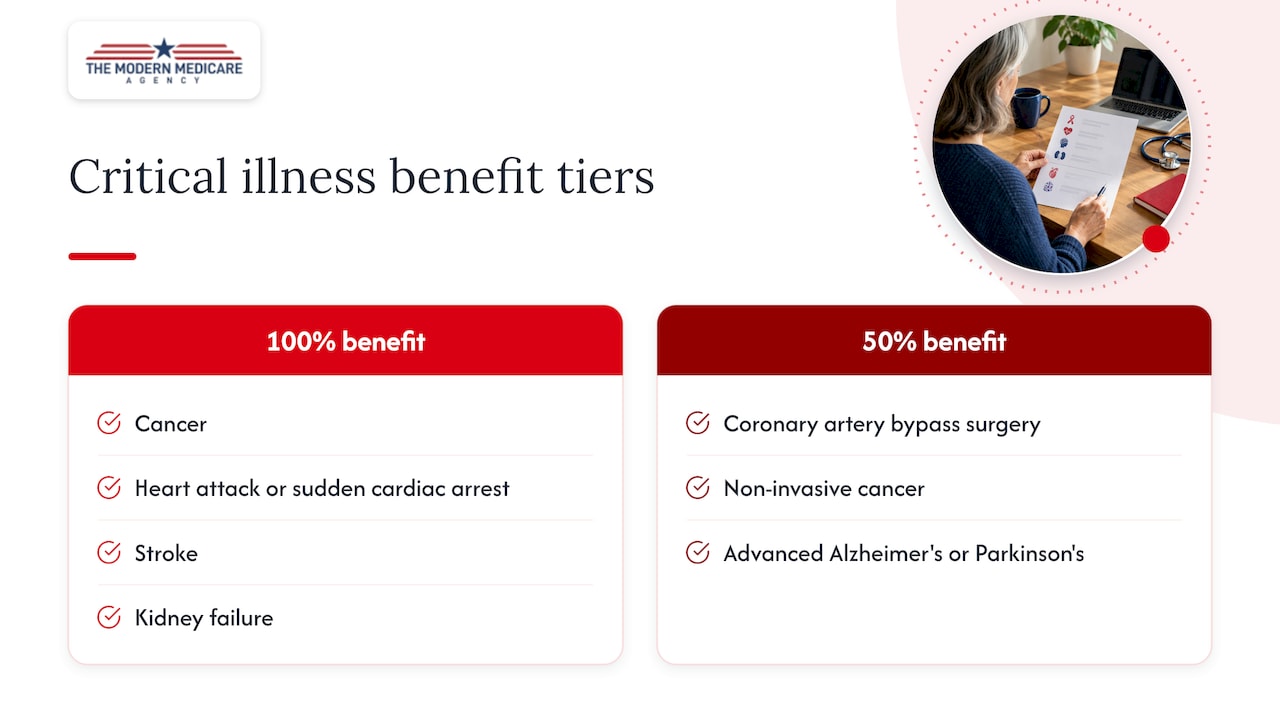
So with a $20,000 policy and a covered stroke diagnosis paying in full, $20,000 arrives as cash. A partial-benefit condition on a plan like the 2023 one would pay half, or $10,000. Which conditions pay in full, which pay in part, and whether a second diagnosis can pay again are all in the policy. Some plans do include a recurrence benefit. One example plan describes extending coverage to a second covered diagnosis, which can bring total benefits up to 200% of the plan’s value, according to the carrier’s field reference manual.
What you can spend the cash on
Because both policies pay you and not the hospital, you decide where the money goes. The Arkansas benefits page lists copays, deductibles, travel, prescriptions and child care as examples. It also states that the cash is paid in addition to your medical coverage, with no offset or coordination of benefits against it. The coverage is described there as tax-free, but tax treatment can vary by situation, so ask a tax professional about yours.
This flexibility is why critical illness appeals to people worried about the cost of life around a diagnosis, not just the bills. Think of the gas and lodging for treatment at a distant cancer center, a spouse who cuts back work hours to help, or home help while you recover.
Which one fits you?
Use these questions to decide. They are not a rule, just a way to put your own situation next to each benefit.
Hospital indemnity may fit if:
- You worry most about the deductible and daily costs of an inpatient stay.
- You have Original Medicare or a Medicare Advantage plan with hospital cost-sharing and want cash to offset it.
- You want a benefit that can pay for several different reasons for admission, from surgery to an accident.
Critical illness may fit if:
- Your family history makes cancer, heart disease or stroke a real concern.
- You want a large single payment that could cover costs a hospital stay would never show, such as travel and lost income.
- You are leaving an employer plan and want to replace the voluntary coverage you had at work.
Both may fit if you want the stay and the diagnosis covered. If a stroke puts you in the hospital, a hospital indemnity policy and a critical illness policy can each pay. The Arkansas page lets employees enroll in one, two or all three supplemental plans, and the same page confirms the benefits are paid in addition to your medical coverage.
Where each one sits next to Medicare
Neither policy is Medicare, and neither is a Medigap plan. Medicare Part A covers inpatient stays, including inpatient cancer treatment, skilled nursing facility care after a qualifying 3-day hospital stay, home health care and hospice. CMS says copayments, coinsurance or deductibles apply to each service. That cost-sharing is what supplemental cash can help with.
So your Medicare coverage choice comes first, and the supplemental policies come second. A Medicare Supplement plan and a Medicare Advantage plan handle the cost-sharing of your covered care in very different ways. Once you know which you have, you can see how big the gap is and whether extra cash makes sense.
Read these terms before you buy either policy
The policy booklet, not the sales page, decides whether a claim pays. Check these items in any hospital indemnity or critical illness plan:
- The trigger. For hospital indemnity, does an observation stay or an ER visit count? For critical illness, how does the policy define each condition?
- The benefit amounts. Look at the admission amount, the daily amount, the maximum number of days, and the ICU amounts. For critical illness, check the full-pay and partial-pay conditions.
- Waiting periods. Many policies pay nothing for a condition diagnosed before the effective date or before a waiting period ends.
- Exclusions. Critical illness policy documents commonly list items such as self-inflicted harm, intoxication or illegal drug use, and certain cosmetic procedures.
- Claim deadlines. Policies ask for proof of loss within a set window after the event.
- Pricing. Premiums usually depend on your age, tobacco status and the coverage level you choose.
- Renewability. Ask whether the premium can change and whether the carrier can cancel.
The free-look period is worth knowing too. One carrier manual describes a 30-day window to cancel after you receive the policy. Look for one in any policy you consider.
This part is where most people get stuck. Policies are written in dense language, and two plans with the same name can pay very differently.
Our view
We believe in education first. It is hard to make a good choice when you don’t understand your options, and supplemental coverage is a place where people often buy on fear and regret it later.
Our approach is to start with the foundation. We look at your Medicare coverage first, because that is where most of your protection comes from. Then we ask what you could not comfortably pay out of pocket: a hospital deductible, a long stay, or the extra costs of a serious diagnosis.
Because we are independent and work with 40+ carriers, we can compare plans side by side for you and match the benefit to the gap. We do not use pressure. If you are turning 65, leaving an employer plan or unhappy with what you have, a review of your coverage takes the guesswork out of the next step.
We also stay in touch after you enroll, with year-round support and an annual coverage checkup, so your supplemental benefits keep matching your life.
Paul
Talk it through with an independent agent
Our team of independent agents, led by Paul Barrett, who has helped Medicare consumers since 2007, helps with hospital indemnity, critical illness, cancer insurance and hospital indemnity plans, alongside Medicare Supplement, Medicare Advantage and Part D. We compare options from multiple carriers and explain each step.

Start with your core coverage on our Medicare Supplement page, or reach us through Paul B Insurance to review what you have today.
FAQ
Can I have both hospital indemnity and critical illness insurance?
Yes. Many benefit programs let you enroll in one, two or all three supplemental plans. Each policy pays under its own terms, in addition to your medical coverage. If you are hospitalized with a covered critical illness, both can pay.
Do these policies replace Medicare or a Medicare Supplement plan?
No. They pay cash on a trigger and do not pay your medical bills. Medicare and your Medicare Supplement or Medicare Advantage plan remain your main coverage. The cash can help with the costs they leave to you.
Which pays more, hospital indemnity or critical illness?
It depends on the plan you choose. Critical illness usually pays a larger single amount, such as $10,000 or $20,000 in published employer examples. Hospital indemnity pays smaller amounts per admission and per day, which add up over a long stay or repeated admissions.
Does the money go to the hospital?
No. Both types pay you directly, and you choose how to spend it. Examples include deductibles, travel, prescriptions and child care.
Sources
- University of California 2026 UC Plus Supplemental Health Plans Guide
- University of California UC Plus Supplemental Health Plans Guide, 2023
- University of Arkansas System Benefits: insurance plans
- CMS, Your Medicare Benefits
- CMS, Medicare General Information, Eligibility, and Entitlement
- CMS, Medicare Coverage of Cancer Treatment Services
- Critical Illness Field Reference Manual