




The Medicare visit that sounds like a physical isn’t a routine physical exam. If you’re wondering what the Medicare annual wellness visit is, it’s a conversation-based prevention visit focused on your health risks and a personalized prevention plan. The Centers for Medicare & Medicaid Services also covers a one-time Welcome to Medicare preventive visit within the first 12 months of Part B coverage, a separate visit with its own timing.
It’s understandable to be unsure which appointment to book or what Medicare will cover. Although the names sound similar, an annual wellness visit has a different purpose from a physical and may not include the tests or hands-on exam you expect.
This guide explains what happens during the visit, how it differs from a physical exam, when you may be eligible, and what to bring. It also covers when additional services may involve extra costs, so you can prepare for your appointment.
Key Takeaways
- A Medicare Annual Wellness Visit focuses on prevention and planning, while a routine physical exam serves a different purpose.
- Learn how eligibility and timing affect when you can schedule your visit.
- Bring medication and provider lists, relevant records, and any requested paperwork to help make the appointment more useful.
- Know what the health risk assessment and prevention planning may cover, including your health history and potential risks.
- Understand why services added to the wellness visit may affect what you pay.
What is the difference between a Medicare Wellness Visit and a physical exam?
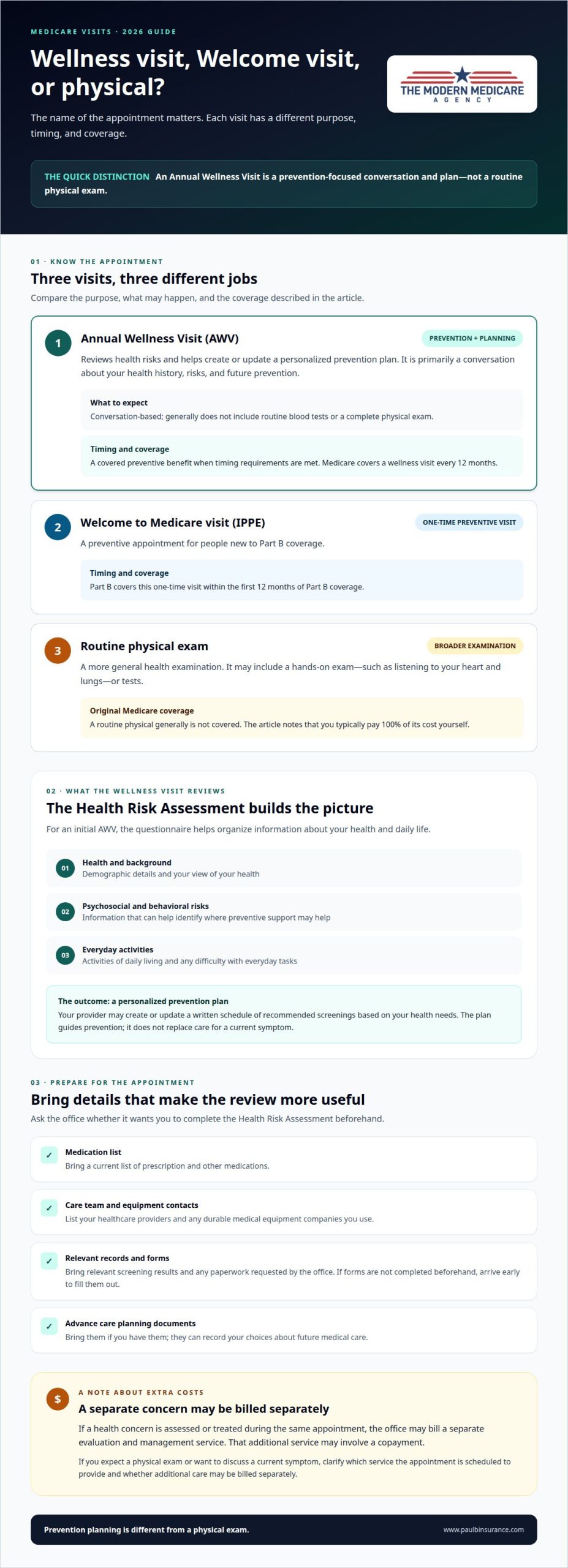
A Medicare Annual Wellness Visit focuses on prevention and planning. A routine physical exam is a broader medical examination. The distinction matters because Medicare covers and bills these services differently.
AWV, IPPE, and Routine Exams
The Annual Wellness Visit (AWV) reviews health risks and helps create or update a prevention plan. The Initial Preventive Physical Examination (IPPE), called the Welcome to Medicare visit, is a one-time preventive appointment. A routine physical exam is a separate, more general examination. According to Centers for Medicare & Medicaid Services, Medicare covers an annual Wellness visit every 12 months. Centers for Medicare & Medicaid Services says Medicare Part B covers a one-time Welcome to Medicare preventive visit within the beneficiary’s first 12 months of Part B coverage.
AWV and Complete Physical Exams
A complete physical exam typically includes a hands-on examination, such as listening to your heart and lungs or checking your blood pressure. An AWV is primarily a conversation about your health history, risks, and prevention plan. It generally doesn’t include routine blood tests or a complete physical exam. If you expect a physical, ask which service the appointment is scheduled to provide.
The distinction also affects coverage. Under Original Medicare, a routine physical exam generally isn’t covered, and you typically pay 100% of its cost yourself. A yearly physical exam billed with CPT codes 99381-99397 isn’t covered by Medicare. An AWV is a covered preventive benefit when you meet its timing requirements. Medicare Advantage plans must cover the same preventive visits as Original Medicare, though plan arrangements may shape how you receive care.
| Visit type | Main purpose | Exam or tests | Medicare coverage |
|---|---|---|---|
| AWV | Review risks and plan prevention | Conversation-based; not a routine physical | Covered preventive visit |
| IPPE | Welcome new Part B members | Preventive review | One-time Part B visit |
| Routine physical | General health examination | May involve hands-on exam or tests | Not covered by Original Medicare as a routine physical |
Reviewing your medications and planning future screenings fit the AWV’s preventive focus. Assessing a current symptom, discussing blood pressure concerns, or performing a physical exam is different from preventive planning. A clinician may bill for additional care separately, so clarify the purpose of the appointment and which services it includes.
Choose an AWV to review prevention and plan future screenings. Choose a physical exam when you need a broader examination.
What should I bring to my Medicare Annual Wellness Visit appointment?
Yes. An Annual Wellness Visit (AWV) may be billed with a separate evaluation and management service, care to assess or treat a health concern, on the same day using modifier 25, a billing code that shows the service was separate from the AWV. That additional service may involve a copayment.
Before your appointment, ask whether the office wants you to complete a Health Risk Assessment (HRA) questionnaire. It organizes information about your health and daily life, helping the provider focus the visit on prevention. If you haven’t completed requested forms beforehand, arrive early to fill them out.
The HRA covers more than diagnoses. For an initial AWV, it includes demographic details, your view of your health, psychosocial and behavioral risks, and activities of daily living. Your answers help describe how you’re functioning, what concerns you, and where preventive support may help. Answer based on your experience, including any difficulty with everyday tasks.
Bring information that can make the review of your medical and family history more complete. A current medication list helps the provider review what you take, and a list of your providers identifies the clinicians involved in your care. Include the names of durable medical equipment companies if you get equipment or supplies through them.
- A current list of prescription and other medications.
- Names of your healthcare providers and durable medical equipment companies.
- Relevant screening results and requested appointment forms.
- Advance care planning documents, if you have them.
These records give the provider a clearer picture of your history and current care. For example, a recent screening result can help inform preventive follow-up. Advance care planning documents can record your choices about future medical care. Bring any paperwork the office requested, as forms can vary between appointments.
The provider uses your HRA and history to create or update a personalized prevention plan. It may include a written schedule of recommended screenings based on your health needs. Your medications, family history, mobility, and daily activities can all inform the discussion. The plan guides prevention; it doesn’t replace care for a current symptom.
If you have a specific concern, such as a new symptom or a medication problem, make a separate appointment to discuss it. This allows the AWV to focus on your HRA, history, and preventive planning. Bringing relevant records helps the provider work from accurate details instead of relying on memory alone.
Purpose of the Medicare Annual Wellness Visit
What is the Medicare annual wellness visit meant to do? It helps you and your provider focus on prevention by assessing health risks and creating or updating a personalized prevention plan. Rather than centering on a physical exam, the appointment organizes information that can guide future health decisions. In 2026, think of it as a planned prevention discussion, not an appointment for treating a new symptom.
The assessment gives your provider a structured view of factors that may affect your health. Your medical and family history help put current risks in context. The discussion may cover mobility, home safety, cognitive concerns, and depression. These topics can bring attention to issues such as difficulty moving safely at home or a change in memory that merits follow-up.
The visit also helps turn that information into practical next steps. A personalized prevention plan can include recommended screenings and a schedule covering the next 5-10 years. That schedule gives you and your provider a shared reference for planning preventive care. It can help organize when to discuss screenings instead of relying on memory during a future appointment.
Risk factors affect people differently. Your provider considers your history and assessment together, then discusses preventive steps suited to your health. A mobility concern, for example, may prompt a conversation about safety, while family history may inform screening discussions. The plan reflects your circumstances rather than applying a one-size-fits-all checklist.
An AWV focuses on prevention; it isn’t meant to replace an appointment for a specific health concern. If you have a new symptom, a medication issue, or a concern that needs diagnosis or treatment, schedule time to address it directly. Keeping that issue separate allows the wellness discussion to focus on risk factors and prevention planning.
Measurements and test results may matter to your overall care, but the AWV’s main purpose is to organize preventive information. Your provider can review your history, assess health risks, and discuss next steps. A written screening schedule also gives you a reference for future care discussions.
Knowing what the Medicare annual wellness visit is can help you make the most of your appointment. Before you leave, understand which risks came up, what screenings are recommended, and whether any concern needs a separate appointment. That gives the visit a practical purpose beyond completing forms.
Annual Wellness Visit components
An Annual Wellness Visit brings preventive steps together in one appointment. The provider uses your health risk assessment, history, and current concerns to guide the discussion. The result is a written screening schedule and a plan tailored to your needs, rather than a routine physical exam.
The health risk assessment is the starting point. For an initial visit, it covers demographic information, your view of your health, psychosocial and behavioral risks, and activities of daily living. Your answers help the provider understand how you feel and function. For example, difficulty with everyday tasks may lead to a discussion about mobility or home safety.
Your provider also reviews your medical and family history, medications, and health risks. This can connect details that might otherwise seem unrelated. A medication list, for instance, provides context for your current care, while family history can inform prevention discussions. The provider may also assess cognitive function and screen for depression.
The visit can address practical risks beyond medical diagnoses. Mobility and home safety matter because they affect daily routines. If you’re concerned about getting around safely, your provider may discuss ways to reduce risks at home. Advance care planning can also help document your choices about future medical care.
Next, you and the provider can develop or update a personalized prevention plan. It may include a written screening schedule covering the next 5-10 years. That schedule helps organize recommended preventive screenings over time. It also gives you a clear reference for future conversations, rather than leaving each screening decision to memory.
An AWV isn’t a complete physical exam, so don’t assume it includes every measurement or test you might expect at a physical. Height and weight, for example, aren’t the main focus of this preventive appointment. Routine blood tests and screenings generally aren’t part of the AWV itself. Recommended tests or services may follow different coverage rules, so distinguish the wellness discussion from additional care.
The covered yearly AWV doesn’t have a Part B deductible. That preventive benefit is separate from additional tests or services that may be discussed or provided. Understanding the distinction helps clarify what the appointment is designed to accomplish.
In practical terms, expect a review, an assessment, and a plan: your provider considers your health risks and history, discusses relevant preventive needs, and records a screening schedule. The written plan is personalized, turning the conversation into preventive steps you can revisit with your provider.
How much does a Medicare Annual Wellness Visit cost, and when might coinsurance apply?
In 2026, the covered Annual Wellness Visit generally costs you nothing under Original Medicare when your provider accepts assignment. This means the provider agrees to Medicare’s approved payment for the service. The Part B deductible, the amount you pay toward covered Part B services before Medicare helps pay, doesn’t apply to the covered wellness visit. That benefit applies to the visit itself, not automatically to every service during the same appointment.
Separate care may result in a separate bill. If your provider performs a test or evaluates a medical concern during the appointment, that service may be billed apart from the preventive visit. Coinsurance is your share of the cost for a covered service. Additional services may involve coinsurance and the Part B deductible if they aren’t covered under the wellness benefit. What you pay depends on the service and how it’s billed.
For example, an appointment may start with prevention planning, then include an evaluation of a new symptom. The provider may bill that evaluation separately using modifier 25, a billing code modifier that identifies an additional service on the same day. A copayment, a set amount you pay for a service, may apply to that separate evaluation even though the covered Annual Wellness Visit itself has no copayment or Part B deductible.
- Covered wellness visit: No Part B deductible applies.
- Additional test or service: Your share of the cost or the deductible may apply, depending on coverage and billing.
- Separate evaluation: A copayment may apply when it’s billed alongside the wellness visit.
Laboratory tests and diagnostic imaging are examples of services that may have a separate cost share. Recommended follow-up screenings may also involve coinsurance or an unmet Part B deductible. A recommendation discussed during the visit doesn’t mean the service is included in the preventive benefit. The charge depends on the service and how Medicare covers it.
Medicare Advantage plans must cover the same preventive visits as Original Medicare, but plan terms can affect costs for other services. A test or separate evaluation may be treated differently from the covered wellness appointment. To understand a charge, focus on the specific service provided, not just the appointment’s name.
Before care begins, ask which services are part of the Annual Wellness Visit and whether your provider plans to address another concern or perform a test. This can clarify whether the appointment is limited to preventive planning or includes separate care. If you receive a bill, compare each listed service with what happened, including any test or evaluation performed that day.
If you’re reviewing how plan coverage fits your Medicare needs, explore Medicare plan options for help understanding the choices available to you.
The Modern Medicare Agency
The Modern Medicare Agency provides personalized, unbiased guidance to help you understand how Medicare plan choices relate to your broader coverage needs. A wellness visit focuses on prevention, while your insurance plan affects how you access covered care. If you’re reviewing your coverage, the agency can help you compare Medicare Advantage, Medicare Supplement (Medigap), and Part D plans.
Its independent brokers help eligible individuals compare options from more than 40 carriers, with year-round support across more than 34 states. This can be useful when you’re weighing plan choices and want clear guidance without pressure. The right next step depends on the coverage questions you want to resolve.
Contact The Modern Medicare Agency to discuss your Medicare coverage questions.
Take Your Next Step With Confidence
Knowing what the Medicare annual wellness visit is gives you a clearer starting point for conversations about your care. As you plan ahead in 2026, keep your preventive-care questions separate from questions about insurance coverage. That makes it easier to focus each conversation on the decision you need to make.
Before reviewing coverage, consider what you want your plan to help you manage, such as access to care or prescription drug coverage. The Modern Medicare Agency offers Medicare Advantage Plans, Medicare Supplement (Medigap) Plans, and Medicare Part D Plans. Its independent guidance can help you consider your options in light of your needs, without turning a wellness appointment into a plan-selection decision.
You don’t have to sort through coverage questions alone. Contact The Modern Medicare Agency to talk through your Medicare questions and take your next step at your own pace.
Frequently Asked Questions
Can the patient complete any portion of the AWV?
Yes, you can complete requested questionnaires before your appointment. Your answers help the provider understand your health and daily routine before you meet. If you haven’t finished the forms, arrive early to complete them. For example, note changes in the tasks you handle at home so your answers are clear and useful.
What information should I share with my provider?
Useful information includes your current health concerns, medications, medical and family history, and the providers involved in your care. The Health Risk Assessment also asks how you view your health, about habits and personal concerns, and about everyday tasks such as bathing or dressing. Sharing these details helps the provider relate prevention choices to your situation instead of discussing recommendations without your health background.
Who is eligible for a Medicare Annual Wellness Visit, and when can they get one?
You need Medicare Part B for an Annual Wellness Visit. Your one-time Welcome to Medicare preventive visit is covered within the first 12 months of Part B coverage, according to the Centers for Medicare & Medicaid Services. Your one-time Welcome to Medicare preventive visit is covered within the first 12 months of Part B coverage. Medicare Part B covers a one-time Welcome to Medicare preventive visit within the beneficiary’s first 12 months of Part B coverage.
What does Medicare cover during an Annual Wellness Visit?
Medicare Part B covers the preventive wellness appointment, including a health risk assessment and work on your prevention plan. The Part B deductible doesn’t apply to the covered yearly visit. The benefit doesn’t automatically cover every service performed during the same appointment. If you discuss a new symptom or receive a separate test, that service may be billed apart from the preventive visit.
What is included in the health risk assessment for an AWV?
The Health Risk Assessment gathers information about your health, basic personal details, social and emotional concerns, habits, and everyday tasks. For an initial assessment, your provider also checks your thinking and memory. For example, your answers about daily routines can help identify difficulties that may affect safe movement or independent activities. The assessment informs prevention discussions; it isn’t a diagnosis by itself.
How do you schedule a Medicare Annual Wellness Visit, and what should you bring?
Contact your primary care provider’s office to arrange the appointment and ask whether you should complete any forms beforehand. Bring a current medication list, the names of your healthcare providers and equipment suppliers, relevant screening results, advance care planning documents, and requested paperwork. Gathering these details can help organize the appointment and fill gaps in your care history.
How is an Annual Wellness Visit different from a Medicare Welcome to Medicare visit or physical exam?
An Annual Wellness Visit is a recurring prevention-focused appointment. Medicare Part B covers a one-time Welcome to Medicare preventive visit within the beneficiary’s first 12 months of Part B coverage. A routine physical exam is a broader examination and isn’t covered by Original Medicare as a routine physical. Tell the office which type of appointment you intend to book.
Does Medicare cover screenings, tests, or vaccines during an Annual Wellness Visit?
The Annual Wellness Visit generally doesn’t include screenings or blood tests as part of the appointment itself. Medicare covers many preventive screenings without a copayment or deductible, but some recommended tests or services may involve cost sharing. Scheduling an AWV doesn’t determine the coverage or billing for a vaccine. If you plan to get vaccinated, ask how it will be handled as a separate service.

Article by
Paul Barrett
Paul Barrett, CMIP is the founder of The Modern Medicare Agency, an independent Medicare-only brokerage based in Melville, NY. With 18 years of Medicare-exclusive experience, a CMIP designation, and more than 5,000 clients served across 37 states, Paul is one of the most credentialed independent Medicare specialists on Long Island — and one of the most direct.
He represents 40+ carriers with no quotas and no allegiances, which means his recommendations are based entirely on what fits each client's specific situation. He is the author of Medicare Mastery Unlocked and host of the Wise Guys Retirement Talk podcast. His content is grounded in primary sources, real carrier intelligence, and 18 years of watching what happens when people get Medicare right — and when they don't.
📞 631-358-5793 | paulbinsurance.com