




What if the Medicare enrollment period you hear about every fall isn’t the one that protects your chance to buy Medigap? If you’re wondering how long is the medigap open enrollment period, the standard federal window lasts six months. It starts on the first day of the month when you’re both at least 65 and enrolled in Medicare Part B.
It’s easy to confuse this window with Medicare’s fall Open Enrollment Period. In 2026, that period runs from October 15 to December 7 and is for changing Medicare Advantage or Part D coverage. It doesn’t, by itself, give you the same guaranteed opportunity to buy or switch Medigap in most states.
This guide explains what the six-month Medigap window protects, what may happen if it ends before you enroll, and how guaranteed issue rights or state rules may create other opportunities. Start by checking your Part B effective date and current coverage. Those details can help you compare options without feeling rushed.
Key Takeaways
- The standard federal answer to “how long is the medigap open enrollment period” is six months. Its start date depends on both your age and your Medicare Part B enrollment.
- During this window, federal protections generally let you apply for available Medigap policies without health-based denial or pricing.
- Medigap and Medicare Advantage work differently, and their enrollment periods don’t provide the same rights.
- If your initial window has passed, check whether a guaranteed issue right or state-specific rule applies before assuming you have no options.
- Gather your Part B effective date and coverage records, then compare policy benefits, premiums, and terms in light of your circumstances.
How long is the Medigap open enrollment period, and when does it begin?
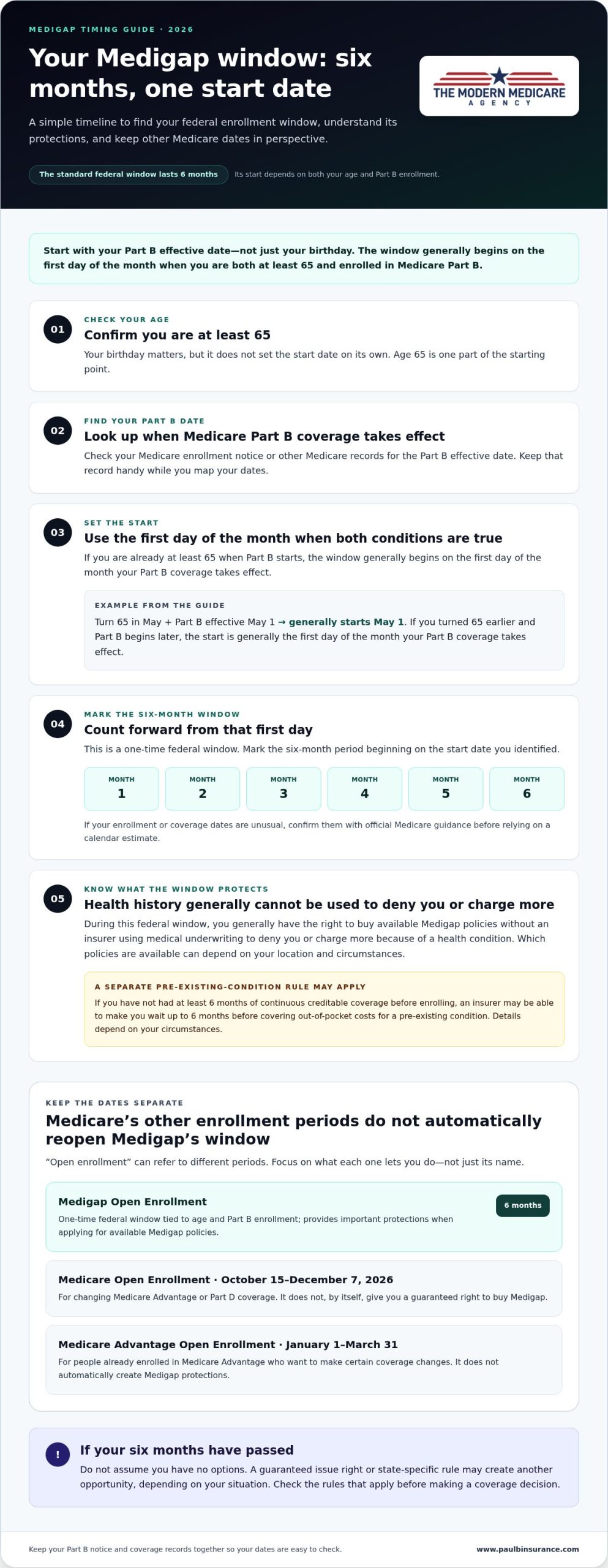
For anyone asking how long is the medigap open enrollment period, the standard federal answer is six months. This is a one-time window that begins on the first day of the month when you are both at least 65 and enrolled in Medicare Part B. Your birthday alone does not set the start date. The key is the month when both conditions are true.
What starts your six-month Medigap window?
Think of age 65 and Part B enrollment as two parts of the same starting point. If you turn 65 in May and your Part B coverage is effective May 1, your window generally begins May 1. If you turned 65 earlier but Part B starts later, the window generally begins on the first day of the month your Part B coverage takes effect. These examples explain the general rule, not an individual eligibility decision.
To map your dates, find the Part B effective date on your Medicare enrollment notice or other Medicare records. Identify the first day of that month, then mark the six-month period beginning on that date. If your enrollment or coverage dates are unusual, check official Medicare guidance before relying on a calendar estimate.
What protections apply during this period?
During the federal window, you generally have the right to buy any Medigap policy available to you under applicable rules, regardless of your health history. An insurer generally cannot use medical underwriting to deny you a policy or charge you more because of a health condition during this protected period. That makes the window a valuable time to compare benefits, premiums, and policy terms. It does not mean every policy is offered in every location.
A separate rule may apply to pre-existing conditions. If you have not had at least six months of continuous creditable coverage before enrolling, an insurer may be able to make you wait up to six months before covering out-of-pocket costs for a pre-existing condition. The details depend on your circumstances, so review current official guidance if this may apply to you.
Medigap supplements Original Medicare, while Medicare Advantage is a different way to receive Medicare coverage. Knowing which type of coverage you have can help you focus on the right enrollment dates and policy choices. The Medigap Wikipedia article offers a general overview of how this supplemental coverage works. For a practical look at Medigap coverage options, compare the available benefits with your needs and circumstances.
Keep your Part B notice and related enrollment records together. Having the effective date in front of you makes it easier to identify your general six-month window and prepare focused questions about your choices. If a date seems unclear, confirm it through official Medicare information before making a coverage decision.
What Medigap open enrollment lets you do, and what it does not mean
Medigap open enrollment is a one-time federal protection window, not a season that automatically returns each year. It generally gives you a chance to apply for available Medigap policies without an insurer using your health to deny coverage or set your price. Which policies are available can depend on your location and circumstances, so the window is not a promise that every plan is offered everywhere.
In short: Medicare’s annual plan-change periods let you make certain changes to Medicare coverage. They do not automatically reopen your federal Medigap enrollment window.
How Medigap enrollment differs from Medicare Advantage enrollment
Medigap works alongside Original Medicare and helps pay certain costs that Original Medicare doesn’t cover. Medicare Advantage is a separate way to receive Medicare benefits through a private plan. These are different coverage paths with different enrollment rules. If you’re weighing them, this Medicare Advantage guide can help clarify how that alternative works.
Medicare Advantage enrollment dates do not set your Medigap open enrollment dates. In 2026, the fall Medicare Open Enrollment Period runs from October 15 through December 7. It is for changes to Medicare Advantage and Part D coverage, and it does not, by itself, give you a guaranteed right to buy Medigap. The Medicare Advantage Open Enrollment Period runs from January 1 through March 31. It is for people already enrolled in Medicare Advantage who want to make certain coverage changes, and it does not automatically create Medigap protections.
Why the word “open enrollment” can cause confusion
Medicare uses the phrase “open enrollment” for more than one period. Focus on what each period lets you do, not just its name. This comparison can help:
| Period | General purpose | What it means for Medigap |
|---|---|---|
| Medigap Open Enrollment | A one-time federal window tied to age and Part B enrollment | Provides important protections when applying for available Medigap policies |
| Medicare Open Enrollment, October 15 to December 7 | Change Medicare Advantage or Part D coverage | Doesn’t automatically provide a Medigap enrollment right |
| Medicare Advantage Open Enrollment, January 1 to March 31 | Make certain changes if you’re enrolled in Medicare Advantage | Doesn’t automatically reopen Medigap’s federal window |
Some people may have other Medigap protections or enrollment opportunities, but a Medicare date alone does not establish that you qualify. Rules can vary by situation and state. For the federal explanation, see Official Medicare Medigap enrollment information, then review your own timing and coverage before making a change.
If you’re comparing coverage paths, an independent conversation can help you sort through Medigap choices. You can explore your Medicare coverage options and clarify which questions to resolve before deciding.
What happens if your Medigap open enrollment period ends?
If you’re asking how long is the medigap open enrollment period because yours may have passed, take a breath. The end of the federal window does not automatically mean you can’t get a Medigap policy. Your options may depend on whether you qualify for another protection and on the rules in your state.
Without a separate protection, applying later may involve medical underwriting. In most states, an insurer may review your health and could deny an application or charge more based on your health history. That does not mean every late applicant will face those outcomes. The rules and available choices depend on your circumstances.
Here’s the general difference:
| Situation | What may apply |
|---|---|
| During the federal Medigap window | Federal protections generally let you apply for available Medigap policies without health-based denial or pricing. |
| After the window, without another protection | Medical underwriting may apply, and an insurer’s decision can depend on its rules and your circumstances. |
| When a qualifying right applies | You may have protected access to certain Medigap coverage, subject to the rules, timing, and plan choices tied to that right. |
When guaranteed issue rights may matter
Guaranteed issue rights are specific protections that may let you buy Medigap in certain situations outside your initial window. For example, losing other health coverage may qualify in some circumstances. These rights have conditions, and the time to use them is limited, often 63 days. Which plans you can choose may also depend on the event. The KFF analysis of Medigap enrollment discusses these protections and coverage choices.
Why state rules can change the picture
Federal rules are only part of the answer. Some states provide additional Medigap enrollment opportunities or protections, and the details vary. Before concluding that underwriting applies, establish your state of residence and note the dates of any coverage change or loss. Those details can help identify which rules may be relevant. Your state insurance department can provide state-specific guidance. An agent can also help you compare Medigap coverage options and organize questions about timing.
If you think a qualifying event may apply, gather notices showing when your other coverage ended and any related plan correspondence. Acting promptly matters because some protections have deadlines. Confirm the current requirements for your situation before submitting an application, and don’t assume that missing the initial window leaves you without a path forward.
How to check your Medigap enrollment dates and protect your options
A quick date review can help you understand where you stand and leave more time to compare coverage calmly. In 2026, use this sequence to organize your information before making a decision:
- Confirm your age. Note when you turned 65, or when you will turn 65.
- Find your Part B effective date. Check your Medicare enrollment notice or records for the date Part B coverage began.
- Map the general window. Use the first day of the month when both age and Part B conditions are met as the starting point, then mark the six-month period. Treat this as a guide and confirm unusual dates through official Medicare information.
- Check your state’s rules. Look for state-specific Medigap protections through your state insurance department, especially if you live in a different state from where you first enrolled.
Date-review checklist: Gather your birth month and year, Part B effective date, Medicare enrollment notices, current coverage details, and any letters about a coverage change.
A simple way to map your personal timeline
Keep the records together and write down the dates you used to estimate your window. If Part B began after you turned 65, use the actual Part B effective date rather than your birthday to identify the general start month. Delayed Part B enrollment, changes in coverage, or other unusual circumstances can affect which rules apply, so don’t rely on a simple estimate alone. Confirm important dates and protections with official Medicare or state guidance.
Save enrollment notices and plan correspondence, including letters that show when coverage started or ended. These records can help you explain your timeline accurately if you need to review your options later.
What to compare before choosing a Medigap policy
Once you have a clearer timeline, compare the policies available to you. Look at benefits, premiums, and insurer terms, then consider how each option fits your needs and budget. Benefits are standardized for the same plan type, but premiums and insurer terms can differ. Availability may depend on your location and circumstances, so don’t assume a particular policy is offered to everyone.
Reviewing options before a deadline gives you more room to weigh trade-offs instead of making a rushed choice. For a plain-language overview of how supplemental coverage works alongside Original Medicare, explore these Medigap coverage basics. If you’re still asking how long is the medigap open enrollment period for your own timeline, an independent agent can help organize your dates and compare Medigap choices. Official Medicare and state guidance remains the place to verify the rules.
Ready to compare Medigap options with your circumstances in mind? Explore Medigap coverage options and take the next step with a clearer picture of your choices.
Get clear, independent help with your Medigap next steps
If your initial Medigap window has passed, that doesn’t automatically mean you’re out of options. Your next step is to understand how your dates, current coverage, and state rules fit together. An independent broker can help you compare available Medigap choices and organize questions about timing, without promising a particular outcome. In 2026, The Modern Medicare Agency compares Medicare plans from more than 40 carriers and provides year-round support as you consider your options.
What a one-on-one Medigap review can clarify
A focused conversation can turn a stack of notices and unanswered questions into a clearer picture. Bring your Part B effective date, current coverage details, state of residence, and any letters about starting or losing coverage. An agent can help review your timeline, identify questions to verify with official sources, and compare available Medigap options relevant to your circumstances. Explore the agency’s Medigap plan-comparison support as you consider what to review.
- Your Part B date and the documents you used to estimate your enrollment timeline
- Any changes to other coverage, including notices showing when it began or ended
- The Medigap choices available for your situation, including benefits and premiums
- Questions that need confirmation from Medicare or your state insurance department
An agent conversation can help you understand your choices and compare plans. It doesn’t replace official guidance on federal or state rules. If you’re still wondering how long is the medigap open enrollment period for your own situation, an agent can help organize the dates and identify what needs official confirmation.
Choose your next step with confidence
If a deadline may be approaching, start gathering your records and reviewing your options promptly. A little preparation can make it easier to ask focused questions and avoid a rushed decision. For rule-specific answers, confirm your circumstances with Medicare or the appropriate state insurance department. The details matter, especially if your coverage history or enrollment dates are unusual.
You don’t have to sort through every detail alone. The Modern Medicare Agency is an independent brokerage, and its agents provide personalized guidance as you compare Medigap choices. Bring your dates and questions, and take the conversation at your pace. Talk with an agent about your Medigap options when you’re ready to review your next step.
Turn your Medigap questions into a clear next step
Understanding how long is the medigap open enrollment period is useful, but your next step is to connect the rules to your own records and coverage needs. If you’re unsure what applies, write down your questions and gather the notices or plan documents that may clarify your situation. You can then review your choices with a clearer picture of what you need to know.
An independent perspective can make comparing options feel more manageable. The Modern Medicare Agency helps people compare Medicare coverage choices based on their circumstances. A conversation can help you sort through what to compare and which timing questions may need an official answer.
Take the next step at your own pace. Get personalized guidance on your Medigap options, and move forward with a clearer sense of what to do next.
Frequently Asked Questions
Is the Medigap open enrollment period six months?
Yes, the standard federal Medigap open enrollment period lasts six months. The word “standard” matters because other protections may create different opportunities, and the federal window isn’t an annual renewal date. If you’re checking how long is the medigap open enrollment period for your situation, distinguish the federal window from any separate state or circumstance-based protection before planning an application.
When does my Medigap open enrollment period start?
Use your Part B effective date as the key record when reviewing your timeline. Check your Medicare enrollment notice or account information, and resolve any mismatch before relying on a date calculation. If your Part B enrollment was delayed or your Medicare eligibility began before age 65, your circumstances may need closer review. Keep the notice with your other coverage records so you can refer to the same date later.
Can I get Medigap after my open enrollment period ends?
Yes, it may still be possible. Start by writing down what coverage you have now, what coverage you had before, and whether anything recently changed. Those details can help identify which application rules may apply. Then compare policies available for your circumstances before making a change. An agent can help you review options, while official sources can clarify rule-specific questions.
What happens if I miss my Medigap open enrollment period?
Missing the period doesn’t by itself tell you what an insurer will decide or whether another protection applies. Avoid making assumptions from the date alone. Review notices related to a change in coverage, note when the change took effect, and promptly verify whether a separate enrollment right or state rule could be relevant. Clear records can make it easier to get a specific answer about your next step.
Is the Medigap open enrollment period the same as Medicare Open Enrollment?
No. The names refer to different enrollment processes. If you’re reviewing a Medicare notice or comparing plan-change dates, first identify the coverage involved: Medigap, Medicare Advantage, or Part D. A date that allows a change to one type of coverage doesn’t automatically establish the rules for another. Reading the notice’s eligibility details can help you avoid acting on a deadline that doesn’t fit your intended change.
Can I switch Medigap plans after my six-month window?
It may be possible, but switching can involve different rules from keeping your current policy. Before taking action, compare the new policy’s benefits and premium with your current coverage, and understand whether you’ve been accepted and when the replacement would begin. Don’t cancel existing coverage based only on an application or quote. If a special protection may apply, verify its conditions before submitting the change.
Do Medigap open enrollment rules vary by state?
Yes. State protections can add options beyond the federal rules, and the details may depend on where you live and your coverage history. Use your current state of residence when looking up guidance, especially if you’ve moved since enrolling. Your state insurance department can explain the protections that apply there. Keep its information with your Medicare records so you can refer to the relevant rules when comparing policies.

Article by
Paul Barrett
Paul Barrett, CMIP is the founder of The Modern Medicare Agency, an independent Medicare-only brokerage based in Melville, NY. With 18 years of Medicare-exclusive experience, a CMIP designation, and more than 5,000 clients served across 37 states, Paul is one of the most credentialed independent Medicare specialists on Long Island — and one of the most direct.
He represents 40+ carriers with no quotas and no allegiances, which means his recommendations are based entirely on what fits each client's specific situation. He is the author of Medicare Mastery Unlocked and host of the Wise Guys Retirement Talk podcast. His content is grounded in primary sources, real carrier intelligence, and 18 years of watching what happens when people get Medicare right — and when they don't.
📞 631-358-5793 | paulbinsurance.com