
What if the best way to handle Medicare mail isn’t to read every envelope right away, but to sort it first? In 2026, letters from Medicare, your current plan, and companies promoting other plans can arrive side by side. Some may ask you to review information, while others are advertisements. It’s understandable to worry that an important request or date could get lost in the pile. Learning how to avoid feeling overwhelmed by Medicare mail starts with a simple routine, not with understanding every letter at once.
You’ll learn how to check who sent each letter, what it’s about, and whether it asks you to take action by a certain date. We’ll also cover how to separate plan marketing from notices about your current coverage, what to look for in documents such as an Annual Notice of Change, and how to verify a confusing message using trusted contact details. The goal is a calm, repeatable way to decide what needs attention and what can wait.
Key Takeaways
- Learn how to avoid feeling overwhelmed by Medicare mail with a simple process for sorting letters one at a time.
- Use the sender and stated purpose to distinguish Medicare information, plan notices, bills, and marketing.
- Check each letter for an action and any date it gives, then sort it without assuming every envelope is urgent.
- Create a simple folder and tracking list so you can find important letters and remember your next step.
- If a notice raises plan questions, verify contact details independently and seek clear guidance before making a decision.
How to Avoid Feeling Overwhelmed by Medicare Mail: Start With a Simple Pause
A growing pile of Medicare-related mail can make it feel as if every envelope needs your attention right now. It doesn’t. In 2026, you can work through the pile one letter at a time, without deciding that every piece is urgent before you’ve opened it. The first step in learning how to avoid feeling overwhelmed by medicare mail is giving yourself permission to pause.
Why Medicare mail can feel confusing
Mail may come from Medicare, your health plan, or another organization. A formal-looking envelope from one sender might arrive beside a colorful postcard promoting a different plan. When they arrive close together, it can be hard to tell a personal notice from general information or marketing. Appearance alone doesn’t tell you whether a letter needs action. Medicare includes different parts and types of coverage; a basic Medicare (United States) overview can help explain the program’s structure, but each letter still needs to be considered on its own.
A letter doesn’t automatically mean there’s a problem. Some mail shares information, while other letters may ask you to review something or take a specific step. Check the sender and the message inside instead of reacting to a bold headline or official-looking design.
What to do before opening or sorting the pile
Choose a comfortable place and set aside a calm moment. Gather the envelopes, a pen, and a folder. You don’t need to finish everything in one sitting. Open one piece of mail, read enough to understand its purpose, and set it aside before moving to the next. If a trusted family member or friend would help you feel more at ease, ask them to sit with you.
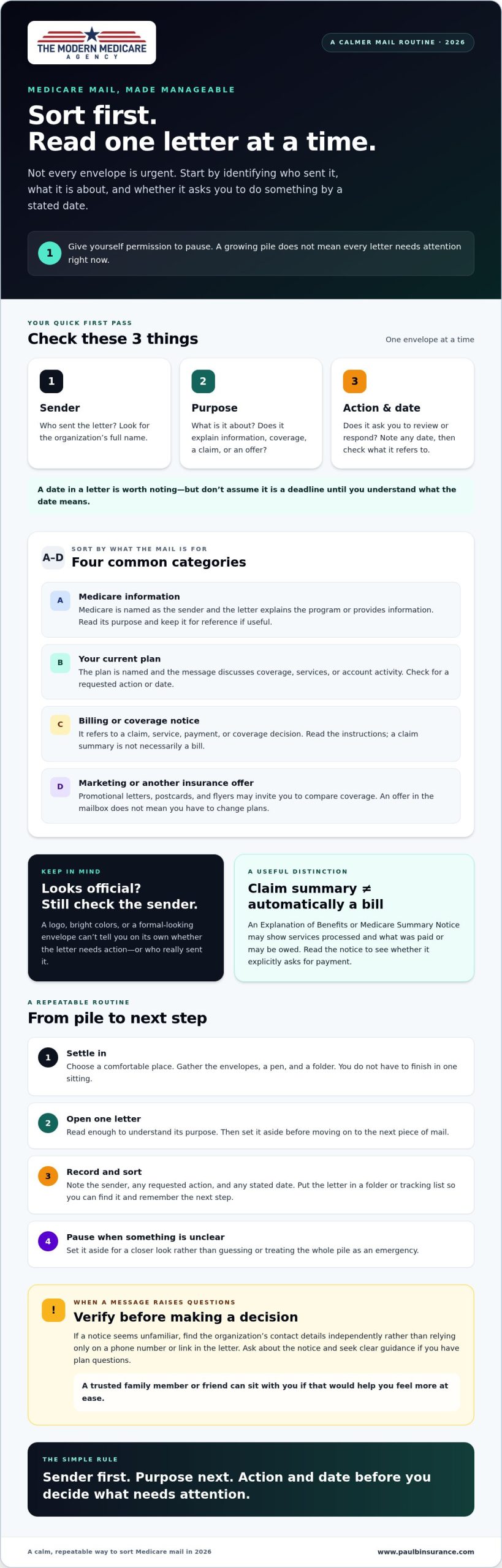
For this first pass, look for three things:
- Sender: Who sent the letter?
- Requested action: Does it ask you to review, respond, or do something else?
- Date: Is a date stated in the letter? Note it down, but don’t assume it’s a deadline until you understand what it refers to.
The sender, requested action, and any stated date help you decide which Medicare letters to review first. If a message is unclear, set it aside for a closer look instead of guessing. This pause gives you a calmer starting point and a practical way to move through the mail without treating the whole pile as an emergency.
What Medicare Mail Might Contain, and How to Tell the Difference
Once you’ve opened a letter, focus on what it’s meant to do. Medicare-related mail can share information, explain plan coverage, describe a claim, request a response, or promote an insurance offer. The sender and stated purpose are more useful clues than a logo, bright colors, or an official-looking envelope. A polished design doesn’t prove that a letter is from Medicare or your current plan.
Official Medicare and plan communications
A letter from Medicare or your health plan may explain coverage, services, plan information, or account activity. Look for the organization’s full name and a clear explanation of why it contacted you. If the message seems unfamiliar, don’t rely only on a phone number or link in the letter. Find the organization’s contact details independently and ask about the notice.
Some mail describes claims rather than asking you to pay. An Explanation of Benefits from a plan or a Medicare Summary Notice may show services that were processed and what was paid or may be owed. These documents aren’t necessarily bills. Read the instructions and check whether the notice explicitly asks for payment. If you’re unsure, contact the plan, Medicare, or provider using verified details.
Marketing mail and other insurance offers
Promotional letters, postcards, and flyers may invite you to learn about or compare coverage. An offer arriving in your mailbox doesn’t mean you’re required to change plans. If the material uses unfamiliar Medicare Advantage terms, this Medicare Advantage guide can help clarify the basics before you decide whether to follow up.
| Mail category | Clues to look for | Sensible next step |
|---|---|---|
| Medicare information | Medicare is named as the sender; the letter explains the program or provides information. | Read the stated purpose and keep it for reference if useful. |
| Plan communication | Your current plan is named; the message discusses coverage, services, or account activity. | Check for a requested action or date, then verify questions with the plan. |
| Billing or coverage notice | It refers to a claim, service, payment, or coverage decision. | Read what the notice says about payment or next steps. Don’t assume a claim summary is a bill. |
| Marketing | An organization promotes an offer or invites you to learn about coverage. | Treat it as an invitation, not an instruction to change plans. |
This kind of sorting is a practical part of how to avoid feeling overwhelmed by Medicare mail: identify the sender, then let the letter’s purpose guide your next step. If it’s still unclear, pause and verify it rather than responding under pressure.
A Three-Step Medicare Mail Triage to Find What Needs Attention
Once you know what kind of mail you’re looking at, use the same quick check for each letter. This gives you a clear next step without treating every notice as urgent. In 2026, the goal isn’t to interpret every detail on the spot. It’s to capture what the letter says and follow up when something isn’t clear.
- Identify the sender. Note the organization named in the letter. Is it Medicare, your current plan, a provider, or another organization?
- Find the requested action. Look for plain instructions, a form to complete, documents being requested, or a request to contact someone. A notice that shares information may not ask you to do anything.
- Record any date stated. Write down the date exactly as it appears and what the letter says it relates to. Don’t assume it’s a response deadline if the letter doesn’t say so.
Prioritize a letter by what it asks, who sent it, and any date stated. This simple, repeatable check is a useful starting point for how to avoid feeling overwhelmed by medicare mail.
How to spot an action request without guessing
Scan for direct wording such as “complete and return,” “send us,” or “contact us.” If a form or supporting document is requested, write down exactly what to provide. Keep the letter with your notes so you can check the wording later. If instructions conflict, or you can’t tell what a date means, don’t fill in the gaps yourself. Contact the organization using details you find independently, such as its official website or a plan contact you’ve already verified.
Then place each letter in one of three groups:
- Action needed: The letter clearly asks you to do something. Note the exact request and any stated date.
- Keep for reference: It shares information but doesn’t appear to request a response.
- Unclear: You can’t tell what it means or whether it needs action. Verify it before deciding.
How to handle confusing or suspicious messages
A surprising call, link, or request for personal or financial information deserves a pause. Don’t share sensitive details with an unexpected caller or unverified contact. Instead, check the message through a trusted official source or contact your plan using information you’ve independently confirmed. An unusual design alone doesn’t prove a message is fraudulent, so verify who sent it before deciding how to handle it.
If you confirm that a letter needs follow-up, keep the notice and your notes together. If you can’t confirm the instructions, leave it in the unclear group until you’ve checked with the sender or an official source. This helps you act on what the letter says, not on what you fear it might mean.
Build a Low-Stress System for Medicare Mail in 2026
A small, consistent filing system can make Medicare mail easier to manage. Keep three folders or clearly marked sections: Action Needed, Plan Information, and Keep for Reference. Put unclear letters aside until you’ve confirmed what they mean. The aim isn’t to create a perfect archive. It’s to make the next step easy to find.
A basic tracking list can help you remember what’s still unresolved. For each letter, note:
- The sender and subject
- The date you received it
- The action requested, if any
- Any date printed in the letter and what it refers to
- Your next step, such as “call plan to clarify”
Review open items at a pace that works for you. There’s no need to follow a universal schedule, but make sure unclear letters and requests don’t disappear under newer mail. Once you’ve confirmed or completed a next step, update your list and move the letter to the appropriate folder.
Choose paper or digital records that work for you
Paper folders may feel easiest, or you might prefer a digital folder on a device or account you can access securely. A mix is fine, too. Keep related plan documents together and use clear file names, such as “Current plan notice” followed by the date. Choose a method you’re comfortable maintaining, and avoid storing sensitive documents somewhere others can access without your permission.
If a caregiver helps you stay organized, you can ask them to sort or track letters with you. Keep control of private information: share only what’s needed for the task, and agree on how documents will be stored or returned.
Know when to ask for help
If you can’t tell what a notice means, contact the named plan or official program using contact details you’ve independently verified. Ask three direct questions: What is this letter about? Do I need to take action? Is there a date I should know about, and what does it refer to? If the letter concerns prescription drug coverage, this Medicare Part D guide may help explain the basic terms.
A clear system is one practical way to learn how to avoid feeling overwhelmed by medicare mail. If a letter raises questions about comparing Medicare plan options, you can also talk with an independent agent about your plan questions.
When Medicare Mail Raises Plan Questions, Get Clear, Personal Guidance
A letter about your coverage can sound urgent, especially if it mentions changes or asks you to review information. But you don’t have to make a plan decision just because a notice feels pressing. First, understand what the letter says and who sent it. In 2026, your current plan is the best place to confirm questions about its own notice, using contact details you’ve verified independently.
Questions to ask before responding to a plan letter
Before you reply, call, or provide information, pause and get specific. Ask who sent the letter, what it concerns, and whether it requests a particular action. If it mentions a date, ask what the date refers to and where the instruction appears in the notice. If the contact details in the letter are unfamiliar, find the organization’s official contact information separately and use it to verify the message.
You can write down the answers as you go. A clear explanation can help you distinguish a request you need to address from information you can simply keep. If the notice remains confusing, ask the representative to explain it in plain language or direct you to the relevant part of the letter. There’s no need to guess.
How an independent Medicare broker may help
Questions about a specific notice should go to the organization that sent it. If the letter prompts broader questions about comparing coverage, an independent Medicare broker may be able to explain options and help you understand differences among Medicare Advantage, Medicare Supplement (Medigap), and Part D plans. The Modern Medicare Agency is an independent brokerage that helps people compare these options from more than 40 carriers. This can support a comparison, but it doesn’t promise a particular plan outcome or mean you need to change coverage.
Getting guidance can be part of how to avoid feeling overwhelmed by medicare mail, especially when a notice brings up questions beyond its immediate instructions. Take the time you need to understand your options. A conversation can help you get clarity without committing to enroll in or switch plans. If you’d like personalized guidance, you can talk with someone about your Medicare questions at your own pace.
Make Your Next Medicare Mail Check Feel More Manageable
In 2026, you don’t have to make sense of every Medicare letter at once. Start by identifying who sent it, what it asks, and whether it states a date. Then keep, file, or follow up on the letter based on what it actually says. If something is unclear, verify the details with the organization using trusted contact information instead of guessing.
That simple routine is a practical way to learn how to avoid feeling overwhelmed by medicare mail. Take it one envelope at a time, and ask for help if a notice raises questions about your plan options.
The Modern Medicare Agency is an independent brokerage that helps people compare Medicare Advantage, Medigap, and Part D options from more than 40 carriers. Its agents offer personalized guidance and year-round support across more than 34 states. If a conversation would help you feel clearer about your choices, talk with someone about your Medicare questions. You can take the next step at your own pace.
Frequently Asked Questions
Why do I get so much mail about Medicare?
Medicare-related mail can come from different organizations for different reasons. You may receive information from Medicare, notices or plan materials from your current insurer, messages about claims or services, and marketing from companies offering coverage. In 2026, these letters and offers can arrive close together, which may make the pile feel confusing. Sort each item by sender and purpose rather than assuming every envelope is urgent or asks you to respond.
How can I tell if Medicare mail needs a response?
Look inside for a clear request, such as completing a form, sending information, or contacting an organization. Check whether the letter states a date and what that date refers to. Don’t assume there’s a deadline if the letter doesn’t say so. If the instructions are unclear, contact the sender using independently verified details. A claims summary, such as an Explanation of Benefits, may describe processed claims rather than request payment.
Is Medicare marketing mail the same as an official Medicare notice?
No. Marketing mail promotes an insurance offer or invites you to learn about coverage, while an official notice comes from Medicare or an organization involved in your current coverage and states its purpose. Design alone isn’t a reliable guide: an advertisement can look formal, and an important notice may be easy to overlook. Check who sent it and what it asks you to do before deciding whether to keep it or follow up.
Can I throw away Medicare mail that looks like advertising?
You can usually set aside promotional material you don’t need, but first check the sender and read enough to make sure it isn’t a notice from Medicare or your current plan. Don’t rely only on a logo, large headline, or envelope design. If you’re unsure, place it with your “unclear” papers and verify its purpose. Keep plan and coverage notices that may help you understand your records or follow up on a request.
What should I do if a Medicare letter has a deadline?
Write down the date exactly as shown and note the action the letter says to take. Read the surrounding instructions so you understand what the date applies to. If either the date or requested action is unclear, contact the organization that sent the letter using independently verified information. Don’t guess or rely on an unfamiliar phone number or link. Keep the letter and your notes together until you’ve confirmed the next step.
How do I know whether an unexpected Medicare call or letter is legitimate?
Pause before responding, especially if someone unexpectedly asks for personal or financial information. Don’t share sensitive details with an unverified caller or contact. Instead, look up the official organization’s contact information independently or use a plan contact you’ve already verified, then ask whether the message is genuine. An unusual design or unexpected timing doesn’t prove a message is fraudulent, so verify its origin before deciding what to do.
Can a Medicare broker help me understand plan mail?
Yes. A Medicare broker may help explain plan terms and compare Medicare Advantage, Medigap, and Part D options, but questions about a specific notice should be confirmed with the organization that sent it. The Modern Medicare Agency is an independent brokerage that helps people compare plans from more than 40 carriers. It offers personalized guidance and year-round support to clients across more than 34 states, without guaranteeing a particular plan outcome.

Article by
Paul Barrett
Paul Barrett, CMIP is the founder of The Modern Medicare Agency, an independent Medicare-only brokerage based in Melville, NY. With 18 years of Medicare-exclusive experience, a CMIP designation, and more than 5,000 clients served across 37 states, Paul is one of the most credentialed independent Medicare specialists on Long Island — and one of the most direct.
He represents 40+ carriers with no quotas and no allegiances, which means his recommendations are based entirely on what fits each client's specific situation. He is the author of Medicare Mastery Unlocked and host of the Wise Guys Retirement Talk podcast. His content is grounded in primary sources, real carrier intelligence, and 18 years of watching what happens when people get Medicare right — and when they don't.
📞 631-358-5793 | paulbinsurance.com