




What if your first move isn’t choosing between your doctor and your Medicare plan, but protecting your care while you confirm what’s changing? If you’re searching for what to do when your doctor leaves your medicare network, it’s understandable to feel unsettled, especially if you rely on ongoing treatment, referrals, or prescriptions.
Start by confirming the details with both your doctor’s office and your plan. Ask when the network change takes effect and how it could affect your care. A provider directory may not reflect the latest information, and rules vary by plan. One doctor leaving a network doesn’t automatically qualify you to change plans outside the usual enrollment periods.
This guide gives you a practical plan for 2026. You’ll learn what to verify, what to ask about continuing care, and how to weigh staying with your plan against reviewing other coverage. Your plan type and available enrollment periods can affect your next steps, so confirm those details before making a decision.
Key Takeaways
- Before deciding what to do when your doctor leaves your medicare network, confirm the change and its effective date with both the plan and the doctor’s office.
- Ask your plan how the network change may affect upcoming treatment, referrals, prescriptions, and appointments.
- Compare the practical trade-offs between keeping your plan and choosing a new provider or reviewing other coverage options.
- Use a call checklist to record answers and keep important care details organized.
- An independent broker may help you compare available plans, but only the plan can confirm a doctor’s network status.
First Steps When Your Doctor Leaves Your Medicare Network
A network notice is a reason to verify what’s changing, not to make an immediate plan decision. In 2026, take time to confirm the details and understand how your care may be affected. If you have an upcoming appointment or ongoing treatment, contact your doctor’s office and plan promptly to discuss next steps before care is disrupted.
This issue often comes up with Medicare Advantage plans, which are offered by private companies and may use provider networks. A network change usually concerns a provider’s participation in a particular plan. It doesn’t automatically mean the doctor has stopped accepting every Medicare option.
Confirm what is changing and when
Before deciding what to do when your doctor leaves your medicare network, find out exactly who or what is affected. The notice may refer to your doctor, the group practice, a facility, or just one office location. Ask the doctor’s office which plans and locations it expects to accept after the change. Confirm the effective date and request written confirmation when available.
Call your plan before making a coverage decision
Call the member services number on your insurance card. Explain the notice and ask the plan to confirm the provider’s network status and the date it changes. Because network rules can differ by plan and service, ask how the change could affect scheduled appointments, referrals, and current treatment. If you take regular prescriptions, ask whether anything about your coverage needs attention.
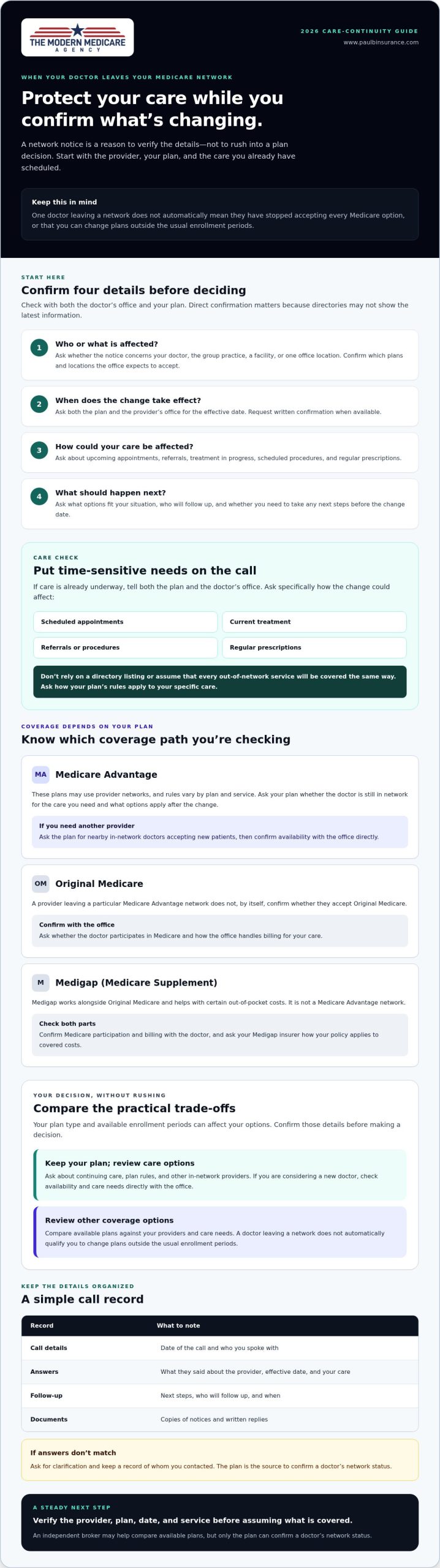
Use this sequence to keep the details straight:
- Confirm the notice. Check who is leaving, which location or service is involved, and the effective date.
- Call your plan. Ask how the change applies to your coverage and upcoming care.
- Contact your doctor. Confirm which plans the office expects to accept and ask about arrangements for your care.
- Document the answers. Note the date of each call, who you spoke with, what they said, and any next steps. Keep copies of notices and written replies.
Be specific about time-sensitive needs. If you have a scheduled procedure, a treatment plan in progress, or a referral underway, tell both the plan and the doctor’s office. Ask what options are available for your situation and who will follow up. Don’t assume that a directory listing or a single phone conversation settles the issue. If you get different answers, ask for clarification and keep a record of whom you contacted.
How a Doctor Leaving a Medicare Network Can Affect Your Coverage
A doctor leaving a network doesn’t necessarily mean they’ve stopped accepting Medicare or that every coverage option is affected. It usually means the provider’s participation in a particular plan is changing. What happens next depends on your coverage type, the plan’s rules, the service you need, and when the change takes effect.
Keep this summary in mind: verify the provider, plan, date, and service before assuming coverage. A doctor may accept one plan but not another, or participate at one location but not another. Confirm the details with your plan and the provider’s office before relying on a directory listing or scheduling care.
If you have Medicare Advantage
Medicare Advantage plans can use provider networks, and network rules differ from one plan to another. Ask your specific plan whether your doctor is still in network for the care you need and what your options are after the change. If you need a new provider, ask the plan to identify nearby in-network doctors who are accepting new patients. Then confirm availability directly with the office. For broader background, see this Medicare Advantage guide.
Out-of-network coverage may depend on your plan type and the service. Don’t assume that a doctor’s departure means you can keep seeing them at the same cost, or that the plan will cover every service outside its network. Ask the plan how its rules apply to your specific care.
If you have Original Medicare or Medigap
Original Medicare doesn’t work like a Medicare Advantage plan network. A provider leaving a particular Medicare Advantage plan’s network doesn’t, by itself, confirm whether that provider accepts Original Medicare. Contact the office and ask whether the doctor participates in Medicare and how the office handles billing for your care.
Medigap, also called Medicare Supplement insurance, works alongside Original Medicare. It helps with certain out-of-pocket costs under Original Medicare, but it isn’t a Medicare Advantage network. Check with the doctor about Medicare participation and billing, and with your Medigap insurer about how your policy applies to covered costs. Confirm the details for the specific service before your appointment.
So, what to do when your doctor leaves your medicare network depends first on the coverage you have. Verify the exact provider and location, ask when the change takes effect, and confirm how your plan treats the care you need. Those answers give you a clearer basis for deciding whether to stay with your current coverage or explore other options in 2026.
Should You Keep Your Plan or Look for a New Doctor?
You don’t have to decide based on the doctor’s network notice alone. First compare the practical impact of finding another provider with the impact of changing coverage. Your treatment needs, prescriptions, access to other doctors, and total plan costs all matter. A plan change may not be available whenever you want, so confirm the 2026 enrollment rules and your eligibility before taking action.
| What to weigh | Keep your plan and find another provider | Explore other coverage options |
|---|---|---|
| Continuity of care | Ask how a new provider could work with your current treatment and records. | Check whether a different plan can support your ongoing care, and confirm its rules with the plan. |
| Doctors and access | Look for nearby in-network doctors in the right specialty who are accepting patients. | Check the full network, including other doctors and facilities you may rely on. |
| Prescriptions and costs | Review whether your current plan still fits your prescription and care needs. | Compare prescription coverage, premiums, cost-sharing, and benefits across available plans. |
When finding another in-network doctor may be practical
Ask your plan for nearby providers who accept your plan and are taking patients. Confirm the specialty, office location, appointment availability, and whether you’ll need a referral. A provider listed in a directory may not have an open appointment, so call the office to check. Your current doctor’s office may also be able to help coordinate records or explain how to transition your care.
When reviewing your coverage may be worth exploring
Review your coverage if the network change affects more than one part of your care or makes it difficult to access suitable providers. Consider the whole picture, not just one doctor. If you have Medicare Advantage, the Medicare Advantage plan guide can help you consider broader plan features.
In 2026, the Annual Enrollment Period for 2027 coverage runs from October 15 through December 7. The Medicare Advantage Open Enrollment Period runs from January 1 through March 31 for people already enrolled in Medicare Advantage. A network disruption may qualify someone for a separate enrollment opportunity in some cases, but one doctor leaving a network doesn’t automatically qualify you. Confirm current rules and your eligibility with Medicare or your plan before making a change.
The best next step depends on your care needs and the choices available to you. Compare both paths carefully. If you want help reviewing plan options, consider personalized guidance from an independent broker. No broker can guarantee a particular doctor’s network participation.
A Step-by-Step Checklist for Protecting Your Care
A written checklist can make calls with your plan and provider easier, especially if you’re managing active treatment or several upcoming appointments. Use these steps to keep important details together and identify what needs attention next. For nonurgent care, confirm provider availability and coverage with the plan before scheduling.
Keep treatment details and records organized
Start with the care you already have in motion. Make a list of appointments, specialists, referrals, treatment plans, and time-sensitive needs. Include prescription names and the prescribing clinician’s contact information so you can ask focused questions. This isn’t a medical plan. It’s a way to help your care team and insurer understand what may need coordination.
- List upcoming care: Note appointment dates, the provider’s name and location, and whether the visit is routine or part of ongoing treatment.
- Ask about records: Contact the current provider’s office to learn how to request your records and whether the office can help coordinate a transition to another clinician.
- Check referrals: Ask the plan and provider how the network change may affect referrals already made or care that has been scheduled.
- Ask about prescriptions: Direct medication coverage questions to your plan or prescribing clinician. Don’t stop or change medication on your own.
Confirm the next steps in writing
For each call, write down the date, the name or role of the person you spoke with, the answer, and any recommended follow-up. Ask the plan to confirm the provider’s network status, the effective date of any change, and how coverage applies to the specific care you need. If the answer is unclear, ask where you can get written confirmation.
- Keep the network notice, call notes, provider messages, and plan replies together in one folder.
- Record who is responsible for each follow-up, such as contacting a doctor’s office or checking an appointment opening.
- Before booking nonurgent care, verify that the provider is available and that your plan’s coverage rules apply to the service and location.
Clear notes can help you compare options without losing track of immediate care needs. If you’d like help understanding available Medicare Advantage choices, review this Medicare Advantage plan guide. An independent broker can help compare plans, but the plan itself must confirm network participation and coverage details.
Get Help Comparing Medicare Options Without Rushing the Decision
You can take this one step at a time: verify the network change, protect any care already in progress, compare realistic options, and then decide. If you’re still weighing what to do when your doctor leaves your medicare network, an independent broker may help you review available plan choices without rushing you into a change.
The Modern Medicare Agency is an independent brokerage that helps Medicare-eligible people compare Medicare Advantage, Medigap, and Part D plans from more than 40 carriers. The agency provides personalized guidance and year-round support. A broker can help you understand plan differences, but can’t guarantee that a particular doctor participates in a plan or that you’re eligible to enroll. Confirm network status, coverage, and enrollment rules directly with the plan.
What a Medicare broker can help you compare
Depending on your current coverage and needs, you may want to compare Medicare Advantage, Medigap, and Part D options. Ask whether a plan includes the doctors and facilities you rely on, covers your prescriptions, and fits the care you expect to use. For broader background before comparing, read this Medicare Advantage comparison guide.
Use your own priorities to guide the discussion. For example, tell the broker if keeping access to a particular specialist matters most, or if prescription coverage and access to other nearby providers are also important. Then verify the specific details with each plan. Provider participation can change, so a comparison is a useful starting point, not a guarantee of access.
What to prepare before asking for guidance
A few details can make a plan discussion more focused. Gather your current plan name, the network notice, the provider’s name and location, and the date the change takes effect. Make a short list of important doctors, prescriptions, upcoming appointments, and questions about treatment or coverage. You don’t need to have every answer before asking for help.
In 2026, confirm current enrollment rules and your eligibility before deciding to change plans. If you’d like to talk through your Medicare options with a caring guide, start a conversation with The Modern Medicare Agency. Take the time you need to understand your choices, then make the decision that fits your coverage and care needs.
Take Your Next Step With Confidence
If your doctor is leaving your network, you don’t have to rush into a plan change. First confirm which provider or location is affected and when the change takes effect. Then ask how your coverage applies to upcoming or ongoing care. These details can help you decide whether finding another provider or reviewing your coverage makes more sense in 2026.
Knowing what to do when your doctor leaves your medicare network starts with protecting your care, then comparing choices based on your doctors, prescriptions, costs, and access to other services. An independent broker can help you review available options, but only the plan and provider can confirm network participation and coverage for your situation.
The Modern Medicare Agency helps people compare plans from more than 40 carriers and provides year-round support across more than 34 states. If you’d like help talking through your Medicare options, connect with a caring guide.
Frequently Asked Questions
What should I do first when my doctor leaves my Medicare network?
Contact both the doctor’s office and your Medicare plan to confirm what’s changing. Ask whether the doctor, a specific location, or certain services are affected, and when the change takes effect. If you’re wondering what to do when your doctor leaves your medicare network, also ask how upcoming appointments and ongoing treatment may be handled. Keep notices and call notes, and don’t assume coverage continues or ends until your plan confirms the details for your situation.
Can I keep seeing my doctor if they leave my Medicare Advantage network?
Possibly, but it depends on your plan, the provider’s status, the service, and the date you receive care. Call your plan and ask what coverage rules apply after the network change. Before receiving nonurgent care, confirm any costs or approval requirements. If treatment is underway, ask both the plan and the doctor’s office about transition or coordination options. Get guidance for your specific situation rather than relying on a general rule.
Does my doctor leaving the network mean I have to change Medicare plans?
No, not necessarily. You may be able to keep your plan and find another provider who accepts it, or you may decide to review other coverage options. Compare your broader provider needs, prescriptions, benefits, and costs before choosing. Whether you can change plans depends on Medicare enrollment rules in effect in 2026 and your circumstances. Confirm your options with Medicare or your plan before taking action.
How do I find a new doctor who accepts my Medicare plan?
Start with your plan’s provider directory, then call the plan to confirm the doctor’s current network status and whether the office is accepting patients. Contact the provider directly too, since directory details can change. Check that the location and specialty fit your needs, and ask about appointment availability and referral requirements. Before scheduling, confirm coverage with your plan, especially if the visit is time-sensitive.
What happens if I need treatment after my doctor leaves my network?
Contact your doctor’s office and plan promptly. Explain what treatment is underway, any upcoming appointments, and whether there are time-sensitive needs. Ask if the plan has a process for continued care or can help you find an appropriate in-network provider. Coverage and transition arrangements vary by plan, so request guidance for your situation. For urgent medical needs, seek appropriate medical care.
Can I switch Medicare plans because my doctor leaves the network?
A provider leaving a network doesn’t automatically let you change plans right away. Enrollment opportunities and eligibility depend on Medicare rules in 2026 and your individual circumstances. Confirm your options with Medicare or your plan before making a change. If you can review coverage, compare the full provider network, prescription coverage, benefits, and costs, not just one doctor. A plan change should fit your broader care needs.

Article by
Paul Barrett
Paul Barrett, CMIP is the founder of The Modern Medicare Agency, an independent Medicare-only brokerage based in Melville, NY. With 18 years of Medicare-exclusive experience, a CMIP designation, and more than 5,000 clients served across 37 states, Paul is one of the most credentialed independent Medicare specialists on Long Island — and one of the most direct.
He represents 40+ carriers with no quotas and no allegiances, which means his recommendations are based entirely on what fits each client's specific situation. He is the author of Medicare Mastery Unlocked and host of the Wise Guys Retirement Talk podcast. His content is grounded in primary sources, real carrier intelligence, and 18 years of watching what happens when people get Medicare right — and when they don't.
📞 631-358-5793 | paulbinsurance.com