




Medicare is generally good insurance for most people turning 65, but the honest answer is: it depends on which parts you enroll in and how you fill the gaps. Original Medicare (Parts A and B) gives you broad access to hospitals and doctors, but it has no annual out-of-pocket cap and leaves real holes in dental, vision, and hearing coverage. Add Medigap plus Part D, or choose Medicare Advantage (Part C), and the picture improves significantly for most people.
According to KFF, about 94% of Medicare beneficiaries 65 and older report being satisfied or very satisfied with their care, with fewer experiencing cost-related problems than privately insured adults ages 50–64. That’s a meaningful data point when you’re weighing whether to stay on employer coverage or transition to Medicare.
Your four immediate next steps:
- Check your Initial Enrollment Period (IEP): it opens three months before your 65th birthday and closes three months after. Missing it triggers late-enrollment penalties.
- List every doctor, specialist, and hospital you currently use. You’ll need this to verify provider participation under any plan you consider.
- Write down every prescription you take. You’ll use this to compare Part D formularies and check whether a Medicare Advantage plan covers your drugs.
- Compare your total expected annual cost across three setups: Original Medicare + Medigap + Part D, Medicare Advantage, and Original Medicare alone. The monthly premium is rarely the whole story.
Table of Contents
- What does Original Medicare actually cover — and what does it miss?
- How does Medicare compare with employer-sponsored or private insurance?
- Original Medicare + Medigap + Part D versus Medicare Advantage: what are the real trade-offs?
- What will you actually pay? Premiums, deductibles, and catastrophic risk
- How do you decide whether Medicare is the right fit for your situation?
- What are the real downsides of Medicare you should know before deciding?
- Will you be able to keep your doctors? What the access data actually shows
- How Paulbinsurance helps you make the right Medicare decision
- Key Takeaways
- What most people get wrong about Medicare — and what actually matters
- Ready to compare your Medicare options with an independent agent?
- Useful sources and further reading
What does Original Medicare actually cover — and what does it miss?
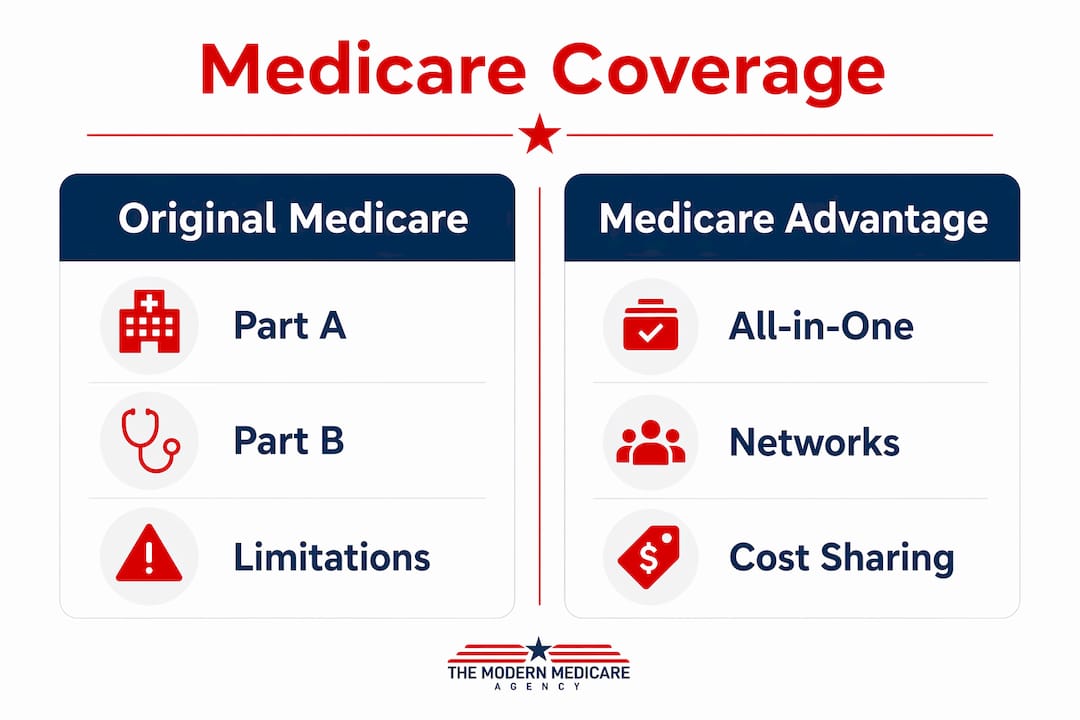
Original Medicare covers two broad categories. Part A is hospital insurance: inpatient hospital stays, skilled nursing facility care after a qualifying hospital stay, hospice, and some home health services. Part B is medical insurance: doctor visits, outpatient procedures, preventive services, durable medical equipment (wheelchairs, CPAP machines), and most medically necessary outpatient care.

Together, Parts A and B cover a lot. But the gaps are where people get surprised.
What Original Medicare does NOT routinely cover:
- Routine dental care (cleanings, fillings, dentures, implants)
- Routine vision exams and eyeglasses
- Routine hearing exams and hearing aids
- Long-term custodial care (assisted living, nursing home personal care)
- Most cosmetic procedures
- Routine foot care for some conditions
- Care received outside the United States
These aren’t minor omissions. A single set of hearing aids can cost $3,000–$6,000 out of pocket. Dental work adds up fast. And long-term care is the biggest financial wildcard of retirement — Medicare covers almost none of it beyond short-term skilled nursing after a hospital stay.
Pro Tip: If you have chronic conditions, take multiple medications, or anticipate needing specialist care regularly, Original Medicare alone creates real financial exposure. Medigap (Medicare Supplement) can cap your out-of-pocket costs at a predictable monthly premium; Medicare Advantage often bundles dental, vision, and hearing extras. Neither is universally better — it depends on your health profile and how much cost unpredictability you can absorb.
How does Medicare compare with employer-sponsored or private insurance?
This is the question most people approaching 65 actually want answered. The short version: Medicare often compares favorably, especially on access and cost-related problems, but employer plans sometimes win on out-of-pocket predictability and integrated extras.
Key differences at a glance:
- Provider access: Original Medicare lets you see any provider who accepts Medicare assignment, which is the vast majority of U.S. physicians. Most employer plans have networks too, but some are narrower than Medicare’s reach.
- Out-of-pocket risk: Many employer plans have annual out-of-pocket maximums. Original Medicare alone does not. A serious illness under Original Medicare alone can produce uncapped costs.
- Premiums: The standard Part B premium changes annually (set by CMS each fall). Employer plans often share premium costs with the employer, which can make them cheaper month-to-month while you’re still working.
- Extras: Employer plans frequently include dental and vision. Original Medicare does not. Medicare Advantage often does.
- Coordination: If you’re still working at 65 and your employer has 20 or more employees, your employer plan is primary and Medicare is secondary. Getting this coordination wrong can cause claim denials.
Statistic worth noting: KFF data shows Medicare beneficiaries 65 and older report fewer cost-related access problems than privately insured adults ages 50–64 — a counterintuitive finding that challenges the assumption that Medicare’s lower provider reimbursements translate into worse access for patients.
One practical note on retiree coverage: if your former employer offers retiree health benefits, those typically coordinate with Medicare rather than replace it. In most cases, Medicare becomes primary and the retiree plan wraps around it. Verify the coordination rules with your benefits administrator before you retire, because the sequencing affects what you owe.
Original Medicare + Medigap + Part D versus Medicare Advantage: what are the real trade-offs?
This is the central decision most new Medicare beneficiaries face. Both paths cover the same core services, but they work very differently in practice.
| Dimension | Original Medicare + Medigap + Part D | Medicare Advantage (Part C) |
|---|---|---|
| Services covered | Parts A & B services; Medigap fills cost gaps | Parts A & B services bundled; most include Part D |
| Premiums | Part B premium + separate Medigap premium + Part D premium | Part B premium + plan premium (often $0) |
| Provider access | Any provider accepting Medicare assignment nationwide | Usually a network; out-of-network often costs more |
| Extra benefits | Generally none (dental/vision/hearing require separate plans) | Many plans include dental, vision, hearing, OTC, fitness |
| Prior authorization | Rarely required for covered services | Common for specialist visits, imaging, procedures |
| Out-of-pocket cap | Medigap can cap costs; Original Medicare alone has no cap | Annual cap required by law (up to $9,250 in-network in 2026) |
| Simplicity | Two or three separate plans to manage | One integrated plan |
Enrollment timing matters enormously for Medigap. During your Medigap Open Enrollment Period (the six months starting when you’re 65 and enrolled in Part B), insurers must sell you any Medigap policy at standard rates regardless of your health. After that window closes, most states allow medical underwriting, meaning a pre-existing condition can raise your premium or disqualify you entirely. If you start with Medicare Advantage and later want to switch to Medigap, you generally lose that guaranteed-issue right. That’s a one-way door many people don’t realize they’re walking through.
Pro Tip: A $0 premium Medicare Advantage plan is not a $0 cost plan. Copays and coinsurance still apply at the point of care. Before enrolling, check the plan’s annual out-of-pocket maximum, the copay for specialist visits, and whether your key providers are in-network. A plan with a $9,250 out-of-pocket cap and $50 specialist copays can cost far more than a Medigap plan with a higher monthly premium if you use care regularly.
For a deeper look at how these two paths compare on cost, see this Medigap vs. Medicare Advantage cost breakdown.
What will you actually pay? Premiums, deductibles, and catastrophic risk
Medicare’s cost structure has several moving parts. Here’s a realistic snapshot for 2026.

| Cost Item | Typical Amount | Notes |
|---|---|---|
| Part A premium | $0 for most people | Free if you or spouse worked enough quarters |
| Part B premium | Set annually by CMS | Higher-income beneficiaries pay more (IRMAA) |
| Part A deductible | Per benefit period | Applies each new hospital benefit period |
| Part B deductible | Annual | Applies once per calendar year |
| Medigap premium | Varies by plan, age, state | Plan G and Plan N are most common choices |
| Medicare Advantage premium | Often $0, some plans charge more | Part B premium still applies separately |
| Part D premium | Varies by plan and formulary | Benchmark plans available in most counties |
| Advantage out-of-pocket max | Up to $9,250 in-network (2026) | Set by law; plans may set lower limits |
The number that catches people off guard: Original Medicare has no annual out-of-pocket maximum. A prolonged hospitalization, cancer treatment, or serious accident can generate tens of thousands of dollars in 20% coinsurance under Part B alone, with no ceiling. Medigap transfers that risk to a predictable monthly premium. Medicare Advantage caps it at the plan’s stated maximum.
Three realistic cost scenarios:
- Healthy, low-utilization: You see your primary care doctor twice a year and get routine labs. Under Original Medicare + a mid-tier Medigap plan + Part D, your total annual cost is mostly premiums. Medicare Advantage with a $0 premium could cost less if you stay healthy.
- Chronic conditions (diabetes, heart disease): Regular specialist visits, ongoing prescriptions, and periodic imaging. Medigap’s predictable cost structure often wins here because copays and coinsurance add up fast under Advantage.
- Catastrophic event (major surgery, cancer diagnosis): Without Medigap, Original Medicare’s uncapped coinsurance can be devastating. A Medigap Plan G or Plan N limits your exposure to a known annual amount. An Advantage plan’s out-of-pocket cap provides a ceiling, but network restrictions and prior authorization can complicate care access when you need it most.
For a detailed look at how Medigap premiums compare to out-of-pocket risk, the Medicare Supplement cost guide at Paulbinsurance walks through the numbers by plan type.
How do you decide whether Medicare is the right fit for your situation?
The question “is Medicare good insurance” only has a useful answer when it’s tied to your specific health, finances, and preferences. Here’s a practical framework.
Decision checklist:
- Assess your health risk. Do you have chronic conditions that require regular specialist care? Higher utilization makes cost predictability more valuable — lean toward Medigap.
- List your current doctors and hospitals. Under Original Medicare + Medigap, any provider accepting Medicare assignment is available to you nationwide. Under Advantage, check whether your providers are in-network before enrolling.
- Check your prescriptions against Part D formularies. Drug coverage varies significantly by plan. A plan with a $0 premium but a Tier 4 or Tier 5 placement for your medication can cost more than a plan with a modest premium and a Tier 2 placement.
- Consider travel. If you spend significant time in multiple states or travel internationally, Original Medicare + Medigap gives you nationwide flexibility. Most Advantage plans are geographically restricted. For international travel, Medicare provides almost no coverage — a travel insurance policy for seniors can fill that gap.
- Estimate your budget for premiums versus catastrophic exposure. A higher Medigap premium buys predictability. A $0 Advantage premium saves money monthly but shifts risk to point-of-care costs.
Red flags for Original Medicare alone (no Medigap):
- You have a serious chronic illness or history of cancer
- You can’t absorb a $10,000+ out-of-pocket bill in a bad year
- You’re not enrolled in a Medicare Advantage plan with an out-of-pocket cap
Red flags for Medicare Advantage:
- You see multiple specialists who may not be in-network
- You travel frequently or split time between states
- You’ve had prior authorization denials under managed care before and found them disruptive
For a practical checklist tailored to your situation, the tips for choosing between Medicare Advantage and supplement plans page at Paulbinsurance is a good starting point.
What are the real downsides of Medicare you should know before deciding?
Medicare has genuine strengths, but it also has trade-offs that don’t get enough attention in the promotional materials.
The most common downsides:
- No routine dental, vision, or hearing in Original Medicare. These aren’t minor gaps. Dental disease is linked to cardiovascular and metabolic conditions, and untreated hearing loss affects cognitive health. You’ll need a separate dental plan, a Medicare Advantage plan that includes these benefits, or you’ll pay out of pocket.
- No out-of-pocket maximum under Original Medicare alone. This is the single biggest financial risk. Without Medigap or an Advantage plan, a serious illness has no cost ceiling.
- Network restrictions and prior authorization under Medicare Advantage. Advantage plans use networks and utilization controls — referrals, prior authorization, step therapy for drugs — to manage costs. For someone who sees multiple specialists or needs complex care, these controls can slow access and create administrative friction.
- Limited Medigap rights after choosing Advantage. If you enroll in Medicare Advantage and later want to switch to a Medigap policy, most states allow insurers to medically underwrite you. A health condition that developed while you were on Advantage can make Medigap unaffordable or unavailable.
Here’s a scenario that illustrates the last point. Someone enrolls in a $0 premium Advantage plan at 65 because it looks like the obvious choice. At 70, after a cancer diagnosis, they want to switch to Medigap for broader access and predictable costs. In most states, the insurer can now charge them significantly more or decline coverage entirely based on their health history. That’s a real consequence of a decision that felt low-risk at 65.
For a fuller picture of Advantage plan trade-offs, see what are the pros and cons of Medicare Advantage plans.
Will you be able to keep your doctors? What the access data actually shows
Provider access is one of the most common concerns people have about Medicare, and the data is more reassuring than most people expect.
Under Original Medicare, you can see any doctor, specialist, or hospital that accepts Medicare assignment. That’s the vast majority of U.S. physicians. You don’t need a referral to see a specialist, and your coverage works the same whether you’re in your home state or traveling across the country.
Medicare Advantage is different. Plans operate within defined networks, and seeing an out-of-network provider typically costs more or may not be covered at all, depending on the plan type (HMO vs. PPO). Some plans require a primary care referral before you can see a specialist.
Steps to verify your providers before enrolling:
- Ask your doctor’s office directly whether they accept Medicare assignment (for Original Medicare) or participate in the specific Advantage plan you’re considering.
- Use the plan’s online provider directory, but call to confirm — directories aren’t always current.
- For specialists, verify both the physician and the facility. A surgeon may be in-network while the hospital they operate at is not.
- If you have a rare condition or see a subspecialist at an academic medical center, confirm that center’s participation explicitly.
On the access question broadly: KFF analysis finds that Medicare beneficiaries 65 and older report comparable or better access to care than privately insured adults ages 50–64, despite Medicare’s lower provider reimbursement rates. The concern that Medicare’s payment structure drives physicians away from Medicare patients is not well-supported by the beneficiary experience data.
How Paulbinsurance helps you make the right Medicare decision
Paul Barrett has been helping Medicare consumers navigate these decisions since 2007. That’s nearly two decades of watching people make the same avoidable mistakes — and helping them avoid the ones that are hardest to undo.
Paulbinsurance is an independent agency, which means the team works with multiple carriers and isn’t tied to pushing any single plan. The goal is to match each person to the coverage that fits their health, budget, and priorities — not to hit a quota for one insurer.
What Paulbinsurance helps with:
- Side-by-side plan comparisons (Medigap vs. Medicare Advantage, Part D formulary checks)
- Enrollment support during your Initial Enrollment Period, Annual Enrollment Period, or Special Enrollment Period
- Guidance on Medigap guaranteed-issue rights and enrollment timing
- Help coordinating Medicare with retiree benefits or employer coverage
- Ongoing support for plan changes, appeals, and annual reviews
- Coverage for related needs: dental insurance, cancer and critical illness plans, hospital indemnity, long-term care, final expense, and annuities
Before a consultation, it helps to have your Medicare card (or your Social Security information if you haven’t enrolled yet), a list of your current medications with dosages, and the names of your primary care doctor and any specialists you see regularly. A typical first consultation takes 30–45 minutes and covers your situation, your options, and a clear recommendation with the reasoning behind it.
Key Takeaways
Medicare is good insurance for most people turning 65, but the version you enroll in — and when you enroll — determines whether it’s truly comprehensive or leaves you with significant financial exposure.
| Point | Details |
|---|---|
| Original Medicare has gaps | Parts A & B don’t cover dental, vision, hearing, or long-term care; add Medigap or Advantage to fill them. |
| No out-of-pocket cap without help | Original Medicare alone has no annual spending limit; Medigap or an Advantage plan’s cap protects you from catastrophic costs. |
| Medigap timing is a one-way door | Your guaranteed-issue window is six months after turning 65 and enrolling in Part B; missing it can make Medigap unaffordable later. |
| Satisfaction data favors Medicare | About 94% of Medicare beneficiaries 65+ report being satisfied with their care, with fewer cost-related problems than privately insured adults 50–64. |
| Paulbinsurance can compare your options | As an independent agency, Paulbinsurance offers free plan comparisons and enrollment support across Medigap, Advantage, and Part D. |
What most people get wrong about Medicare — and what actually matters
Most people approaching Medicare focus almost entirely on the monthly premium. That’s the wrong number to optimize for.
The premium is visible. The total annual cost — premiums plus deductibles plus copays plus coinsurance, all the way up to a potential catastrophic event — is what actually determines whether a plan was a good choice. A $0 premium Advantage plan that charges $50 per specialist visit, requires prior authorization for imaging, and has a $9,250 out-of-pocket maximum can cost far more in a difficult year than a Medigap plan with a $180 monthly premium and near-zero point-of-care costs.
The second mistake is treating the Medigap enrollment window as something you can revisit later. You can’t, in most states, without health underwriting. The six months after you turn 65 and enroll in Part B are the only time you’re guaranteed the right to buy any Medigap policy at standard rates. People who start with Advantage because it looks cheaper at 65 sometimes find themselves locked out of Medigap at 72 because of a health condition that developed in between. That’s not a hypothetical — it’s a pattern that shows up repeatedly.
A few practical things worth checking before you finalize any decision: verify that your specific drugs are on the Part D formulary at a tier you can afford (not just that the plan “covers” them), confirm your doctors accept the specific plan you’re enrolling in (not just Medicare generally), and read the plan’s prior authorization requirements for the services you actually use.
Medicare is worth it. The question is which version of Medicare is worth it for you.
Ready to compare your Medicare options with an independent agent?
Sorting through Medigap plans, Medicare Advantage networks, and Part D formularies takes time — and the stakes are high enough that getting it wrong has real consequences. Paulbinsurance offers free, no-pressure plan comparisons across all major plan types, with guidance grounded in nearly two decades of Medicare-specific experience.

Whether you’re turning 65, retiring and losing employer coverage, or reconsidering a plan you already have, the team at Paulbinsurance can walk you through your options side by side. You’ll get a clear comparison of Medicare Advantage plans, Medigap policies, and Part D drug coverage — matched to your doctors, your prescriptions, and your budget. No jargon, no pressure, and no obligation to enroll. To get started, visit paulbinsurance.com or reach out directly to book a free consultation. Have your medication list and your current doctors’ names ready, and the conversation will be productive from the first minute.
Useful sources and further reading
These are the primary sources worth bookmarking as you research your Medicare options. Each covers a specific part of the decision.
- Medicare.gov — The official CMS site for enrollment rules, plan comparison tools, coverage details, and the Medicare Plan Finder. Start here for anything enrollment-related.
- Medicare.gov: Compare Original Medicare & Medicare Advantage — Side-by-side breakdown of the two main paths, including out-of-pocket maximum rules and Medigap basics.
- KFF: Medicare beneficiary satisfaction and access — The most cited independent analysis of how Medicare beneficiaries rate their coverage and access compared with privately insured adults.
- NCOA: Weighing the pros and cons of Medicare Advantage — Balanced overview of Advantage plan benefits and trade-offs from the National Council on Aging.
- CMS: 2026 Medicare Parts B premiums and deductibles — Official fact sheet with current Part B premium and deductible figures.
- Social Security Administration: Medicare Parts overview — Plain-language summary of what each Medicare part covers.
One reminder: plan details, premiums, and formularies vary by ZIP code and change each year. Always verify specifics for your county and enrollment year using the Medicare Plan Finder at Medicare.gov before making a final decision.
This article is general information, not professional insurance or financial advice. Confirm current rules, premiums, and plan availability for your specific situation with Medicare.gov or a licensed Medicare agent.