




Medicare does not pay for the long-term care most couples eventually face, and a couple has to plan for two people’s care needs, not one. The workable plan is to price the care, decide how a private policy, savings and public programs will share the bill, and set it up while both spouses are still healthy enough to qualify. As independent Medicare agents, we help couples work through that sequence, starting with what Medicare does and does not cover.
TL;DR
- Medicare and Medigap don’t pay for most long-term care, including help with dressing, bathing and eating in a nursing home or at home.
- In 2025 the national median for assisted living was $6,200 a month per person, so a couple needing it together faces about twice that.
- Couples can often stay together through assisted living that accepts two residents or a continuing care community, but the rules differ by state and by community.
- Medicaid and VA benefits help only within strict income, asset and service limits, and rules are changing through 2028.
- Planning while both spouses are healthy keeps the most options open.
Table of Contents
- What Medicare covers, and what it leaves to you
- What care costs when two people may need it
- Can spouses stay together while receiving care?
- Who qualifies for benefits: the six activities of daily living
- Ways couples pay for long-term care
- Protecting the spouse who stays home
- Our view: plan for two, not one
- Talk to an agent who can look at both of you
- FAQ
- Sources
What Medicare covers, and what it leaves to you
Most people turning 65 assume Medicare handles any serious health need. It handles medical care. Long-term care is mostly non-medical: help with daily activities such as bathing, dressing, eating, toileting and moving from bed to chair. Medicare’s own page says most health insurance, Medigap included, does not pay for these services, whether they happen in a nursing home, in assisted living or at home. You pay for them yourself unless another program steps in.
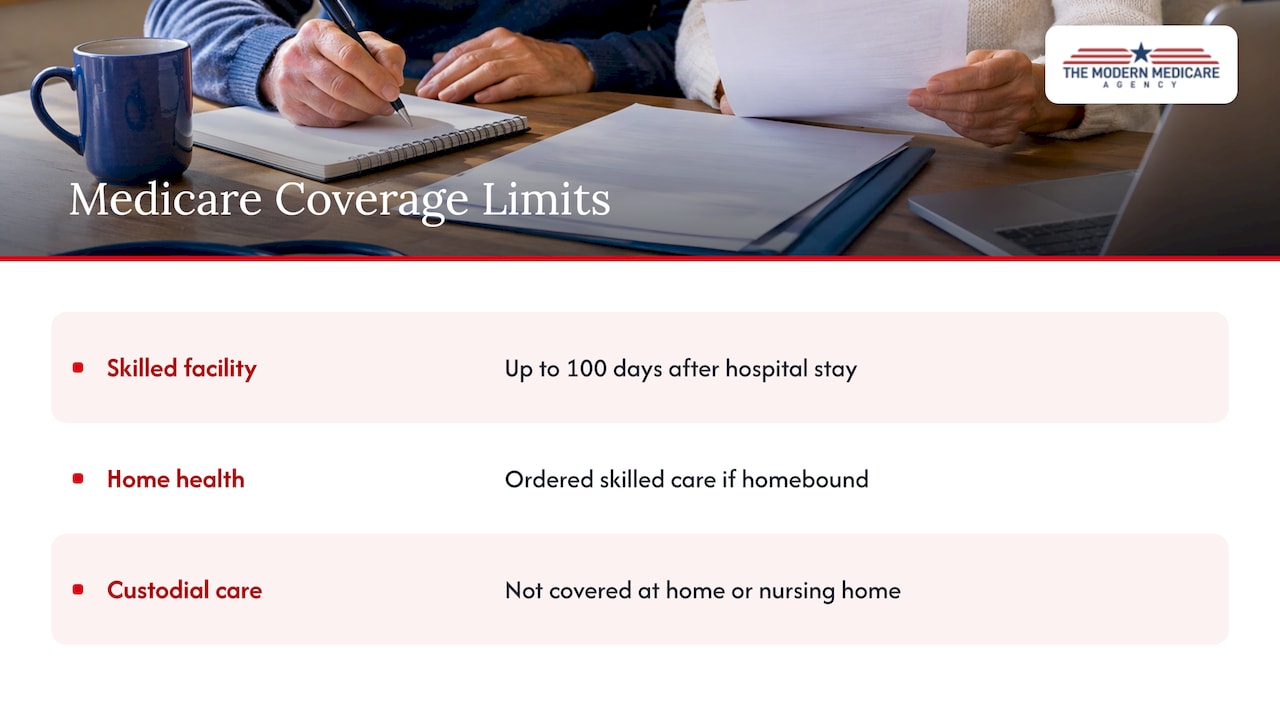
What Medicare does pay for is narrower. According to the VA’s explanation of Medicare benefits, Original Medicare pays for skilled nursing facility care for up to 100 days in a benefit period after a hospital stay. It also covers home health services such as intermittent skilled nursing and therapy when the patient is homebound and a physician orders the care through a Medicare-certified agency. If the only care needed is custodial, Medicare will not pay in a nursing home or at home.
In practice, that means one spouse can recover from a hip fracture with Medicare paying for rehab, then need years of help with daily tasks that Medicare will not touch. If you want the details by setting, we explain them in our guides on Medicare and nursing home care in 2026, custodial care and in-home care. For memory conditions, see our dementia and Alzheimer’s coverage guide.
What care costs when two people may need it
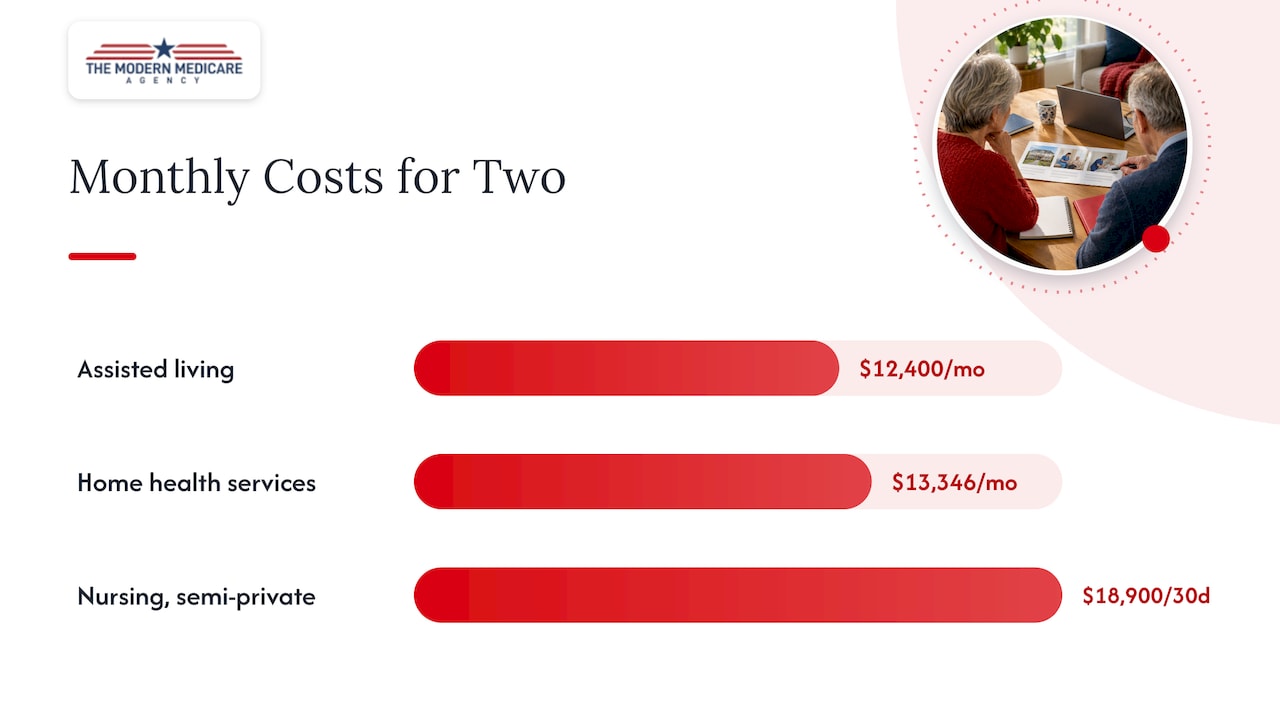
The key difference for couples is that every figure you read is per person. Kentucky’s Department of Insurance consumer guide reports 2025 national medians of $315 a day for a semi-private nursing home room and $355 a day for a private room. The same guide puts home health aide and homemaker services at $35 an hour, or $6,673 a month, and assisted living at $6,200 a month.
Here is what that looks like for a couple, using those national medians and our own arithmetic:
| Type of care | Median for one person | If both spouses need it |
|---|---|---|
| Assisted living | $6,200 a month | $12,400 a month |
| Home health aide and homemaker services | $6,673 a month | $13,346 a month |
| Nursing home, semi-private room | $315 a day (about $9,450 in a 30-day month) | about $18,900 for 30 days |
Your local costs will differ from national medians, and the two spouses rarely need care at the same time or in the same amount. A more typical picture is one spouse needing paid care for several years while the other still lives at home and still has a household to run. The National Institute on Aging notes that many families find care costs take a large share of monthly income even when they believed they had saved enough. That is the real couple’s problem: paying for one person’s care without leaving the healthy spouse short.
Can spouses stay together while receiving care?
Often yes, but it depends on the setting and on each partner’s needs.
Assisted living and board-and-care homes
Assisted living in most states means 24-hour staff, meals, housekeeping and transportation, and each state sets its own rules, according to the Alzheimer’s Association’s care options guide. The same guide describes board-and-care homes as small residences of 2 to 20 people who need daily supervision and personal care. Many communities offer apartments for two. Ask each one how it handles a couple when one spouse needs more help than the other, and what happens to the rent and service fees if one moves to a higher level of care.
Continuing care retirement communities
A continuing care (life-care) community is built for exactly this situation. The Merck Manual describes them as guaranteeing that residents are cared for on the same property as their needs progress, from independent living through assisted living to a nursing home. They can also help couples live together or at least near each other when one partner needs more help than the other can give. Contracts and entrance fees vary, so read the contract carefully before you commit.
Staying at home
Many couples prefer to age at home, with a home health aide or adult day services covering the gaps. This keeps spouses together, but the hourly cost adds up quickly, as the table shows. It also puts a heavy load on the healthy spouse if paid help is limited.
Who qualifies for benefits: the six activities of daily living
Private long-term care policies and some government programs use the same trigger. Oklahoma State University Extension explains that qualifying generally requires substantial help with two or more of six activities of daily living: transferring, incontinence hygiene, toileting, dressing, bathing and eating. For a cognitive impairment such as Alzheimer’s, the trigger is substantial supervision to protect safety instead.
Talk through this together. Knowing the trigger helps you see when a policy or program would start paying, and it helps each spouse explain their wishes before a crisis.
Ways couples pay for long-term care
The National Institute on Aging describes the usual mix: personal funds, government programs and private financing options, since most health and disability insurance includes little or no long-term care benefit. Here are the main pieces and how they fit a couple.
Private long-term care insurance
Private long-term care insurance policies cover a range of benefits, depending on the policy, in settings that include the home, assisted living or a nursing home. For couples, the real advantage is timing. Kentucky’s Department of Insurance advises that planning now, while you are still insurable, gives you a better chance of staying independent, protecting your family from personal and financial costs, and preserving assets. Health conditions that develop later can limit your options, so the best moment is usually while both spouses are in good health.
We can help you compare long-term care insurance along with Medigap so the two fit together. Our guide on Medigap and long-term custodial care shows where the line sits between them.
Savings, annuities and life insurance
Self-funding is the other main route. Some couples set aside savings for care, and others look at annuities or life insurance as part of the plan. Which fits depends on your assets, income and how much risk you want to carry. A conversation about your numbers will tell you far more than a rule of thumb.
Medicaid
Medicaid is a joint federal and state program, and it is the largest public payer of long-term care. Medicare’s page says you may be eligible through Medicaid if you meet your state’s requirements. A Colorado publication on Medicaid and veterans benefits describes the typical shape of the rules: a countable asset limit of roughly $2,000 for the applicant and a five-year look-back on transfers of assets. Limits and spousal protections differ by state, so check your own state Medicaid office before you plan around it.
Two changes are worth knowing about, both from the 2025 federal budget law (P.L. 119-21):
- Starting January 1, 2028, the law sets a $1 million cap on home equity for Medicaid long-term care eligibility, with no inflation adjustment.
- Starting January 1, 2027, retroactive Medicaid coverage is limited to one month before application for expansion enrollees and two months for other groups. Justice in Aging notes that applications often take weeks or months, which raises the risk of unpaid bills during the wait.
The practical lesson for couples: apply early, and keep records of income and assets organized.
VA benefits for veterans and surviving spouses
If one of you served, ask about VA benefits. The Aid and Attendance benefit, as listed in a Colorado publication effective December 1, 2025, pays up to $2,424 a month to a single veteran, up to $2,874 a month to a married veteran and up to $1,558 a month to a single surviving spouse toward care. It requires wartime service, a need for another person’s help with daily activities (or being bedridden, in a nursing home or blind or nearly blind), and net worth under $163,699. The full details are in that guide.
There is also a newer rule. Effective September 11, 2025, the VA may pay up to 100% of the nursing home rate for eligible veterans’ non-institutional care, up from a previous 65% cap, according to the Federal Register. That covers services such as homemaker and home health aide care, adult day health care and veteran-directed care. For application questions, the VA itself is the authority to contact.
Protecting the spouse who stays home
When one spouse needs care, the other still has to live on the household’s income and savings. Build the plan around that person.
- Add up the household budget for two. List both spouses’ income (Social Security, pensions, retirement withdrawals) and fixed costs, then subtract the likely cost of care for one spouse. The remainder is what the healthy spouse lives on.
- Decide which care setting each of you would prefer. Home, assisted living or a continuing care community each have different costs and different ways to keep you together.
- Choose how the bill will be split. A private policy, savings, and public programs each pay for different things, so decide the order in which you would use them.
- Do it while both of you can qualify. Insurability changes with health, which is why Kentucky’s guidance points to early planning.
- Review it every year. Costs, health and rules change, and so should the plan.
On step 1, remember that Medicare is separate for each spouse. Our guide to choosing a Medicare plan for your spouse explains how to match two people’s plans to their different health needs.
Our view: plan for two, not one
Couples tend to treat long-term care as one person’s problem, usually the spouse who is sicker. In reality it is a household problem. The first spouse to need care draws on the same savings and income the other will live on afterward.
We believe in education first. It is hard to choose well when you do not understand your options, so we start by walking couples through what Medicare covers, what it does not, and what that means for each of you. Many people are surprised to learn that nothing in Medicare, Medigap included, pays for ongoing help with dressing and bathing.
As independent agents with access to 40+ carriers, we can look at long-term care insurance, Medigap, Medicare Advantage, annuities and life insurance side by side, with no pressure and a focus only on what you need. Paul Barrett has been helping Medicare consumers since 2007. We offer annual coverage checkups and year-round support, so the plan you build at 65 is reviewed as your needs and the rules change.
The best time to talk is before anyone needs care.
Paul
Talk to an agent who can look at both of you
We are an independent Medicare agency, and we help couples with Medicare supplements, Medicare Advantage, Part D, long-term care insurance, annuities, life insurance and final expense coverage. We review your situation, explain your options in plain language and compare plans across carriers. Start on our Medicare Supplement and Long-Term Care Insurance page to see how it fits together.

If you are new to Medicare, turning 65, leaving employer coverage or unhappy with your current plan, a review is a good place to begin. You can reach us through paulbinsurance.com.
FAQ
Does Medicare pay for long-term care for either spouse?
No, not for custodial care. Medicare and Medigap do not pay for most long-term care, such as help with bathing and dressing. Medicare can pay for short-term skilled nursing after a qualifying hospital stay, up to 100 days per benefit period, and for some home health care that is medically ordered. See our guide on Medicare and long-term care.
Can a husband and wife live in the same assisted living community?
Many communities offer apartments for couples, and continuing care communities in particular are designed so that spouses with different needs can live on the same property. Since each state sets its own assisted living rules, ask each community how it handles couples and how fees change if one spouse needs more care.
Does the VA cover long-term care for spouses?
In some cases. Aid and Attendance can pay a higher amount to a married veteran and up to $1,558 a month to a single surviving spouse, subject to wartime service, care need and net worth limits, as listed in a Colorado benefits guide. Contact the VA for your own eligibility.
When is the right time to buy long-term care insurance?
While you are still healthy enough to qualify. Kentucky’s Department of Insurance says planning while you are still insurable gives you the best chance of protecting your independence and assets. Many couples start thinking about it around the time they enroll in Medicare.
Sources
- Long Term Care Coverage, Medicare.gov
- Medicare Benefits and Long Term Care, VA Geriatrics and Extended Care
- Long-Term Care Insurance guide, Kentucky Department of Insurance
- Paying for Long-Term Care, National Institute on Aging
- Care Options, Alzheimer’s Association
- Life-Care Communities, Merck Manual Consumer Version
- Understanding Long-Term Care, Oklahoma State University Extension
- Medicaid Programs and Veterans Benefits, 2026 Colorado guide
- Federal Register, January 12, 2026, VA non-institutional care rule
- Summary of Medicaid changes in P.L. 119-21, American Medical Association
- Budget Reconciliation Act of 2025: Medicaid and Medicare provisions, Justice in Aging
Recommended
- Using an Annuity to Fund Long-Term Care: A Simple 2026 Guide
- 2026 U.S. Long Term Care Insurance Costs: $950–$5,000+ and When to Buy
- What to Know About Medicare and Long-Term Care Coverage: Essential Insights for Planning Your Future
- Long-Term Care Insurance vs Hybrid Policies: Your 2026 Guide to Peace of Mind