




You might think every insurance agent has the same goal: to find you the most affordable coverage for your specific health needs. The reality is often different. In 2026, some agents are restricted by the very companies they represent, which can limit your choices significantly. If you’ve been feeling overwhelmed by the 40 plus carriers available this year, you’re likely wondering, what is the difference between a medicare broker and a captive agent? Understanding this distinction is the first step toward avoiding high out-of-pocket costs and aggressive sales tactics that don’t put you first.
We know how stressful it feels to worry if your doctors or prescriptions will still be covered next month. It’s perfectly normal to feel a bit lost when faced with so many complex choices. In this guide, we promise to clear up the confusion so you can choose a partner who acts as your long-term advocate. We’ll compare the freedom of an independent broker against the limitations of a captive representative. This will give you the clarity you need to secure your peace of mind and protect your budget for the year ahead.
Key Takeaways
- Understand the fundamental shift in loyalty between an agent who works for a company and one who works for you.
- See how having access to over 40 different carriers in 2026 protects your budget and keeps your doctors covered.
- Learn what is the difference between a medicare broker and a captive agent so you can avoid high-pressure sales tactics.
- Get a list of simple questions to ask any professional to ensure you’re getting the full picture of your 2026 options.
The Big Question: Who Does Your Medicare Agent Actually Represent?
Choosing a plan in 2026 feels like solving a high-stakes puzzle with too many pieces. You have two main paths to get help, and the road you take changes your entire experience. One path leads to a captive agent. The other leads to an independent broker. You might wonder, what is the difference between a medicare broker and a captive agent? The answer is simple: it’s about who the agent serves. One represents the insurance company; the other represents you.
A captive agent is essentially an employee or a contractor for one specific insurance brand. They are the voice of that company. An Insurance broker is an independent professional who works for the client. They have the freedom to shop around. This choice is likely the most important decision you’ll make before you even look at a plan. It determines whether you get a sales pitch or a true partner who puts your budget first.
The Importance of Neutrality in 2026
The 2026 Medicare landscape is more crowded than ever. With over 40 different carriers competing for your attention, the risk of “brand loyalty” is high. If you talk to a captive agent, their loyalty is fixed. They have to tell you their plan is the best, even if a competitor offers better coverage for your specific doctors. A one-size-fits-all approach often fails in modern healthcare. You need someone who can look at Medicare Advantage and Medigap options across the board without being tied to a single logo.
Setting Your Expectations for Professional Help
There’s a common myth that getting expert help will cost you more money. That’s simply not true. You should never pay more to understand what is the difference between a medicare broker and a captive agent. Whether you use an agent or sign up yourself, the plan costs the same. The real value is in the peace of mind. A calm guide protects you from aggressive sales tactics. They take the time to listen to your fears about out-of-pocket costs. By the end of the process, you should feel a sense of certainty. You aren’t just picking a plan; you’re gaining a long-term advocate who will be there if your needs change next year.
The Captive Agent: A Direct Connection to a Single Brand
Imagine you receive a glossy flyer in the mail from a famous insurance company. When you call the number on that card, you’ll likely speak with a captive agent. These professionals are employees or contractors for one specific brand. Their primary goal is to keep you within that company’s ecosystem. While they might be very knowledgeable about their specific plans, their toolkit is strictly limited. They can only offer what their employer allows them to sell. This is a central point when asking what is the difference between a medicare broker and a captive agent. Their loyalty belongs to the company, not to you.
You will often encounter captive agents through direct mail or carrier-specific call centers. They are the face of the brand. However, because they only represent one carrier, they cannot provide a neutral comparison of the entire market. In 2026, with so many new plan variations appearing, this lack of choice can be a significant hurdle. If you want to see how these roles differ in practice, you can explore this comparison of a Medicare Broker vs. Agent.
The Limitations of the Single-Carrier Model
The biggest risk of working with a captive agent is the lack of flexibility. What happens if your primary doctor leaves that carrier’s network mid-year? A captive agent cannot move you to a competitor that still covers your doctor. They simply don’t have the license or the authority to do so. They are unable to compare their plan against the 40 plus other carriers available in 2026. This means their advice is often biased toward their employer’s bottom line. They are trained to find reasons why their plan is the best, even if it leaves you with higher out-of-pocket costs than a plan from another company.
The Sales Experience with a Captive Agent
Understanding what is the difference between a medicare broker and a captive agent is especially helpful when you notice the scripted nature of the conversation. These agents frequently work under high-pressure sales quotas. They need to hit specific numbers for their company to stay employed. This pressure can sometimes lead to aggressive tactics that make you feel rushed. They are restricted from recommending a competitor, even if that other company has a much better Part D prescription plan for your specific medications. If you’re looking for a path that prioritizes your needs over a company’s sales targets, it might be time to talk to an independent advocate instead.
The Medicare Broker: Your Independent Guide to the Whole Market
If the captive agent is the voice of a single brand, the independent broker is your personal shopper. They don’t represent the insurance company. They represent you. When people ask what is the difference between a medicare broker and a captive agent, they usually want to know who is looking out for their wallet. A broker is a professional licensed with dozens of different companies. This independence allows them to take a marketplace approach. Instead of trying to fit you into one plan, they compare Medicare Advantage and Medigap options across the entire 2026 market to find what actually works for your life.
You might wonder how this service stays free for you. It’s a common concern. Brokers are paid a commission by the insurance carrier you eventually choose. Because they get paid regardless of which brand you pick, their only incentive is to keep you happy. Their loyalty stays with you. If a carrier treats you poorly or raises rates too high, your broker can help you move. They aren’t tied to a single logo, which makes them your most powerful ally in a complex system. This professional independence is a valuable asset in any major financial decision, much like the neutral market access provided by Indi Mortgage North for those seeking home financing.
Access to 40+ Carriers and Thousands of Plans
Choice is your best defense against high costs. In 2026, the market is flooded with options that look similar on the surface but differ wildly in the fine print. An independent broker uses specialized software to filter these plans by your specific zip code. They can see exactly which plans cover your specific medications and which ones your preferred doctors accept. This level of detail is how they find the perfect match among Medicare Supplement (Medigap) options. You don’t have to guess if a plan is right. You’ll have the data to prove it.
A Long-Term Relationship Beyond Enrollment
Your journey doesn’t end the moment you sign a paper. That’s actually where the real work begins. A broker provides year-round support that a call center agent simply can’t match. They act as your personal advocate if a claim gets stuck or if you have questions about your coverage in the middle of the year. When 2027 rolls around, they’ll be there to perform an annual review. If your current plan changes its rules or raises its prices, your broker will already have a list of alternatives ready. It’s the peace of mind that comes from having an expert on speed dial who knows your history and cares about your future.
Comparing Choice, Cost, and Service: Side-by-Side Analysis
To really understand what is the difference between a medicare broker and a captive agent, you have to look at how they handle your health and your money side-by-side. It’s one thing to hear a definition. It’s another to see how it impacts your wallet when you’re standing at the pharmacy counter in 2026. This choice affects your daily life. It determines who picks up the phone when a claim is denied or when your favorite doctor suddenly leaves your network.
Think of this as your roadmap to clarity. We’ve broken down the two roles based on the factors that matter most to seniors today. Whether you value a familiar brand name or you want the lowest possible out-of-pocket costs, seeing the facts clearly will help you feel certain about your next step. This comparison helps remove the anxiety from a complex process.
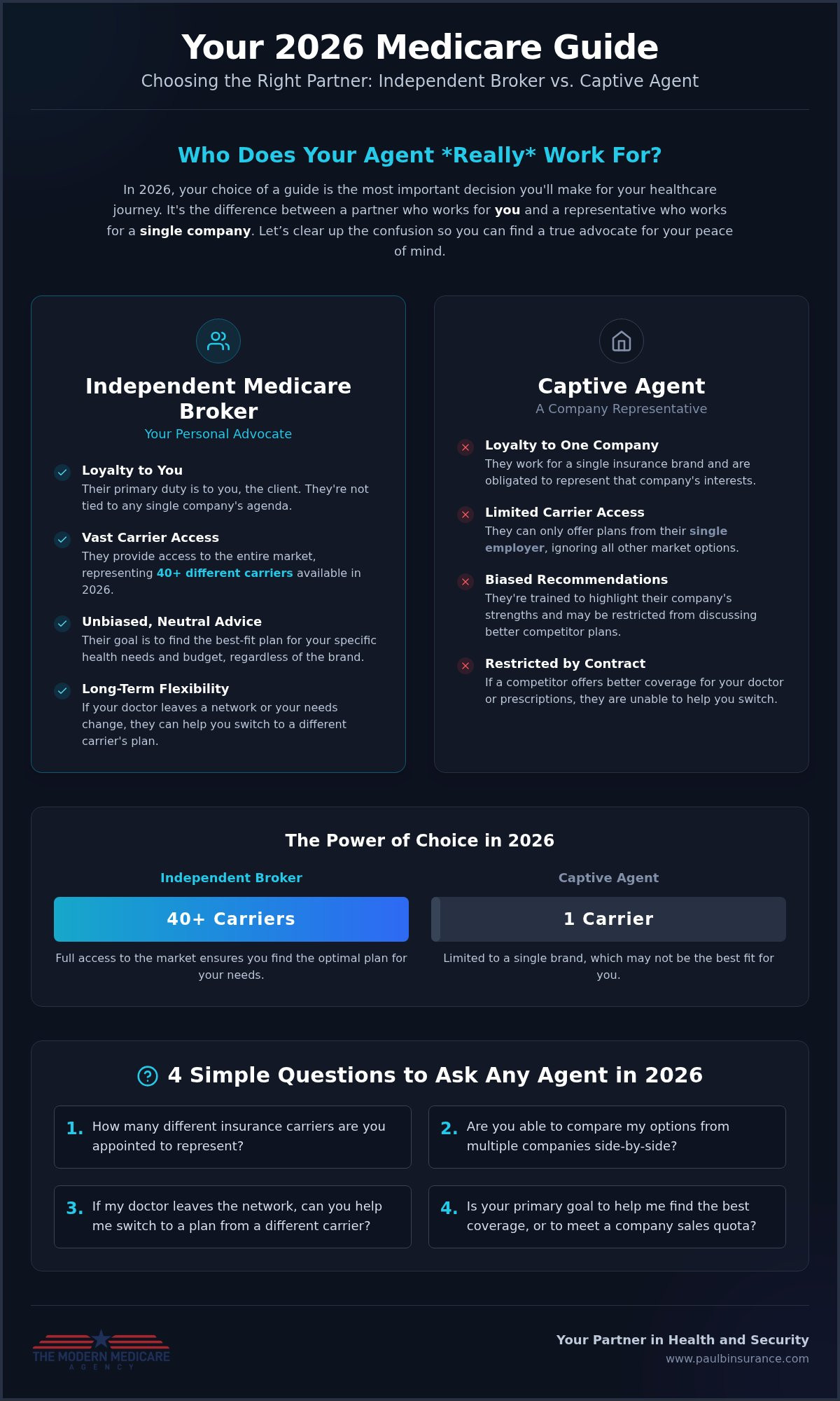
The Comparison Breakdown: Broker vs. Captive Agent
Key Comparison Points:
- Number of Plans: Brokers provide access to over 40 carriers and thousands of options. Captive agents are limited to one specific insurance company.
- Whose Interests Come First: Brokers represent the client. Captive agents represent the insurance carrier.
- Cost to You: Both services are provided at no cost to the consumer. The insurance companies pay the professionals directly.
- Post-Enrollment Support: Brokers offer year-round advocacy and annual reviews. Captive agents are often limited to brand-specific administrative help.
Which Option Is Right for You?
Some people are “One Brand” fans. They’ve used the same insurance company for years and feel comfortable staying in that ecosystem. If you don’t mind having limited choices, a captive agent might feel familiar. However, most seniors in 2026 are shifting toward the “Smart Shopper” mindset. When you look at what is the difference between a medicare broker and a captive agent, the biggest factor is variety. The odds of one single company having the best Medigap plan and the best drug coverage for your specific medications are very low. An independent broker does the hard work of comparing those thousands of combinations for you.
Choosing a broker means you aren’t just a policy number to a giant corporation. You’re a client with a personal advocate. If you’re ready to move from confusion to certainty, reach out to an independent expert who puts your needs first.
Choosing Your Partner for a Stress-Free Medicare Journey
Picking your Medicare partner is a major decision that affects your health and your wallet for years to come. You want to be sure you’re getting the full story. When you first sit down with a professional, simply ask, “How many different insurance companies can you actually enroll me in?” A captive agent will answer with just one. A broker will list dozens. Asking this simple question helps you immediately see what is the difference between a medicare broker and a captive agent in a real-world setting. You deserve to know if your guide is looking at the whole 2026 market or just one small corner of it.
At The Modern Medicare Agency, we choose to stay independent for a very specific reason. We want to be your advocate, not a company’s salesperson. We do the heavy lifting of researching thousands of plan variations so you don’t have to spend your weekends staring at spreadsheets. Our approach is built on simplicity. We provide the research, we explain the pros and cons in plain English, and you make the final choice based on what’s best for your life. You don’t have to do this alone.
How Paul Barrett and the Team Protect Your Interests
Paul Barrett and our dedicated team are committed to protecting your interests every single day. Because we represent over 40 different carriers, we can ensure you never overpay for coverage that doesn’t fit your needs. Our “No-Pressure” guarantee means our primary goal is your education, not a sale. We want you to feel empowered and protected, not pushed into a plan that doesn’t feel right. If you’re worried about the rising costs of medicine, our Medicare Part D prescription support can help you find the most cost-effective way to get your medications in 2026.
Your Next Steps Toward Certainty
Moving from a state of confusion to a state of certainty is easier than you might think. You can schedule a simple, conversational review of your options that fits your schedule. To make our first meeting as productive as possible, try to have a list of your current prescriptions and the names of your preferred doctors ready. This allows us to use our specialized software to filter through the thousands of 2026 options to find the perfect match for your zip code. When you’re ready for a partner who prioritizes your peace of mind, schedule your personalized Medicare review with Paul Barrett. We look forward to helping you navigate this journey with clarity and confidence.
Secure Your Peace of Mind for 2026
You now have a clear answer to the question: what is the difference between a medicare broker and a captive agent? It’s the difference between being limited to one brand’s rules and having the freedom to choose from the entire market. In 2026, the complexity of Medicare requires a partner who puts your health and budget first. By choosing an independent advocate, you gain access to unbiased comparisons from over 40 carriers. We are licensed in over 34 states and provide year-round personal support at no cost to you. You don’t have to guess if your doctors are covered or if you’re overpaying for prescriptions. We handle the research so you can enjoy your life with total certainty. This journey is about your security and your comfort.
Let us be your advocate, so compare 40 plus carriers with Paul Barrett today
You deserve a healthcare journey that’s simple, clear, and focused entirely on you. We are here to make that a reality. Our team is ready to help you move from confusion to certainty with a single conversation.
Frequently Asked Questions
Does it cost more to use a Medicare broker than a captive agent?
It doesn’t cost you a single penny more to use either type of professional. The insurance companies pay these agents directly for the work they do. Whether you sign up through a broker, a captive agent, or directly on a website, the plan premiums and benefits remain exactly the same. You are essentially getting a personal expert to help you navigate the system for free.
Can a captive agent sell me a plan from a different insurance company?
No, a captive agent is legally restricted to only selling plans from the company they work for. They cannot offer you a plan from a competitor, even if that other plan is a better fit for your health needs. This is a key part of what is the difference between a medicare broker and a captive agent. Their goal is to keep you loyal to their specific brand.
How do Medicare brokers get paid if their services are free to me?
Brokers receive a commission directly from the insurance carrier after you enroll in a plan. Because they represent over 40 different carriers in 2026, they get paid regardless of which company you choose. This setup is designed to keep their advice unbiased. They focus on finding the plan that makes you happy because they want to keep you as a client for years to come.
Will a broker help me if I have a problem with my plan later in the year?
Yes, providing year-round support is one of the biggest benefits of working with an independent broker. If you have a billing issue or a denied claim in the middle of 2026, you can call your broker directly. They act as your personal advocate with the insurance company. Captive agents often move on to the next sale, but a broker stays by your side as a long-term partner.
Is a Medicare broker the same as a Medicare advisor?
These terms are often used interchangeably in casual conversation, but there’s a slight distinction. A broker is specifically licensed to sell plans from multiple companies. An advisor might be a general term for anyone giving advice, including those who don’t sell plans. To be safe, always ask if they are an independent broker. This ensures they have the freedom to shop the entire market for you.
Can I switch from a captive agent to an independent broker at any time?
You can choose to work with a new broker at any time, but changing your actual insurance plan is different. While you can switch your professional representative, you usually have to wait for a valid enrollment period to change the plan itself. A broker can review your current coverage right now and prepare you for the next available window. They’ll help you transition smoothly when the time is right.
What questions should I ask to find out if an agent is captive or independent?
The most direct question you can ask is, “How many different insurance carriers are you licensed to sell for today?” If they only name one company, they are a captive agent. You might also ask if they can show you a side-by-side comparison of plans from at least five different brands. A true independent broker will have no problem showing you the variety available in the 2026 market.
Why are there so many more Medicare Advantage plans available in 2026?
The 2026 market has seen a surge in options because more insurance companies are competing for your business than ever before. Carriers have expanded their service areas into new states and added specialized benefits to attract seniors. While this variety is great for finding a custom fit, it also makes the choice much more confusing. This is why having an independent expert to filter through the noise is so valuable.

Article by
Paul Barrett
Paul Barrett, CMIP is the founder of The Modern Medicare Agency, an independent Medicare-only brokerage based in Melville, NY. With 18 years of Medicare-exclusive experience, a CMIP designation, and more than 5,000 clients served across 37 states, Paul is one of the most credentialed independent Medicare specialists on Long Island — and one of the most direct.
He represents 40+ carriers with no quotas and no allegiances, which means his recommendations are based entirely on what fits each client's specific situation. He is the author of Medicare Mastery Unlocked and host of the Wise Guys Retirement Talk podcast. His content is grounded in primary sources, real carrier intelligence, and 18 years of watching what happens when people get Medicare right — and when they don't.
📞 631-358-5793 | paulbinsurance.com