
A Medicare consult is a free, personalized meeting with a licensed independent agent who helps you compare and enroll in Medicare Advantage, Medigap, and Part D plans. If you’re turning 65, losing employer coverage, or simply unsure whether your current plan still fits, booking a consult is the right next step.
The term “Medicare consult” isn’t an official industry term. Agents and brokers typically call it a plan consultation or enrollment meeting. Whatever the label, the purpose is the same: a one-on-one session where a licensed professional walks you through your options, checks your doctors and medications against available plans, and helps you enroll. Organizations like the State Health Insurance Assistance Program (SHIP) and CMS-regulated independent agencies like Paulbinsurance both offer this kind of guidance, each with a different structure and purpose.
Table of Contents
- What does a Medicare consult actually cover?
- Who runs Medicare consultations, and which should you choose?
- How agent consultations are scheduled and what federal rules govern them
- How to prepare for your Medicare consultation
- What to expect during and after the consult
- What does a Medicare consult cost, and how is the agent paid?
- Red flags to watch for and questions that reveal bias
- Paulbinsurance: how we run Medicare consultations
- Key Takeaways
- Why the education-first approach changes everything
What does a Medicare consult actually cover?
An independent-agent consultation covers the three main private plan categories: Medicare Advantage (Part C), Medicare Supplement insurance (Medigap), and Medicare Part D prescription drug plans. Agents do not sell Original Medicare (Parts A and B). Enrollment in Parts A and B runs through Social Security, not through an agent.
Within those three categories, a good consult goes well beyond handing you a brochure. Agents typically:
- Run a formulary check to confirm your medications are covered at a manageable tier under a specific Part D or Advantage plan
- Verify that your preferred doctors and specialists are in-network before you commit
- Walk through premium vs. out-of-pocket trade-offs so you understand total yearly cost, not just the monthly bill
- Handle enrollment paperwork and submit your application directly to the carrier
Beneficiaries in most regions have many Medicare Advantage and Part D options, and agents typically represent multiple carriers. That said, no single agent carries every plan in your market, which is why asking which carriers they’re contracted with matters.
Pro Tip: Ask the agent to run a side-by-side cost comparison using your actual medication list before you agree to anything. A plan with a $0 premium can cost significantly more than a $40-per-month plan once drug tiers and copays are factored in.
Who runs Medicare consultations, and which should you choose?
Two main sources offer Medicare guidance: independent licensed agents and SHIP counselors. They serve different purposes.
| Independent Agent (e.g., Paulbinsurance) | SHIP Counselor | |
|---|---|---|
| Best for | Plan comparison, enrollment, ongoing support | Impartial baseline education, complaint help |
| Bias / compensation | Commission paid by carriers upon enrollment | Federally funded, no commissions, no products sold |
| Services offered | MA, Medigap, Part D comparison; enrollment; follow-up | Benefits counseling, claims help, rights explanation |
| Cost to beneficiary | Free | Free |
SHIP offers free, unbiased counseling in all 50 states and territories and never sells insurance. That impartiality is its strength. An independent agent brings something SHIP cannot: the ability to actually enroll you, compare live plan options across carriers, and stay with you year after year when your plan changes.
The most effective approach combines both. Experts recommend using SHIP first for unbiased education, then an independent agent for plan comparison and enrollment. Think of SHIP as the orientation and the agent as the specialist who executes.
- Use SHIP first if you’re brand new to Medicare and want a no-pressure overview of how Parts A, B, C, and D interact
- Add an independent agent when you’re ready to compare specific plans, check your formulary, and enroll
- Use both if you’ve received a plan recommendation you want independently verified
How agent consultations are scheduled and what federal rules govern them
Before any in-person marketing meeting, federal rules require an agent to document a Scope of Appointment (SOA) form. The SOA must be submitted 48 hours before the meeting and specifies which plan types the agent is permitted to discuss. If you want to add a plan type that wasn’t on the original SOA, the agent must complete a new form before that conversation can happen.
Your rights at a Medicare marketing appointment: Agents must document your permission to meet and may only discuss the plan types listed on the SOA. They cannot sell unrelated products, ask for your bank account or credit card number, or offer gifts exceeding a modest limit. If an agent violates any of these rules, you can report them by calling 1-800-MEDICARE. Medicare.gov outlines each of these protections in its agent-meeting fact sheet.
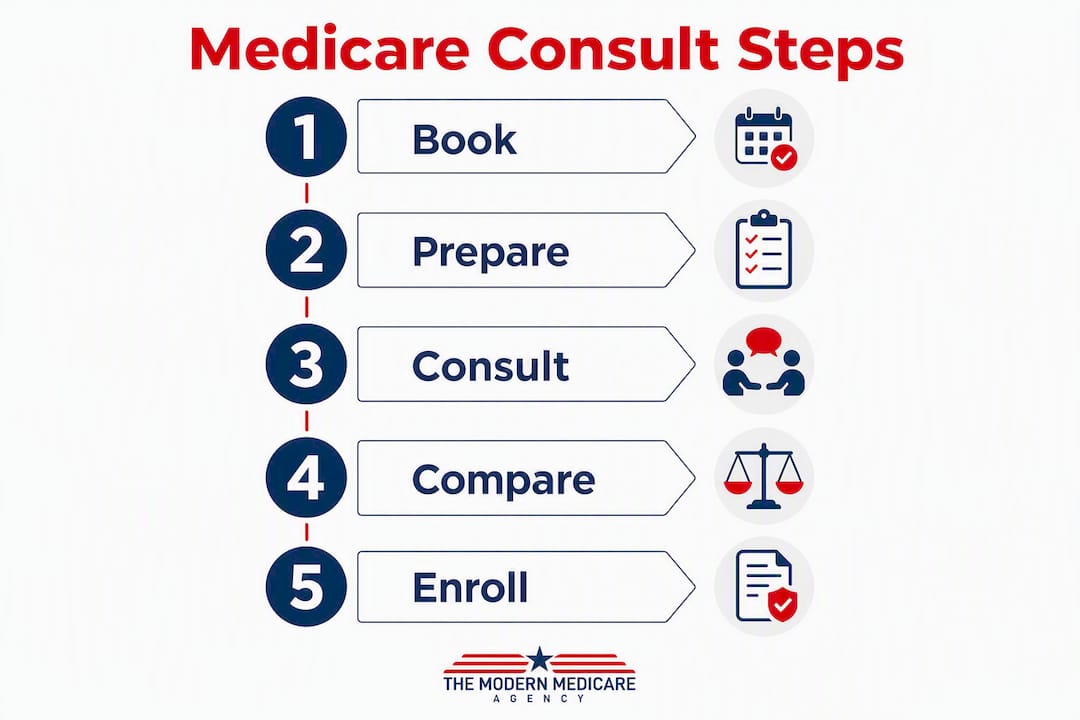
A typical consult follows this sequence: you request an appointment, the agent sends the SOA for your signature, the meeting takes place, and the agent submits your enrollment application if you decide to proceed. The carrier then contacts you directly to confirm your enrollment and verify that you understand how the plan works.
Pro Tip: Before the meeting, confirm the agent’s license through your state’s Department of Insurance website. Ask for their National Producer Number (NPN) and verify it at NIPR.com. This takes two minutes and tells you immediately whether the agent is in good standing.
How to prepare for your Medicare consultation
Preparation turns a general conversation into a plan-specific recommendation. Bringing accurate medication and provider lists changes the consult from general advice to a concrete cost comparison.
Bring these documents:
- Your current insurance cards (Medicare, employer, or retiree coverage)
- A list of your doctors, specialists, and preferred hospital
- A three-month medication list with drug names, dosages, and your pharmacy
- Current monthly premiums and any out-of-pocket costs you’re tracking
- Any recent notices from your employer’s retiree benefits office
Ask the agent these questions:
- Are my doctors in-network under this plan?
- What’s my estimated total yearly cost, not just the monthly premium?
- How are my specific medications tiered, and what are the copays?
- Which plans require prior authorization for my prescriptions or procedures?
- What happens if I need to appeal a coverage denial, and will you help?
On the SOA form, list only the plan types you actually want to discuss. If you’re only interested in Medigap and Part D, say so. This keeps the meeting focused and prevents the conversation from drifting into products you didn’t come to explore.

What to expect during and after the consult
A standard Medicare consultation runs 30–60 minutes. Here’s how the timeline typically unfolds:
| Phase | What happens |
|---|---|
| Pre-meeting | SOA signed (48 hours before in-person meetings); documents gathered |
| Consult | Agent reviews your situation, runs plan comparisons, answers questions |
| Enrollment | Application submitted to carrier (same day or shortly after) |
| Carrier confirmation | Plan calls you to verify enrollment and explain how coverage works |
| Follow-up | Agent checks in at plan start date and before Annual Enrollment Period |
Enrollment windows that determine your timing:
- Annual Enrollment Period (AEP): — October 15 through December 7 each year. Switch or drop Medicare Advantage and Part D plans; changes take effect January 1.
Book your consult at least 60 days before your target enrollment date. That buffer gives you time to compare options without pressure.
What does a Medicare consult cost, and how is the agent paid?
The consultation itself is free to you. Agents are compensated by insurance carriers through commissions when you enroll in a plan. CMS establishes fair market value caps on agent compensation for Medicare Advantage and Part D enrollments, setting maximum amounts agents can receive, covering both initial enrollment and renewal payments.
A few transparency points worth knowing:
- Some carriers set zero-dollar commissions on specific plans. Ask whether any plan being recommended carries a nonstandard commission arrangement.
- CMS rules also govern administrative payments and bonuses, which can create subtle incentives beyond the standard commission.
- Ask the agent directly: “Which carriers are you contracted with, and are there any plans in my area you can’t offer me?”
Getting a written summary of the plans discussed, including the ones you didn’t choose, is reasonable to request and a sign of a trustworthy agent.
Red flags to watch for and questions that reveal bias
Most agents operate ethically. But the ones who don’t tend to follow a recognizable pattern.
Walk away if an agent: pressures you to sign the same day, asks for your bank account or credit card number during the meeting, offers gifts worth more than $15, refuses to show you their license or NPN, or won’t provide the SOA before an in-person meeting. These behaviors violate Medicare marketing rules and should be reported to 1-800-MEDICARE.
Questions that expose bias quickly:
- “Which plan types are you licensed and contracted to sell in my county?”
- “How are you compensated if I enroll in this plan versus that one?”
- “Do you offer ongoing support after enrollment, or does the relationship end there?”
- “Can you show me a plan you’re NOT recommending and explain why?”
For licensing verification, use your state’s Department of Insurance lookup tool or check the agent’s NPN at NIPR.com. For a deeper look at warning signs, the guide on signs of a bad Medicare agent covers the full list.
Paulbinsurance: how we run Medicare consultations
Paulbinsurance is an independent Medicare agency built around one principle: education before enrollment. Principal agent Paul Barrett has been helping Medicare consumers since 2007, and the agency covers Medicare Advantage, Medigap, Part D, dental, hospital indemnity, final expense, long-term care, and annuities.

Every consult starts with a clear SOA, a transparent disclosure of how the agency is compensated, and a plan comparison built around your actual doctors and medications, not a generic recommendation. After enrollment, the team follows up at your plan start date and reaches out before each Annual Enrollment Period to make sure your coverage still fits.
You can start with a Medicare Advantage plan overview to get oriented, or go straight to a consultation. Book by phone, through the online contact form at paulbinsurance.com, or request a local appointment. Bring your medication list and your questions. The meeting is free, and there’s no obligation to enroll.
Key Takeaways
A Medicare consult with a licensed independent agent is free, federally governed by the Scope of Appointment process, and most effective when you arrive prepared with your medication list, provider names, and specific questions.
| Point | Details |
|---|---|
| Consultations are free | Agents are paid by carriers through commissions; you pay nothing for the meeting. |
| SOA protects your rights | The Scope of Appointment form limits what an agent can discuss; request it before any in-person meeting. |
| Prepare before you go | Bring your medication list, doctor names, and current premiums to get a plan-specific recommendation. |
| Use SHIP for a baseline | SHIP counselors offer free, impartial education in all 50 states before you meet with an agent. |
| Paulbinsurance | Paul Barrett’s independent agency offers education-first consultations covering MA, Medigap, and Part D since 2007. |
Why the education-first approach changes everything
Most people assume the consult is where the selling happens. In my experience, the consult is where confusion gets resolved. Beneficiaries who come in with a medication list and a few direct questions leave with a real answer. Those who come in without preparation often leave with a plan that looked good on paper but didn’t account for their actual prescriptions or their specialist’s network status.
The agents who push you to sign on the first call aren’t doing you a favor. Medicare decisions affect your healthcare access and your finances for the next 12 months at minimum. The right agent slows down, asks about your situation, and shows you why one plan fits better than another using your numbers. That’s the standard every beneficiary should hold their agent to, and it’s the standard Paulbinsurance holds itself to.
Useful sources and where to verify
- Medicare.gov agent meeting rules: Official fact sheet on what agents can and cannot do during a meeting, plus how to report violations
- Medicare.gov marketing rules for health plans: Agent licensing requirements and plan marketing rules
- Scope of Appointment explained (Medical News Today): Plain-language explanation of the SOA requirement and 48-hour rule
This article provides general educational information about Medicare plan consultations. It is not legal, medical, or financial advice. Confirm current rules, enrollment deadlines, and plan availability with Medicare.gov or a licensed professional before making coverage decisions.