
Could Medicare cover your care in a clinical trial while leaving some study-related costs to someone else? In 2026, medicare coverage for clinical trials generally depends on whether the trial qualifies and what each service or item is for. Medicare may cover routine care you would need even outside the study, while an investigational treatment or other study-specific item may be handled differently.
It’s understandable to be unsure which bill goes where. A doctor visit or lab test may count as routine care, while a drug or service being tested may be considered part of the study. Your plan type can also affect how trial-related services are billed and what you may pay.
This guide explains the general Medicare rules for qualifying trials and how Original Medicare, Medicare Advantage, Medigap, and Part D may apply. You’ll also find questions to ask the trial team about routine care, study-provided items, and billing, along with cost-sharing details to review with your plan before enrolling. A few clear questions can help you understand your coverage and make a more informed decision.
- In 2026, Medicare coverage for clinical trials depends on whether the trial qualifies and what each service or item is used for.
- Learn how to distinguish routine care from investigational services and items that may follow different payment rules.
- Compare how Original Medicare and Medicare Advantage may handle trial-related billing and cost-sharing.
- Find out how Medigap and Part D may contribute, depending on the expense and your coverage.
- Use practical questions for the trial coordinator and your plan to clarify billing before deciding whether to participate.
Medicare coverage for clinical trials: what beneficiaries should know first
Taking part in a clinical trial can bring hope, but questions about coverage and bills are understandable. Will Medicare pay for care you would need anyway? What about tests or treatments used only for the study? In 2026, the answer depends on whether the study meets Medicare’s criteria and what each service or item is for.
A clinical trial is a research study that evaluates a medical approach, such as a treatment or test, with people. Medicare’s national coverage policy provides a framework for covering certain routine costs in qualifying trials. In general, a qualifying trial must evaluate a Medicare-covered service, have a therapeutic purpose, and meet Medicare’s other coverage criteria. Not every study automatically qualifies.
What does Medicare mean by a qualifying clinical trial?
CMS policy sets standards for which clinical trials may qualify for Medicare coverage of routine care. Factors such as federal funding or an Investigational New Drug application may help a trial meet the criteria, but eligibility depends on the applicable policy and the study’s details. This framework doesn’t mean every trial needs separate individual approval from CMS. Before enrolling, ask the research team whether the study is considered Medicare-qualifying and how it determined that status.
Routine care versus research-only services
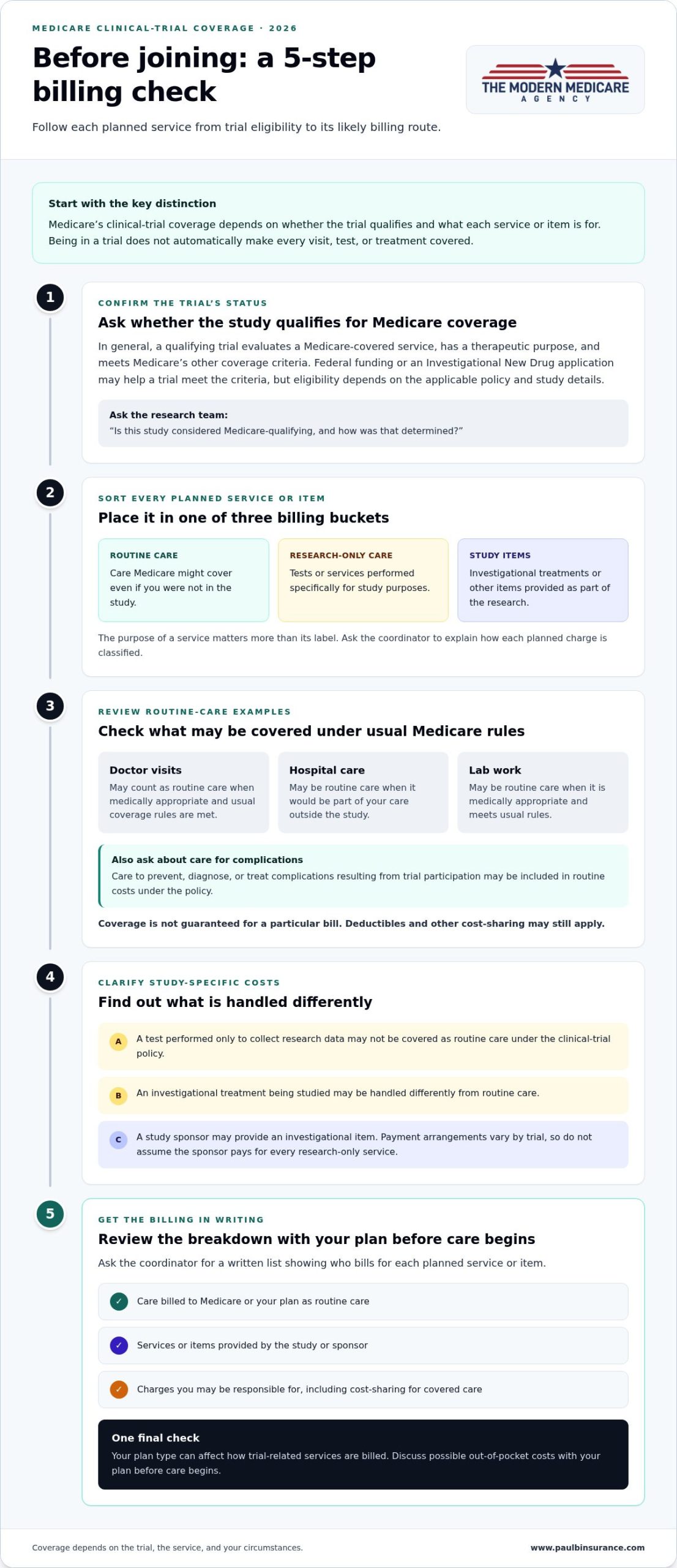
The key distinction is the purpose of each service. Routine care is care Medicare might cover even if you weren’t in the study. Research-only services or items are included specifically to conduct or evaluate the trial. A service’s label alone doesn’t determine how it will be billed, so ask for an explanation of each planned charge.
For example, doctor visits, hospital care, or lab tests may be routine care when they’re medically appropriate and meet Medicare’s usual coverage rules. By contrast, a test performed only to collect research data, or an investigational treatment being studied, may be handled differently and could be supplied by the study sponsor. Coverage depends on the service, the trial, and your circumstances. Don’t assume every visit or test is covered just because it happens during a trial.
Ask the research coordinator to sort planned care into three groups:
- Routine care: services that may be covered under ordinary Medicare rules.
- Research-only care: tests or services performed for study purposes.
- Study items: investigational treatments or other items provided as part of the research.
This breakdown is a practical starting point for understanding who may be billed. If you have Medicare Advantage, reviewing how your plan works can also help you prepare. See this Medicare Advantage plan guide. The central question for medicare coverage for clinical trials isn’t simply whether you’re participating. It’s which costs count as routine care and whether the study meets Medicare’s criteria.
Which clinical-trial costs may Medicare cover in 2026?
Once the trial’s status is clear, find out how each bill will be handled. Medicare may cover routine costs in a qualifying clinical trial when the services meet Medicare’s usual coverage rules. That doesn’t mean every trial-related service is covered or that covered care is free. Deductibles and other cost-sharing may still apply.
CMS’s National Coverage Determination (NCD) 310.1 describes routine costs as care Medicare would generally cover outside the trial, along with care to prevent, diagnose, or treat complications resulting from trial participation. The specific service and your circumstances still matter.
Examples of routine costs to discuss
Depending on medical need and Medicare’s coverage rules, routine costs might include a doctor visit, hospital stay, or lab work that would be part of your care even if you weren’t in the study. Care to address a complication related to participation may also be considered under the policy. These examples don’t guarantee Medicare will pay a particular bill. Ask how each planned service is classified and billed.
Research-only costs are different. A test performed solely to collect study data, or an investigational treatment being evaluated, may not be covered as routine care under the clinical-trial policy. Ask whether each service would be part of standard care or is required only because you’re participating in the study.
Who may pay for study-specific items and services?
Payment arrangements vary by trial. A study sponsor may provide an investigational item, while other research-related services may be handled according to the study’s arrangements and applicable coverage rules. Don’t assume the sponsor pays for every research-only service or that Medicare pays for every service delivered during the trial.
Before enrolling, request a written breakdown showing who bills for each planned service or item. Ask the coordinator to identify:
- Care billed to Medicare or your plan as routine care.
- Services or items provided by the study or sponsor.
- Any charges you may be responsible for, including cost-sharing for covered care.
Use this breakdown to discuss possible out-of-pocket costs with your plan before care begins. If you’re reviewing how supplemental coverage may help with Medicare cost-sharing, explore Medigap coverage options. Clear billing information makes medicare coverage for clinical trials easier to understand, one service at a time.
Original Medicare, Medicare Advantage, Medigap, and Part D compared
Your plan type can affect how trial-related care is processed and what you may pay. The general Medicare framework starts with the same question: is the service routine care that Medicare covers, or is it specific to the research? In 2026, details can differ by coverage type, so use this comparison as a starting point, not a guarantee of payment.
| Coverage | How it may fit into a qualifying trial |
|---|---|
| Original Medicare | May cover eligible routine services under Medicare’s usual rules. Deductibles and coinsurance may apply. |
| Medicare Advantage | For qualifying clinical trials, trial-related services are billed under Original Medicare. Your plan must refund the difference if your Original Medicare cost-sharing is higher than what your plan would charge. |
| Medigap | May help pay eligible Original Medicare cost-sharing, depending on the policy and service. |
| Part D | Drug coverage depends on the medication and the plan’s applicable coverage rules. |
How Original Medicare and Medicare Advantage fit into trial coverage
With Original Medicare, qualifying routine services are handled through Parts A or B, depending on the care, and usual cost-sharing may apply. Medicare Advantage plans have their own benefits and cost-sharing, but qualifying clinical trials have a specific billing rule: trial-related services are billed to Original Medicare. Your Advantage plan must refund you if your Original Medicare cost-sharing is higher than your plan’s cost-sharing for those services. Ask the trial team how it will bill each service, then confirm your expected costs with your plan. To review Medicare Advantage plan options, compare the plan terms that matter to you.
Where Medigap and Part D may fit
Medigap works alongside Original Medicare and may help with eligible out-of-pocket costs, subject to the policy’s benefits and limits. It doesn’t determine whether a trial service is covered in the first place. Part D is separate: it covers eligible prescription drugs under its own rules, and a study drug’s status may depend on the medication and how it’s provided. Ask whether a drug is billed to your Part D plan, supplied through the study, or handled another way.
To understand medicare coverage for clinical trials, ask both the research team and your plan who bills for each service, which coverage rules apply, and what cost-sharing you may owe. Plan terms matter, even when the trial qualifies.
Questions to ask before joining a Medicare-covered clinical trial
As you consider a clinical trial in 2026, it’s reasonable to want a clearer picture of possible bills. Ask the trial team and your Medicare plan to explain the services, billing, and potential cost-sharing in plain language. Whenever possible, resolve questions before consenting, but don’t delay urgent care to sort out paperwork.
Questions for the clinical-trial team
The research coordinator can explain how the study is organized and which services are part of the research. Ask for answers in writing when available, especially if a service could be billed to you or your coverage.
- Does the study qualify for Medicare coverage of routine costs? Ask how the team determined its Medicare status and whether that applies to the services planned for you.
- Which services are routine care, research-only, or billed separately? Ask about visits, tests, treatments, and investigational items. Request a written breakdown of who provides or bills for each one.
- Could I have cost-sharing or other charges? Ask for a written estimate or explanation of expected costs where available. An estimate can help you prepare, though it may not guarantee the final amount.
- Who can help if I receive an unclear bill or explanation of benefits? Get the right contact person and ask what documents to share if a charge doesn’t match what you were told.
Questions for your Medicare plan
Your plan can explain how its rules apply to the services involved. Share the trial’s service list if you have one, and keep notes of the date, the person you spoke with, and the guidance provided.
- How will routine trial services be billed, and what cost-sharing might apply? Ask about each service rather than relying on a general answer about the study.
- Do network rules or other plan procedures apply? Ask whether any steps are relevant to the specific doctors, facilities, or services involved in your trial.
- Can you provide the explanation in writing? Save plan responses with the trial documents, estimates, bills, and explanations of benefits. This record makes it easier to follow up if information differs.
Clear answers can help you understand your next steps and prepare for possible costs, though they can’t guarantee that every service is covered. If you’d like help comparing Medicare plan terms and cost-sharing, review your Medicare coverage options as you consider Medicare coverage for clinical trials.
Get clear Medicare guidance before making a clinical-trial coverage decision
In 2026, you can make a more informed decision by looking at four things together: whether the trial meets Medicare’s criteria, what each service or item is for, how your plan handles the care, and what cost-sharing may apply. No single answer covers every bill. The trial team can explain the study’s billing, and your Medicare plan can clarify how its rules apply to your coverage.
It’s normal to have questions. Keep the trial’s service list, any written cost explanation, and your plan details together so you can refer to the same information when speaking with each party.
When a Medicare plan review may help
A plan review can help you compare general benefits, cost-sharing, and coverage terms across Medicare Advantage, Medicare Supplement, and Part D options. An independent broker can explain those differences and help you understand plan terms, but can’t determine whether a particular trial qualifies or guarantee that a specific service will be covered. The Modern Medicare Agency is an independent brokerage that compares plans from more than 40 carriers.
A calm next step for 2026
Before discussing your questions, gather what you have about the study, including its name, planned services, and any written explanation of who may bill for them. Have your current plan information nearby, too. Your situation and the services involved may differ from another participant’s, so ask about your own details rather than relying on someone else’s experience.
Understanding medicare coverage for clinical trials is a step-by-step process. Start with the trial’s Medicare status, then clarify which services are routine or research-specific, how your plan handles them, and what costs you may face. You don’t need to solve everything at once.
If you’d like help comparing Medicare plan options and understanding their terms, speak with an independent Medicare guide. There’s no need to make a plan change to ask questions or get clearer about your coverage.
Move forward with a clearer coverage picture
In 2026, medicare coverage for clinical trials depends on more than whether you’re enrolled in a study. The trial must qualify, and each service or item needs to be considered by its purpose and applicable coverage rules. Routine care may be covered, but cost-sharing can still apply, while research-specific items may be handled differently.
Your plan type matters, too. Before participating, ask the trial team how services will be billed and ask your Medicare plan what cost-sharing or plan procedures may apply. Keep written answers and estimates together so you have a clear record to refer to.
If you’d like help comparing Medicare plan terms, an independent guide can help you understand your options without determining trial eligibility or promising a specific coverage outcome. The Modern Medicare Agency compares plans from more than 40 carriers and provides personalized guidance and year-round support across more than 34 states.
Talk with an independent Medicare guide to compare plan terms and take your next step with greater confidence.
Frequently Asked Questions
Does Medicare cover clinical trials?
Yes, Medicare may cover routine costs in qualifying clinical trials in 2026 if the services meet applicable Medicare coverage rules. Not every study qualifies, and participation alone doesn’t mean every trial-related service is covered. The study must meet Medicare’s criteria, and each service is considered by its purpose. Ask the research team whether the trial qualifies and how it determined that before you enroll.
What clinical-trial costs does Medicare cover?
Medicare may cover routine care that would generally be covered even if you weren’t in the trial, such as medically appropriate doctor visits, hospital care, or lab tests. Care to prevent, diagnose, or treat complications related to trial participation may also be considered under Medicare’s policy. Coverage depends on the service and your circumstances. Research-only tests or investigational items may be handled differently, and cost-sharing may still apply.
Does Medicare Advantage cover clinical trials?
For a qualifying clinical trial, trial-related services are billed under Original Medicare, even if you’re enrolled in Medicare Advantage. Your plan must refund the difference if your cost-sharing under Original Medicare is higher than what your Advantage plan would charge for those services. Billing and costs can depend on the care involved, so ask the research team how it will bill and confirm details with your plan before participating.
Can I use Medigap to help pay clinical-trial costs?
Medigap may help pay eligible cost-sharing for services covered by Original Medicare, depending on your policy’s benefits and terms. It doesn’t make a research-only service covered, and it generally works alongside Original Medicare rather than Medicare Advantage. Ask whether a planned service is billed to Original Medicare and whether your Medigap policy may help with the related cost-sharing. The answer can depend on both the service and your specific policy.
Does Medicare Part D cover drugs used in a clinical trial?
It depends on the drug and the coverage rules that apply to it. A medication used in a trial may be supplied through the study, or it may be handled separately under prescription drug coverage. Don’t assume a trial drug will be paid by Part D just because your plan covers other prescriptions. Ask the research coordinator who provides the medication and contact your Part D plan about its coverage.
Will joining a clinical trial make me pay more for Medicare care?
It might, but participation doesn’t automatically mean you’ll pay more. Medicare may cover qualifying routine services, yet deductibles or other cost-sharing can still apply. Research-only services or items may follow different payment arrangements, and the sponsor’s role varies by study. Before enrolling, request a written explanation of who bills for each service and any expected cost-sharing. Then review those details with your Medicare plan.
What should I ask before joining a clinical trial with Medicare?
Ask the trial team whether the study qualifies for Medicare coverage and which services are routine care, research-only, or billed separately. Request written cost estimates or billing explanations where available, and find out who to contact if a bill is unclear. Ask your Medicare plan how the services will be handled, what cost-sharing may apply, and whether plan procedures are relevant. Keep the responses with your trial documents.

Article by
Paul Barrett
Paul Barrett, CMIP is the founder of The Modern Medicare Agency, an independent Medicare-only brokerage based in Melville, NY. With 18 years of Medicare-exclusive experience, a CMIP designation, and more than 5,000 clients served across 37 states, Paul is one of the most credentialed independent Medicare specialists on Long Island — and one of the most direct.
He represents 40+ carriers with no quotas and no allegiances, which means his recommendations are based entirely on what fits each client's specific situation. He is the author of Medicare Mastery Unlocked and host of the Wise Guys Retirement Talk podcast. His content is grounded in primary sources, real carrier intelligence, and 18 years of watching what happens when people get Medicare right — and when they don't.
📞 631-358-5793 | paulbinsurance.com