




Your home health agency might have told you that Medicare simply won’t pay for an aide to help with bathing or dressing, but that statement is often legally incorrect. We understand the anxiety of watching private-pay care costs climb while you’re already managing a 2026 Part B deductible of $283 and standard premiums of $202.90. It feels like the system is designed to keep you overwhelmed, especially when you’re told one thing by a handbook and another by a provider.
We want to move you from confusion to confidence by explaining exactly how medicare coverage for home health aides works this year. We’ll show you that this coverage is a legal right, though it’s often locked behind strict rules that agencies find difficult to manage. You will learn the four specific requirements you must meet to qualify, the truth about the “homebound” status, and the exact steps to take so your doctor can help you secure the care you need. We’re here to simplify the jargon so you can protect your health and your budget in 2026.
Key Takeaways
- Learn how to unlock medicare coverage for home health aides by understanding the strict “skilled care” requirements that must be met first.
- Discover the “Four Keys” to eligibility, including the specific way your doctor must document your “homebound” status to avoid common denials.
- Identify the critical difference between medical aide services and custodial care so you aren’t surprised by unexpected out-of-pocket costs.
- Understand how the 2026 landscape for Medicare Advantage plans might offer you extra help with daily activities that Original Medicare doesn’t cover.
- Get a clear, step-by-step plan for your next doctor’s visit to ensure your plan of care is signed, certified, and ready for approval.
Does Medicare Cover Home Health Aides? The Simple Answer for 2026
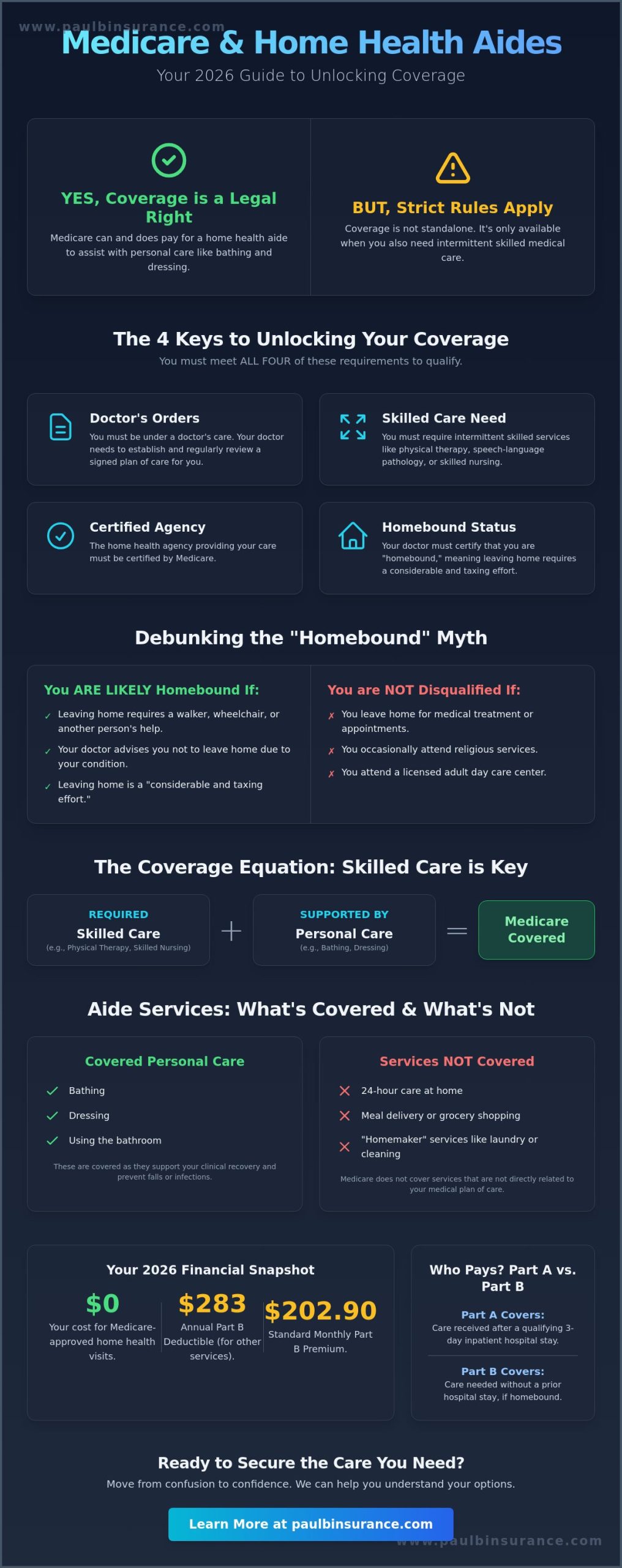
Yes, medicare coverage for home health aides is a real benefit you can use in 2026. However, it’s rarely a standalone service. Medicare pays for an aide only when you also require “skilled” care, such as physical therapy, speech-language pathology, or continued occupational therapy. We see many families get frustrated when they’re told Medicare doesn’t cover personal care. The truth is that Medicare isn’t a long-term custodial program for seniors who just need a little help around the house. It’s a medical program designed to help you recover and regain your independence.
You might hear a “no” from local agencies because of recent financial pressures. For the 2026 calendar year, the Centers for Medicare & Medicaid Services (CMS) finalized a 1.3% aggregate decrease in payments to home health providers. This reduction, which includes a 3.0% temporary adjustment, makes agencies very selective about the cases they take. To qualify for coverage, your care must be “intermittent.” This means you can receive up to 28 hours per week of combined nursing and aide visits. In very specific medical situations, this can sometimes stretch to 35 hours per week.
What Exactly Does a Home Health Aide Do?
Aide services focus on hands-on personal care that supports your clinical recovery. This includes help with bathing, dressing, and using the bathroom. These tasks are covered because they help prevent infections or falls while you’re receiving therapy. These home care services are different from “chore” services. Medicare won’t pay for an aide if the only help you need is with laundry, meal delivery, or grocery shopping. It also doesn’t cover 24-hour care at home or “homemaker” services that aren’t related to your plan of care.
Medicare Part A vs. Part B: Which One Pays?
The part of Medicare that pays for your aide depends on your recent medical history. Part A usually covers the bill if you’re coming home after a qualifying three-day inpatient hospital stay. If you haven’t been in the hospital but your doctor determines you’re homebound and need care, Medicare Part B takes over. The good news is that your out-of-pocket cost for these visits is $0 in 2026. While you still have to meet your annual Part B deductible of $283 for other services, home health visits themselves are fully covered. If you’re using Medicare Advantage Plans, your costs should also be $0, though your plan might require prior authorization before the agency can start visits.
The 4 Requirements for Medicare Home Health Coverage
Unlocking medicare coverage for home health aides isn’t impossible, but it does require you to have four specific “keys” in your hand. We know how stressful it is to feel like you’re jumping through hoops just to get the help you deserve. To make the process smoother, we’ve outlined the exact criteria the government uses to decide who gets care. According to the Official Medicare Coverage Rules, you must meet all four of these standards:
- Doctor’s Orders: You must be under the care of a physician who creates and regularly reviews a signed plan of care.
- Skilled Need: You must require “skilled” care, like physical therapy or nursing, on an intermittent basis.
- Certified Agency: The agency you hire must be Medicare-certified.
- Homebound Status: You must be certified by your doctor as being “homebound.”
If even one of these is missing, the agency will likely deny your request. We’re here to help you understand these rules so you can have a productive conversation with your medical team.
Understanding the “Homebound” Status
Many people think “homebound” means you are a prisoner in your own house. That’s a common myth that causes unnecessary worry. In 2026, the definition remains clear: leaving your home must require a “considerable and taxing effort.” If you use a wheelchair, walker, or need the assistance of another person to get to appointments, you likely meet this requirement. You don’t lose your eligibility just because you attend religious services or go to a licensed adult day care center. It’s about the physical difficulty of the journey, not the fact that you occasionally step outside.
The Need for “Skilled” Care
This is the most common place where families get stuck. You cannot get an aide if your only need is help with bathing or dressing. These personal tasks are only covered if they support a “trigger” service. In 2026, these triggers include physical therapy, speech-language pathology, or intermittent skilled nursing care. Occupational therapy is a bit unique; while it can’t usually start your care, it can keep your home health services going if you still need it after your other therapies have finished. If you’re feeling overwhelmed by these rules, you can always reach out for a clear explanation of how your specific plan handles these requirements.
Home Health Aide Services vs. Custodial Care: Knowing the Difference
We often speak with families who feel blindsided when they realize Medicare won’t pay for a caregiver to simply “stay” with their loved one. This confusion stems from the “Custodial Care Gap.” While medicare coverage for home health aides is a guaranteed benefit for those who qualify, it’s strictly designed for medical recovery or stabilization. It isn’t a long-term solution for seniors who need help with daily life due to aging or cognitive decline. In 2026, the reality is that Medicare focuses on clinical outcomes rather than residence help.
This distinction is why many families find it difficult to secure care for a parent with dementia. If the primary need is supervision to ensure a loved one doesn’t wander or leave the stove on, Medicare classifies this as custodial care. Since this isn’t considered “skilled” medical care, the bill won’t be covered. You can find the specific details on these limitations in the Official Medicare Home Health Coverage Rules. We want you to have this clarity now so you aren’t left facing an unexpected private-pay bill later.
When Aide Care Becomes “Custodial”
The difference between covered care and denied care often comes down to the “why” behind the service. If an aide helps you bathe for three weeks while you recover from a hip replacement, Medicare sees that as part of your medical plan. However, if that same aide is bathing you just for general hygiene because you can’t do it yourself anymore, it becomes custodial. Custodial care is non-medical assistance that Medicare traditionally excludes. Tasks like meal preparation, light housekeeping, and laundry are only covered if they are “incidental,” meaning they happen during a visit that’s primarily focused on your medical personal care.
Filling the Gaps in Your Coverage
Since Medicare has these strict limits, we often look for other ways to protect your savings and your health. While Medicare Supplement insurance is excellent for covering your 20% coinsurance for things like durable medical equipment, it doesn’t pay for custodial care either. To cover long-term help with daily living, many of our clients explore Long-Term Care insurance. We can help you look at those options to see if they fit your budget. For those with very limited income and assets, Medicaid remains the primary government program that pays for true custodial care in the home. Our goal is to help you build a plan that moves you from confusion to confidence, ensuring you aren’t caught off guard by the gaps in the system.
How to Get Your Home Health Care Approved (and What to Do if Denied)
Securing medicare coverage for home health aides starts in your doctor’s office, not at the home health agency. Many seniors feel defeated when an agency claims “Medicare doesn’t pay for that,” but you have the power to change the outcome. We recommend a proactive four-step approach to ensure your paperwork is bulletproof. First, schedule a dedicated “Face-to-Face” meeting with your primary physician to discuss your home care needs specifically. This isn’t just a casual chat; it’s a legal requirement for coverage in 2026.
During this visit, ensure your doctor writes a detailed narrative explaining exactly why you are homebound. It isn’t enough to say you’re “weak.” They must document that leaving home requires a “considerable and taxing effort.” Once you have this, request a referral to a Medicare-certified agency. Finally, ask to see the “Plan of Care,” also known as Form CMS-485. This document lists your aide service hours. If the hours aren’t on this form, the agency won’t send an aide. If you need help reviewing your plan options before this happens, you can schedule a call with us to ensure your coverage is ready.
The “Jimmo” Standard: Care to Maintain, Not Just Improve
There’s a persistent myth that you must be “getting better” for Medicare to keep paying for an aide. This is false. A landmark court case confirmed that Medicare must pay for care even if you’re only maintaining your current condition or slowing a decline. When you speak with an agency, use the word “Maintenance.” Tell them the care is medically necessary to prevent a relapse or further hospitalization. This is especially vital in 2026 as agencies face a 1.3% payment reduction and may try to discharge “stable” patients too early. Your goal is to show that without the aide, your health will suffer.
What to Do if the Agency Says “No”
If an agency decides to stop your services, they must give you a “Notice of Medicare Non-Coverage” (NOMNC) at least two days before care ends. Don’t panic. You have the right to a fast appeal. Follow the instructions on that notice to contact your local Quality Improvement Organization (QIO) by noon of the following day. The QIO will review your medical records independently. This is the moment when you need your doctor to “back you up” with a quick letter or phone call. We’ve seen these appeals move from confusion to confidence once the right medical evidence is presented.
How Your Choice of Medicare Plan Impacts Home Care in 2026
Your choice of plan in 2026 fundamentally changes how you access help at home. While Original Medicare follows the strict medical rules we discussed earlier, nearly 98% of seniors now have access to Medicare Advantage Plans with no extra monthly premium. These private plans must provide at least the same medicare coverage for home health aides as the government plan, but they often go a step further. They can include “flex” benefits that cover things the standard program won’t touch. We want to help you understand these differences so you can choose a plan that actually supports your goal of staying at home.
Managing medications is another huge part of staying independent. With the 2026 Medicare Part D rules, your out-of-pocket spending for prescription drugs is capped at $2,100. This cap provides massive peace of mind, ensuring that the cost of life-saving pills doesn’t compete with the cost of your home care. When we look at your total health picture, we consider how these drug costs and home benefits work together to protect your savings.
Medicare Advantage “Flex” Benefits for Home Care
In 2026, many Advantage plans use “Special Supplemental Benefits for the Chronically Ill” (SSBCI) to fill the gaps. These benefits are specifically for those with long-term health issues. Some plans might pay for “In-Home Support Services,” which include limited hours for help with laundry, light cleaning, or even meal prep. These benefits vary wildly by zip code and carrier. A plan in one city might offer 40 hours of help a year, while a plan in the next county offers none. We simplify this jargon so you know exactly what’s available in your specific neighborhood.
Working with an Independent Broker to Find the Right Plan
We don’t work for the insurance companies; we work for you. A captive agent can only show you products from one company, which often means you lose out on better options. We take an unbiased approach, comparing over 40 carriers to find the right fit for your needs. We look at the fine print to see which plan offers the best home support and the lowest out-of-pocket maximums. While the legal limit for in-network out-of-pocket costs is $9,250 in 2026, many of the plans we find for our clients set that limit much lower. If you’re ready to move from confusion to confidence, Schedule a Call With Paul to find a plan that protects your independence.
Secure Your Independence at Home in 2026
We know that the maze of insurance rules can leave you feeling exhausted. Getting medicare coverage for home health aides doesn’t have to be a battle when you have the right keys to the lock. Remember that your doctor’s narrative is the most powerful tool you have to prove your homebound status. Whether you choose a Medicare Advantage plan with extra flex benefits or stick with Original Medicare, the goal remains the same: keeping you safe and comfortable in your own house.
We’ve spent years perfecting a methodical 5-step process to move you from confusion to confidence. As an independent broker licensed in 34 states, we represent over 40 different carriers. This means we don’t have to push one company; we simply find the one that fits your life and your health goals. You don’t have to do this alone. Confused about home care? Schedule a free, simple consultation with Paul Barrett today.
You deserve peace of mind and a clear path forward. We’re here to protect your health and your independence every step of the way.
Common Questions About Home Health Care in 2026
Does Medicare pay for 24-hour care at home?
No, Medicare doesn’t pay for 24-hour care at home. The program is designed for “intermittent” or part-time visits rather than continuous supervision. If you need around-the-clock help, you’ll need to explore other options like long-term care insurance or private-pay arrangements. We know this is a difficult reality for many families, but knowing this limit early helps you avoid a sudden crisis in care.
How many hours a week will Medicare pay for a home health aide?
You can generally receive up to 28 hours per week of combined skilled nursing and aide services. In some very specific medical situations in 2026, this can be extended to a maximum of 35 hours per week. These visits must be part of a physician-ordered plan of care and are intended to be temporary. We recommend checking your “Plan of Care” form to see exactly how many hours your agency has committed to providing.
What is the “Jimmo v. Sebelius” settlement and how does it help me?
The Jimmo settlement is a legal ruling that protects your right to care even if your health isn’t improving. It established that medicare coverage for home health aides is available to maintain your current condition or slow a decline. You don’t have to show “progress” to keep your benefits. This is a vital protection for seniors with chronic conditions who need help to stay stable and out of the hospital.
Can I choose my own home health aide under Medicare?
You cannot choose a specific individual to be your aide under Medicare rules. You must receive care through a Medicare-certified home health agency that your doctor has authorized. While you have the right to choose which certified agency you want to use, that agency is responsible for hiring and scheduling the specific staff members who come into your home.
Does Medicare cover home health aides for patients with dementia or Alzheimer’s?
Medicare covers aides for dementia patients only when there’s a concurrent need for skilled nursing or physical therapy. If the care is strictly for “custodial” needs, like watching a loved one to prevent wandering, Medicare won’t pay. This is a common gap in coverage that causes a lot of stress. We often help clients look for Medicare Advantage plans that might offer extra “In-Home Support Services” to help with these specific needs.
What happens if I need home care but I am not “homebound”?
If you aren’t certified as homebound by your doctor, you won’t qualify for the Medicare home health benefit. To meet the 2026 requirement, leaving your home must be a “considerable and taxing effort.” If you can leave home easily for non-medical reasons, you might be better served by outpatient therapy. We can help you compare how different plans handle the costs of those outpatient visits.
Do Medicare Supplement (Medigap) plans pay for home health aides?
No, Medigap plans don’t pay for additional home health aide services. These plans are designed to cover your “gap” costs, like the $1,736 Part A hospital deductible or your 20% coinsurance for medical equipment. Since home health visits already have a $0 copay for those who qualify, a Supplement plan doesn’t add more hours or new aide benefits to your existing coverage.
Will Medicare pay for a family member to be my home health aide?
Medicare generally won’t pay a family member to provide your care. All aides must be trained, certified, and employed by a Medicare-certified agency to receive payment. While some state Medicaid programs have “consumer-directed” options that allow for family caregivers, the federal Medicare program does not offer this in 2026. We can help you look at your total plan options to see if there are other ways to support your family’s caregiving needs.

Article by
Paul Barrett
Paul Barrett, CMIP is the founder of The Modern Medicare Agency, an independent Medicare-only brokerage based in Melville, NY. With 18 years of Medicare-exclusive experience, a CMIP designation, and more than 5,000 clients served across 37 states, Paul is one of the most credentialed independent Medicare specialists on Long Island — and one of the most direct.
He represents 40+ carriers with no quotas and no allegiances, which means his recommendations are based entirely on what fits each client's specific situation. He is the author of Medicare Mastery Unlocked and host of the Wise Guys Retirement Talk podcast. His content is grounded in primary sources, real carrier intelligence, and 18 years of watching what happens when people get Medicare right — and when they don't.
📞 631-358-5793 | paulbinsurance.com