




What happens after Medicare processes a claim can affect the remaining medical bill. A Medicare crossover claim is a claim Medicare sends to a secondary insurer after paying or making its primary-payer decision. This lets the secondary plan review eligible costs Medicare did not cover, such as deductibles, copayments, or coinsurance.
It’s understandable to wonder whether the claim moves automatically and when the next payment will arrive. Participating secondary insurers can receive claims through Medicare’s crossover process, often within 24-48 hours after Medicare pays its portion. But not every secondary insurer participates, so some claims need to be sent separately.
This guide explains how crossover claims work, how they reach Medigap plans, what payment timing can mean for providers and patients, and why a claim may not cross over. You’ll also learn how a crossover claim differs from other Medicare secondary payer claims, so you can take the right next step if a bill or payment is delayed.
Key Takeaways
- Understand how Medicare processes a claim first and may forward it to a participating secondary insurer for consideration of remaining costs.
- Learn why crossover timing affects provider billing and what may happen when a claim needs to be submitted separately.
- Recognize common crossover problems, including missing or mismatched claim details that can interrupt processing.
- See how Medigap plans can receive eligible claims through Medicare’s crossover process and consider covered cost-sharing.
- Distinguish a Medicare crossover from other situations where Medicare acts as the secondary payer, such as some employer coverage arrangements.
Expected crossover and payment timelines
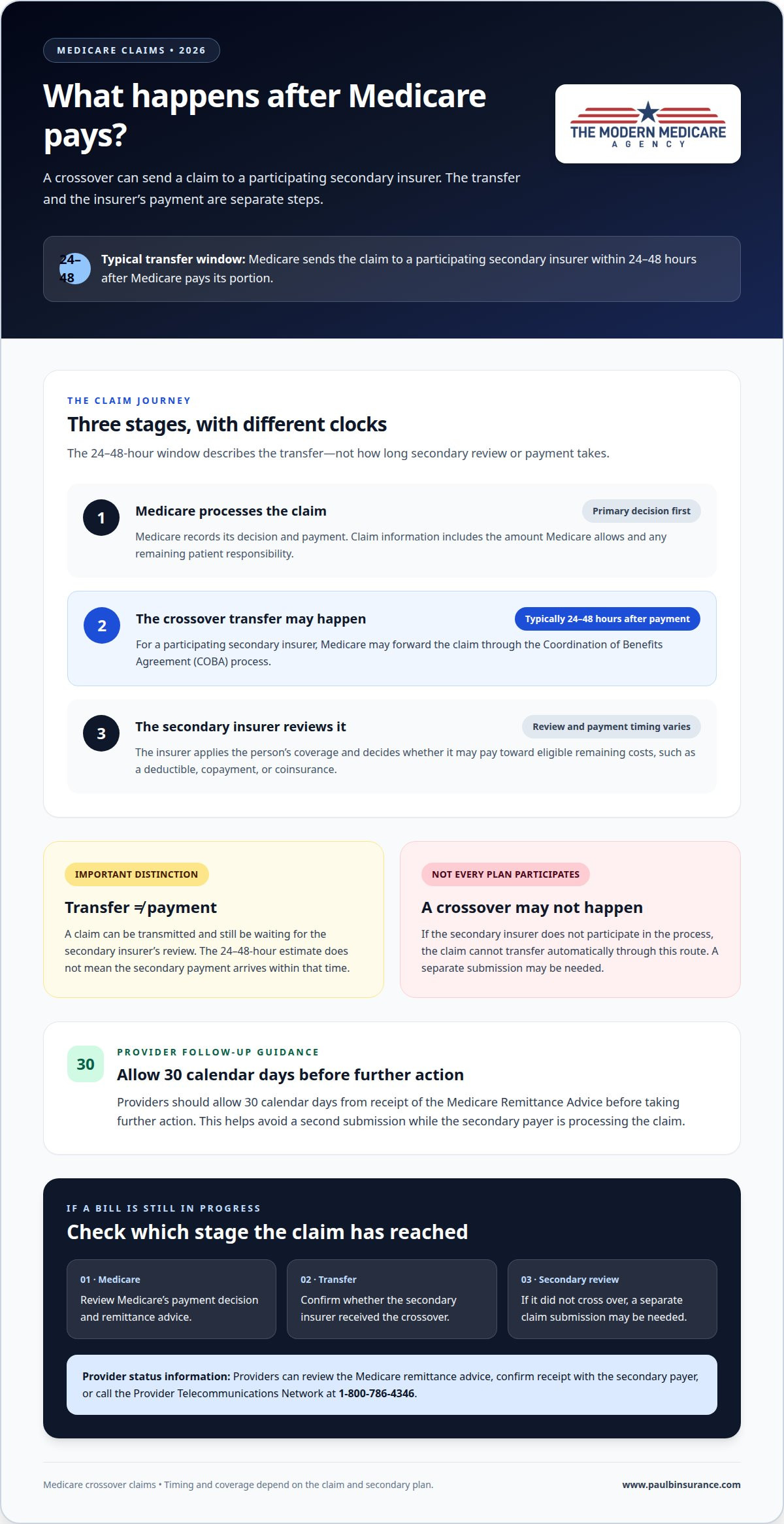
After Medicare processes a claim and pays its portion, the crossover can begin. Medicare claims are typically sent to a participating secondary insurer within 24-48 hours after Medicare pays. That window describes the transfer, not the time required for the secondary insurer to review the claim or issue payment.
The process follows a sequence. First, Medicare processes the claim as the primary payer and records its decision. Then the claim information may be sent to the secondary insurer through the Coordination of Benefits Agreement (COBA) process. The secondary insurer reviews Medicare’s decision under the person’s coverage and processes any amount it may owe.
- Medicare processes the claim. Its payment decision comes first when Medicare is the primary payer. The amount Medicare allows and the remaining patient responsibility are part of the claim information.
- The crossover transfer takes place. For participating secondary insurers, the claim is typically forwarded within 24-48 hours after Medicare’s payment.
- The secondary insurer reviews the claim. It applies the terms of the person’s coverage and determines whether it will pay toward remaining cost-sharing.
The Benefits Coordination & Recovery Center administers Medicare claims crossover functions on CMS’s behalf and serves as the national claims crossover contractor. Automatic crossover to a private secondary insurer may depend on whether it participates in the crossover process. Without an agreement, the claim cannot be transferred automatically through this route.
For example, when someone has Original Medicare and a participating Medigap plan, Medicare processes the claim first. If the plan receives the crossover, it can review eligible costs left after Medicare’s decision. Someone with Medicare and Medicaid may also have a crossover, but the receiving program and process can vary by state.
Keep the stages separate when tracking a bill in 2026. A claim may be processed by Medicare, transmitted to a secondary insurer, and still awaiting that insurer’s review. The 24-48-hour timeframe applies to the usual transfer after Medicare pays; it does not mean the secondary payment arrives within that same period. If the secondary plan does not receive a crossover, the claim may need another submission route. The next useful information is Medicare’s payment decision and whether the secondary insurer received the claim, because those details show which stage remains.
California payments received from a Medi-Cal recipient, except Share of Cost payments, must be refunded when the provider receives Remittance Advice Details for that service (14019.3).
In California, Medi-Cal reimbursement for a Medicare crossover claim combined with Medicare payment may not exceed Medi-Cal’s maximum allowed amount for similar services (14109.5).
Provider revenue cycle and patient billing effects
For a provider, coordination between Medicare and a secondary payer determines how a claim moves through billing. Medicare’s remittance advice records its decision and payment. The provider uses it to see what remains for the secondary plan to review, rather than treating the patient’s balance as final straight away.
How can providers check whether a Medicare claim crossed over? Review the Medicare remittance advice for information about the claim’s crossover, then confirm receipt with the secondary payer. Providers can also call the Provider Telecommunications Network at 1-800-786-4346 for crossover claim status information.
The next step depends on whether the secondary insurer participates in the COBA program. Not all secondary insurers participate, so some claims must be submitted manually. If a claim does not arrive automatically, the provider may need to send it to the secondary payer with Medicare’s remittance advice as proof of the primary decision.
Timing matters for the provider’s revenue cycle. Providers should allow 30 calendar days from receipt of the Medicare Remittance advice before taking further action. That interval helps prevent a second submission while the secondary payer is processing the claim. It also gives the provider a clear point to review whether the claim has moved forward or needs follow-up.
For patients, a crossover can reduce the need to manage separate claim paperwork, but it does not mean every remaining amount will be paid. The secondary plan applies its own coverage rules. It may consider a deductible, coinsurance, or copayment, while any amount it does not pay remains subject to the patient’s coverage and billing protections.
State Medicaid programs may have their own payment rules. In New York, Medicaid reimburses crossover claims for the deductible, coinsurance, or copayment amounts shown on the Medicare crossover claim. California sets a different limit: Medi-Cal reimbursement combined with Medicare’s payment may not exceed Medi-Cal’s maximum allowed amount for similar services.
California also has a specific protection for people eligible for both Medicare and Medi-Cal. Providers who accept these patients may not bill them for Medicare deductibles or coinsurance; those amounts may be billed only to Medi-Cal. This affects the provider’s billing steps and the patient’s responsibility, so the state program and claim details matter.
A practical billing sequence is to record Medicare’s decision, allow the stated processing period, and then confirm the secondary payer’s status. If the claim has not crossed over, a manual submission may be needed. Keeping Medicare’s remittance advice with the claim connects the primary payment to the secondary review.
Common reasons crossovers fail
If a Medicare claim doesn’t cross over, ask the provider whether the secondary plan received it. The provider may need to submit the claim manually, attaching Medicare’s remittance advice to show the primary decision.
One common cause is that the secondary insurer does not participate in the Medicare COBA crossover program. Without the required arrangement for automatic transfer, Medicare cannot route the claim through this process. The provider may need to send the claim and Medicare’s remittance advice directly to the secondary payer. The claim must still be reviewed under that plan’s rules.
Claim details can also prevent successful processing. If a member ID card includes a Coordination of Benefits Agreement ID number, providers should include it on the claim. A missing or incorrect identifier can prevent the claim from matching the person’s secondary coverage. Comparing the submitted details with the member’s card can help identify the problem.
Part B drug claims have a specific reporting requirement in Medicaid crossover billing. Each reported HCPCS code for a physician-administered drug requires a matching National Drug Code, using a 1-to-1 relationship. If a state Medicaid agency receives an associated HCPCS code without an NDC, it will likely deny the crossover claim. The provider must ensure the drug information is reported together before submission.
Eligibility can be another obstacle, even after Medicare has processed the claim. Providers must continue to verify a patient’s New York Medicaid eligibility for claims sent to Medicare. If the patient’s eligibility is not established for the claim, the state Medicaid review may not proceed as expected. Eligibility verification is a separate step that the crossover does not replace.
In Colorado, institutional inpatient claims also depend on the correct Facility Type Code. An incorrect code can disrupt processing because the claim does not identify the institutional setting as required. Providers should check this code alongside Medicare’s decision and the patient’s coverage information.
These examples show several possible failure points: participation, claim identification, required drug details, eligibility, or coding. The right correction depends on where the handoff stopped. A claim rejected for a missing NDC needs a different fix from one that never crossed over because the secondary insurer does not participate.
A clear next step for beneficiaries is to ask the provider whether Medicare’s remittance advice shows a crossover and whether the secondary payer received the claim. If it did not arrive automatically, the provider can use the remittance advice to support a manual submission. This helps distinguish a transfer problem from a secondary payer’s decision about what the coverage will pay.
Crossover claims to Medigap plans
Which Medicare claims qualify for automatic crossover? Claims can be forwarded automatically when Medicare processes them as the primary payer and the secondary insurer participates in the COBA crossover process. The claim must match the insurer’s enrollee information so it can be routed for review.
COBA provides a standard arrangement for CMS and participating health insurance organizations to exchange enrollee eligibility details and Medicare-adjudicated claim information. For a Medigap plan, this coordination of benefits lets the plan receive Medicare’s decision and consider eligible Original Medicare deductibles, copayments, or coinsurance. The crossover shares the claim; it does not guarantee that the plan will pay every remaining amount.
Medigap plans typically accept professional and institutional Medicare crossover claims daily. However, a separate claim-based route under OBRA 1987 Section 4081 has a limitation: it does not support 837 institutional claims. Medigap plans using that route cannot receive institutional claims for inpatient, outpatient, home health, or hospice services through that process. The distinction matters because the type of service and the plan’s crossover arrangement affect whether automatic forwarding works.
For example, a professional claim for a doctor’s service may be sent to a participating Medigap plan after Medicare processes it. The plan then reviews the Medicare-adjudicated details against the member’s coverage. An institutional claim follows a different format, so a plan using the OBRA 1987 Section 4081 route cannot receive that claim through the same claim-based method.
How do Medicare crossover claims work for people with QMB or other Medicaid coverage? Medicare processes the claim first, then sends eligible claim information to Medicaid through the crossover process. Medicaid covers remaining Medicare cost-sharing for dual-eligible beneficiaries, subject to the applicable state program’s rules.
For someone with Qualified Medicare Beneficiary (QMB) coverage, the crossover connects Medicare’s payment decision with Medicaid’s review of remaining cost-sharing. The claim route differs from a Medigap plan’s route: Medicaid is a public program, while Medigap is private supplemental insurance. A state may also have claim-specific procedures, so the destination and processing rules depend on whether Medicaid or a Medigap plan is secondary.
In 2026, the practical question is whether the claim reached the correct secondary payer through its applicable route. A participating Medigap plan may receive eligible claims automatically, while a plan using the OBRA claim-based process has the institutional-claim limitation. If a Medicare Supplement plan is part of your coverage, understanding its role can clarify which remaining costs it may consider.
What is the difference between a Medicare crossover claim and a Medicare secondary payer claim?
A crossover claim describes how Medicare sends a processed claim to secondary coverage. A Medicare secondary payer claim describes a situation in which Medicare pays after another insurer. The difference is the direction of payment and claim movement: one term focuses on transferring information, the other on which plan pays first.
For a crossover, Medicare must be the primary payer. It processes the claim, records its decision, and then forwards claim details to an eligible secondary payer. That payer may be Medicaid, a Medigap plan, or commercial insurance. The recipient reviews the claim under its own coverage terms and considers any remaining deductible, copayment, or coinsurance.
A Medicare secondary payer situation starts differently. Another insurer is responsible for paying before Medicare. In the United States, Medicare is generally secondary to active employer coverage when the employer has at least 20 employees, according to the Centers for Medicare & Medicaid Services. The provider submits the claim to the employer plan first, then Medicare may process what remains.
Consider two examples. If someone has Original Medicare and a participating Medigap plan, Medicare pays first and may send the claim to Medigap. That is a crossover. If someone has qualifying active employer coverage and Medicare is secondary, the employer plan processes the claim before Medicare. That is a secondary payer arrangement, not the usual Medicare-first crossover sequence.
The terms can be confusing because both involve more than one payer. Keep the distinction clear by asking two questions: Which plan is primary, and is Medicare forwarding its processed claim? If Medicare pays first and forwards the claim, the crossover process may apply. If another plan must pay first, Medicare is secondary.
This distinction also explains why a claim does not always move automatically between plans. Automatic crossover depends on Medicare being primary and the receiving insurer participating in the applicable transfer process. When Medicare is secondary, the claim follows the other insurer’s payment decision first. A crossover is not simply any claim involving two insurance plans.
Understanding the payment order can help make a bill or explanation of benefits easier to interpret. Check which insurer processed the claim first, then identify whether Medicare’s decision was sent onward or followed another plan’s decision. For help understanding how supplemental coverage fits alongside Original Medicare, review Medigap coverage options.
The Modern Medicare Agency
The Modern Medicare Agency helps you understand how your Medicare coverage fits together when a claim involves more than one payer. If you’re reviewing secondary coverage or choosing a plan, its independent guidance can clarify the differences between Medicare Advantage, Medicare Supplement (Medigap), and Part D options. Understanding those differences can help you identify your coverage and ask informed questions about claim handling.
You can turn to The Modern Medicare Agency when you want personal help comparing Medicare plans and understanding how your coverage aligns with your needs. The agency offers plans from multiple carriers and provides year-round support.
For help understanding your Medicare options, contact The Modern Medicare Agency.
Make Your Next Coverage Decision With Confidence
Knowing what a Medicare crossover claim is can help you see where claim handling ends and coverage decisions begin. If a bill leaves you unsure how your current plan fits, consider whether your coverage still meets your needs and whether you understand each plan’s role. The Modern Medicare Agency offers a free Medicare consultation to help you compare options and make sense of your coverage.
The Modern Medicare Agency offers Medicare Advantage Plans, Medicare Supplement (Medigap) Plans, and Medicare Part D Plans. Its independent guidance can help you compare options based on your needs, without pressure to make a decision before you’re ready. When you’d like support with your Medicare choices, contact The Modern Medicare Agency. A clear conversation can help you take your next step with greater confidence.
Frequently Asked Questions
What is a Medicare crossover claim?
If you’re asking, “What is a Medicare crossover claim?” it’s a claim Medicare sends to another insurer after processing it. For example, when someone has Medicare and Medicaid, Medicaid may receive claim information to review remaining cost-sharing. The secondary payer makes its own decision under the person’s coverage. A crossover describes how claim information moves; it does not guarantee that the secondary plan will pay.
How does Medicare automatically send claims to Medicaid or supplemental insurance?
Medicare uses the Coordination of Benefits Agreement, or COBA, process to send eligible claim information to participating secondary payers. The transfer depends on Medicare being primary and the receiving insurer having the required arrangement. If a private insurer cannot receive claims through that process, the claim may need a separate submission. A provider can use Medicare’s remittance advice to support that submission and show the primary payer’s decision.
How long does Medicare claim crossover processing take?
Knowing what a Medicare crossover claim is also helps set timing expectations: the transfer to a participating secondary insurer typically happens within 24-48 hours after Medicare pays its portion. That timeframe covers the handoff, not the secondary plan’s full review or payment. A claim can be transmitted promptly but still need more processing before the insurer decides what it will pay. Check with the secondary payer if it remains unresolved.
What are Medicare crossover claim billing rules for providers?
Providers should bill Medicare first when it is the primary payer, then use Medicare’s remittance advice to guide any secondary claim. If an automatic crossover does not occur, the provider may submit the claim to the secondary payer with that advice. Providers should allow 30 calendar days from receiving the Medicare Remittance advice before taking further action. Accurate claim details, including required drug codes when applicable, also matter.
Can a Medicare crossover claim result in a balance bill or patient costs?
Yes, a patient may still have costs if the secondary plan does not cover every remaining amount. The plan’s coverage determines what it considers, so a crossover alone does not settle the patient’s balance. California has a specific protection: providers who accept people eligible for both Medicare and Medi-Cal may not bill them for Medicare deductibles or coinsurance; those amounts may be billed only to Medi-Cal.

Article by
Paul Barrett
Paul Barrett, CMIP is the founder of The Modern Medicare Agency, an independent Medicare-only brokerage based in Melville, NY. With 18 years of Medicare-exclusive experience, a CMIP designation, and more than 5,000 clients served across 37 states, Paul is one of the most credentialed independent Medicare specialists on Long Island — and one of the most direct.
He represents 40+ carriers with no quotas and no allegiances, which means his recommendations are based entirely on what fits each client's specific situation. He is the author of Medicare Mastery Unlocked and host of the Wise Guys Retirement Talk podcast. His content is grounded in primary sources, real carrier intelligence, and 18 years of watching what happens when people get Medicare right — and when they don't.
📞 631-358-5793 | paulbinsurance.com