
What if your employer health plan is actually costing you more than Medicare would in 2026? It’s completely normal to feel a bit overwhelmed when you’re trying to figure out how these two systems fit together. You’ve worked hard for your benefits, and the last thing you want is to lose your favorite doctor or get hit with a lifelong late enrollment penalty because of a simple misunderstanding. Understanding medicare and employer coverage coordination is the key to protecting your savings and your health as you continue your career.
You deserve to feel confident that your medical bills are covered without any surprises. This guide will show you exactly how to navigate the 2026 rules with ease. We’ll explain the rules that determine whether your job or Medicare pays your bills first and compare costs, like the new $202.90 Part B premium, against your current work premiums. We also look at the 2026 Part B deductible of $283 to see how it fits your budget. By the end, you’ll have a clear, step-by-step path to choosing the most cost-effective coverage while maintaining the peace of mind you’ve earned.
Key Takeaways
- Understand the 2026 “rulebook” that decides which insurance company pays your doctor first, protecting you from unexpected medical bills.
- See why your company’s headcount is the magic number that determines if Medicare becomes your primary or secondary coverage.
- Learn how to accurately compare your work insurance costs against 2026 Medicare premiums to simplify your medicare and employer coverage coordination.
- Protect your savings by learning the critical 2026 rules for Health Savings Accounts and why COBRA isn’t the safety net many people assume it is.
- Follow a clear, stress-free path to verify your current benefits and decide if switching to a Medicare Advantage or Medigap plan is your best financial move.
What Is Medicare and Employer Coverage Coordination?
Coordination of benefits is simply the rulebook that decides which insurance company pays your doctor first. It creates a clear hierarchy for your medical bills, ensuring that everyone knows their role before a claim is even filed. Medicare and employer coverage coordination acts as a reliable safety net that ensures your health expenses are covered by the right entity at the right time. Without these rules, you might find yourself stuck in the middle of two companies both claiming the other should pay. This process removes that uncertainty, allowing you to focus on your health instead of your paperwork.
Primary vs. Secondary Payers Explained
Think of the primary payer as the first line of defense for your medical bills. This company receives the bill first and pays up to the limits of your policy. The secondary payer acts as a backup, covering costs the primary plan might leave behind, such as deductibles or co-payments. It’s a structured partnership designed to lower your out of pocket costs. If you choose to leave your work plan and only have Medicare, it becomes the sole payer for all your needs. For many people in 2026, having both plans can provide an extra layer of security, but the value depends entirely on which one takes the lead.
The Consequences of Getting Coordination Wrong
Mistakes in this area can cause immediate financial stress. If the billing order is incorrect, providers may refuse to see you because they aren’t sure who is responsible for the payment. You might also encounter “conditional payments.” This happens when Medicare pays a bill to help you out, but later discovers your employer plan should have paid first. Medicare will then work to recover that money, which can be a confusing and long process to resolve.
There are also long-term risks to consider. If you assume your work coverage is primary when it actually isn’t, you might skip signing up for Part B. Missing that window can lead to lifelong late enrollment penalties that increase your monthly costs forever. Staying informed about these rules helps you avoid these traps and ensures your transition into Medicare is smooth and protected. If you find your employer plan is secondary and doesn’t offer enough value, you might consider looking into Medicare Advantage plans or Medigap plans to fill the gaps more affordably.
The Size of Your Company: Who Pays First in 2026?
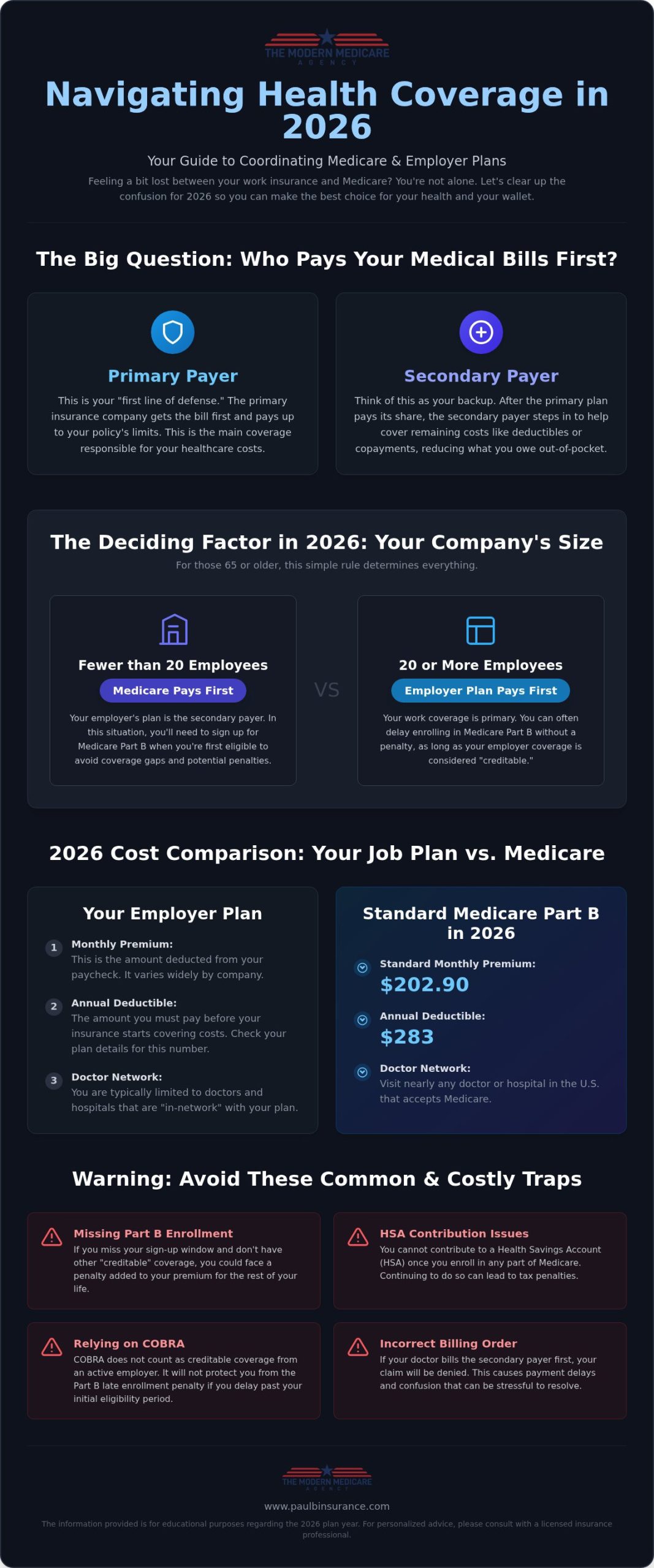
The size of your employer is the most important detail when setting up your medicare and employer coverage coordination. It acts as the compass that points to who should pay your bills first. Medicare uses specific headcount thresholds to make this decision. For most people over age 65, the magic number is 20 employees. If you qualify due to a disability, that threshold increases to 100 employees. Knowing where you stand helps you avoid the stress of unpaid claims.
The 20-Employee Rule for Seniors Over 65
If you or your spouse work for a company with 20 or more employees, your group health plan is usually the primary payer. In this case, Medicare acts as the secondary insurance. It steps in to help with costs your work plan doesn’t cover. Many people in this situation choose to delay Part B to save on the $202.90 monthly premium, provided their work coverage is considered “creditable.”
The situation changes completely if your employer has fewer than 20 employees. In these smaller companies, Medicare is usually the primary payer. This is a critical distinction for 2026. If you work for a small business and don’t sign up for Part B, your employer plan might refuse to pay its portion of the bill. They often assume Medicare has already paid its share. Official guidelines on how Medicare works with other insurance confirm that these employer size rules are the standard for protecting your coverage. If you aren’t sure how your company’s headcount impacts your specific situation, you can always talk with a specialist who can help you verify the numbers.
Special Rules for Disability and ESRD
Rules are slightly different if you’re under 65 and have a disability. For these individuals, the employer must have at least 100 employees for the group plan to be the primary payer. If the company is smaller than that, Medicare takes the lead. These thresholds are strictly enforced in 2026 to ensure the system remains fair for everyone involved.
End-Stage Renal Disease (ESRD) has its own unique coordination window. There is a 30-month coordination period where your employer plan stays primary regardless of the company size. Once those 30 months end, Medicare automatically becomes the primary payer. Staying ahead of these timelines is the best way to maintain peace of mind. You don’t want to find out about a change in your “primary” status only after a claim is denied. By verifying your employer’s size now, you can make an informed choice that protects your health and your wallet.
Should You Keep Your Employer Plan or Switch to Medicare?
Many people assume that keeping their current work plan is the easiest and cheapest path. However, in 2026, the math has changed. You need to look closely at your monthly budget and your healthcare needs. The standard 2026 Medicare Part B premium is $202.90. Compare this number to what you pay for your employer plan. Don’t forget that your employer might be paying a large part of your premium now. If you switch, you’ll be responsible for the full Medicare cost. Making the right choice requires a careful look at how medicare and employer coverage coordination affects your wallet.
Staying on your work plan isn’t always the best financial move, even if you like your current coverage. Understanding medicare and employer coverage coordination helps you see the real value of each option before you make a commitment. We want to help you find the most cost-effective path forward so you can enjoy your retirement years without financial stress.
The “Creditable Coverage” Test
One of the first things to check is your prescription drug coverage. Creditable coverage is insurance that’s expected to pay at least as much as Medicare’s standard drug plan. If your work plan isn’t creditable, you could face a penalty later. Every year, your employer must send you a “Notice of Creditable Coverage.” Keep this document in a safe place. It’s your proof that you don’t need a Part D plan yet. If you’re curious about how these rules work, check out our guide on Medicare Part D.
Calculating the Total Cost of Care
Premiums are only one part of the story. You also need to look at your maximum out-of-pocket (MOOP) limits. Many employer plans have high deductibles that you must pay before the insurance kicks in. In contrast, a Medicare Supplement (Medigap) plan can virtually eliminate your doctor visit copays and the 2026 Part B deductible of $283. This provides a level of predictability that many employer plans simply can’t match.
You should also weigh the “extras.” Many work plans include dental and vision benefits. Medicare generally doesn’t cover these services. If you switch, you might want to look into a private dental insurance plan to keep your smile healthy. By comparing these side-by-side, you can choose the path that offers the most peace of mind for your 2026 health journey.
Critical Coordination Traps: HSAs and COBRA
Even with a solid plan, certain traps can create unexpected hurdles in your medicare and employer coverage coordination. Two of the most common areas where people feel stuck are Health Savings Accounts (HSAs) and COBRA. These systems have strict rules that don’t always play well with Medicare. If you aren’t aware of the 2026 regulations, you might face tax penalties or find yourself without the coverage you expected. We want to help you spot these issues early so you can move forward with total confidence.
The HSA 6-Month Rule
In 2026, many high-earning employees continue to use HSAs to manage their healthcare costs. For individuals with self-only coverage, the contribution limit is $4,400. If you have family coverage, it’s $8,750. However, the moment you enroll in any part of Medicare, you must stop these contributions. If you don’t, you’ll face tax penalties from the IRS. This is a major concern for those earning above the $109,000 IRMAA threshold who rely on these accounts for tax savings.
The biggest trap is the six month look-back period. When you apply for Medicare after age 65, your Part A coverage can be backdated by up to six months. If you were still putting money into your HSA during that time, those contributions are considered “excess.” To avoid this, we recommend stopping your HSA contributions at least six months before you plan to sign up for Medicare. You can still spend the money already in your account on qualified medical expenses like your Part B premiums or dental care.
Why COBRA and Medicare Don’t Mix
Many people believe that COBRA is the same as “active” employer coverage. This is a dangerous misconception in 2026. COBRA is technically “past employment” insurance. Because of this, Medicare almost always pays first, and COBRA pays second. Relying on COBRA without Part B can lead to a total loss of coverage for major medical events. If a hospital bill arrives and Medicare isn’t there to pay the primary portion, COBRA might refuse to pay anything at all.
You also only have an eight month window to sign up for Part B once your active employment ends. If you wait until your 18 months of COBRA is over, you will likely face a lifelong late enrollment penalty. If you are currently on COBRA and realizing you need a more stable path, you might find that a Medicare Advantage Plan offers better value and lower out of pocket costs. Transitioning away from COBRA before these traps spring is the best way to protect your savings. Ask our team for a personal coverage review to ensure your transition is handled correctly.
How to Set Up Your Medicare Coordination in 2026
Now that you understand the rules, it’s time to put your plan into motion. Moving from a state of uncertainty to one of total clarity involves a few specific steps. Successfully managing your medicare and employer coverage coordination requires a structured approach to ensure no detail is missed. By following this path, you can protect your health and your savings without the usual stress that comes with insurance paperwork. We’re here to make sure you feel empowered at every turn.
- Step 1: Talk to your HR department to verify your company’s headcount and your specific coverage type.
- Step 2: Compare your current work benefits against the 2026 Medicare Advantage and Medigap options available in your area.
- Step 3: Notify the Social Security Administration or the Benefits Coordination and Recovery Center (BCRC) about your insurance status.
- Step 4: Keep your doctors informed so they know exactly which insurance company to bill first for your visits.
- Step 5: Review your coverage every year during the Open Enrollment Period to ensure it still fits your 2026 budget and health needs.
The Role of Your HR Department
Your HR manager is a key partner in this journey. You should ask them if your group health plan is considered “primary” or “secondary” based on the headcount rules we discussed earlier. If you’re signing up for Medicare after your initial window because you were working, you’ll need them to sign the CMS-L564 form. This “Request for Employment Information” form is your proof of active employment and prevents any late enrollment penalties. Don’t forget to ask how these changes might affect your spouse’s coverage, as their insurance is often tied to your employment status. Getting these answers early prevents surprises later.
Why a Medicare Broker is Your Best Advocate
You don’t have to navigate this complex system alone. The Modern Medicare Agency acts as your personal guide through the coordination storm. As independent brokers, we have access to over 40 different insurance carriers. This allows us to look at the entire 2026 market to see if your employer plan is actually the best value for you. We take the “government-speak” and turn it into simple, clear choices that make sense for your life. Having a trusted advisor ensures that your transition is handled with care and precision. If you want to learn more about how we protect our clients, read our guide on why use a Medicare broker. We’re dedicated to removing the anxiety from this process so you can move forward with peace of mind.
Take Control of Your 2026 Healthcare Journey
Navigating the intersection of work insurance and Medicare doesn’t have to be a source of stress. You now know that your company’s size is the primary factor in determining who pays your bills first. Whether you’re staying on your current plan or considering a switch to a Medicare Supplement or Medicare Advantage plan, the most important step is making an informed choice based on the current landscape. Avoiding coordination traps with HSAs and COBRA ensures you keep your savings protected and your coverage seamless. Mastering medicare and employer coverage coordination is about more than just rules; it’s about your peace of mind.
You don’t have to figure this out alone. Let Paul Barrett and The Modern Medicare Agency simplify your coverage coordination today. Our team provides expert advice tailored specifically to the 2026 Medicare landscape. As independent brokers, we compare over 40 carriers to ensure you find the highest value. We offer zero-cost consultations to help you find your best financial path forward. You’ve worked hard for your benefits, and we’re here to help you protect them.
Frequently Asked Questions
Do I have to sign up for Medicare if I am 65 and still working?
You aren’t always required to sign up for Medicare at 65 if you have “creditable” coverage through an employer with 20 or more employees. In this case, your work insurance stays primary. If your company is smaller, with fewer than 20 employees, Medicare must become your primary payer. You’ll need to enroll in Part B to avoid massive out of pocket costs. Always verify your company size with HR before making a decision.
Who pays first if I have Medicare and a small business employer plan?
Medicare pays first if your employer has fewer than 20 employees. In these small business settings, Medicare is the primary payer and your work insurance is secondary. This means your employer plan only picks up costs after Medicare has paid its share. If you don’t enroll in Medicare, you might be responsible for the entire bill because your work plan isn’t required to pay the “primary” portion of the claim.
Can I keep my HSA if I enroll in Medicare Part A?
You can keep the money already in your HSA, but you must stop all new contributions once you enroll in any part of Medicare. This includes Part A. In 2026, the contribution limit for individuals is $4,400. To avoid tax penalties, stop your contributions at least six months before you apply for Medicare. This accounts for the six month look-back period that Social Security uses when starting your Part A coverage.
Does my employer plan count as creditable coverage in 2026?
Your employer plan is creditable if it pays out at least as much as a standard Medicare Part D prescription drug plan. Your employer must send you a written “Notice of Creditable Coverage” every year, usually before October. This document is very important. If your coverage isn’t creditable and you don’t sign up for Part D when you’re first eligible, you could face a permanent late enrollment penalty when you eventually switch.
What happens to my spouse’s coverage if I switch to Medicare?
Your spouse can typically stay on your employer plan even if you decide to switch to Medicare yourself. However, every company has different rules about “dependent” coverage once the primary employee leaves the plan. You should ask your HR department for their specific policy. If your spouse is also over 65, their own medicare and employer coverage coordination will depend on whether you are still actively working at a company with 20 or more employees.
Is COBRA considered primary coverage if I am over 65?
No, COBRA is almost always secondary to Medicare. It doesn’t count as “active” employment coverage, so Medicare becomes the primary payer the moment you are eligible. Relying on COBRA as your main insurance after age 65 is a common trap. If you don’t have Part B, COBRA might refuse to pay for your medical services. You have a limited eight month window to sign up for Medicare after your active work ends.
How do I tell Medicare that I have other insurance?
You notify Medicare by calling the Benefits Coordination and Recovery Center or updating your profile on the official Medicare website. It’s also helpful to tell your doctor’s billing office exactly which insurance is primary. Providing this information is a key step in medicare and employer coverage coordination. It ensures your claims are processed correctly the first time. This prevents the stress of receiving a denied claim or an unexpected bill later.
Can I drop my employer coverage and switch to Medicare at any time?
You can usually drop your employer coverage at any time, but you must be careful about your Medicare enrollment windows. Most people wait for a Special Enrollment Period to ensure they don’t have a gap in coverage. Once you notify your employer that you’re leaving the plan, you can coordinate your Medicare start date for the first of the following month. We recommend talking to your HR department to understand their specific “drop” requirements first.

Article by
Paul Barrett
Paul Barrett, CMIP is the founder of The Modern Medicare Agency, an independent Medicare-only brokerage based in Melville, NY. With 18 years of Medicare-exclusive experience, a CMIP designation, and more than 5,000 clients served across 37 states, Paul is one of the most credentialed independent Medicare specialists on Long Island — and one of the most direct.
He represents 40+ carriers with no quotas and no allegiances, which means his recommendations are based entirely on what fits each client's specific situation. He is the author of Medicare Mastery Unlocked and host of the Wise Guys Retirement Talk podcast. His content is grounded in primary sources, real carrier intelligence, and 18 years of watching what happens when people get Medicare right — and when they don't.
📞 631-358-5793 | paulbinsurance.com