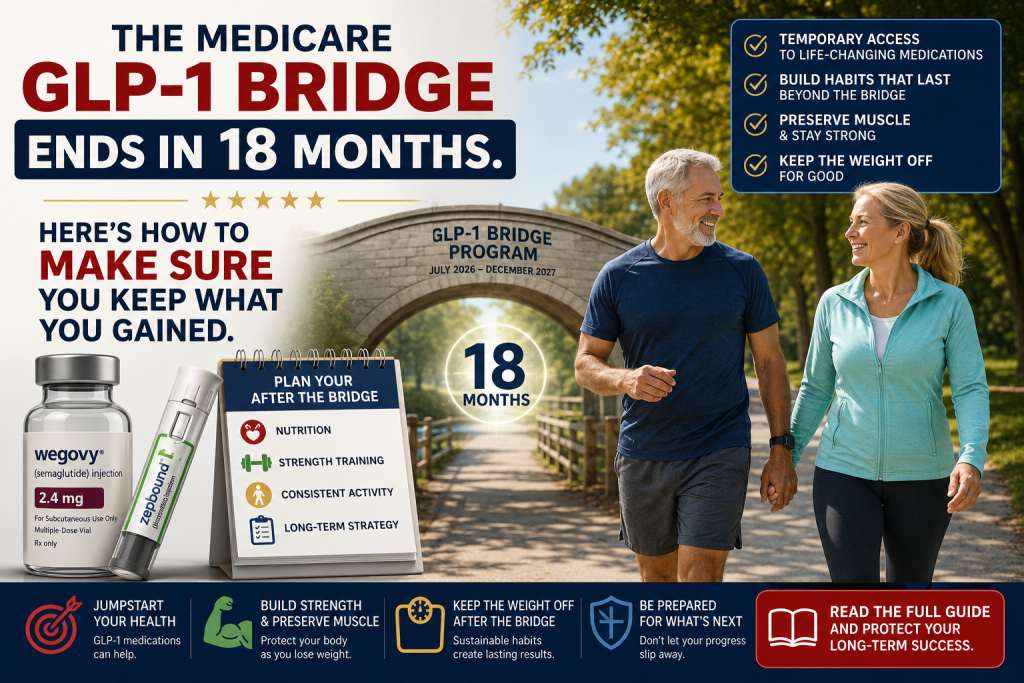
By Paul Barrett, CMIP | The Modern Medicare Agency | Melville, NY Published: July 2026
The Medicare GLP-1 Bridge launched July 1, 2026. If you qualify, you can now get Wegovy, Zepbound, or Foundayo for $50 a month. For many Medicare beneficiaries, this is life-changing access to medications that were previously out of reach.
But here’s the question nobody in the Medicare world is asking yet — and they should be:
What happens to you on January 1, 2028?
That’s when the Bridge ends. No guaranteed extension. No clear congressional path to permanent coverage. If you start Wegovy in July 2026 and lose 40 pounds by the end of 2027, then the program closes and the drug costs $400–$700 a month cash — what do you do?
Some people will find a way to continue. Many won’t.
The research is clear that most people who stop GLP-1 medications without a plan regain significant weight. The cardiometabolic benefits — lower blood pressure, better blood sugar control, reduced cardiovascular risk — tend to reverse in proportion to how much weight comes back.
But here’s what the same research also shows: the people who do keep their results share specific, actionable habits. This isn’t a mystery. It’s a protocol. And the 18 months you have on the Bridge is exactly enough time to build it.
I’m not a doctor and this isn’t medical advice. But I am someone who has spent 18 years in Medicare watching what happens when people plan ahead versus when they don’t. And I’m an active competitive athlete in my mid-fifties who thinks seriously about how the body works and how to take care of it for the long term.
This is the article I wish someone had written when the Bridge launched.
First: The Honest Data on What Happens When People Stop
Let’s start with the reality, because sugarcoating it doesn’t help anyone.
Clinical trials paint a sobering picture. The landmark STEP 4 trial of semaglutide (Wegovy) and the SURMOUNT-4 trial of tirzepatide (Zepbound) both showed the same pattern: when the drug is stopped, weight comes back — and it comes back quickly. On average, participants in controlled trials regained roughly two-thirds of their lost weight within a year of stopping. The cardiometabolic improvements — reduced blood pressure, improved blood sugar, lower cardiovascular risk markers — reversed proportionally with the weight regain.
The discontinuation rate itself is striking: up to 65% of people who start GLP-1 medications stop within the first year, most often due to cost, side effects, or insurance changes.
But the real-world story is more nuanced — and more hopeful.
A Cleveland Clinic analysis of nearly 8,000 patients — one of the largest real-world GLP-1 studies to date — found that 45% of patients who stopped their medication maintained meaningful weight loss at one year. That’s almost half. The clinical trials show roughly a third maintaining results. Why the gap?
Two reasons. First, real-world patients who stopped tended to have lost less weight than trial participants to begin with, making maintenance easier. Second — and this is the critical point — real-world patients didn’t simply stop the drug and do nothing. They continued pursuing weight management through other means: switching medications, resuming GLP-1 therapy at lower doses when possible, or adopting structured lifestyle changes.
The people who kept their results had a plan. The people who didn’t, mostly didn’t keep their results.
The Hidden Risk Nobody Is Talking About: Muscle Loss
Here is the part of the GLP-1 story that deserves far more attention — especially for Medicare beneficiaries, who are predominantly 65 and older.
GLP-1 medications work by suppressing appetite dramatically. You eat significantly less. You lose weight. But here’s the biological reality: when the body loses weight rapidly, it doesn’t lose only fat. It also loses lean body mass — muscle.
In the landmark STEP 1 semaglutide trials, participants lost an average of 15% of their body weight. Roughly 39% of that lost weight was lean mass, not fat. On high-efficacy GLP-1 doses, some studies show an average lean mass decline of 10–15% in patients losing more than 15% of body weight.
For a 65-year-old, this is not an abstract concern.
Natural aging already causes skeletal muscle loss of 12–16% over a lifetime. Up to half of adults over 80 experience sarcopenia — the clinical term for age-related muscle wasting that drives falls, fractures, loss of independence, and mortality. The combination of rapid, GLP-1-induced weight loss and pre-existing age-related muscle decline can create what researchers call sarcopenic obesity: a state where a person achieves a “normal” BMI but has severely compromised body composition — too little muscle to support daily function, despite looking thinner on the scale.
The Harvard Science Review described this plainly in February 2026: “When an older adult with pre-existing, age-related muscle decline uses a GLP-1 agonist without structured intervention, they risk developing sarcopenic obesity… the sudden drop in muscle mass accelerates mitochondrial dysfunction and oxidative stress at the cellular level, essentially mimicking the biological markers of rapid aging.”
This doesn’t mean older adults shouldn’t use these medications. The cardiovascular, metabolic, and quality-of-life benefits are real and meaningful. It means they should use them with a plan — one that actively counters muscle loss throughout the 18-month Bridge period.
What Actually Works: The Protocol for Keeping Your Results
The research is reasonably consistent on what separates people who maintain GLP-1 results from those who don’t. None of this is complicated. All of it requires intentionality.
1. Protein — More Than You Think, Starting Day One
The most evidence-backed intervention for preserving muscle during GLP-1 therapy is adequate protein intake. Current 2026 clinical guidelines recommend 1.2–1.6 grams of protein per kilogram of body weight per day for adults on GLP-1 medications. For a 180-pound person, that’s roughly 98–130 grams of protein daily.
The challenge: GLP-1 medications suppress appetite dramatically. Many people find themselves eating very little — which means protein intake often falls below what the body needs to protect muscle. The result is that more of the weight lost comes from muscle rather than fat.
The solution is deliberate. Prioritize protein at every meal, even when you’re not hungry. Lean proteins — chicken, fish, eggs, Greek yogurt, cottage cheese — should anchor every meal. If whole food sources feel like too much, a quality protein supplement can bridge the gap.
Registered dietitian nutritionists can reduce GLP-1 discontinuation rates by 5–10% in clinical settings. If your doctor prescribes you a GLP-1 through the Bridge program, ask for a referral to a dietitian at the same appointment. Treating it as optional is a mistake.
2. Resistance Training — Non-Negotiable, Not Optional
Research presented at the European Congress on Obesity in 2025 found that adults taking GLP-1 drugs were able to retain muscle while losing weight by doing two things: strength training and eating enough protein. Both were necessary. Neither was sufficient alone.
Current guidelines recommend 2–3 resistance training sessions per week during GLP-1 therapy. This doesn’t mean powerlifting or gym memberships you won’t use. It means:
- Bodyweight exercises: squats, pushups, step-ups, resistance band work
- Light dumbbell work targeting major muscle groups
- Water aerobics or resistance-based pool exercise for anyone with joint limitations
- Chair-based strength exercises for those with mobility constraints
The goal is to send the body a signal: keep this muscle. We’re using it. Don’t sacrifice it for energy.
For Medicare beneficiaries, many Medicare Advantage plans cover gym memberships through programs like SilverSneakers, Silver&Fit, or One Pass. If you’re on an Advantage plan, check your benefits — you may already be paying for access you’re not using. This is the moment to use it.
3. Don’t Lose Too Fast — Slower Is Smarter for Older Adults
The velocity of weight loss matters, especially over 65. Rapid weight loss accelerates muscle loss. The goal is not to lose as much as possible in 18 months. The goal is to lose fat while preserving muscle — which often means a more moderate pace than the drug’s maximum effect.
Talk to your doctor about starting at the lowest effective dose and titrating slowly. This is not the approach most people take — the tendency is to maximize the dose for maximum results. For younger adults in good health, that math may work. For older adults already managing some degree of age-related muscle loss, slower titration with active muscle preservation strategies is the smarter approach.
4. Build the Habits During the 18 Months — Not After
This is the strategic insight that matters most for Bridge participants.
The Bridge gives you 18 months of appetite suppression. During that window, eating less feels easy — the drug is doing the work. The critical mistake is using those 18 months only to lose weight without simultaneously building the habits that will maintain the weight loss without the drug.
Think of the Bridge as a scaffolding, not a permanent structure. The scaffolding makes construction possible. But when the scaffolding comes down, the building needs to stand on its own.
By the end of 2027, before the Bridge closes, you want to have:
- A protein intake habit that feels automatic
- A resistance training routine that’s genuinely part of your week
- A dietary pattern you can sustain without extreme restriction
- A relationship with food and appetite that doesn’t require pharmaceutical support to maintain
None of this happens by accident in 18 months. It happens by design, starting now.
5. Have a Conversation With Your Doctor About What Comes Next — Before December 2027
This is the one action item most Bridge participants won’t take — and the most important one.
Twelve months from now, ask your doctor: “If the Bridge program doesn’t continue after December 2027, what’s our plan?” The answer might be:
- Transition to a lower maintenance dose — some patients do well on significantly lower doses than their therapeutic weight-loss dose. The cost math changes at a lower dose.
- Manufacturer direct-pay programs — Novo Nordisk and Eli Lilly have both developed lower-cost direct-purchase options. Under the Trump administration’s TrumpRx initiative, negotiated prices through manufacturers may be available.
- Alternative medications — older GLP-1 medications (liraglutide, dulaglutide) are available at lower cost, including generics in some cases. They’re less potent but may be sufficient for maintenance.
- Endoscopic procedures — emerging research from Digestive Disease Week 2026 showed that endoscopic sleeve gastroplasty — a non-surgical stomach volume reduction — produced significantly better post-GLP-1 weight maintenance than lifestyle modification alone in patients who stopped their medication.
- The lifestyle protocol above — for patients who have genuinely built the habits during their 18 months, discontinuation doesn’t have to mean regain.
The worst outcome is getting to December 31, 2027, having lost significant weight and improved your health, and then watching those gains reverse because nobody planned for what came next.
The Cardiometabolic Benefits: What Stays and What Goes
One more piece of data worth understanding clearly.
The SURMOUNT-4 post-hoc analysis showed that among people who regained 75% or more of their lost weight after stopping tirzepatide, cardiometabolic markers — blood pressure, blood sugar, cardiovascular risk factors — had returned essentially to baseline by week 88. The benefits reversed with the weight.
This is the argument for maintenance. If you lose 30 pounds on Wegovy and your blood pressure normalizes, your prediabetes resolves, and your cardiovascular risk score improves — and then you stop the drug and regain 25 pounds — most of those health gains are gone. The Medicare system pays for the results of obesity-related disease: the cardiac events, the diabetes management, the kidney disease progression. The Bridge is an attempt to prevent that spending upstream. But the prevention only holds if the results hold.
The patients who benefit most from the Bridge program over the long run will be the ones who use it as a catalyst — not a cure.
A Note on Why This Article Exists
I write about Medicare. But I’m also a certified personal trainer with a degree in Physical Education, several nutrition courses under my belt, and a Health Coaching certificate from the Institute for Integrative Nutrition.
Health and fitness has been a passion of mine my entire life — and as I’ve gotten older, that passion has shifted from performance to something I think matters even more: staying strong, functional, and genuinely capable of enjoying the life you worked so hard to build.
That shift didn’t happen in a vacuum. It happened because of my clients.
After 18 years in Medicare, I’ve sat across from hundreds of people who spent their careers looking forward to retirement — the travel, the grandkids, the golf, the garden — and arrived there physically unable to enjoy it. Not because of a sudden illness. Because of a slow, quiet erosion of strength, mobility, and energy that nobody warned them about and nobody helped them address.
That’s what I think about when I read the research on GLP-1s and muscle loss in older adults. I don’t see an abstract statistic. I see the people I work with every day — people who deserve better than losing 40 pounds, feeling incredible, and then watching it reverse because the program ended and nobody gave them a plan for what came next.
I’m also an active competitive athlete in my mid-fifties. I play softball and basketball. I take recovery, muscle preservation, and long-term physical capacity seriously — not as a hobby, but as a commitment I make to myself so I can keep showing up fully for my clients, my family, and my own life.
The Medicare GLP-1 Bridge is genuinely good news. Eighteen months of $50 access to clinically proven weight loss medications is something millions of Americans needed and didn’t have. I don’t want to dampen that.
But I also don’t want anyone to start Wegovy in July 2026, lose 35 pounds, feel better than they have in years, and then watch it all come back in 2028 because nobody told them what to do next.
That’s what this is for.
Summary: Your 18-Month Action Plan
When | What to Do |
Month 1 — Now | Talk to your doctor, get prior authorization submitted, confirm eligibility, get a dietitian referral |
Month 1–3 | Start the drug, establish protein targets (1.2–1.6g/kg/day), begin resistance training 2–3x/week |
Month 3–6 | Review progress with your doctor, adjust dose if losing too fast, check your Advantage plan’s gym benefits |
Month 6–12 | Solidify lifestyle habits — these should feel routine by now, not effortful |
Month 12 | Have the “what happens after December 2027” conversation with your doctor |
Month 15–18 | Evaluate post-Bridge options: manufacturer programs, alternative medications, maintenance dose, lifestyle plan |
December 31, 2027 | Bridge ends — your plan is already in place |
Questions? Let's Talk.
I help Medicare beneficiaries think through their coverage options — including how the GLP-1 Bridge interacts with your current Part D plan, your Medicare Advantage benefits, and what plan changes might make sense as this program evolves.
If you have questions about eligibility, coverage, or plan interactions — or if you just want to make sure your Medicare coverage is the right fit heading into 2027 — call me. No charge, no pressure.
Paul Barrett, CMIP The Modern Medicare Agency 📞 631-358-5793 ✉️ medicare@paulbinsurance.com 🌐 paulbinsurance.com 📍 445 Broad Hollow Rd, Melville, NY 11747
Related reading:
- Medicare Is Now Covering Weight Loss Drugs — But Before You Get Too Excited, Read This First
- Medicare Supplement Plans in Farmingdale, NY: 2026 Rates and Your Real Options
- Medicare Advantage Plans in Farmingdale, NY: Your Honest 2026 Local Guide
Sources:
- eClinicalMedicine/The Lancet — Weight Maintenance After Discontinuation of GLP-1 Therapies (May 2026)
- Cleveland Clinic — What Happens When Patients Stop Taking GLP-1 Drugs (March 2026)
- AJMC — Weight Regain After GLP-1 Discontinuation Is Less Rapid in Real World (May 2026)
- Harvard Science Review — The GLP-1 Aftermath: Muscle Loss and Cellular Aging (February 2026)
- Endocrine News — GLP-1 Agonists and Muscle Loss: A Hidden Risk for Older Adults (September 2025)
- Ubie Health — Critical 2026 Update: New GLP-1 Rules to Stop Muscle Loss Now
- Medical News Today — GLP-1 Use May Not Lead to As Much Muscle Loss As Feared (May 2026)
- BMJ — Stopping Weight Loss Drugs Linked to Weight Regain and Reversal of Heart Health Markers (January 2026)
- Medscape — Solutions Emerging for Post-GLP-1 Weight Regain (June 2026)
- AJMC — GLP-1 Therapies in 2026: Beyond Blood Sugar and the Scale (June 2026)
- CMS Medicare GLP-1 Bridge Official Page
Disclaimer: This article is for educational and informational purposes only. It does not constitute medical, nutritional, or fitness advice. Consult your physician before starting or stopping any medication, and consult a registered dietitian or certified fitness professional regarding nutrition and exercise programming. The Modern Medicare Agency is not connected with or endorsed by the United States government or the federal Medicare program.