How the Inflation Reduction Act genuinely transformed prescription drug coverage since 2023, what the new GLP-1 Bridge program actually covers, and the state programs that can save you real money most people have never heard of.
The Short Answer
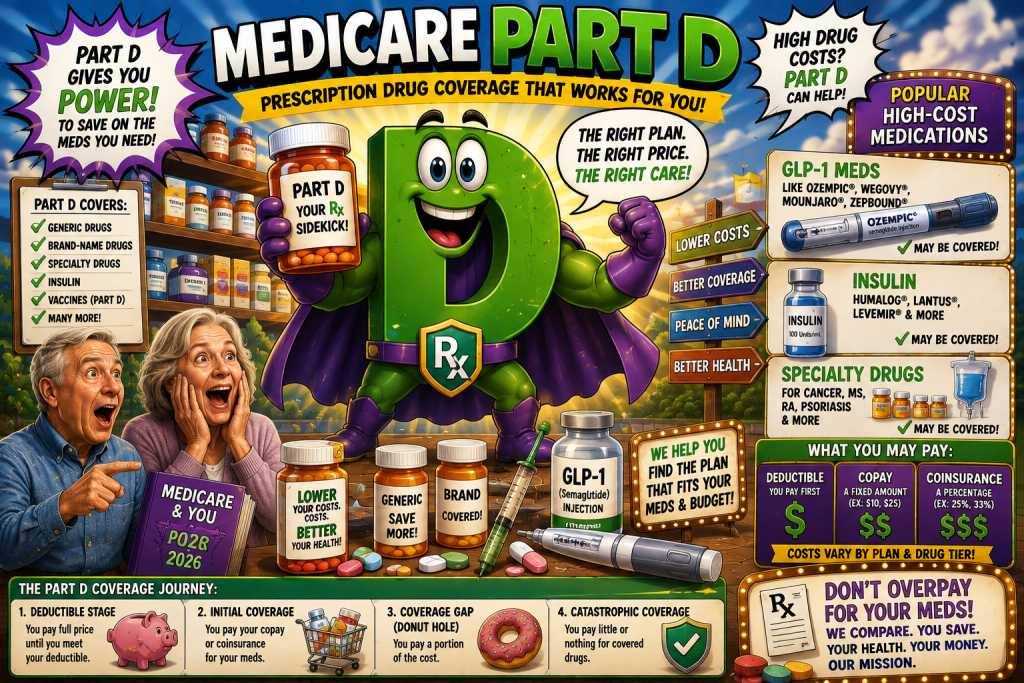
Medicare Part D is prescription drug coverage, offered through private insurers, either as a standalone plan or bundled into a Medicare Advantage plan. It’s undergone the most sweeping overhaul in its history over the past few years — the old “donut hole” is gone, replaced by a hard $2,100 out-of-pocket cap in 2026, the government now directly negotiates prices on some of the costliest drugs in the country, and a brand-new temporary program covers GLP-1 weight-loss medications for a flat $50 copay. This article walks through what actually changed, why, and what’s coming next.
For the full breakdown of how the standard benefit works — deductible, coinsurance, formularies, tiers, and choosing a plan — see our [complete Part D guide]. This article focuses on the bigger transformation happening around Part D right now.
Key Takeaways
- Part D is the only way to get prescription drug coverage under Medicare — it’s never automatic, and going without it (or other creditable coverage, like employer, VA, or TRICARE drug coverage) for 63+ days triggers a permanent late enrollment penalty.
- Enrollment is tied to specific windows, just like every other part of Medicare — you can’t sign up whenever you feel like it.
- Every Part D plan in 2026 follows the same basic structure: a deductible up to $615, then 25% coinsurance, then $0 for covered drugs once you hit the $2,100 out-of-pocket cap.
- You generally can’t add a standalone Part D plan on top of a standard Medicare Advantage plan — doing so can get you disenrolled from your Medicare Advantage coverage entirely.
- The federal Extra Help program can substantially reduce or eliminate Part D costs for people with limited income — it’s separate from Medicaid and widely underused.
- Every Part D plan must cover at least 2 drugs in every therapeutic category — but that’s a floor, not a guarantee your specific medication is covered. Plans vary enormously beyond that minimum, and some cover hundreds more drugs than others even at similar premiums.
- Step therapy, quantity limits, and prior authorization can all affect a drug even when it’s technically covered — and plans differ significantly in how strictly they apply these restrictions.
- IRMAA, the income-based surcharge most people associate only with Part B, applies to Part D too, billed separately through Social Security.
- Medicare doesn’t sell Part D directly — it’s administered entirely through private insurers like Blue Cross Blue Shield, Aetna, Humana, UnitedHealthcare, Cigna, and Wellcare, all operating under Medicare’s rules.
- The standalone Part D marketplace has been shrinking, partly because the Inflation Reduction Act shifted more financial risk onto insurers, prompting some carriers to consolidate or exit — and many carriers have also stopped paying agents commissions to enroll people in standalone Part D plans at all, making it harder to find an agent willing to help with this genuinely complicated part of Medicare.
- Coming prepared with an accurate, current medication list — including whether each drug is generic or brand-name — makes it dramatically easier for an agent to help you quickly and accurately, especially given how little agents are now compensated for this work.
- Your plan’s formulary, drug tiers, quantity limits, and rules can all change every year without your consent — reviewing your Annual Notice of Change during AEP is genuinely your only real window to fix anything that changed, since switching plans afterward is very limited.
- The Inflation Reduction Act of 2022 triggered the most significant redesign of Part D since it launched in 2006 — eliminating the donut hole, capping out-of-pocket costs, and letting Medicare negotiate drug prices for the first time in the program’s history.
- The first round of government-negotiated prices took effect January 1, 2026, on 10 widely used drugs, with discounts ranging from 38% to 79% off list price.
- Insulin is capped at $35/month and recommended adult vaccines are $0 — both permanent, not temporary.
- A new, temporary GLP-1 Bridge program covers certain weight-loss medications for a flat $50 copay starting July 1, 2026, operating completely outside your normal Part D benefit.
- The federal subsidy that’s helped keep standalone Part D premiums stable is ending after 2026 — expect real premium increases for 2027, though estimates vary on how large.
- A small number of states run their own supplemental drug assistance programs that work alongside Part D — and New York’s EPIC program is genuinely one of the best in the country.
The Basics First: Why You Need Part D and What Happens If You Don’t Enroll
Before getting into everything that’s changed, it’s worth covering the fundamentals plainly, because they matter just as much as the headline reforms above.
If you want prescription drug coverage under Medicare, you need a Part D plan — either a standalone plan alongside Original Medicare, or one bundled into a Medicare Advantage plan. Medicare doesn’t provide drug coverage automatically the way it does with Part A and Part B.
You can’t just sign up whenever you feel like it. Like every other part of Medicare, Part D enrollment is tied to specific windows: your Initial Enrollment Period around age 65, the fall Annual Enrollment Period (October 15–December 7) if you’re changing plans, and Special Enrollment Periods tied to specific qualifying events. Outside those windows, you generally can’t just enroll on a whim.
Going without Part D — or other creditable drug coverage — for 63 or more consecutive days after you’re first eligible triggers a permanent late enrollment penalty. It’s calculated as 1% of the national base beneficiary premium ($38.99 in 2026) for every full month you went without coverage, rounded to the nearest 10 cents, and it’s added to your premium for as long as you have Part D — even if you switch plans later. (Full worked examples of this penalty, including a real client case, are in our [Medicare Enrollment guide].)
Paul’s Honest Take: People sometimes assume this penalty doesn’t apply to them because they’re healthy and don’t take much medication right now. It’s not about what you take today — it’s about whether you have creditable coverage in place at all. This is genuinely one of the most avoidable mistakes in all of Medicare, and it’s also one of the most permanent once it happens.
A quick note on what counts as “creditable coverage”: you don’t necessarily need a Medicare Part D plan specifically to avoid the penalty — drug coverage through an employer, a union, the VA, or TRICARE can count as creditable if it’s at least as good as standard Part D coverage. What matters is having something that qualifies, without a 63-day gap, from the point you’re first eligible.
How the Standard Benefit Actually Works in 2026
Before diving into everything that’s changed, here’s the basic cost structure every Part D plan follows in 2026, whether standalone or bundled into Medicare Advantage:
Stage | What You Pay |
Deductible | Up to $615 (some plans set it lower, some at $0) |
Initial coverage | 25% coinsurance on covered drugs |
Catastrophic coverage | $0 for covered drugs, once your out-of-pocket spending hits $2,100 for the year |
In plain terms: you pay your plan’s deductible first, then 25% of your drug costs, and once your total out-of-pocket spending for the year reaches $2,100, your covered medications cost you nothing for the rest of the calendar year. (The full mechanics — including how the old “donut hole” used to work before it was eliminated — are covered in our [complete Part D guide].)
Standalone Plan vs. Medicare Advantage Bundle: One Important Rule
If you’re on Medicare Advantage, your Part D coverage is almost always already built into that plan. You generally can’t add a separate standalone Part D plan on top of a standard Medicare Advantage plan — doing so can actually get you automatically disenrolled from your Medicare Advantage coverage entirely, since the two aren’t designed to be combined. If you’re on Original Medicare instead, you’ll need to actively choose and enroll in a standalone plan, since Medigap doesn’t include drug coverage at all.
Extra Help: Financial Assistance Many People Qualify For and Don’t Know It
If your income and resources are limited, the federal Extra Help program (also called the Low-Income Subsidy, or LIS) can substantially reduce — sometimes essentially eliminate — your Part D premium, deductible, and copays. People with full Medicaid benefits are automatically enrolled. But you don’t have to be on Medicaid to qualify: Extra Help has its own separate income and asset limits, and a meaningful number of people who would qualify never apply simply because nobody ever mentioned it to them.
Paul’s Honest Take: This is one of the most underused benefits in all of Medicare, and it costs nothing to find out if you qualify. I always ask clients whose income is on the tighter side whether they’ve ever been screened for Extra Help — more often than you’d expect, the answer is no. If you’re a New York resident, it’s also worth knowing Extra Help and the state’s EPIC program (covered below) are separate programs with separate eligibility rules — you could potentially qualify for both.
IRMAA Applies to Part D Too — Not Just Part B
Most people know that higher earners pay more for Part B through a surcharge called IRMAA. Far fewer realize the same surcharge applies to Part D. If your income is above certain thresholds — based on your tax return from two years prior — you’ll pay an extra amount on top of your regular Part D plan premium, billed separately through Social Security, regardless of which specific plan you choose.
Paul’s Honest Take: This one catches people off guard because it doesn’t show up on your Part D plan’s bill — it comes through Social Security separately, and it’s easy to miss the connection. If your income has recently dropped due to retirement or another qualifying life event, you can appeal your IRMAA determination using Form SSA-44. Full IRMAA thresholds and dollar amounts for both Part B and Part D are in our [Medicare Costs guide].
Formularies: Why Two Plans With the Same Premium Can Be Worlds Apart
Here’s the single most important shopping principle in all of Part D, and it deserves its own section because it’s genuinely more consequential than the premium: every plan has its own formulary — its specific list of covered drugs — and formularies vary enormously from one plan to the next, even among plans that look nearly identical on price.
The CMS floor: at least 2 drugs per category
Medicare requires every Part D formulary to cover at least two drugs in every therapeutic category and class, so a plan can’t simply refuse to cover an entire category of medication outright. For a handful of “protected classes” — including certain antidepressants, antipsychotics, and anti-cancer drugs — the rule is stricter, generally requiring plans to cover all or substantially all drugs in that category.
Beyond that floor, carriers have real flexibility. Plans are also allowed to add drugs to their formulary beyond what’s required, and this is exactly where the real differences between plans show up. Some plans build out genuinely broad formularies covering hundreds more drugs than a leaner, more restrictive competitor — even when both plans meet the same minimum CMS requirement and charge a similar premium.
Paul’s Honest Take: This is exactly why “meets CMS requirements” and “covers what you actually take” are two completely different standards. The 2-drugs-per-class rule is a floor, not a guarantee that your specific medication is included. I’ve compared plans side by side where one covered a client’s exact medication and the other, despite a nearly identical premium, didn’t cover it at all — or covered it only at a much higher tier. The only way to know for sure is to check your actual drug list against a plan’s actual formulary, every single time.
What else to pay attention to beyond “is it covered”
Even when a drug is technically on a plan’s formulary, that’s not the end of the story. A handful of restrictions can still affect how easily — and how cheaply — you can actually fill it, and plans vary meaningfully in how strict they are about applying these:
- Step therapy — the plan requires you to try a lower-cost drug first, and only covers the more expensive one if the cheaper option doesn’t work
- Quantity limits — the plan caps how much of a drug it will cover in a given period, sometimes less than what your doctor actually prescribed
- Prior authorization — your doctor has to justify the prescription to the plan before it’s covered
Some plans apply these restrictions far more aggressively than others. Two plans can both technically cover the same drug, and one might let you fill it without any hurdles while the other requires step therapy, a quantity limit, and prior authorization all at once.
Paul’s Honest Take: I tell every client the same thing: don’t stop your comparison at “is my drug covered, yes or no.” Ask what tier it’s on, whether there’s a quantity limit, whether step therapy applies, and whether prior authorization is required. I’ve had clients switch plans specifically because their existing plan required step therapy on a medication their doctor had already determined, through real trial and error, wasn’t going to work for them. Checking for these specific restrictions is exactly the kind of thing that’s easy to skip when you’re just comparing premiums side by side — and exactly the kind of thing that costs people real time and money at the pharmacy counter when they skip it.
Who Actually Sells Part D Plans
Here’s a basic fact that surprises some people: the federal government does not sell or administer Part D plans itself. Part D exists entirely through private insurance companies that contract with Medicare to offer drug coverage. This is exactly why you’ll see familiar commercial insurance names attached to Part D plans — companies like Blue Cross Blue Shield, Aetna, Humana, UnitedHealthcare, Cigna, and Wellcare, among others, all sell standalone Part D plans, standard Medicare Advantage plans that bundle in Part D.
Paul’s Honest Take: This trips people up sometimes because Medicare feels like a government program, and in the biggest sense it is — but the actual drug coverage you’re using every time you fill a prescription is being administered by a private company, operating under Medicare’s rules. That’s exactly why two Part D plans can differ so much even though they’re both “Medicare” plans: the government sets the framework, but the private carrier decides the specific formulary, tiers, and rules within it.
Why There Are Fewer Part D Plans Than There Used to Be
It’s worth knowing that the standalone Part D marketplace has genuinely been shrinking, and the Inflation Reduction Act is a real part of why. As the law shifted more financial liability for high drug costs onto insurers — through the new $2,100 out-of-pocket cap and other changes — the math changed for carriers on how much they take in through premiums versus how much they have to pay out in claims. Several carriers have responded by consolidating or exiting the standalone Part D market entirely, which is exactly why the number of standalone plans nationally has dropped meaningfully over the past couple of years. (The specific 2026 numbers are covered in our [Part D guide].)
Paul’s Honest Take: Fewer plans doesn’t necessarily mean worse coverage — sometimes it means the weaker, redundant options got consolidated away. But it does mean there’s less room for error in choosing the right one, since there are simply fewer alternatives left to switch to if your first pick doesn’t fit.
Why It’s Getting Harder to Find an Agent Who’ll Actually Help You With Part D
There’s a related development worth being honest about, because it directly affects the kind of help you can expect to get. A large majority of the carriers that sell standalone Part D plans have stopped paying agents any commission at all to enroll people in them — and the trend has accelerated significantly over the past couple of AEP seasons. Centene, the parent company of WellCare and the largest standalone Part D insurer in the country, has stopped paying commissions on its entire standalone Part D lineup. Other major carriers have followed with similar cuts, either eliminating PDP commissions entirely or reducing them to a fraction of what they used to pay.
Paul’s Honest Take: I’ve been doing this for 18 years, and Part D is genuinely one of the most complicated corners of Medicare — it’s where I field the most questions, the most confusion, and honestly, the most stress from clients. We never got paid much for this work to begin with; helping someone compare formularies across a dozen plans has always been genuinely time-consuming for what it paid. Now, for a large share of these plans, we don’t get paid anything at all. One of the largest carriers, WellCare, even clawed back the renewal commissions agents were earning on Part D clients we’d already enrolled years earlier — money agents were counting on for work they’d already done. I’m telling you this not to complain, but because it matters to you directly: agents have genuinely lost real income on Part D, and that’s only going to make it harder, year after year, to find someone willing to spend real time helping you compare formularies and get this right — instead of just pointing you toward whatever pays them something. If you find an agent who still takes the time to walk you through your Part D options carefully, that’s someone doing right by you largely out of principle at this point, not financial incentive. That’s worth recognizing and appreciating.
How to Make It Easier on Whoever Helps You
Given everything above, there’s something genuinely practical you can do that makes a real difference: come prepared. The single biggest thing that slows down a Part D review, and honestly the most frustrating part of this work for an agent doing it for free, is a consumer who isn’t sure exactly what they take.
Before you sit down with anyone to review your Part D options, put together a simple, current list of:
- Every medication you take, spelled correctly, not guessed at from memory
- Whether each one is generic or brand-name — this genuinely changes the tier and the cost, and “I think it’s generic” isn’t something an agent can work with
- The dosage and how often you take it
Paul’s Honest Take: You’d be surprised how often someone tells me “I take the blood pressure pill” or “the cholesterol medication, I think it’s the generic one” — and I genuinely can’t run an accurate comparison from that. It’s not a knock on anyone; medication names are hard to remember and spell, especially if you’re managing several. But the more organized you are walking in, the faster and more accurately I — or any good agent — can actually help you, especially for free. A printed list from your pharmacy, or just a note in your phone with the exact drug names, dosages, and whether they’re generic, makes a real difference.
Be Patient, Especially During AEP
One more honest, practical note: the Annual Enrollment Period is genuinely the busiest stretch of the year for any agent who actually does this work well. We’re helping existing clients review their ANOC, catching formulary and tier changes, and fielding calls from new people all at the same time, in a compressed six-and-a-half-week window.
Paul’s Honest Take: If you reach out to an agent during AEP and don’t hear back instantly, please don’t take it personally — it almost never means we don’t care, it usually means we’re genuinely swamped helping people who need us. I’ll say something plainly that I think most agents feel but don’t always say out loud: existing clients come first during that window, and new people come second. That’s not a lack of care for someone new reaching out — it’s simply the reality of a compressed enrollment season and a responsibility to the people who’ve trusted us for years. If you’re new and reaching out during AEP, a little patience goes a long way, and coming prepared with your medication list ready will help whoever you work with move faster on your behalf.
Why Reviewing Your Plan Every Single Year Isn’t Optional
This might be the single most practically important piece of advice in this entire article, so it deserves its own section: your Part D plan is allowed to change meaningfully from one year to the next, and it’s on you to catch those changes before they cost you money.
Every year, a carrier can adjust:
- The formulary — which drugs are covered at all
- The tier a specific drug sits on, which directly affects your copay or coinsurance
- Quantity limits — how much of a drug they’ll cover in a given period
- Step therapy requirements — whether you have to try a cheaper drug first
- Prior authorization rules — whether your doctor now needs to justify a prescription before it’s covered
- The premium and deductible themselves
None of these changes require your active consent — they show up in your Annual Notice of Change (ANOC), which carriers are required to send by September 30 each year, ahead of the Annual Enrollment Period.
Here’s the part that makes this genuinely urgent, not just good practice: once the Annual Enrollment Period closes on December 7, your ability to change your Part D plan for the new year is very limited. Outside of a handful of specific Special Enrollment Period situations, you’re generally locked into whatever plan you have until the next AEP rolls around. If a formulary change quietly moved your medication to a higher tier, or added a step therapy requirement, and you didn’t catch it during AEP, you could be stuck absorbing that cost for the better part of a year.
Paul’s Honest Take: I say this to every single client, every single fall, regardless of how happy they were with their plan the year before: read the ANOC, or better yet, have someone walk through it with you. Pay attention to your premium, your deductible, and specifically whether your actual medications are still covered at the tier and cost you’re used to. If you’re managing a real out-of-pocket cost concern, it’s also worth knowing you have the option to enroll in the Medicare Prescription Payment Plan (M3P) — a genuine result of the Inflation Reduction Act that lets you spread your out-of-pocket drug costs into monthly bills across the year instead of paying it all at the pharmacy counter upfront. It doesn’t lower what you owe, but it can make a big pharmacy bill far more manageable. The bottom line: AEP is your real window to fix anything that’s changed. Miss it, and you’re generally living with those changes until next year.
The Inflation Reduction Act: The Biggest Change to Part D Since It Began
Part D launched in 2006 and, until recently, worked roughly the same way for nearly two decades. The Inflation Reduction Act of 2022 (IRA) changed that fundamentally, shifting real financial liability away from consumers and onto private insurers and drug manufacturers. Here’s what actually changed:
1. The out-of-pocket cap that never existed before
Historically, Part D had no true ceiling on what you could spend on covered drugs in a year — a genuinely dangerous gap for anyone on expensive, ongoing medication. The IRA fixed that directly: a hard annual out-of-pocket cap of $2,000 took effect in 2025, rising to $2,100 in 2026. The moment your combined deductible and coinsurance hit that number, your covered medications cost you $0 for the rest of the calendar year.
2. The donut hole is gone
The old, confusing “coverage gap” — where costs spiked in the middle of the year — has been eliminated entirely. Part D now runs through three simple stages: a deductible, an initial coverage phase where you pay 25% coinsurance, and the $2,100 catastrophic cap. (Full mechanics in our [Part D guide].)
3. Medicare can finally negotiate drug prices
For the first time in the program’s history, the federal government has the legal authority to directly negotiate prices with drug manufacturers on a selected list of high-cost medications. The first round of negotiated prices — what the law calls “Maximum Fair Prices” — took effect January 1, 2026, on 10 drugs:
Drug | Treats | Discount from List Price |
Eliquis | Blood clots | 56% |
Jardiance | Diabetes, heart failure | 66% |
Xarelto | Blood clots | 62% |
Januvia | Diabetes | 79% |
Farxiga | Diabetes, heart failure, kidney disease | 68% |
Entresto | Heart failure | 53% |
Enbrel | Rheumatoid arthritis, psoriasis | 67% |
Imbruvica | Blood cancers | 38% |
Stelara | Psoriasis, Crohn’s disease | 66% |
NovoLog / Fiasp (insulin) | Diabetes | 76% |
These 10 drugs alone accounted for roughly 20% of total Part D drug spending before negotiation. CMS has already announced a second round of 15 additional drugs — including major diabetes drugs like Ozempic — with negotiated prices taking effect in 2027, and a third round announced for 2028.
Paul’s Honest Take: One important nuance worth understanding: a lower negotiated price for the drug doesn’t automatically mean a lower copay for you. What you actually pay still depends on your specific plan’s deductible and cost-sharing structure — if your plan charges a flat copay rather than coinsurance, a cheaper drug price may not immediately show up in your bill the way you’d expect. It’s still a genuinely significant, historic change, but it’s not an automatic discount for every single person on Medicare.
4. Insulin and vaccines: permanent, not temporary
Two of the IRA’s most consumer-friendly provisions are now permanent fixtures of Part D, not pilot programs:
- Insulin is capped at $35 per month for all covered insulin products, regardless of whether you’ve met your deductible.
- All adult vaccines recommended by the CDC’s Advisory Committee on Immunization Practices — including shingles and RSV vaccines — are $0, with no copay and no deductible required.
The GLP-1 Bridge Program: A Genuinely New Door Opening
There’s a brand-new, temporary program worth understanding in detail if GLP-1 medications for weight management are relevant to you or someone you’re helping. Medicare has historically been legally barred from covering drugs prescribed specifically for weight loss. The Medicare GLP-1 Bridge changes that, temporarily.
What it covers
Three specific medications, strictly when prescribed for weight management (not for diabetes, which is already covered under standard Part D rules):
- Wegovy (semaglutide — injection and tablet forms)
- Zepbound (tirzepatide — KwikPen configuration only; single-dose pens and vials are excluded)
- Foundayo (orforglipron — tablet form)
Ozempic and Mounjaro are not part of this program, because they’re already covered under standard Part D for people with a Type 2 diabetes diagnosis.
Who qualifies
- You must be enrolled in a standalone Part D plan or a Medicare Advantage plan with drug coverage
- At least 18 years old, with a BMI of 35 or higher, or a BMI of 30+ with a weight-related health condition
- You cannot have a primary diagnosis — like Type 2 diabetes or severe sleep apnea — that would already qualify you for standard GLP-1 coverage
- Your prescribing doctor must certify you’re using the medication alongside a structured lifestyle program
How it actually works
This is genuinely unusual: the program operates completely outside your regular insurance plan. At the pharmacy, your claim is submitted to your normal Part D plan first. When it’s inevitably denied (since weight-loss drugs aren’t part of standard Part D coverage), it’s automatically routed to a separate, central Medicare processor, which handles approval and pays the pharmacy directly.
Your flat cost is $50 per 30-day fill — but because this runs outside your standard Part D benefit, that $50 does not count toward your annual $615 deductible or your $2,100 catastrophic cap. Prescriptions are limited to 30-day fills at retail or approved online pharmacies — no 90-day mail-order supplies.
Timeline
The program launched July 1, 2026, and is currently authorized through December 31, 2027. CMS had originally planned to transition into a broader framework called the BALANCE Model, which would have required insurers to offer comprehensive nutrition and lifestyle programs — but that model has been indefinitely delayed due to industry resistance, and the $50 Bridge program remains the active path through the end of 2027.
Paul’s Honest Take: This is a genuinely new opportunity for people who’ve wanted access to these medications but couldn’t get Medicare to cover them for weight loss specifically. The word “temporary” matters, though — this is authorized only through the end of 2027, and what happens after that is a real open question. If this applies to you, it’s worth talking to your doctor about the eligibility requirements directly rather than waiting, since program details can be updated.
The Trade-Off: Rising Standalone Premiums for 2027
None of these consumer protections came free. To help keep standalone Part D premiums from spiking while insurers absorbed the new $2,100 cap, the government ran a Premium Stabilization Demonstration that paid insurers behind the scenes. That subsidy is ending after 2026.
There’s a real, honest disagreement about how much this will actually cost consumers. CMS’s own projection puts the national base beneficiary premium rising modestly, from $38.99 to about $41.33, with most people seeing under a $10/month increase. Independent analysts, including KFF and AARP, project a rougher landscape — internal administration estimates cited in reporting suggest roughly half to three-quarters of standalone Part D enrollees could see premium jumps in the $10–$20/month range.
Paul’s Honest Take: This mainly affects people on standalone Part D plans through Original Medicare — Medicare Advantage enrollees are largely shielded from this specific change, since MAPD pricing works differently. Whichever projection turns out closer to reality, my advice doesn’t change: don’t assume last year’s plan is automatically still your best deal this AEP. Review your options every year, especially this one.
One structural shift worth watching: as insurers adjust to these new liabilities, some carriers have started moving away from predictable flat copays and toward coinsurance percentages on certain tiers — which can front-load costs earlier in the year rather than spreading them evenly. It’s one more reason formulary and cost-sharing details matter more than the sticker premium when comparing plans.
State Pharmaceutical Assistance Programs: The Benefit Most People Have Never Heard Of
Here’s something genuinely underused: fewer than half of all states run a dedicated State Pharmaceutical Assistance Program (SPAP) — a state-funded benefit that wraps around your Part D coverage to further lower your costs. According to AARP research, only 13 states operate a broad, general SPAP built specifically to help seniors with Part D costs, down from 23 states two decades ago as many states scaled back after Part D itself launched.
The three strongest programs in the country are New York, Pennsylvania, and New Jersey — genuinely richer and more broadly accessible than what most other SPAP states offer.
Program | State | Key Strength | Income Limit (Single) |
EPIC | New York | Highest income ceiling in the country; accepted at virtually every pharmacy statewide | $75,000 |
PACE / PACENET | Pennsylvania | Simpler flat copays ($8–$15) from day one, no sliding deductible | $33,500 |
PAAD / Senior Gold | New Jersey | Also open to people with disabilities ages 18–64 on SSDI, not just seniors | ~$48,000 |
What makes New York’s EPIC genuinely stand out nationally: the income ceiling is the highest in the country by a wide margin — a single senior earning up to $75,000 can still receive help, which is essentially unheard of anywhere else. EPIC is also integrated directly into the state health department, so it’s accepted at nearly every retail pharmacy in New York, without the network restrictions some other states’ programs carry.
One more genuinely useful detail: if you’re enrolled in a qualifying SPAP, CMS grants you a Special Enrollment Period — meaning you can switch your Part D or Medicare Advantage plan once, at any point in the year, not just during the fall Annual Enrollment Period.
(New York readers: our [complete guide to EPIC and Medicare in New York] covers eligibility and the application process in full.)
Paul’s Honest Take: EPIC is one of the most under-utilized benefits I come across, full stop. I’ve met plenty of New York residents whose income puts them comfortably within EPIC’s range who had simply never heard of it — nobody along the way ever mentioned it. It costs nothing to apply, and if you qualify, it’s real money back in your pocket every month. If you’re on Medicare in New York and haven’t checked whether you qualify, that’s worth five minutes of your time.
Frequently Asked Questions
Is the “donut hole” still a thing? No. As of 2025, it’s gone. Part D now runs through a deductible, a 25% coinsurance phase, and a hard $2,100 out-of-pocket cap for 2026, after which covered drugs cost $0 for the rest of the year.
Can I have a standalone Part D plan and Medicare Advantage at the same time? Generally no. Most Medicare Advantage plans already include Part D coverage, and enrolling in a separate standalone plan on top of a standard Medicare Advantage plan can actually get you disenrolled from that plan. If you’re on Original Medicare instead, you’ll need a standalone plan since Medigap doesn’t cover drugs.
How do I know if I qualify for Extra Help? It depends on your income and financial resources, and the thresholds are more generous than many people assume. It costs nothing to check, and if you qualify, it can substantially reduce your Part D premium, deductible, and copays.
Does IRMAA apply to Part D, or just Part B? Both. If your income is above certain thresholds, you’ll pay an extra surcharge on Part D on top of your regular plan premium, billed separately through Social Security, regardless of which plan you choose.
Does every Part D plan have to cover my medication? Not your exact drug, but plans are required to cover at least two drugs in every therapeutic category, with stricter rules for certain “protected classes” like antidepressants and anti-cancer drugs. Beyond that floor, formularies vary enormously — some plans cover hundreds more drugs than others, even at similar premiums. Always check your specific medication against a plan’s actual formulary.
What are step therapy, prior authorization, and quantity limits? These are restrictions plans can apply even to covered drugs. Step therapy requires trying a cheaper drug first; prior authorization requires your doctor to justify the prescription; quantity limits cap how much you can fill at once. Plans vary significantly in how strictly they apply these, so it’s worth checking beyond just whether a drug is “covered.”
Does a lower negotiated drug price mean I’ll pay less? Not automatically. The negotiated price lowers what Medicare and your plan pay for the drug, but your actual out-of-pocket cost still depends on your specific plan’s deductible and cost-sharing structure.
Does Medicare cover GLP-1 drugs for weight loss now? Starting July 1, 2026, a temporary program called the Medicare GLP-1 Bridge covers Wegovy, Zepbound (KwikPen only), and Foundayo for weight management at a flat $50 copay, for eligible beneficiaries, through December 31, 2027. It runs entirely outside your standard Part D benefit.
Will my Part D premium go up in 2027? Likely, though estimates vary. A federal subsidy that’s helped stabilize standalone Part D premiums is ending after 2026. CMS projects a modest increase for most people; independent analysts project some enrollees could see larger jumps. Medicare Advantage drug coverage is largely unaffected by this specific change.
What is a State Pharmaceutical Assistance Program? A state-funded benefit, available in only 13 states, that works alongside Medicare Part D to further reduce your premium, deductible, or copays. New York’s EPIC program, alongside Pennsylvania’s and New Jersey’s programs, are considered the most generous in the country.
Is insulin really capped at $35 a month for everyone on Medicare? Yes, for all Part D-covered insulin products, regardless of which plan you’re on or whether you’ve met your deductible. This is a permanent provision of the IRA, not temporary.
Do I really need Part D if I don’t take medications right now? Almost always, yes. Going without Part D or other creditable drug coverage for 63 or more consecutive days after you’re first eligible triggers a permanent late enrollment penalty added to your premium for as long as you have Part D — regardless of what you take today.
Does the government offer Part D plans directly? No. Part D is administered entirely through private insurance companies under contract with Medicare — familiar names like Blue Cross Blue Shield, Aetna, Humana, UnitedHealthcare, Cigna, and Wellcare all sell Part D coverage, either as standalone plans or bundled into Medicare Advantage.
Can I switch my Part D plan any time during the year if I don’t like a change? Generally no. Outside of specific Special Enrollment Period situations, you’re locked into your plan until the next Annual Enrollment Period (October 15–December 7). This is exactly why reviewing your Annual Notice of Change every fall matters so much — it’s your real opportunity to catch and fix formulary or cost changes before they affect you for the better part of a year.
Do agents get paid to help people enroll in Part D plans? Less and less. A large majority of standalone Part D carriers have cut or entirely eliminated agent commissions in recent years, including Centene (WellCare’s parent company), the largest standalone Part D insurer in the country. This has made it genuinely harder to find an agent willing to spend real time helping compare Part D formularies, since much of that work now goes unpaid.
What should I bring when I meet with an agent to review my Part D options? A current, accurate list of every medication you take, including the exact name (not a guess or a description), whether it’s generic or brand-name, and the dosage. Coming prepared like this makes a real difference in how quickly and accurately an agent can help you, especially since most agents are doing this work for free or close to it.
Why is it hard to reach an agent during the Annual Enrollment Period? AEP (October 15–December 7) is the busiest stretch of the year for agents who genuinely do this work well, since they’re reviewing existing clients’ plans and fielding new inquiries simultaneously in a compressed window. Most agents prioritize existing clients during this time — a little patience with a new agent during AEP, along with coming prepared, goes a long way.
The Bottom Line
Part D has changed more in the last three years than it did in its first fifteen. The out-of-pocket cap, the end of the donut hole, direct price negotiation, capped insulin, free vaccines, and now a new pathway to GLP-1 coverage all add up to a genuinely more consumer-friendly program than the one that existed even five years ago. That said, the subsidy ending in 2027 is a real reminder that none of this is static — Part D will keep changing, and staying informed matters more than ever.
If you want help understanding exactly how these changes affect your specific medications, or want to find out whether you qualify for EPIC or another state assistance program, that’s exactly the kind of review I do with clients every day, at no cost to you.
Call 631-358-5793 or visit paulbinsurance.com to set up a time to talk it through.
Paul Barrett, CMIP, is the founder of The Modern Medicare Agency, based in Melville, NY, and has spent 18+ years exclusively helping people navigate Medicare — never life insurance, never annuities, just Medicare. He’s licensed in 37 states, represents more than 40 carriers, and has personally helped over 5,000 clients choose coverage that actually fits their lives.
Figures current as of 2026 and sourced from CMS, KFF, and AARP. Part D formularies, tiers, and specific drug costs vary by plan — always verify your specific medications against a plan’s current formulary before enrolling.
Sources
- KFF — Key Facts About Medicare Drug Price Negotiation
- Medicare Rights Center — Negotiated Prices Take Effect for Ten Drugs in 2026
- CMS — Medicare Drug Price Negotiation Program Fact Sheet
- Medicare.gov — Medicare GLP-1 Bridge Program
- KFF — CMS’s Decision to End Part D Subsidies Could Mean Larger Premium Increases
- AARP — New Era of State Pharmaceutical Assistance Programs Serving Older Adults
- New York State Department of Health — EPIC Program
- InsuranceNewsNet — Agents Fight for Part D Commissions
- Fortune — Medicare Advantage Agent Commission Cuts
- Medicare.gov — Extra Help with Medicare Prescription Drug Costs
- Social Security Administration — Medicare Premiums for Higher-Income Beneficiaries