




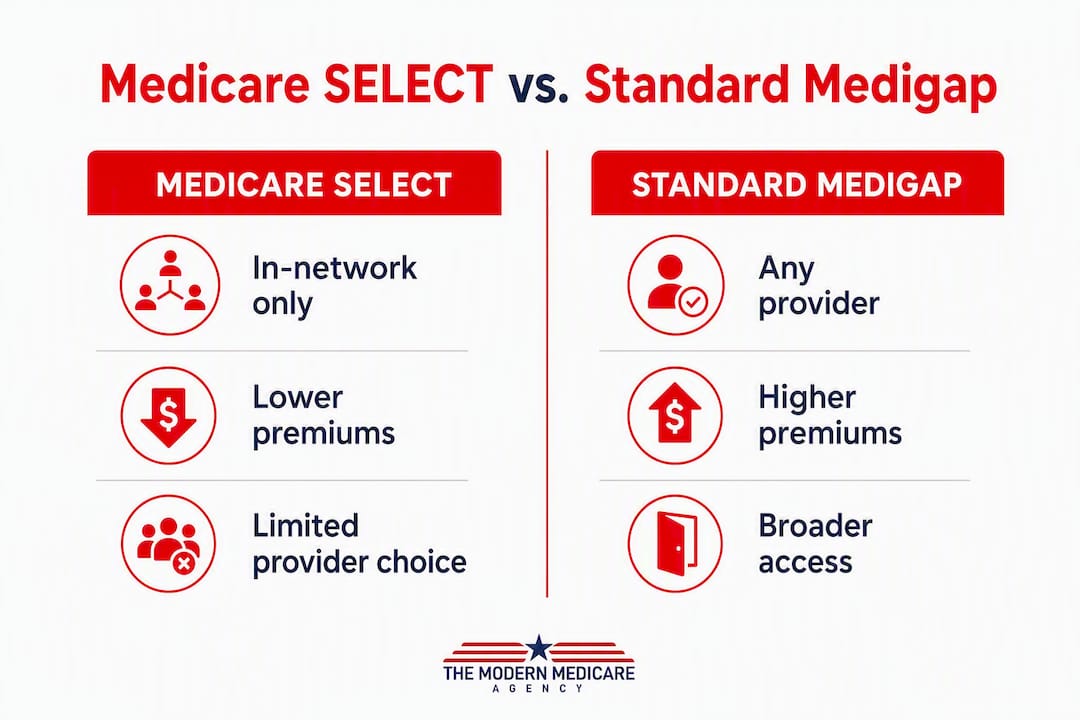
Medicare SELECT is a version of standardized Medigap (Medicare Supplement) insurance that requires you to use a specific network of hospitals and sometimes doctors for non-emergency services. It offers the same lettered-plan benefits as a standard Medigap policy when you stay in-network, but typically at a lower monthly premium. For most people, it’s the right call if you live near your preferred hospitals, rarely travel for care, and want to keep monthly costs down.
Here’s the core trade-off at a glance:
- Lower premiums in exchange for using a defined provider network for non-emergency care
- Same benefits as the corresponding lettered Medigap plan (Plan G SELECT = standard Plan G benefits, in-network)
- Emergency care is always covered regardless of network, under Original Medicare rules
- No coverage from the SELECT policy for non-emergency care at out-of-network facilities
Pro Tip: Most new SELECT enrollees have a 12-month trial window to switch to a standard Medigap plan without medical underwriting. If you try SELECT and find the network too limiting, that safety valve protects you.
Table of Contents
- How does Medicare SELECT work day to day?
- Does SELECT give you the same coverage as standard Medigap?
- Why are Medicare SELECT premiums lower, and what drives your total cost?
- Pros, cons, and who SELECT actually fits
- Where is Medicare SELECT available, and how do state rules affect it?
- Who can enroll in Medicare SELECT, and when?
- How do you decide between SELECT and standard Medigap?
- What an experienced Medicare agent looks for in a SELECT fit
- Key Takeaways
- Why education-first advice matters when evaluating SELECT
- Get a personalized Medicare SELECT comparison from Paulbinsurance
- Useful sources
How does Medicare SELECT work day to day?
The operational difference between SELECT and standard Medigap comes down to one word: network. For non-emergency hospital stays and, depending on the policy, specialist visits, you must use providers in the plan’s approved network to receive full benefits.

In-network care works exactly like standard Medigap. Original Medicare pays its share, and your SELECT policy covers the gaps it’s designed to cover under that letter plan.
Out-of-network, non-emergency care is a different story. Original Medicare still pays its share of approved charges, but the SELECT policy pays nothing. That means you’re on the hook for whatever Original Medicare doesn’t cover, which can be substantial for a hospital stay.
Emergency and urgent care are the exception. If you’re in a genuine medical emergency, Original Medicare covers you regardless of where you are or which hospital treats you. Your SELECT policy follows suit. Traveling out of state and needing emergency care? You’re covered. Scheduling elective knee surgery at an out-of-state hospital because you prefer that surgeon? That’s where SELECT leaves you exposed.
A few other operational rules worth knowing:
- Some SELECT policies require a referral from a primary care physician to see a specialist, which standard Medigap plans do not require
- Network size varies significantly by insurer and region; a SELECT plan in a major metro may have dozens of in-network hospitals, while a rural plan might have only a handful
- Provider directories can change, so a hospital that’s in-network today may not be next year
Pro Tip: Always ask the insurer for a current provider directory for your specific ZIP code before enrolling. A plan that lists 40 hospitals statewide may have only two within a reasonable drive of your home.
Does SELECT give you the same coverage as standard Medigap?
Yes, with one critical qualifier: the benefits are identical when you use in-network providers. Medicare SELECT plans follow the same standardized letter structure (A through N) as regular Medigap plans, so a SELECT Plan G covers exactly what a standard Plan G covers, including Part A coinsurance, Part B coinsurance, skilled nursing facility coinsurance, and the Part A deductible. The insurer cannot strip out benefits just because it’s a SELECT version.
What changes is where those benefits apply. Here’s how the two plan types compare across the dimensions that matter most:
| Dimension | Medicare SELECT | Standard Medigap |
|---|---|---|
| Provider access | In-network hospitals (and sometimes doctors) required for non-emergency care | Any provider that accepts Medicare, nationwide |
| Monthly premium | Generally lower | Generally higher |
| Benefit equivalence | Identical to the same letter plan, in-network | Identical to the same letter plan, anywhere |
| Emergency/out-of-area care | Covered under Original Medicare rules | Covered under Original Medicare rules |
| Out-of-network non-emergency | SELECT policy pays nothing; Original Medicare pays its share | Covered per plan benefits, no network limit |
One thing SELECT is not: it is not Medicare Advantage. Advantage plans replace Original Medicare entirely. SELECT supplements it. You cannot hold a SELECT plan and a Medicare Advantage plan simultaneously, the same rule that applies to all Medigap policies.
When you’re reading that table to make a decision, focus on the bottom two rows. The premium difference only matters if the network actually covers the providers you use. If it doesn’t, the savings evaporate fast.
Why are Medicare SELECT premiums lower, and what drives your total cost?
Premiums are lower because insurers limit where they must pay full benefits. By restricting coverage to a defined network, the insurer controls its risk exposure. Fewer covered claims means lower pricing passed on to you as a lower monthly premium.
But premium is only one piece of the cost picture. Your real annual cost includes the monthly Medigap premium, your Original Medicare Part B premium, and the potential out-of-pocket exposure if you receive non-emergency care outside the network. That last number is the one most people underestimate.
Other factors that affect what you pay:
- Plan letter: A SELECT Plan G will cost more than a SELECT Plan N because Plan G covers more
- Age-rating method: Community-rated, issue-age-rated, and attained-age-rated policies price differently over time
- Location: Premiums vary by state and even by county
- Insurer pricing practices: Two insurers can offer the same SELECT Plan G in the same ZIP code at very different prices
| Cost driver | What to ask your insurer or agent |
|---|---|
| Network size | How many in-network hospitals are near my home? |
| Out-of-network exposure | What would I owe for a 3-day hospital stay at an out-of-network facility? |
| Premium rating method | Is this community-rated, issue-age-rated, or attained-age-rated? |
| Annual premium increases | What has the average rate increase been over the past five years? |
| Part B premium | Am I accounting for the standard Part B premium on top of this? |
Pro Tip: Run a simple annual cost estimate: (monthly SELECT premium × 12) + (Part B premium × 12) + a realistic out-of-network risk buffer. Compare that total to the same calculation for a standard Medigap plan. The gap is often smaller than the monthly premium difference suggests.
Pros, cons, and who SELECT actually fits
SELECT isn’t for everyone. Here’s the honest breakdown.
Pros:
- Lower monthly premiums than a comparable standard Medigap plan
- Identical benefits to the same letter plan when you stay in-network
- Predictable costs for people who use a stable set of local hospitals
- The trial window lets you test it without permanent commitment
Cons:
- No SELECT policy benefits for non-emergency out-of-network care; you absorb what Original Medicare doesn’t pay
- Some policies require specialist referrals, adding an administrative step standard Medigap doesn’t have
- Network availability is limited in some states and rural areas
- Switching to a standard Medigap plan after the 12-month window may require medical underwriting
Who it fits best: People on fixed incomes who use a consistent set of local hospitals and rarely travel for medical care. If your cardiologist, primary care doctor, and preferred hospital are all in-network, SELECT can save you real money every month with no practical downside.
Who should think twice: Frequent travelers, snowbirds, anyone with multiple specialists across different health systems, and people who might relocate in the next few years.
Ask yourself these questions before enrolling:
- Do I travel more than a few weeks per year and might need non-emergency care away from home?
- Are all my current specialists and preferred hospitals in the plan’s network?
- Could I absorb a large unexpected bill if I needed out-of-network care?
- Am I likely to move in the next two to three years?
Pro Tip: If you’re unsure, enroll in SELECT and use the 12-month trial window deliberately. Track every provider interaction. If you hit a network friction point, switch to standard Medigap before the window closes.
Where is Medicare SELECT available, and how do state rules affect it?
Not every insurer offers SELECT, and not every state has robust SELECT options. Availability depends on whether an insurer has chosen to file a SELECT product in your state and whether it has built a provider network there. In some states, SELECT plans are common. In others, you may find only one or two insurers offering them, or none at all in your county.
State insurance departments oversee Medigap plan filings, including SELECT. They can tell you which companies are licensed to sell SELECT in your state and what consumer protections apply. The New York Department of Financial Services, for example, publishes specific guidance on SELECT rules for New York residents. Most state insurance departments maintain similar resources.
What to check before you assume a plan is available:
- Your state insurance department’s website for a list of licensed SELECT insurers
- The insurer’s provider directory filtered to your ZIP code or county
- Whether the network includes your current primary care physician and any specialists you see regularly
- Whether the network extends to any hospitals you might use while traveling within your state
If you move out of the SELECT plan’s coverage area, you typically qualify to switch to a standardized Medigap plan, and some moves trigger guaranteed-issue rights that protect you from underwriting. That’s a meaningful consumer protection, but it requires you to act promptly when the move happens.
Pro Tip: Don’t rely on the insurer’s marketing materials to confirm network coverage. Call the insurer directly, ask for the provider directory for your specific ZIP code, and verify that your current providers are listed before you sign anything.
Who can enroll in Medicare SELECT, and when?
The eligibility rules for SELECT mirror those for all Medigap policies. You must have Original Medicare Parts A and B, and you cannot hold a Medigap plan and a Medicare Advantage plan at the same time.
Enrollment steps:
- Confirm you have Original Medicare Parts A and B active
- Identify your Medigap Open Enrollment Period: it begins the month you turn 65 and are enrolled in Part B, and lasts six months
- During that window, you have guaranteed-issue rights, meaning no insurer can deny you or charge more based on health history
- Outside that window, most states allow medical underwriting, which can result in higher premiums or denial
- Enroll in a SELECT plan through a licensed insurer in your state
- Within the first 12 months, you retain the right to switch to a standard Medigap plan without underwriting
Key documents and questions to have ready:
- Your Medicare card (showing Parts A and B effective dates)
- A list of your current providers and hospitals
- The insurer’s provider directory for your ZIP code
- Written confirmation of the referral rules, if any, for specialist visits
- The insurer’s rate increase history for the past three to five years
People under 65 on Medicare due to disability face a different landscape. Federal law does not require insurers to sell Medigap to people under 65, though some states do mandate it. Check your state’s Medigap eligibility rules before assuming you can enroll.
For a broader look at enrollment timing and how to avoid late penalties, the Medicare enrollment guidance at Paulbinsurance walks through the full timeline step by step.
How do you decide between SELECT and standard Medigap?
The decision comes down to three variables: your provider relationships, your travel patterns, and your budget tolerance for unexpected bills. Here’s a practical framework.
Decision checklist:
- Map your current providers. Are your primary care doctor, all active specialists, and your preferred hospital in the SELECT plan’s network?
- Estimate your travel exposure. Do you spend significant time in another state or region where you might need non-emergency care?
- Calculate total annual cost for both options (see the cost section above). Is the premium difference meaningful enough to justify the network constraint?
- Assess your ability to absorb a surprise bill. If an out-of-network non-emergency hospital stay would create financial hardship, standard Medigap is the safer choice.
Questions to ask the insurer or your agent:
- Which specific hospitals and physician groups are in-network for my ZIP code?
- Does this plan require referrals to see specialists, and is that requirement in writing?
- Can you show me an example of what I would owe for a three-day in-network hospital stay versus an out-of-network one?
- What is the plan’s rate increase history over the past five years?
- If I switch to a standard Medigap plan within 12 months, which plans am I guaranteed access to?
Red flags to watch for:
- A provider directory that’s hard to access or hasn’t been updated recently
- Vague or inconsistent answers about referral requirements across different sales channels
- A network with fewer than three or four in-network hospitals in your immediate area
- Aggressive underwriting language in the application that suggests the insurer expects to deny applicants
Pro Tip: Ask the insurer for a sample explanation of benefits showing a denied out-of-network non-emergency claim. Seeing the actual dollar exposure in writing is more persuasive than any premium comparison spreadsheet.
For a side-by-side look at how Medigap plan letters compare on benefits and costs, that resource walks through each plan option in detail.
What an experienced Medicare agent looks for in a SELECT fit
Medicare SELECT tends to work best for fixed-income retirees who reliably use a small set of local hospitals and providers. That’s not a generalization; it’s a pattern that shows up consistently when you look at who actually benefits from the premium savings without hitting network friction.
The clients who run into trouble with SELECT are almost always in one of these situations:
- They travel frequently and need non-emergency care while away from home
- They have multiple specialists who practice at different hospital systems, some of which are out-of-network
- They have a chronic condition that requires care at a specialized center not in the SELECT network
- They moved after enrolling and didn’t act quickly enough to trigger their guaranteed-issue rights
A network fit check, done properly, takes about 15 minutes. You pull the insurer’s provider directory, cross-reference it against the client’s current provider list, and then run one or two sample claim scenarios: an elective hospital stay in-network, and the same stay out-of-network. The dollar difference between those two scenarios tells you more than any premium comparison.
Pro Tip: The trial window exists because network fit is hard to predict from a directory alone. If a client is genuinely uncertain, enrolling in SELECT and tracking real-world network friction is a legitimate strategy, as long as they know the window closes.
For clients still deciding between SELECT, standard Medigap, and Medicare Advantage, the Advantage vs. supplement comparison at Paulbinsurance lays out the structural differences clearly.
Key Takeaways
Medicare SELECT offers the same lettered Medigap benefits as a standard plan but restricts full coverage to in-network providers for non-emergency care, making it a strong fit for cost-conscious beneficiaries with stable, local provider relationships.
| Point | Details |
|---|---|
| Same benefits, network rules | A SELECT Plan G covers the same benefits as standard Plan G, but only when you use in-network providers. |
| Lower premiums, real exposure risk | Premiums are lower because the insurer limits where it pays; out-of-network non-emergency care leaves you covering what Original Medicare doesn’t pay. |
| 12-month trial window | New enrollees can switch to a standard Medigap plan within 12 months without medical underwriting. |
| State and insurer availability varies | Not all states or insurers offer SELECT; always verify network coverage for your specific ZIP code before enrolling. |
| Paulbinsurance | Paulbinsurance runs provider-network checks and total-cost comparisons to help you decide whether SELECT or standard Medigap fits your situation. |
Why education-first advice matters when evaluating SELECT
Most people who call asking about Medicare SELECT have already seen the lower premium and want to know if there’s a catch. There is, but it’s not the same catch for everyone. That’s the part generic guides miss.
The conventional wisdom is that SELECT is “good for healthy people who don’t use much care.” That framing is backwards. The people who benefit most from SELECT aren’t the ones who use little care; they’re the ones who use care predictably, at a consistent set of local providers. A person with a serious chronic condition who sees the same cardiologist at the same in-network hospital every three months is often a better SELECT candidate than a healthy 66-year-old who travels six months a year.
The 12-month trial window is genuinely underused. Most agents mention it once and move on. It deserves more emphasis because it changes the decision calculus entirely. You don’t have to be certain SELECT is right for you before enrolling. You have to be willing to pay attention for 12 months and act if the network creates real friction.
One more thing worth saying plainly: the provider directory is a living document. A hospital that’s in-network when you enroll can leave the network mid-year. Ask the insurer what happens to your coverage if a key provider leaves the network, and get the answer in writing.
Get a personalized Medicare SELECT comparison from Paulbinsurance
Sorting through SELECT networks, plan letters, and premium differences on your own takes time, and a wrong call can cost you far more than the premium savings you were chasing.

Paulbinsurance is an independent Medicare agency that has been helping beneficiaries compare Medigap options since 2007. The team runs provider-network checks against your actual provider list, calculates total annual costs for SELECT versus standard Medigap side by side, and walks you through enrollment timelines so you don’t miss a guaranteed-issue window. There’s no pressure to pick a specific plan; the goal is to make sure you understand exactly what you’re buying before you sign.
Ready to see whether SELECT saves you money without exposing you to network risk? Get your free Medigap cost comparison and find out which plan structure fits your providers, your budget, and your life.
This article provides general information about Medicare SELECT and Medigap plans. It is not professional insurance or legal advice. Rules, availability, and costs vary by state and insurer. Confirm current details with your state insurance department or a licensed Medicare agent before enrolling.
Useful sources
These are the authoritative resources used to verify the facts in this article. Each one is worth bookmarking if you’re actively comparing Medicare options.
- Medicare.gov: What’s Medicare Supplement Insurance (Medigap)? — The official CMS resource for Medigap basics, plan letters, and enrollment rules
- CMS: Medigap (Medicare Supplement Health Insurance) — Federal oversight page for Medigap policy standards and consumer protections
- Medicare.gov: Compare Medigap Plan Benefits — Side-by-side benefit chart for all current Medigap letter plans
- Medicare.gov: Get Medigap Costs — Guidance on how Medigap premiums are set and what affects pricing
- New York DFS: What is Medicare SELECT? — State-level example of how a department of financial services explains SELECT rules and out-of-network consequences
- Medical News Today: Medicare SELECT definition, costs, and more — Covers plan standardization, moving out of coverage area, and guaranteed-issue rights
- Healthline: Medicare SELECT coverage, cost, eligibility, and enrollment — Explains premium drivers, referral requirements, and total cost calculation
To check SELECT availability in your state, visit your state insurance department’s website and search for licensed Medigap insurers. Ask specifically for a provider directory filtered to your county or ZIP code before comparing any plan.