




Last week, a client named Robert discovered that his chronic heart condition qualified him for a plan that actually coordinates his specialists for him. He had spent years feeling like he was managing his health alone, but that changed once he understood his options. We know how exhausting it feels to juggle endless appointments while worrying if your Medicaid benefits might suddenly disappear. This confusion is exactly why we’ve put together this guide to have medicare special needs plans (SNP) explained simply for 2026.
With nearly 8.2 million people now choosing these plans, you aren’t alone in seeking specialized support. Enrollment in Chronic Condition plans surged by 45% this year because families need more than just basic coverage. We promise to show you how these plans work, who qualifies, and how to find tailored care without the typical stress. While the end of the Value-Based Insurance Design (VBID) program has changed how some benefits like food credits are handled in 2026, we’ll help you understand those shifts. We will walk through the three main types of plans and provide a clear path to the security you deserve.
Key Takeaways
- Learn why SNPs are more than just standard coverage and how they act as a “custom-fit” solution for your specific health or financial journey.
- We have medicare special needs plans (SNP) explained so you can quickly see if you qualify for specialized D-SNP or C-SNP benefits in 2026.
- Discover the two simple steps required to verify your eligibility and secure a plan that focuses resources exactly where you need them most.
- Understand how an independent broker compares over 40 different carriers to protect your interests rather than just selling one brand.
What is a Medicare Special Needs Plan (SNP)?
We often see people feeling overwhelmed by the sheer number of choices in the Medicare system. If you’re managing a complex health condition or balancing a tight budget, a standard plan might not feel like enough. To have medicare special needs plans (SNP) explained properly, you have to look at them as “custom-fit” solutions. These are a specialized category of Part C plans that go beyond basic coverage to address specific life situations. By having medicare special needs plans (SNP) explained through the lens of your own health, the complexity starts to fade away.
Every one of these plans is required to include Medicare Part D prescription drug coverage. This ensures that your medical care and your medications are managed under one roof. When we look at What is a Special Needs Plan?, we see a framework designed to wrap around your unique life situation rather than forcing you to fit into a one-size-fits-all box. We believe you deserve a plan that understands your history and your future goals.
Coordinated Care: The Heart of an SNP
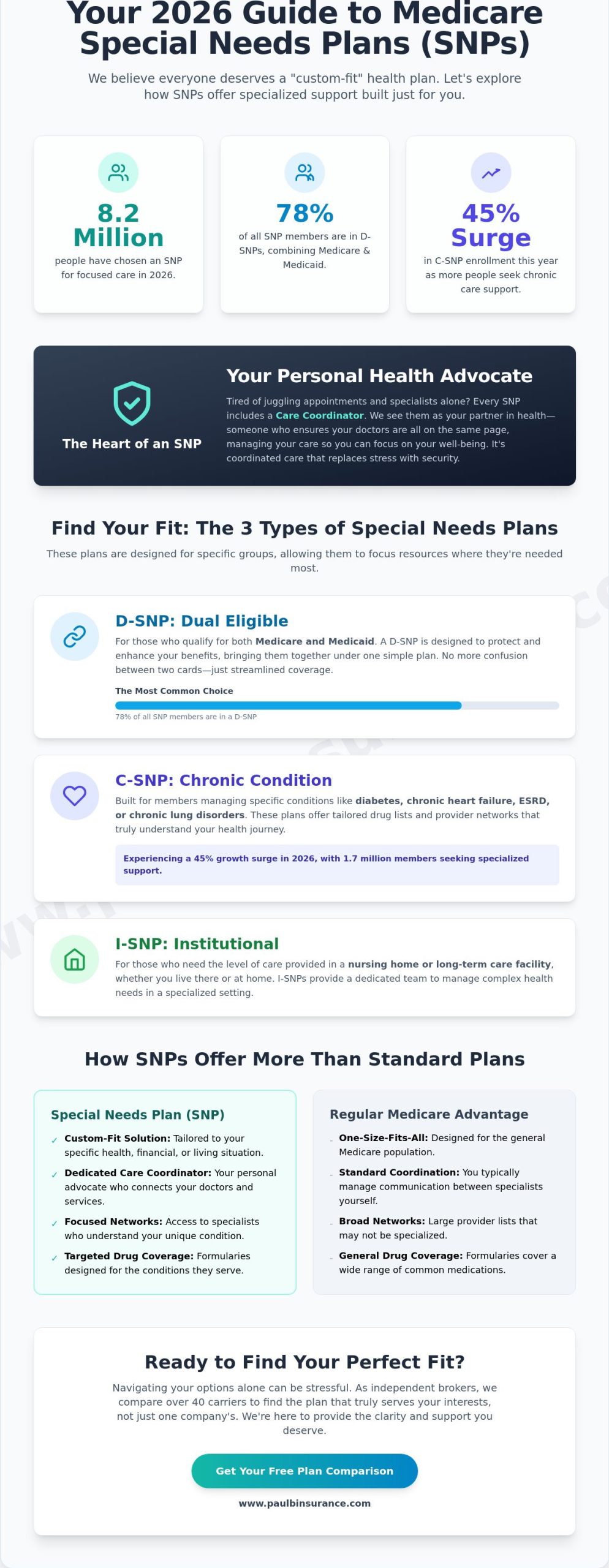
Managing doctors, test results, and pharmacy refills can feel like a full-time job. In an SNP, the care coordinator is the heart of the experience. We view this person as your personal health advocate. They make sure your cardiologist knows what your primary doctor is doing, and they ensure your prescriptions don’t conflict with each other. It’s like having a unified team that actually talks to each other. This single change can lift a massive weight off your shoulders. It replaces the stress of managing specialists alone with a clear, guided path to wellness. You don’t have to be the messenger between three different doctors anymore.
Who Are These Plans Designed For?
These plans aren’t open to everyone, which is actually a major benefit. Because enrollment is restricted, the plan can focus all its resources on specific needs. We generally see three main groups who qualify in 2026:
- Chronic Condition SNPs (C-SNP): For those living with conditions like diabetes, chronic heart failure, or certain lung diseases.
- Dual Eligible SNPs (D-SNP): For individuals who qualify for both Medicare and Medicaid.
- Institutional SNPs (I-SNPs): For those who require a nursing home level of care, whether they live in a facility or at home.
Since Medicare Advantage Plans serve as the foundation for these options, you still get all your original Medicare rights and protections. The difference is the extra layer of support tailored to your life. We are here to help you identify which of these groups you might belong to and what that means for your daily care. Our goal is to make sure you feel protected and empowered by your choice.
Understanding the Three Main Types of SNPs
We believe that understanding your specific category is the first step toward finding peace of mind. To have medicare special needs plans (SNP) explained correctly, we need to look at the three distinct groups these plans serve. In 2026, nearly 8.2 million people have chosen these plans because they offer a level of focus that standard plans simply can’t match. Each type is designed to solve a different set of challenges, whether those are financial, medical, or related to your living situation.
D-SNPs: Bridging Medicare and Medicaid
Dual Eligible Special Needs Plans (D-SNPs) are the most common choice, making up 78% of all SNP enrollees in 2026. Many people we talk to are afraid that joining a new plan might cause them to lose their existing Medicaid benefits. We want to reassure you that a D-SNP is actually designed to protect and enhance those benefits. It brings Medicare and Medicaid together so they work as one unit. This removes the stress of carrying two different cards and wondering which one covers which bill. We can help you check your dual-eligibility status for 2026 to see if this path is right for you.
C-SNPs: Tailored Support for Chronic Illness
Chronic Condition SNPs (C-SNPs) are seeing a massive surge this year. Enrollment jumped by 45% between 2025 and 2026, reaching 1.7 million people. These plans are built for those managing specific diagnoses like diabetes, chronic heart failure, end-stage renal disease (ESRD), HIV/AIDS, or chronic lung disorders. The formulary, or drug list, is curated specifically for the medications usually required for these conditions. If you want to dive deeper into how medications are covered, you can read our Medicare Part D guide. By focusing on a specific illness, the plan can offer specialized provider networks that understand your daily health battles.
I-SNPs: Specialized Care for Institutional Needs
Institutional SNPs (I-SNPs) serve a smaller but vital group of individuals who need a nursing home level of care. We also help families look at “Institutional-Equivalent” (IE-SNP) options. These allow you to receive that same high level of care right in your own home. It often brings the doctors and nurses to you, which reduces the stress and exhaustion of frequent hospital visits. For family members, this provides an incredible sense of security. In 2026, rural I-SNP enrollment grew by 13% as more people realized they could get this specialized care without moving to a major city.
Each of these plans requires you to meet specific criteria to stay enrolled. If your health or financial status changes, we can help you pivot to a different option so your coverage never skips a beat. If you’re feeling unsure about which category fits your life, we are here to help you compare your options today.
How SNPs Differ from Regular Medicare Advantage Plans
We often hear from people who aren’t sure if they should just pick a standard Medicare Advantage plan or look into something more specific. It’s a common point of confusion. While every SNP is technically a Medicare Advantage plan, the opposite isn’t true. To have medicare special needs plans (SNP) explained clearly, you have to think about the difference between a general tool and one built for a single, vital purpose. A standard plan is designed for the general population, while an SNP is built entirely around you.
The biggest difference is “Restricted Enrollment.” Most plans try to attract as many people as possible. SNPs do the opposite. They only accept members who meet very specific health or financial criteria. While that might sound limiting, it’s actually a massive advantage. Because these plans only serve a specific group, they can pour all their resources into solving the problems that matter to you. This includes access to “Tailored Provider Networks.” Instead of a broad list of general doctors, you get access to specialists who spend their entire careers treating your specific condition. We spend a lot of our time helping people compare these specialized options against Medicare Supplement Insurance. Our goal is to help you see which path provides the most security for your unique situation.
The Benefits of a Specialized Formulary
When you have medicare special needs plans (SNP) explained, the medication list is often the biggest surprise. Standard plans have to cover a bit of everything. An SNP, however, builds its “formulary” or drug list to prioritize the specific medications needed for your chronic condition. This focus often leads to lower out-of-pocket costs for the life-saving drugs you use every day. It’s important to remember that these drug lists can change every year. We always recommend a thorough 2026 review to ensure your specific prescriptions are still covered at the best possible price.
Extra Services You Might Not Find Elsewhere
Beyond medical care, these plans often include support for your daily life. In 2026, we see a heavy focus on benefits that address the “social determinants of health.” This might include transportation to your specialist appointments or specialized wellness programs designed for your mobility level. Many of these plans also include dental insurance as a bundled benefit. These aren’t just “perks.” They are essential tools that help you stay independent and healthy. We believe these extra layers of support are what turn a standard insurance policy into a true care system.
Eligibility and Enrolling in an SNP for 2026
We’ve spent time looking at what these plans are and how they differ from standard options. Now, we need to focus on the “how.” Getting started doesn’t have to be a source of anxiety. To have medicare special needs plans (SNP) explained for 2026, you simply need to follow a methodical path. We’ve broken this down into five manageable steps to take the guesswork out of your enrollment journey.
- Step 1: Confirm your Medicare status. You must be enrolled in both Medicare Part A and Part B for 2026 to be eligible for any Special Needs Plan.
- Step 2: Verify your “Special Need.” This means having your Medicaid status or your specific medical diagnosis ready. We can help you confirm if your condition matches the 2026 C-SNP requirements.
- Step 3: Check your local area. These plans are tied to your ZIP code. A plan available in a neighboring county might not be available in yours.
- Step 4: Review your doctors. We want to make sure your specialists and preferred hospitals are in the plan’s network. This protects the relationships you’ve already built with your care team.
- Step 5: Compare the market. We recommend working with an independent broker who can look at all 40+ available carriers. This is the only way to ensure you aren’t missing a better option just because one agent only represents one brand.
If you’re ready to see which plans are available in your ZIP code right now, we can provide a personalized comparison to help you find the right fit.
Special Enrollment Periods: A Gift of Flexibility
One of the most reassuring parts of having medicare special needs plans (SNP) explained is learning about Special Enrollment Periods (SEPs). Most people only get one chance a year to change their coverage. However, many people who qualify for an SNP have more flexibility. In 2026, if you have Medicaid or receive “Extra Help,” you generally have the right to switch plans once per quarter during the first nine months of the year. This provides a safety net if your health needs change unexpectedly. We can help you determine exactly which enrollment windows are open to you right now.
What Happens if You Lose Your Eligibility?
We know it’s stressful to think about losing your coverage if your financial or health status changes. If you no longer meet the “Special Need” criteria, you don’t lose your insurance overnight. Most plans offer a “grace period” that typically lasts between one and six months. During this time, we work closely with you to find a new path. Whether you need to transition to a standard Advantage plan or explore a different option, we ensure there is no gap in your care. For more details on the general rules of who qualifies, you can visit our Medicare Eligibility Guide. Our mission is to keep you protected, no matter how your circumstances shift.
Why Navigating SNPs With an Independent Broker Makes Sense
We understand that after having medicare special needs plans (SNP) explained, you might feel like you have a mountain of homework to do. The truth is, you don’t have to do it alone. Most people start their journey by calling a specific insurance company. While those agents are often helpful, they are restricted by their position. They can only sell you the plans their specific company offers. We believe you deserve a much broader view of the market. As independent brokers, we don’t work for the insurance companies; we work for you. This allows us to compare over 40 different carriers to find the one that fits your unique health profile and budget for 2026.
Our commitment doesn’t end when your enrollment form is submitted. We provide year-round support to ensure your coverage continues to meet your needs as your health evolves. If your doctor leaves a network or your medication costs change mid-year, we are here to help you find a solution. We want to move you from a state of confusion to one of absolute certainty. By choosing an autonomous professional, you gain a dedicated advocate whose only mission is to protect your interests and your health.
Our Unbiased Approach to Your Health
Our services come at no cost to you. We are compensated by the insurance carriers, which allows us to offer completely impartial support. This removes the stress of wondering if you’re being steered toward a specific plan for the wrong reasons. You get the peace of mind that comes from knowing every single option in your ZIP code was explored before you made a choice. Paul Barrett has built this practice on the mission of providing trusted Medicare advice that puts the client first. We treat your healthcare journey with the same care and attention we would give our own family members.
Taking the First Step Together
We offer a low-pressure path to review your current coverage and see if an SNP might serve you better in 2026. There’s no obligation and no high-pressure sales tactics. If you decide that a new plan is the right move, we handle all the paperwork for you. We take care of the heavy lifting and the administrative hurdles so you can focus on what matters most: your well-being. We want to replace your anxiety with a clear, structured path to the care you deserve. We are here to make sure you never have to navigate these complex waters alone.
Secure Your Specialized Care for 2026
We hope having medicare special needs plans (SNP) explained has helped you feel more confident about the year ahead. You now know that whether you qualify based on your income, a chronic condition, or your living situation, there’s a plan built specifically for your needs. These options offer more than just insurance; they provide a coordinated team dedicated to your health. It’s about getting the right care at the right time.
Choosing the right path doesn’t have to be a lonely or stressful process. Our team, led by Paul Barrett, provides expert guidance by comparing options from over 40 different carriers. We offer year-round support across 34+ states to ensure you always have someone in your corner. We’ve helped many people move from uncertainty to peace of mind, and we’d be honored to do the same for you.
Let us help you find the peace of mind you deserve, contact us for a free Medicare SNP review today.
You’ve worked hard to manage your health, and you deserve a plan that works just as hard for you. We’re ready to help you take that next step toward a more secure and certain future.
Frequently Asked Questions
Can I join a Special Needs Plan if I don’t have Medicaid?
Yes, you can absolutely join an SNP without Medicaid if you meet other specific criteria. While Dual Eligible plans require Medicaid, Chronic Condition plans (C-SNPs) are for people with certain illnesses like diabetes or heart failure. Institutional plans (I-SNPs) are for those needing a nursing home level of care. We can help you look at your health profile to see which category fits your life best.
Do I have to use specific doctors with an SNP?
Yes, most SNPs use a network of specialists who are experts in treating your specific condition. Because these plans focus on “Care Coordination,” your doctors work together to manage your health. In most cases, you’ll need to see providers within the plan’s network to ensure your care is covered. We always recommend checking if your current specialists are included before you make a final decision for 2026.
What is a Dual Special Needs Plan (D-SNP) and how is it different from regular Medicare?
A D-SNP is a specialized plan for people who are “dual eligible,” meaning they have both Medicare and Medicaid. Unlike regular Medicare, which only covers your medical costs, a D-SNP coordinates your Medicaid benefits too. This simplifies your life by putting all your coverage in one place. It’s a key part of having medicare special needs plans (SNP) explained because it protects your Medicaid while adding extra support.
Are Medicare SNPs more expensive than standard Advantage plans?
Actually, many SNPs offer a $0 monthly premium, especially for those with low incomes. In 2026, most Institutional plans offer premiums at or below the low-income premium subsidy amount, allowing you to enroll without a member premium. While costs vary by plan and location, these plans are designed to be affordable. We can help you compare the out-of-pocket costs of an SNP against a standard plan to find the most secure option.
What happens to my SNP coverage if I move to a different state in 2026?
If you move to a different state, you will likely need to choose a new plan because SNPs are tied to specific service areas. Moving is considered a “qualifying life event,” which triggers a Special Enrollment Period. This gives you the chance to find a new plan in your new ZIP code without a gap in your coverage. We can help you research the available options in your new home so your care stays consistent.
Can I have a Medigap plan and an SNP at the same time?
No, it’s not possible to have a Medigap plan and an SNP at the same time. Since an SNP is a type of Medicare Advantage plan, it replaces your original Medicare structure. Medigap plans only work with original Medicare. If you’re currently in a Medigap plan and want to switch to an SNP, we can help you understand how that change affects your costs and your access to doctors.
Does every SNP cover prescription drugs?
Yes, every Special Needs Plan is required by law to include Medicare Part D prescription drug coverage. This is a major benefit because it ensures your medications are coordinated with your medical treatments. The drug list, or formulary, is usually tailored to the specific conditions the plan serves. This focus helps keep your out-of-pocket costs for essential medications as low as possible throughout 2026.
How do I know if my chronic condition qualifies for a C-SNP?
You qualify if you have one of the severe or disabling chronic conditions defined by Medicare, such as diabetes, chronic heart failure, or certain lung diseases. In 2026, enrollment in these plans surged by 45% because people want this specialized focus. To join, your doctor will need to verify your diagnosis. We can provide you with the full list of qualifying conditions as part of having medicare special needs plans (SNP) explained for your specific health journey.

Article by
Paul Barrett
Paul Barrett, CMIP is the founder of The Modern Medicare Agency, an independent Medicare-only brokerage based in Melville, NY. With 18 years of Medicare-exclusive experience, a CMIP designation, and more than 5,000 clients served across 37 states, Paul is one of the most credentialed independent Medicare specialists on Long Island — and one of the most direct.
He represents 40+ carriers with no quotas and no allegiances, which means his recommendations are based entirely on what fits each client's specific situation. He is the author of Medicare Mastery Unlocked and host of the Wise Guys Retirement Talk podcast. His content is grounded in primary sources, real carrier intelligence, and 18 years of watching what happens when people get Medicare right — and when they don't.
📞 631-358-5793 | paulbinsurance.com