
What if that $315,000 estimate you’ve seen for retirement healthcare isn’t a bill you have to pay all at once, but a manageable monthly budget you can actually control? We understand the anxiety that comes with seeing the 2026 Medicare Part B premium rise to $202.90 per month. It’s natural to worry that a single medical emergency could wipe out years of hard work. By using a clear retirement healthcare cost estimator approach, we help you move from confusion to confidence. You deserve to feel secure, even when the “crazy maze” of insurance feels overwhelming.
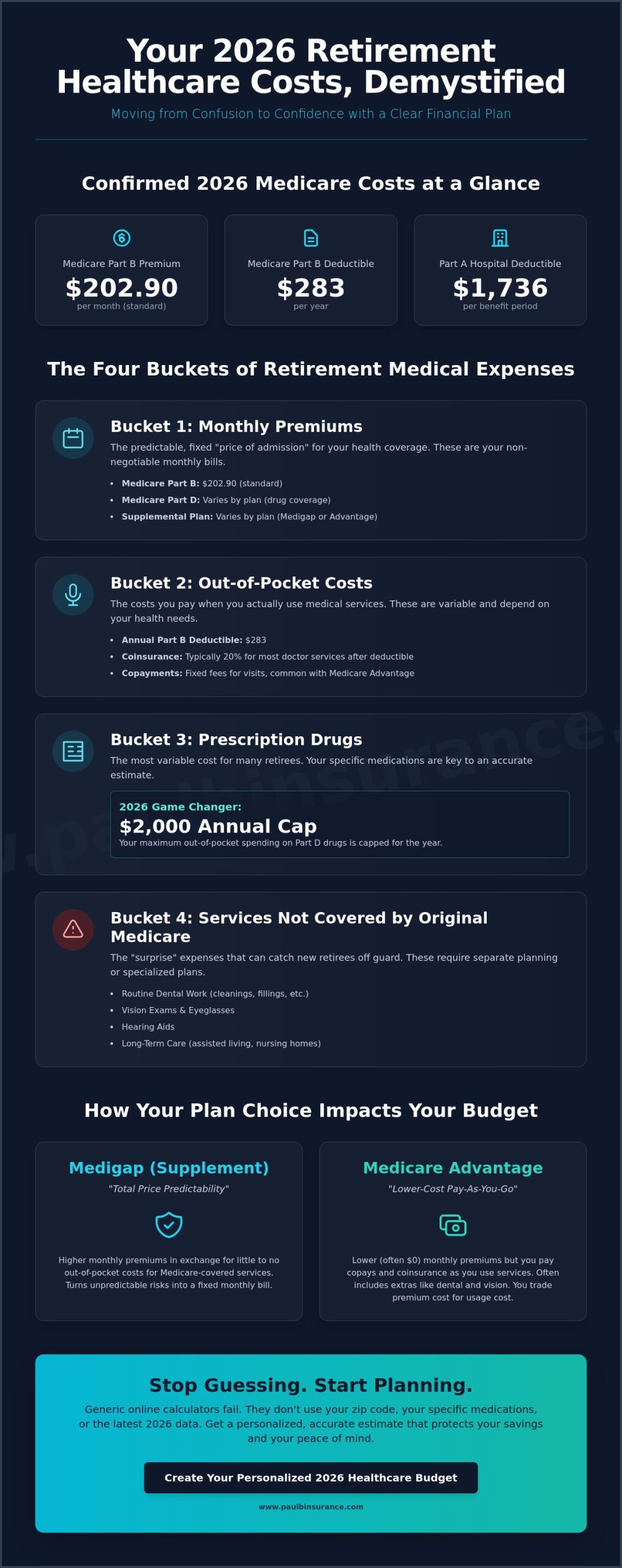
We’ll show you exactly how to turn unpredictable risks into predictable premiums. This guide breaks down the confirmed 2026 costs, from the $283 Part B deductible to the $1,736 hospital deductible, so you know exactly what to expect. We’ll walk through the “four big buckets” of expenses and help you choose a plan that limits your risk. Our goal is to provide the clarity you need to protect your savings and your peace of mind. You’ll finish this article with a concrete plan to handle 2026 inflation and medical costs without the stress.
Key Takeaways
- Learn how a retirement healthcare cost estimator helps you forecast the true price of 2026 premiums and protects you from the myth that Medicare is entirely free.
- Identify the “four big buckets” of medical spending so you can plan for both your monthly insurance bills and the out-of-pocket costs at the doctor’s office.
- Compare how different plan structures, like Medigap and Medicare Advantage, can either provide total price predictability or a lower-cost “pay-as-you-go” experience.
- Discover why generic online calculators often fail to account for your specific zip code and how local factors impact your 2026 healthcare budget.
- Find out why a personalized review of your current medications is the only way to get an accurate estimate for your Part D prescription drug costs.
What is a Retirement Healthcare Cost Estimator and Why Do You Need One?
Think of a retirement healthcare cost estimator as more than just a calculator. It’s a specialized tool designed to pull back the curtain on your future medical bills. It forecasts your monthly premiums, annual deductibles, and the potential out-of-pocket risks that could otherwise catch you off guard. Many people enter retirement believing the dangerous myth that “Medicare is free.” In 2026, we know that isn’t the case. With the standard Part B premium now at $202.90, failing to plan for these costs can lead to a significant budget shortfall.
Seeing headlines about couples needing $315,000 to $400,000 for medical care can feel paralyzing. We don’t want you to look at that number and feel defeated. Instead, we use our “Confusion to Confidence” framework to break that massive figure into manageable monthly pieces. Understanding the U.S. healthcare system is difficult, but we’re here to simplify the jargon so you can see exactly how these numbers apply to your life. You shouldn’t have to guess about your financial security.
Fixed Costs vs. Unpredictable Risks
Your budget consists of two main parts. First, there are fixed costs. These are the bills you know are coming every month, like your Part B premium or your Medicare Supplement payment. Then, there are unpredictable risks. These include the $1,736 Part A hospital deductible or the 20% coinsurance you might owe after a major surgery. A retirement healthcare cost estimator bridges the gap between these two, helping you choose a plan that turns those scary “what-ifs” into a predictable monthly expense.
Why 2026 is a Unique Year for Your Estimates
Planning for 2026 requires looking at a very different landscape than even two years ago. We’ve reached the full implementation of the $2,000 out-of-pocket cap for Medicare Part D prescription drugs. While this is great news for your wallet, it has changed how plans are priced across the board. Additionally, healthcare inflation is currently projected at 5.8%, which is more than double the 2.4% Social Security COLA for 2026. This means older calculators from 2023 or 2024 are now dangerously outdated. They don’t account for the new $283 Part B deductible or the latest IRMAA thresholds, which could leave you with a much higher bill than you expected.
The Four Big Buckets That Drive Your Retirement Medical Expenses
Most people feel overwhelmed when they see a report like the Fidelity Retiree Health Care Cost Estimate, which suggests a healthy couple might need $315,000 or more. That number is huge and scary. However, it’s much easier to manage when we break it down into four specific “buckets.” Using a retirement healthcare cost estimator isn’t about predicting a single massive bill. It’s about understanding your monthly cash flow so you can enjoy your retirement without checking your bank balance every time you visit the doctor.
We organize your expenses into these four categories to bring clarity to the process:
- Bucket 1: Monthly Premiums. This is the “price of admission” for your coverage. It includes what you pay for Medicare Part B, your Part D drug plan, and any supplemental coverage like a Medigap plan.
- Bucket 2: Out-of-Pocket Costs. These are the expenses you pay when you actually use healthcare services. It includes the $283 annual Part B deductible and any copays or coinsurance for specialist visits or tests.
- Bucket 3: Prescription Drugs. Even with the new $2,000 out-of-pocket cap in 2026, drug costs remain the most variable factor for our clients. Your specific medications determine whether this bucket is a small drip or a steady stream.
- Bucket 4: Services Not Covered. This includes things like routine dental work, vision exams, and long-term care. These are often the biggest “surprises” for new retirees.
Understanding the Part B Premium and IRMAA
For 2026, the standard Part B premium is $202.90 per month. Most people have this amount deducted directly from their Social Security check. However, your retirement healthcare cost estimator might look different if you’re a higher earner. This is where the Income-Related Monthly Adjustment Amount, or IRMAA, comes into play. If your modified adjusted gross income from two years ago was over $109,000 as an individual or $218,000 as a couple, you’ll pay a surcharge. It’s vital to remember that Social Security looks at your 2024 tax returns to determine your 2026 rates.
The “Hidden” Costs: Dental and Vision
It’s a common shock to discover that Original Medicare doesn’t cover routine teeth cleanings, fillings, or new glasses. These costs can add up quickly if you aren’t prepared. We often recommend adding a $50 to $100 monthly buffer to your estimates to cover these “extras.” You might also consider a dedicated dental insurance plan to keep these costs predictable. If you’re feeling unsure about how these pieces fit together, you can always schedule a quick chat with us to review your specific needs.
Why Static Calculators Often Get Your Retirement Costs Wrong
Most generic tools you find online provide a single, scary number that doesn’t tell your whole story. While a basic retirement healthcare cost estimator can give you a starting point, it often relies on national averages that ignore your specific reality. We’ve seen many retirees feel unnecessary stress because a calculator told them they need nearly $1 million to save for healthcare in retirement. These tools frequently miss the mark because they don’t account for the massive changes we’ve seen in 2026, such as the full implementation of the $2,000 out-of-pocket cap for prescription drugs. This new cap actually makes some estimates lower than they were just two years ago, yet many old calculators haven’t been updated to reflect this benefit.
Static tools also fail to mention the “Plan Choice” factor. They often assume you’ll stay on Original Medicare forever, paying 20% of every medical bill without a safety net. We help you look past these generic averages to find your actual number. Whether you choose a plan with a higher premium and lower risk or a $0 premium plan with more “pay-as-you-go” costs, your personal budget will look very different from the person living next door.
The Impact of Your Physical Location
Your physical address is one of the most important factors in your 2026 budget. Medicare Advantage networks are strictly local, not national, and prices for supplemental coverage vary wildly by state. We serve clients in more than 34 states and see these cost differences firsthand every day. A retiree’s budget in New York looks vastly different from one in California or Florida because of local provider competition and state regulations. If your retirement healthcare cost estimator doesn’t ask for your zip code, it isn’t giving you an accurate picture of your future.
Accounting for Future Health Changes
A static calculator usually assumes your health stays exactly the same for twenty years. It doesn’t account for the “Health Status Trap,” where a “Good” rating today might change tomorrow. This is why understanding your “guaranteed issue” rights is so vital for your long-term estimate. Choosing a Medicare Supplement insurance plan can create true cost certainty. With Medigap, your monthly premium is predictable, and you won’t face massive “surprise” bills if your health needs increase. We focus on protecting you from these unpredictable shifts so you can maintain your lifestyle regardless of what the future holds.
How Your Plan Choice Can Lower Your Estimated Out-of-Pocket Costs
Your choice of insurance plan is the single biggest lever you can pull to change your retirement healthcare cost estimator results. While the government sets the standard 2026 Part B premium at $202.90, the plan you choose to wrap around that coverage determines how much you pay when you actually get sick. It’s the difference between having a fixed, “all-you-can-eat” medical budget or a “pay-as-you-go” system. We want to help you understand the financial “feel” of these two paths so you can choose the one that fits your comfort level.
Many of our clients feel stuck between two very different financial strategies. One path prioritizes knowing your exact costs every month, while the other focuses on keeping your monthly bills as low as possible while you’re healthy. Neither is “wrong,” but choosing the one that doesn’t match your budget style is a leading cause of retirement stress. We use our expertise to show you how the math works out for each scenario in 2026.
Medigap: The Predictable Path
A Medigap overview shows that plans like Plan G or Plan N are designed for total predictability. With Medigap, you pay a higher monthly premium to an insurance company, but in return, they pick up almost all the “surprise” bills that Original Medicare leaves behind. For example, once you meet your $283 Part B deductible for the year, your Medigap plan covers the 20% coinsurance that would otherwise be your responsibility. This is the best choice for those who want to know their exact retirement healthcare cost every single month without worrying about a hospital stay wiping out their savings.
Medicare Advantage: The Pay-As-You-Go Path
If you prefer to keep your monthly fixed costs low, our Medicare Advantage Guide explains a different approach. These plans often have $0 or very low monthly premiums, and they frequently include “extras” like dental, vision, and hearing coverage. The trade-off is that you pay copays as you go for services like doctor visits or lab tests. However, every Advantage plan has a “secret” safety net called an Out-of-Pocket Maximum. This is a legal limit on how much you can spend on covered medical services in a year. Once you hit that limit, the plan pays 100% of your costs. This path is often a great fit for those who are currently healthy and want to maximize their monthly cash flow.
Deciding between these two paths doesn’t have to be a guessing game. We can help you run the numbers for your specific health needs and medications. If you’re ready to see which plan structure gives you the most peace of mind, schedule a 15-minute call with us to build your personalized 2026 budget.
Creating Your Personalized 2026 Healthcare Budget With Us
A 15-minute conversation beats a 15-minute generic online calculator every single time. While a basic retirement healthcare cost estimator is a helpful starting point, it cannot see the full picture of your life. It doesn’t know which doctors you trust or the specific dosages of the medications you take. We take the guesswork out of the equation by looking at your actual needs for 2026. This personalized approach ensures your budget is built on reality, not just a national average that might not apply to your zip code.
We believe in a “never rushed, never pressured” way of doing business. Our goal is to move you from a state of confusion to a place of total confidence. We do this through a simple 5-step process:
- Listen: We start by hearing your specific concerns about 2026 costs.
- Review: We look at your current doctors and medications to ensure they are covered.
- Analyze: We run your numbers through professional software to find the most accurate estimates.
- Compare: We show you how different plans impact your monthly cash flow.
- Protect: We help you enroll in the plan that gives you the most peace of mind.
Accuracy is especially important for your Part D prescription drug costs. With the new 2026 rules in place, plan formularies have changed significantly. We review your specific list of medications to find the plan that offers the lowest total cost, including both premiums and copays. You shouldn’t have to guess if your life-saving medicine is still covered.
Our Unbiased Comparison of 40+ Carriers
There’s a big difference between a “captive agent” and an independent broker. A captive agent works for one insurance company and can only sell you their specific products. This limits your options and often leads to higher costs. As independent brokers, we work for you. We use professional-grade software to compare plans from over 40 different carriers. This unbiased perspective allows us to find the “hidden gems” in the 2026 market that a generic tool would miss. You can learn more about how this benefits you in our Medicare Broker guide.
Schedule Your “Peace of Mind” Call
You don’t have to navigate the “crazy maze” of the insurance system alone. We’re here to provide the guidance and clarity you deserve as you plan your 2026 budget. Our services are provided at no cost to you, which means you get expert advice without any added financial burden. We’ll help you include your specific doctors and local hospitals in your estimate so there are no surprises when you need care. Schedule a Call with Paul and the team today and let’s turn your healthcare confusion into retirement confidence.
Take the Next Step Toward Financial Peace of Mind
You’ve worked hard to reach this milestone, and the 2026 landscape offers new opportunities to protect your savings. We’ve explored how recent changes, like the new $2,000 drug cost cap and the $202.90 Part B premium, affect your monthly cash flow. You now understand the vital difference between the predictable costs of Medigap and the flexible “pay-as-you-go” nature of Medicare Advantage. However, a generic retirement healthcare cost estimator can’t account for your specific doctors or the medications you rely on every day. We represent over 40 top-rated carriers and serve clients in 34+ states, providing unbiased guidance with zero pressure. Our team is here to simplify the jargon and ensure you don’t make costly enrollment mistakes. You deserve a partner who values your peace of mind as much as you do.
Ready for a personalized estimate? Schedule a Call With Paul and the team today. We’re here to help you navigate the 2026 system with clarity and ease.
Common Questions About Planning Your 2026 Healthcare Budget
Is Medicare really free when I turn 65 in 2026?
No, Medicare is not free. While most people don’t pay a premium for Part A, it has a $1,736 deductible for hospital stays in 2026. You must also pay a monthly Part B premium, which is $202.90 for most retirees this year. On top of that, you’ll have costs for prescription drug plans and any supplemental coverage you choose to limit your financial risk.
How much does the average couple spend on healthcare in retirement?
According to March 2026 data from Fidelity, a healthy 65-year-old couple can expect to spend between $315,000 and $400,000 throughout their retirement. This estimate covers premiums, deductibles, and co-pays, but it doesn’t include long-term care. While that total sounds overwhelming, we focus on breaking it down into a predictable monthly budget so you can stay in control of your savings.
What is the $2,000 Part D cap and how does it help my budget?
The $2,000 cap is a federal limit on what you pay out-of-pocket for covered prescription drugs in a single year. This full implementation in 2026 is a major win for your budget. It means that even if you take very expensive medications, your pharmacy costs won’t spiral out of control. Using a retirement healthcare cost estimator helps you see how this cap provides a much-needed safety net for your fixed income.
Does a retirement healthcare cost estimator include long-term care?
Most standard estimators don’t include long-term care because Medicare generally doesn’t cover stays in assisted living or nursing homes. These costs are a separate but vital part of your overall strategy. We often help clients look at other options, like annuities or life insurance, to address these potential expenses. Planning for long-term care separately ensures a medical crisis doesn’t drain your retirement accounts.
How often should I re-run my healthcare cost estimate?
We recommend reviewing your numbers every single year during the fall enrollment season. Healthcare inflation is currently 5.8%, which is more than double the 2.4% Social Security cost-of-living adjustment for 2026. Because your costs are rising faster than your benefits, a yearly check-up ensures your plan still fits your health needs and your wallet. We make this process simple and stress-free for you.
Can I change my Medicare plan if my estimated costs get too high?
Yes, you have specific windows each year to switch your coverage. During the Medicare Advantage Open Enrollment Period from January 1 to March 31, you can switch to a different Advantage plan or go back to Original Medicare. If your 2026 retirement healthcare cost estimator shows that your current plan is becoming too expensive, we can help you find a more affordable path that still protects your health.
Do I need to include dental and vision in my retirement estimator?
You should definitely include dental and vision because Original Medicare doesn’t cover routine cleanings, fillings, or glasses. These “hidden” costs can add hundreds of dollars to your yearly spending if you aren’t prepared. We suggest either setting aside a dedicated emergency fund for these services or looking into a standalone dental insurance plan to keep your out-of-pocket costs low and predictable.
What happens to my estimated costs if I move to a different state?
Your costs will almost certainly change because Medicare Advantage and Part D plans are priced by zip code. If you move from a high-cost area like New York to a different state, your monthly premiums and available doctor networks will shift. We are licensed in 34+ states and can help you update your estimate so you know exactly what to expect in your new home.

Article by
Paul Barrett
Paul Barrett, CMIP is the founder of The Modern Medicare Agency, an independent Medicare-only brokerage based in Melville, NY. With 18 years of Medicare-exclusive experience, a CMIP designation, and more than 5,000 clients served across 37 states, Paul is one of the most credentialed independent Medicare specialists on Long Island — and one of the most direct.
He represents 40+ carriers with no quotas and no allegiances, which means his recommendations are based entirely on what fits each client's specific situation. He is the author of Medicare Mastery Unlocked and host of the Wise Guys Retirement Talk podcast. His content is grounded in primary sources, real carrier intelligence, and 18 years of watching what happens when people get Medicare right — and when they don't.
📞 631-358-5793 | paulbinsurance.com