



What if the biggest threat to your retirement nest egg isn’t a stock market crash, but a series of hidden medical bills that Medicare simply wasn’t designed to pay? We understand the stress of looking at the 2026 healthcare landscape and feeling like the maze of rules is designed to keep you confused. It’s perfectly normal to feel protective of your hard-earned savings when you’re facing a $202.90 monthly Part B premium and a hospital deductible that has climbed to $1,736. You’ve worked too hard to let a medical crisis dictate your financial future.
We’re here to help you move from uncertainty to total peace of mind. This guide simplifies planning for out-of-pocket healthcare costs in retirement by breaking down the exact numbers you need for a realistic 2026 budget. We’ll show you how to leverage the $2,100 out-of-pocket cap on prescription drugs and how to shield yourself from the $9,250 maximum exposure found in many Medicare Advantage plans. By the end of this article, you’ll have a clear dollar-amount estimate and a strategy to cap your annual costs. This ensures you’re never surprised by a bill you didn’t see coming, allowing you to focus on enjoying your retirement years with confidence.
Key Takeaways
- Discover why Original Medicare’s 20% coinsurance can be a major financial risk and how we can help you cap that exposure.
- Compare the “Total Predictability” of a Medigap plan against the “Pay as You Go” model of Medicare Advantage to see which matches your lifestyle.
- Learn how the 2026 prescription drug changes, including the new $2,100 out-of-pocket limit, can shield your savings from high medication costs.
- Follow our simple 5-step process for planning for out-of-pocket healthcare costs in retirement to move from confusion to total confidence.
- Identify often overlooked expenses like dental and vision care to ensure your 2026 budget covers every aspect of your well-being.
The Reality of Healthcare Costs in 2026: Why Medicare Isn’t Free
The dream of a peaceful retirement often hits a snag when the first medical bills arrive in the mail. In 2026, healthcare has officially become the largest non-discretionary expense for most seniors, often eclipsing the cost of housing or food. We see the stress this causes every day, especially when you realize that “out-of-pocket costs” isn’t just one simple fee. It’s the combined weight of your monthly premiums, yearly deductibles, and coinsurance. While Medicare (United States) provides a vital safety net, it’s not a blank check. The 20% coinsurance required by Part B is particularly dangerous because it has no ceiling. If you face a chronic illness or a major surgery, that 20% can quickly drain a savings account.
We understand why this feels overwhelming. Medical inflation in 2026 continues to rise faster than the Social Security cost-of-living adjustments. This means your purchasing power is shrinking just as your health needs might be growing. Effective planning for out-of-pocket healthcare costs in retirement is about more than just saving money; it’s about protecting your lifestyle from these rising tides. We want to help you build a wall around your savings so a single hospital stay doesn’t change your plans for the future.
Debunking the ‘Medicare Covers Everything’ Myth
Many of our clients are surprised to learn that Original Medicare has no annual out-of-pocket maximum. This means there’s no “stop-loss” point where the government takes over 100% of the costs. If you rely solely on Original Medicare, you’re on the hook for 20% of every doctor visit, lab test, and outpatient procedure. Additionally, standard Medicare doesn’t cover long-term care, hearing aids, or routine dental insurance plan services. Staying with just the basics is a high-risk financial strategy that leaves you exposed to unlimited debt if a health crisis strikes.
How Much Should You Budget for 2026?
Current industry data suggests a healthy 65-year-old couple retiring in 2026 should prepare to spend over $300,000 on healthcare throughout their retirement. However, “average” numbers can be misleading for your personal journey. Your actual costs depend heavily on your specific health history and even your zip code, as plan availability and local provider rates vary. This is why planning for out-of-pocket healthcare costs in retirement requires a personalized look at your unique situation. We focus on your specific medications and health goals to turn these scary averages into a manageable, predictable budget that gives you back your confidence.
Breaking Down the Big Three: Premiums, Deductibles, and Coinsurance
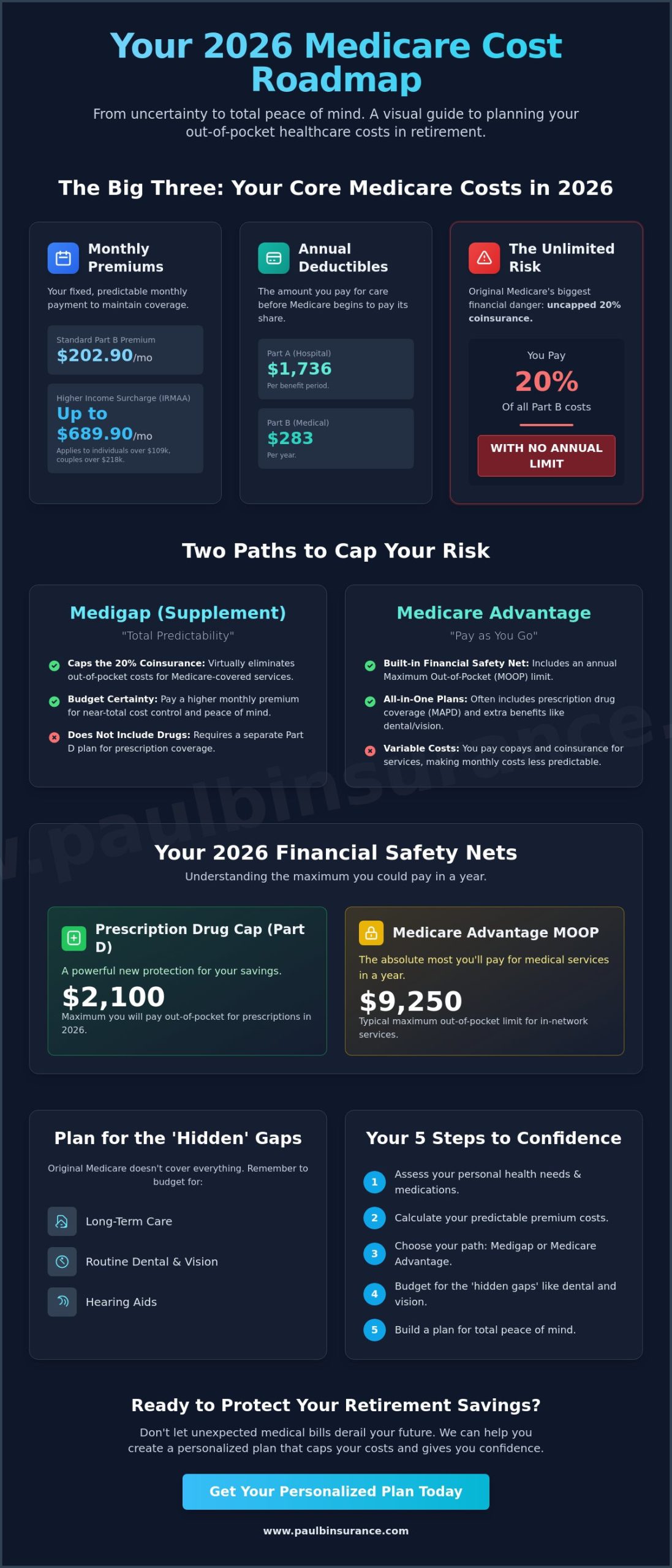
When we talk about planning for out-of-pocket healthcare costs in retirement, we’re really talking about managing three specific types of bills. Think of your healthcare budget as a three-legged stool. If you don’t understand how premiums, deductibles, and coinsurance work together, the whole structure can feel unstable. We want to remove that instability for you. Most people start with the monthly premium. This is the baseline fee you pay just to keep your coverage active. In 2026, the standard Part B premium is $202.90. If your income is higher than $109,000 as an individual or $218,000 as a couple filing jointly, you’ll face the Income-Related Monthly Adjustment Amount, or IRMAA. These surcharges can push your monthly cost as high as $689.90, so we always suggest looking at your tax returns from two years ago to see where you stand.
Once you’ve paid your monthly fee, you encounter the deductible. This is your “entry fee” for the year. For 2026, the Part B annual deductible is $283. You pay this amount yourself before Medicare starts sharing the bill. After that, you enter the world of coinsurance. This is where the real financial danger hides. Medicare typically pays 80% of your medical bills, leaving you with the remaining 20%. A 20% share might not sound like much for a routine checkup, but it’s a retirement-killer if you face a $50,000 surgery. Without a cap on that 20%, a single health event could cost you $10,000 or more in a single month.
Predictable vs. Unpredictable Costs
We find it helpful to separate your budget into two buckets. Premiums are predictable, fixed costs. You can automate these payments and know exactly what’s leaving your account. On the other hand, hospital stays and visits to specialists are variable risks. They happen when you least expect them. Your Maximum Out-of-Pocket (MOOP) is the financial safety net that limits your total yearly spending on these variable medical services. If you’re feeling overwhelmed by these numbers, you can schedule a call with Paul to see how different plans cap these risks.
The Part B Premium in 2026
Most people have their $202.90 Part B premium deducted automatically from their Social Security checks. It’s a simple system that helps you avoid missed payments. If you haven’t started taking Social Security yet, the government will send you a bill directly every three months. You must stay on top of these bills. Missing your initial enrollment window or letting your coverage lapse can lead to permanent late enrollment penalties. These penalties stay with you for life, raising your monthly costs every single year. We’re here to help you steer clear of these expensive mistakes so your retirement funds stay protected.
Medigap vs. Medicare Advantage: Two Paths to Cost Control
Choosing between these two paths is the most important decision you’ll make when planning for out-of-pocket healthcare costs in retirement. It’s a choice between two very different financial philosophies: “Pay Now” or “Pay as You Go.” We’ve seen that most seniors prefer one over the other based on how they like to manage their monthly cash flow. We’re here to help you weigh the predictable costs of a supplement against the lower premiums of an Advantage plan so you can choose the one that lets you sleep better at night.
The Medigap Strategy: Predictable Monthly Budgeting
If you hate financial surprises, Medicare Supplement Insurance, often called Medigap, is likely your best fit. You pay a higher monthly premium, but in return, the plan pays almost all of your out-of-pocket medical bills. In 2026, Plan G remains the gold standard for cost certainty. It covers that dangerous 20% coinsurance we discussed earlier. Once you pay your $283 annual Part B deductible, you won’t see another medical bill for the rest of the year, no matter how many times you visit a specialist. This strategy offers total freedom of access, allowing you to see any doctor in the country who accepts Medicare. Just keep in mind that Medigap plans don’t include prescription coverage, so you’ll need to budget for a separate Part D plan.
The Advantage Strategy: Low Premiums with Managed Risk
On the other hand, Medicare Advantage Plans are designed for those who want to keep their monthly fixed costs as low as possible. For 2026, the average monthly premium for these plans has dropped to just $14.00, and many people even find $0 premium options in their area. You “pay as you go” through small co-pays when you actually use medical services. Healthy retirees often choose this path because these plans usually bundle drug, dental, and vision coverage into one package. However, you must stay within a specific network of doctors, like an HMO or PPO. If you travel frequently or want to see a doctor outside the network, your costs will rise. To protect you, these plans have a Maximum Out-of-Pocket (MOOP) limit. For 2026, the in-network cap is $9,250. This is your “worst-case scenario” safety net, ensuring that even in a difficult health year, your financial exposure is capped at a specific number.
Planning for the ‘Hidden’ Gaps: Drugs, Dental, and Vision
Even after you’ve handled your medical insurance, your budget might still have a few leaks. We often see retirees focus so much on doctors and hospitals that they forget about the “hidden” gaps that can quietly drain a bank account. Specifically, medications, dental work, and vision care are often the biggest surprises for those planning for out-of-pocket healthcare costs in retirement. Original Medicare was never designed to be a catch-all for every health need. It’s our job to help you spot these holes before they become financial emergencies.
The 2026 Prescription Drug Revolution
The year 2026 brings a massive relief for anyone with high medication costs. The out-of-pocket maximum for covered prescription drugs is now capped at $2,100. This is a game-changer. Previously, there was no limit on what you might pay for specialty medications, but now you have a hard ceiling. We also want to highlight the “smoothing” option. This allows you to spread your drug costs into predictable monthly installments rather than hitting a large deductible all at once. Even if you don’t take medications today, having Medicare Part D is essential. It protects you from future health changes and helps you avoid permanent late enrollment penalties that could haunt your budget for years.
Vision and Hearing: The Costs of Aging
As we age, our needs for vision and hearing care naturally increase. Unfortunately, Medicare coverage for these services remains very limited. A high-quality pair of hearing aids can easily cost $4,000 or more, and most standard plans won’t cover a penny of that. While some Medicare Advantage plans offer small allowances for glasses or hearing exams, they rarely cover the full cost of advanced technology. We suggest setting up a dedicated health savings fund specifically for these items. This proactive approach ensures you aren’t forced to choose between your savings and your ability to hear your grandkids or see clearly.
Then there’s the “Dental Dilemma.” We’ve seen too many seniors get hit with $5,000 bills for crowns or root canals because they assumed Medicare would help. It won’t. Original Medicare does not cover routine dental care. This is why exploring Dental Insurance options is a critical part of a smart retirement strategy. These plans can turn a massive, unexpected expense into a manageable monthly line item. We believe planning for out-of-pocket healthcare costs in retirement should be simple and transparent. If you want to see how these different pieces fit into your personal budget, you can request a custom Medicare plan review to get a clear picture of your total 2026 costs.
Our 5-Step Plan to Protect Your Retirement Savings
We’ve walked through the complex world of 2026 Medicare costs, from the $202.90 standard Part B premium to the new $2,100 prescription drug cap. Now, it’s time to put that knowledge into action. We believe that planning for out-of-pocket healthcare costs in retirement should be a logical, stress-free process. You don’t have to guess at your financial future. By following these five steps, you can move from a state of worry to a place of total security.
- Step 1: Inventory your health needs. Grab a pen and list your current doctors and every medication you take. Because the 2026 Part D rules have changed, knowing your specific prescriptions is the only way to ensure you’re hitting that $2,100 out-of-pocket limit as efficiently as possible.
- Step 2: Choose your financial philosophy. Decide if you prefer the “Total Predictability” of Medigap or the “Lower Premiums” of a Medicare Advantage plan. Remember the $9,250 in-network maximum we discussed earlier; that is your safety net if you choose the Advantage path.
- Step 3: Factor in the hidden gaps. Account for dental, vision, and hearing costs. Since Medicare won’t pay for that $5,000 dental bridge, we recommend looking at a standalone dental insurance plan to keep those costs predictable.
- Step 4: Consult an independent expert. Don’t limit yourself to one company’s offerings. An independent broker can compare 40 or more different carriers at once to find the one that fits your specific zip code and health profile.
- Step 5: Perform an annual check-up. Medicare plans change every single year. We suggest a quick review during the Open Enrollment period to make sure your 2026 plan is still the best value for 2027.
The Power of an Independent Broker
There’s a big difference between a “captive agent” and an independent advocate. A captive agent works for one insurance company and can only show you their specific products. If their prices go up, they can’t help you find a better deal. We work for you, not the insurance companies. We have the freedom to shop the entire market to protect your interests. Our guidance is unbiased, and our services come at no cost to you. If you want to learn more about how we help you find the right fit, check out our Medicare Broker Guide for deeper insights into finding a trusted advisor.
From Confusion to Confidence
We’re here to make sure you’re never rushed or pressured into a decision. Planning for out-of-pocket healthcare costs in retirement is about protecting your peace of mind so you can focus on what matters most. Stop guessing about your 2026 medical budget and start planning with expert data. We’ll simplify the jargon and show you exactly how each plan works for your unique situation. When you’re ready to clear the fog and take control of your financial future, Schedule a Call With Paul for a personalized healthcare cost review. We’ll help you find the path from confusion to confidence.
Take Control of Your 2026 Healthcare Journey
You now have the tools to turn a complex maze into a clear, manageable path. We’ve explored how the new $2,100 prescription drug cap provides a vital safety net and why choosing between the predictability of Medigap or the flexibility of Medicare Advantage is the foundation of your financial security. Planning for out-of-pocket healthcare costs in retirement doesn’t have to be a source of constant stress when you have a dedicated advocate by your side. We’re here to help you navigate these choices with the clarity you deserve.
Our team provides expert guidance across 34 states and offers unbiased comparisons from 40 different insurance carriers to find your perfect fit. We live by a “Never Rushed, Never Pressured” philosophy because your peace of mind is our highest priority. You’ve worked hard for your retirement savings; let’s work together to build a wall around them. Schedule a Call With Paul to Map Out Your Retirement Healthcare Costs and move from confusion to confidence today. We’re ready to help you protect your future with a plan that actually works for you.
Frequently Asked Questions
What is the average out-of-pocket cost for healthcare in retirement?
Most industry estimates suggest a healthy 65-year-old couple retiring in 2026 should prepare to spend over $300,000 on medical expenses throughout their retirement years. On a monthly basis, we recommend budgeting between $500 and $700 per person. This range covers your $202.90 Part B premium, supplemental insurance costs, and the typical co-pays or deductibles you’ll encounter for routine care and medications.
Does Medicare have an annual out-of-pocket maximum?
Original Medicare, which includes Part A and Part B, does not have an annual out-of-pocket maximum. This means your 20% coinsurance responsibility for medical services is unlimited unless you have additional coverage. To protect yourself, you can choose a Medicare Advantage plan, which has a 2026 in-network cap of $9,250, or a Medigap plan that pays nearly all of your cost-sharing responsibilities for you.
How does the drug cap in 2026 help my retirement planning?
The $2,100 out-of-pocket cap on Part D prescription drugs provides a predictable ceiling for your medication expenses. Before this change, seniors taking expensive specialty drugs could face unlimited costs. Now, your planning for out-of-pocket healthcare costs in retirement is much simpler because you know that once you reach that $2,100 limit, your plan pays 100% for your covered drugs for the rest of the year.
Can I change my Medicare plan if my out-of-pocket costs get too high?
Yes, you can change your Medicare Advantage or Part D plan every year during the Annual Enrollment Period from October 15 to December 7. Changes made during this time take effect on January 1. If you want to switch from Medicare Advantage back to Medigap, you may have to answer health questions. This is why we help you compare options early so you don’t get stuck in a plan that doesn’t fit your budget.
Is Medigap or Medicare Advantage better for someone on a fixed budget?
Medigap is often the better choice for those who want a predictable monthly budget with no surprise bills. While Medigap has a higher monthly premium, it removes the stress of co-pays. Medicare Advantage plans have lower premiums, sometimes as low as $0, but you must be prepared to pay as you go. If you have a difficult health year, you could be responsible for costs up to the $9,250 limit.
What happens to my out-of-pocket costs if I retire before age 65?
If you retire before 65, you’ll likely need to purchase private insurance through the Health Insurance Marketplace because Medicare eligibility typically starts at age 65. These plans often have much higher premiums and deductibles than Medicare. We recommend looking into COBRA or marketplace subsidies to bridge the gap. Planning for out-of-pocket healthcare costs in retirement should begin several years before you actually stop working to account for these higher early-retirement costs.
Do out-of-pocket costs include my monthly Part B premium?
Yes, your $202.90 monthly Part B premium is a core out-of-pocket expense that you must include in your budget. Most people have this amount deducted directly from their Social Security checks. Even though it’s a “fixed” cost, it’s still money leaving your pocket. When we help you build a retirement plan, we look at this premium alongside your deductibles and co-pays to give you a total picture of your spending.
How can an independent Medicare broker help me lower my costs?
An independent broker lowers your costs by comparing over 40 different insurance carriers to find the most competitive rates in your specific zip code. We don’t work for the insurance companies, so we have no reason to push one brand over another. Our only goal is to find the plan that covers your specific doctors and medications for the lowest possible price. This unbiased guidance ensures you never pay more than you have to.

Article by
Paul Barrett
Paul Barrett, CMIP is the founder of The Modern Medicare Agency, an independent Medicare-only brokerage based in Melville, NY. With 18 years of Medicare-exclusive experience, a CMIP designation, and more than 5,000 clients served across 37 states, Paul is one of the most credentialed independent Medicare specialists on Long Island — and one of the most direct.
He represents 40+ carriers with no quotas and no allegiances, which means his recommendations are based entirely on what fits each client's specific situation. He is the author of Medicare Mastery Unlocked and host of the Wise Guys Retirement Talk podcast. His content is grounded in primary sources, real carrier intelligence, and 18 years of watching what happens when people get Medicare right — and when they don't.
📞 631-358-5793 | paulbinsurance.com