




When a disability prevents you from working, the last thing you need is more stress. Yet, trying to understand your benefit options can feel like navigating a maze of confusing rules and acronyms. The fear of making a mistake or being denied is real, especially when trying to understand the ssdi vs ssi programs. This is where the anxiety stops and clarity begins.
This simple guide is your trusted resource for 2026. We will walk you through the critical differences between Social Security Disability Insurance and Supplemental Security Income, step-by-step. You will gain a clear understanding of how to qualify, how each program impacts your healthcare, and exactly how to navigate the 24-month transition to Medicare with confidence. Our goal is to provide the guidance you need to secure your benefits and protect your future, giving you complete peace of mind.
Key Takeaways
- Understand the fundamental difference between SSDI vs. SSI to see if your work history or your financial need determines your eligibility.
- Discover how your disability benefit directly determines whether you qualify for Medicare or Medicaid, and learn about the critical waiting periods involved.
- Learn if you are eligible for “concurrent benefits,” which could allow you to receive payments from both programs at the same time.
- Identify the exact documents you need to prepare a strong application and move forward in the process with confidence.
What is the Difference Between SSDI and SSI? The Basics
Navigating Social Security benefits can feel like trying to solve a puzzle in the dark. The acronyms alone-SSDI, SSI-are enough to cause confusion and stress. But you don’t have to feel overwhelmed. Understanding the core distinction between these two vital programs is the first, most important step on your journey from confusion to confidence.
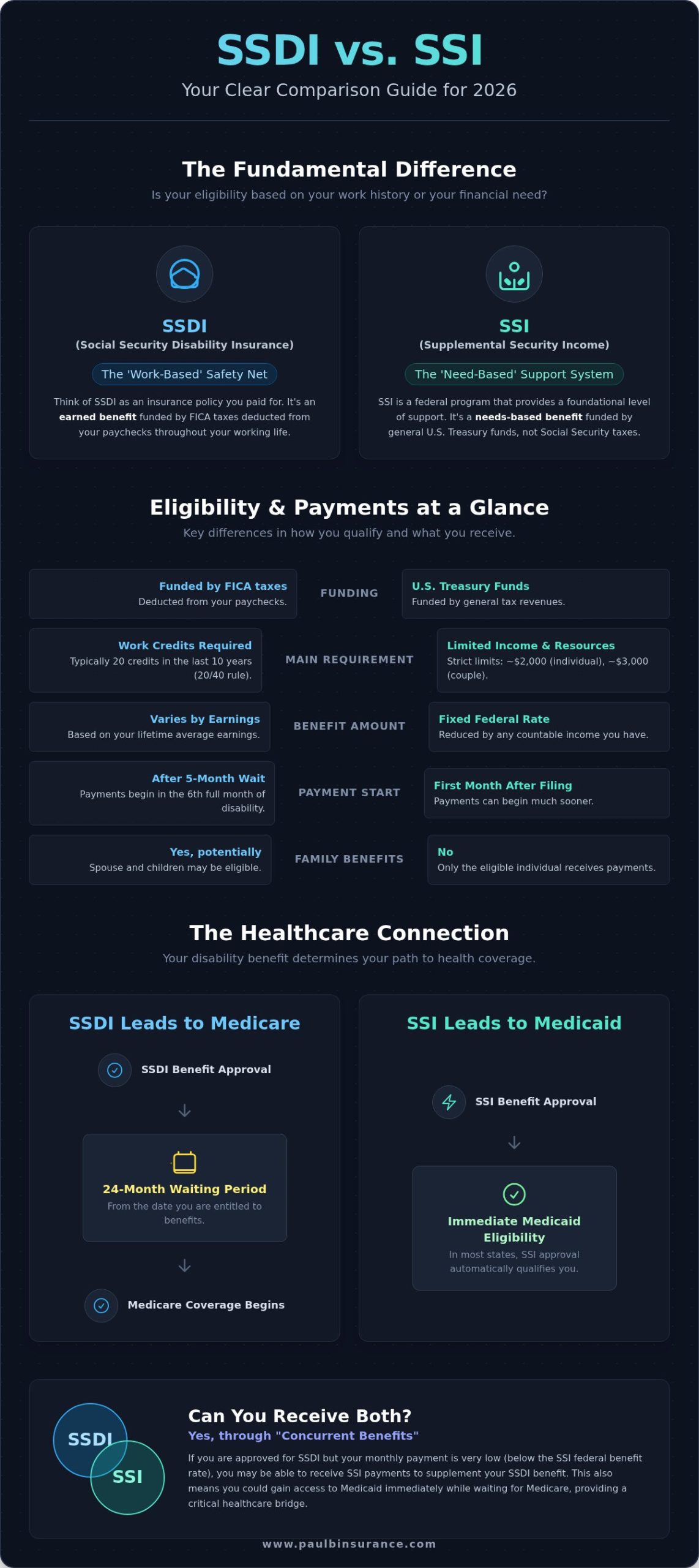
At its heart, the ssdi vs ssi debate comes down to one simple question: Is your eligibility based on your work history or your financial need? Answering this will point you in the right direction. Let’s break down these two programs with the simple clarity you deserve.
SSDI: The ‘Work-Based’ Safety Net
Think of Social Security Disability Insurance (SSDI) as an insurance policy you’ve paid for throughout your working life. With every paycheck, a small amount goes to FICA taxes, which fund this program. To qualify, you must have earned enough “work credits.” The system, officially known as Social Security Disability Insurance, requires not just a sufficient total number of credits, but also that you’ve worked recently enough to have an “insured status.” In some cases, your spouse or children may also be eligible for benefits based on your work record, providing a crucial safety net for your entire family.
SSI: The ‘Need-Based’ Support System
Supplemental Security Income (SSI) operates on a completely different principle. It is not funded by Social Security taxes but by general U.S. Treasury funds. Eligibility isn’t tied to your work history but to your financial situation. To qualify, you must have very limited income and few resources. For 2026, this means your countable assets must fall below a strict federal limit, which is typically a few thousand dollars. SSI provides a foundational level of support for disabled adults and children, or individuals aged 65 and older, who have minimal financial means and may not be eligible for other Social Security benefits.
Comparing SSDI vs. SSI: 2026 Eligibility and Payment Rules
Navigating the eligibility maze for Social Security disability benefits can feel overwhelming. The core difference when comparing ssdi vs ssi comes down to two simple questions: Did you work and pay into Social Security? And what are your current income and resources? Let’s break down the 2026 rules with the clarity you deserve.
First, it’s important to know that the Social Security Administration (SSA) uses the same strict medical standards to determine disability for both programs. Your condition must be severe enough to prevent you from doing substantial work and be expected to last at least one year or result in death. You can review the complete criteria on their page for Official Social Security disability benefits. Once you’re approved, your payment timeline differs: SSDI has a five-month waiting period, while SSI payments can begin the first full month after your application date.
Looking ahead, the 2026 Cost-of-Living Adjustment (COLA), announced in late 2025, will adjust monthly benefit amounts for both programs to help your payments keep up with inflation.
Financial Requirements for SSI in 2026
Supplemental Security Income (SSI) is a needs-based program. This means your eligibility depends on having very limited income and resources. For 2026, the resource limit is expected to remain strict: $2,000 for an individual and $3,000 for a couple.
- What counts as a resource? Things like cash, bank accounts, stocks, and bonds.
- What doesn’t count? The SSA excludes your primary home, one vehicle, and personal household goods.
Be aware that “in-kind support”-like a family member paying your rent or buying your groceries-can also be counted as income and may reduce your monthly SSI check.
Work Credit Requirements for SSDI
Social Security Disability Insurance (SSDI) is an earned benefit, funded by the FICA taxes you paid while working. To qualify, you must have a sufficient work history. The SSA uses a “work credit” system, and the most common rule is the “20/40 rule.” This means you generally need to have earned at least 20 work credits during the 10 years immediately before your disability began. Younger workers who become disabled may qualify with fewer credits. You can easily see your work history by creating a my Social Security account online to view your official statement.
The Healthcare Connection: How Benefits Lead to Medicare or Medicaid
Understanding your disability benefits is only half the battle. The next, and often more confusing, question is: “How will I get healthcare?” The answer depends entirely on which benefit you receive. The path to healthcare is one of the most significant differences when comparing ssdi vs ssi, and navigating it correctly is essential for your financial security and peace of mind.
Navigating the 24-Month Medicare Waiting Period
If you are approved for SSDI, you will automatically qualify for Medicare. However, there is a catch: a mandatory 24-month waiting period. This clock starts from the date your disability payments begin, not the date you were approved. While this wait can be stressful, there are two key exceptions for immediate Medicare eligibility:
- Amyotrophic Lateral Sclerosis (ALS)
- End-Stage Renal Disease (ESRD)
For everyone else, finding coverage during this two-year gap is critical. Options can include COBRA, a spouse’s plan, or an ACA Marketplace plan. Planning for your eventual transition is just as important. Getting expert guidance on future options like Medicare Advantage Plans ahead of time ensures you make a confident choice when the time comes.
Medicaid and SSI: Immediate Protection
For SSI recipients, the healthcare picture is much simpler and faster. In most states, being approved for SSI automatically makes you eligible for Medicaid, with coverage often starting the very same month. This immediate protection removes the anxiety of a long waiting period. If you receive both a small SSDI check and SSI (making you “dual eligible”), Medicaid can provide coverage during the 24-month Medicare wait and may continue to help with costs even after Medicare begins.
Whether you are waiting for Medicare or enrolling in Medicaid, the rules can feel like a maze. The core difference in the ssdi vs ssi debate is clear: SSDI involves a long wait for Medicare, while SSI provides immediate access to Medicaid. Having a trusted guide to help you secure coverage and plan for the future is the first step from confusion to confidence.
Concurrent Benefits: Can You Receive Both SSDI and SSI?
It might seem confusing, but the answer is yes-it is possible to receive both Social Security Disability Insurance (SSDI) and Supplemental Security Income (SSI) at the same time. This is known as receiving “concurrent benefits.” It typically happens when your SSDI payment is very low, usually because of a limited work history. If your monthly SSDI benefit is less than the maximum federal SSI payment, SSI can step in to supplement that income up to the allowed limit.
The primary advantage of this arrangement is powerful: you gain access to both Medicare (which comes with SSDI after a waiting period) and Medicaid (which comes with SSI eligibility in most states). This is called being “dual eligible,” and it can significantly lower your out-of-pocket healthcare costs.
The Math of Concurrent Benefits
However, the calculation isn’t straightforward. The Social Security Administration (SSA) counts your SSDI payment as “unearned income,” which reduces your SSI benefit. They do allow a $20 general income exclusion. For example, if you receive a $500 SSDI check, the SSA subtracts the $20 exclusion, leaving $480 of countable income. They then subtract that $480 from the maximum SSI payment, and you receive the difference. This complex interaction is a key part of the ssdi vs ssi puzzle.
This is also where a common pitfall occurs. A small cost-of-living increase to your SSDI can accidentally push your total income just over the limit, causing you to lose your SSI eligibility-and your Medicaid coverage along with it. Navigating this maze requires a patient guide to avoid costly mistakes.
Managing Your Healthcare as a Dual Eligible
As a dual-eligible beneficiary, Medicare pays first for your healthcare bills, and Medicaid acts as secondary coverage, often paying for costs that Medicare doesn’t cover. This includes your prescription drugs. Because you qualify for SSI, you are automatically enrolled in the ‘Extra Help’ program, which dramatically lowers the cost of your Medicare Part D prescription plan. For those with SSDI payments too high for SSI but still facing significant medical costs, a Medicare Supplement (Medigap) plan can be a trusted solution to help cover Medicare’s gaps.
Understanding how these programs work together is vital. If you’re feeling overwhelmed by the options, we’re here to provide simple, clear guidance. You can move from confusion to confidence with the right support at Paul B Insurance.
Moving from Confusion to Confidence: Your Next Steps
Understanding the core differences in the SSDI vs SSI debate is the first major hurdle. Now, it’s time to take action. The path to securing your benefits can feel long, but by breaking it down into manageable steps, you can move forward with clarity and purpose. Here is a simple roadmap to guide you.
- Step 1: Gather Your Documentation. Before you apply, collect all relevant medical records, treatment histories, and a detailed work history. Having this information organized and ready will make the application process much smoother.
- Step 2: Submit Your Application. You can apply for benefits online through the Social Security Administration’s website, which is often the fastest method. Alternatively, you can call or visit your local Social Security office to apply in person.
- Step 3: Prepare for the Appeals Process. It is a difficult but important truth that most initial applications are denied. Do not be discouraged. This is a standard part of the process, and you have the right to appeal the decision. Many successful claims are approved during the appeals stage.
- Step 4: Plan for Your Health Coverage. If you are approved for SSDI, you will become eligible for Medicare after a 24-month waiting period. It is crucial to start planning for this transition. Contact The Modern Medicare Agency once you are within 6 months of your Medicare eligibility date so we can help you prepare.
Why Professional Guidance Matters
When your Medicare eligibility begins, you’ll face a new set of choices. Unlike a ‘captive agent’ who only works for one company, an independent broker like Paul Barrett works for you. We help you navigate the Medicare maze, compare plans from multiple carriers impartially, and ensure your Dental and Vision needs are met alongside your core medical benefits.
The Paul Barrett Promise
We believe that finding the right insurance should bring you peace of mind, not more stress. Our approach is always ethical: you will never be rushed and never be pressured. We simplify the confusing jargon so you know exactly how your benefits work for you. When you’re ready to move from feeling overwhelmed to feeling empowered, we’re here to help.
Take the next step with confidence. Schedule a no-cost, no-obligation call with Paul today.
From Confusion to Clarity: Your Next Steps with SSDI and SSI
Understanding the differences between Social Security Disability Insurance (SSDI) and Supplemental Security Income (SSI) is the first step toward securing the support you deserve. Remember, SSDI is an earned benefit tied to your work history that leads to Medicare, while SSI is a needs-based program connected to Medicaid. Clarifying the ssdi vs ssi distinction is crucial, as it directly impacts both your financial stability and your healthcare options for 2026 and beyond.
As you navigate your benefits, the transition to Medicare can feel like another complex maze. You don’t have to walk it alone. As independent brokers serving over 34 states, we provide ethical, ‘no-pressure’ guidance. With access to more than 40 carriers, our only goal is to find the right plan for you, simplifying the jargon so you can avoid costly mistakes and feel confident in your choices.
Ready to trade stress for peace of mind? Schedule a complimentary call with Paul to simplify your Medicare transition.
Frequently Asked Questions About SSDI vs. SSI
Is SSDI better than SSI?
Neither program is inherently “better”; the right one depends on your personal situation. Social Security Disability Insurance (SSDI) is an earned benefit based on your work history and FICA tax contributions, so it often provides a higher monthly payment. Supplemental Security Income (SSI) is a needs-based program for those with very limited income and resources, regardless of work history. Think of SSDI as an insurance policy you paid for, while SSI is a crucial safety net for financial hardship.
Can I switch from SSI to SSDI later on?
You can’t simply switch from SSI to SSDI, but you can become eligible for SSDI later. This typically happens if you return to work and earn enough work credits to qualify. If you are then approved for SSDI and your new benefit amount is higher than your SSI payment, your SSI will stop. It’s also possible to receive both benefits concurrently if your SSDI payment is very low, but this is less common. It all comes down to meeting the specific eligibility rules for each program.
How much does SSDI pay compared to SSI in 2026?
While we can’t predict the exact 2026 figures, we can look at current trends which adjust for cost-of-living annually. In 2024, the maximum federal SSI payment is $943 per month for an individual. In contrast, SSDI payments are based on your lifetime earnings history. The average SSDI benefit in 2024 is around $1,537 per month, but your specific amount could be higher or lower depending on your work record. SSDI payments almost always exceed the maximum SSI payment.
What happens to my SSDI when I reach full retirement age?
When you reach your full retirement age, your SSDI benefits do not stop; they simply convert to Social Security retirement benefits. The great news is that the payment amount will remain the same. The Social Security Administration automatically handles this transition, so you don’t need to take any action. Think of it as your disability benefit seamlessly becoming the retirement benefit you would have received had you worked until retirement age. Your payments will continue without interruption.
Will I lose my SSI if I have money in a savings account?
Yes, you can lose your SSI benefits if your savings exceed the strict limits. To be eligible for SSI, your countable resources must not be worth more than $2,000 for an individual or $3,000 for a couple. These resources include cash, bank accounts, stocks, and bonds. The home you live in and one vehicle are typically not counted. It is crucial to manage your savings carefully to remain within these limits and maintain your eligibility for this needs-based program.
Does SSDI cover my spouse or children?
Yes, one of the significant advantages of SSDI is that certain family members may also qualify for benefits based on your work record. These are called auxiliary or dependent benefits. Eligible family members can include your spouse if they are age 62 or older (or any age if caring for your child under 16), as well as your unmarried children under age 18. This extra support can be a lifeline for your entire family, providing crucial financial stability.
How long does it take to get approved for SSDI vs. SSI?
The approval timeline for both programs can be quite long, and there is little difference in the processing time. The initial application decision typically takes three to six months. However, since many initial claims are denied, the process can extend to a year or more if you need to go through appeals. Understanding the key distinctions in the SSDI vs SSI application requirements can help you prepare, but patience is essential for both programs.
Can I work while receiving SSDI or SSI benefits?
Yes, you can work while receiving benefits, but there are strict rules. For SSDI, you cannot earn more than the Substantial Gainful Activity (SGA) amount, which is $1,550 per month in 2024. For SSI, the rules are even tighter, and nearly any income you earn will reduce your payment after a small initial disregard. The Social Security Administration offers work incentives to help you return to the workforce, but it’s vital to understand and follow these earnings limits to protect your benefits.

Article by
Paul Barrett
Paul Barrett, CMIP is the founder of The Modern Medicare Agency, an independent Medicare-only brokerage based in Melville, NY. With 18 years of Medicare-exclusive experience, a CMIP designation, and more than 5,000 clients served across 37 states, Paul is one of the most credentialed independent Medicare specialists on Long Island — and one of the most direct.
He represents 40+ carriers with no quotas and no allegiances, which means his recommendations are based entirely on what fits each client's specific situation. He is the author of Medicare Mastery Unlocked and host of the Wise Guys Retirement Talk podcast. His content is grounded in primary sources, real carrier intelligence, and 18 years of watching what happens when people get Medicare right — and when they don't.
📞 631-358-5793 | paulbinsurance.com