




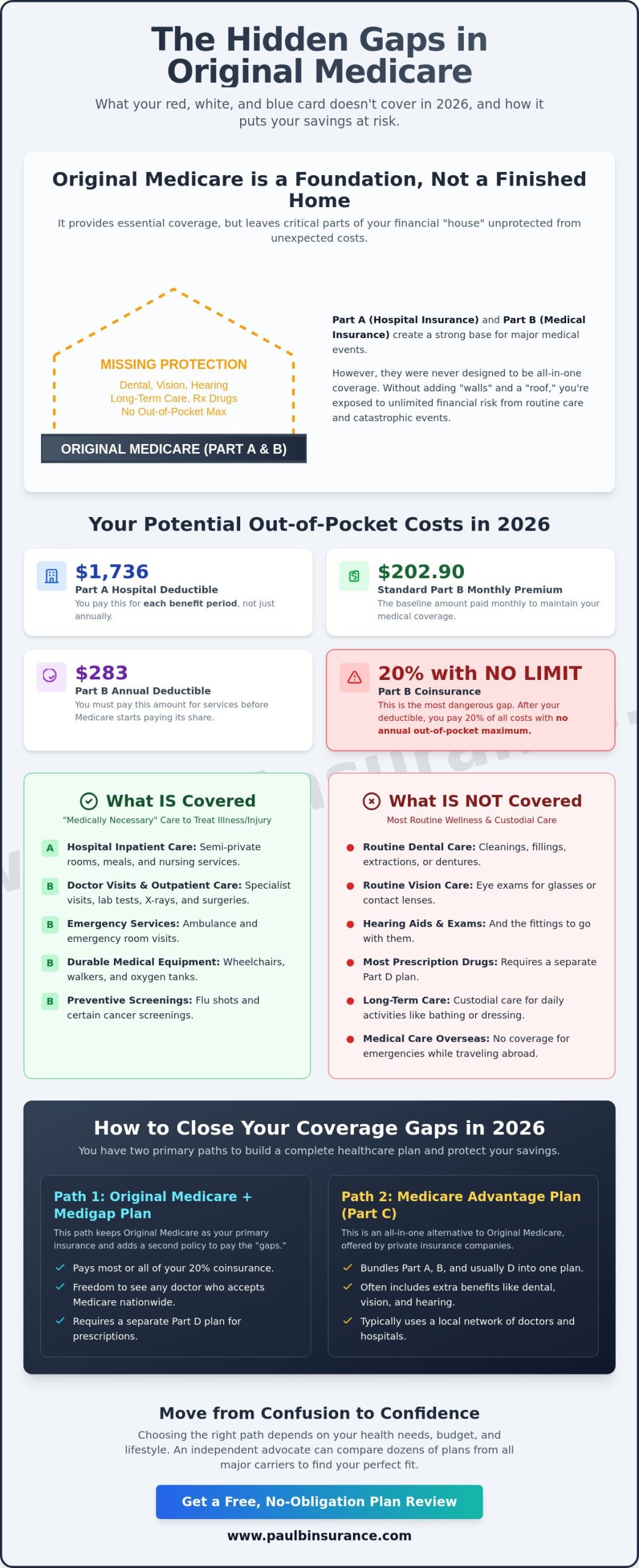
Most people think signing up for Part A and Part B means their healthcare bills are finally handled, but what if we told you that “full coverage” is actually one of the biggest myths in retirement? We know how exhausting it is to wade through government jargon only to feel more confused than when you started. It’s stressful to worry that one unexpected trip to the dentist or a routine eye exam could drain your savings because you didn’t know the rules. It’s vital to understand exactly what is not covered by original medicare before you face the $1,736 Part A deductible or the $202.90 monthly Part B premium in 2026.
We’re here to help you move from confusion to confidence by showing you exactly where your coverage ends and how to protect yourself. You deserve to know that your financial foundation is solid without fearing a surprise bill in the mail. This guide breaks down the confirmed 2026 costs, lists every major exclusion from hearing aids to long-term care, and provides a simple path to achieving total peace of mind.
Key Takeaways
- Learn the specific list of services that make up what is not covered by original medicare, including routine dental, vision, and hearing care.
- Protect your savings by identifying the hidden out-of-pocket costs that government coverage won’t pay for in 2026.
- Compare the two main ways to close your coverage gaps, ensuring you have the right “roof and walls” for your healthcare house.
- Find out how to handle expenses that fall outside the doctor’s office, such as long-term care and medical emergencies while traveling abroad.
- See how an independent advocate helps you choose between dozens of carriers to find the perfect fit for your specific needs.
Understanding the Limits: What Original Medicare Is (and Isn’t)
We often talk to folks who feel a huge sense of relief when they first get their red, white, and blue card in the mail. It feels like a safety net has finally appeared after years of planning. However, Original Medicare is actually a two-part government program designed to provide a foundation, not a finished home. It’s important to understand what is not covered by original medicare because the government version lacks many of the protections you might be used to from an employer’s private plan. For instance, the most dangerous gap is the lack of an out-of-pocket maximum. In the private sector, there’s usually a “stop-loss” limit that protects you from financial ruin; in the government-run program, there’s no such limit. If you have a catastrophic health event, those 20% bills just keep coming.
The Difference Between Part A and Part B
Think of Part A as your “room and board” coverage for the hospital. If you’re admitted, Part A helps pay for your bed and meals, but it comes with a $1,736 deductible for every benefit period in 2026. Part B is “everything else,” covering doctor visits, lab tests, and X-rays. In 2026, the standard Part B premium is $202.90, and the annual deductible is $283. While it’s essential, Part B only pays 80% of the cost for most services. You’re responsible for the other 20%, and that bill has no ceiling. Part B covers things like:
- Outpatient surgeries and specialist visits
- Emergency room and ambulance services
- Durable medical equipment like wheelchairs or oxygen
- Mental health services and some preventive screenings
We help our clients see that while these two parts are a start, they leave your savings exposed to unlimited risk. Knowing what is not covered by original medicare is the only way to avoid these “surprise” bills that can derail your retirement.
Why ‘Medically Necessary’ Doesn’t Mean ‘Everything’
The government uses a specific gatekeeper to decide if they’ll pay your claim: “medically necessary.” This sounds straightforward, but it’s often a source of deep frustration for seniors. The Centers for Medicare & Medicaid Services (CMS) typically focuses on treating an active illness or injury rather than supporting your overall wellness. This narrow focus is why routine dental work, vision exams, and hearing aids are excluded. They’re seen as “routine” rather than “essential” for life-saving care. In 2026, the definition of medical necessity remains the hurdle between you and covered care. We see many people frustrated because their wellness needs don’t fit the government’s sickness criteria. If you want to see how private plans fill these holes, checking out a Medicare Advantage guide can help you find a more complete solution that covers the whole person.
The ‘Big Three’ Gaps: Dental, Vision, and Hearing Care
We often hear from seniors who are shocked to learn that their “full” coverage doesn’t include the services they use most frequently. It’s a frustrating reality, but routine dental, vision, and hearing care are the primary examples of what is not covered by original medicare in 2026. While the government has made strides in other areas, like the $2,100 out-of-pocket cap for prescription drugs this year, these “big three” remain firmly outside the core program. This means if you need a routine cleaning, a new pair of glasses, or help with a hearing loss, you’re likely paying the full bill yourself.
Dental care is perhaps the most significant hurdle. Original Medicare won’t pay for cleanings, fillings, or extractions. If you find yourself needing dentures or a root canal, the costs can quickly reach thousands of dollars. Vision care follows a similar pattern. While your health is vital, eye exams for glasses or contact lenses aren’t included. Hearing aids are another major expense that many of our clients find overwhelming. In 2026, high-quality hearing aids can cost a significant amount, yet they aren’t considered “medically necessary” by government standards. We believe you shouldn’t have to choose between your savings and your ability to see, hear, or smile with confidence.
The Exceptions: When Medicare DOES Step In
There are rare moments where the government decides to help. For example, Medicare will cover cataract surgery because it’s considered a medical necessity to restore your sight. They might also pay for certain dental services if they’re an integral part of a covered hospital procedure, such as jaw reconstruction after an accident. If you’re at high risk for glaucoma, perhaps due to diabetes or a family history, Medicare does cover annual screenings. However, these are the exceptions to the rule. For the vast majority of your wellness needs, you’ll need a different strategy.
The Hidden Cost of Neglecting Routine Care
We see it all the time: a small dental issue turns into a major medical complication. Research shows a direct link between poor oral health and serious conditions like heart disease and diabetes. Similarly, untreated vision loss is a leading cause of falls and injuries among seniors. We encourage you to view these services as “essential wellness” rather than optional extras. To help our clients stay ahead of these costs, we often recommend looking into a specific dental insurance plan that provides the routine support the government lacks.
Don’t let these gaps leave you feeling vulnerable. If you’re feeling overwhelmed by these exclusions, feel free to reach out to us for a simple, no-pressure conversation about your options. We can help you find a plan that treats your body as a whole, not just a list of government-approved parts.
Beyond the Doctor’s Office: Long-Term Care and Travel
Many of our clients are surprised to learn that some of the most expensive healthcare needs have nothing to do with a doctor’s prescription. When we look at what is not covered by original medicare, we have to look outside the four walls of a clinic. For instance, if you’ve ever dreamt of spending your retirement traveling the world, you should know that your coverage essentially stops at the water’s edge. Similarly, if you eventually need help with daily life, like getting dressed or preparing meals, you’re often on your own financially. These aren’t just “extras.” They are significant life events that require a plan to ensure your savings stay protected.
Skilled Nursing vs. Custodial Care
This is where things often get confusing for families navigating the system. Medicare does cover skilled nursing care, but only for short periods and under very strict conditions. In 2026, the “3-day prior hospital stay” rule still stands. This means you must be an inpatient for at least three days before Medicare will help with a rehab facility. Even then, your coverage is limited. You’ll face a $217 daily coinsurance for days 21 through 100 of your stay. Custodial care, which is help with bathing, eating, or dressing, is never covered. Because this type of long-term care can cost thousands of dollars a month, it’s one of the biggest threats to your retirement savings. We want to make sure you’re never caught off guard by these rules because the financial impact of a long-term stay can be devastating without a backup plan.
Health Care Outside the United States
If you’re planning a trip to celebrate your retirement, keep in mind that Original Medicare doesn’t follow you across the border. Whether you’re on a cruise in the Caribbean or visiting family in Europe, a medical emergency could result in a massive bill that you’d have to pay upfront. Some Medigap plans offer foreign travel emergency coverage, which can be a lifesaver for frequent flyers. Without this supplemental protection, you are responsible for 100% of the cost of care received outside the U.S.
We also remind our clients that “boutique” or concierge medicine fees are another out-of-pocket expense. Your doctor might charge a monthly or annual membership fee for better access or longer appointments, but Medicare won’t reimburse a penny of that fee. The same strict line applies to cosmetic surgery. Unless a procedure is reconstructive, such as surgery after an accident or a mastectomy, it’s considered elective. These lifestyle and long-term expenses are classic examples of what is not covered by original medicare, and we are here to help you find the right tools to close these gaps with confidence.
How to Close the Coverage Gaps in 2026
Once you realize that your hospital and medical insurance leaves so much to chance, the next logical question is how to fix it. We don’t want you to feel overwhelmed by the maze of options. There are two primary paths to securing your future: Medicare Advantage or a Medicare Supplement plan. Both are designed to address what is not covered by original medicare, but they do it in very different ways. Choosing the right one is about matching a plan to your specific lifestyle and budget so you never have to worry about a surprise bill again.
Medicare Advantage: The All-in-One Alternative
Medicare Advantage, or Part C, is a popular choice because it simplifies your life by bundling everything together. These plans are managed by private companies and often include the “extras” that the government excludes, like routine dental, vision, and hearing care. In 2026, the average monthly premium for an Advantage plan is projected to decrease to $14.00, making it a very affordable way to gain comprehensive protection. However, these plans use networks. It’s vital to ensure your trusted doctors and specialists are included in the plan’s network before you enroll. For a deeper look at how these bundles work, you can explore our Medicare Advantage Guide.
Medicare Supplement (Medigap) + Standalone Plans
If you prefer total freedom and predictable costs, a Medicare Supplement plan might be your best fit. Often called Medigap, these plans are designed to pay the 20% coinsurance that Original Medicare leaves behind. This path allows you to see any doctor in the United States who accepts Medicare; there are no networks to worry about. While Medigap handles the medical gaps, it doesn’t cover prescriptions. To solve this, you’ll need to add a standalone Part D plan. In 2026, Part D is more valuable than ever because the annual out-of-pocket maximum is capped at $2,100. This means once you spend that amount on covered drugs, your cost for the rest of the year is $0.
We believe that understanding what is not covered by original medicare shouldn’t be a source of stress. It should be the foundation for a better plan. Whether you choose the all-in-one convenience of Advantage or the flexibility of Medigap, we’re here to ensure you make that choice with confidence. If you’re ready to find the perfect fit for your needs, schedule a consultation with us and we’ll walk through the options together, one step at a time.
Moving From Confidence to Confidence with an Independent Broker
We know that trying to make sense of this system feels like walking through a thick fog. It’s why we’ve dedicated ourselves to being your calm, patient guide. By now, you’ve seen that what is not covered by original medicare can leave some pretty big holes in your safety net. You shouldn’t have to face those risks alone or spend your weekends reading government pamphlets. We simplify the jargon so you know exactly how it works, moving you from confusion to confidence with a plan that actually protects you.
Our 2026 commitment to you goes far beyond a single phone call. We provide year-round support because we know that questions don’t just happen during enrollment season. Whether you receive a confusing bill in July or need to check if a new medication is covered in December, we’re here to help. We use a simple 5-step process to ensure you’re protected. We start by listening to your needs, educating you on the rules, comparing the top plans, handling the paperwork, and staying by your side every year after. It’s a methodical path designed to remove the anxiety from your healthcare decisions.
Independent Broker vs. Captive Agent
There’s a major difference in how you receive advice, and it can affect your wallet for years. A captive agent is limited to just one company’s products. They’re often forced to fit your needs into their specific plan, even if a better or cheaper option exists elsewhere. We believe you deserve better than limited choices. As an independent broker, we compare over 40 different carriers to find the one that fits your specific life. We don’t work for the insurance companies; we work for you. This unbiased approach ensures you’re never rushed and never pressured into a decision that isn’t perfect for your situation.
Your Next Steps to Peace of Mind
Taking the first step toward security is easier than you think. Understanding what is not covered by original medicare is the foundation, but the real goal is a plan that lets you focus on your retirement instead of your medical bills. We invite you to join us for a no-obligation consultation to review your 2026 options. To make our time together most effective, we suggest you gather a few items beforehand:
- A current list of your medications and dosages.
- The names of your preferred doctors and specialists.
- Any specific health goals or upcoming procedures you have planned for 2026.
We’re here to be your advocate and your educator. Our mission is to serve and protect our clients, ensuring you steer clear of costly enrollment mistakes and late penalties. Let’s work together to build a healthcare plan that gives you the confidence to enjoy every day of your retirement.
Take the Next Step Toward Total Peace of Mind
You now have a clear map of exactly what is not covered by original medicare. From the $2,100 Part D out-of-pocket cap to the “Big Three” gaps in dental, vision, and hearing, you’ve learned how to spot the risks before they become bills. We believe that knowing the rules is the first step in moving from confusion to confidence. Your retirement shouldn’t be defined by the fear of a surprise hospital bill or an uncovered dental emergency. You’ve done the hard work of learning the limits; now it’s time to build your protection.
We are here to help you create a complete plan that fits your life. Our team provides unbiased, independent guidance and has access to 40+ top insurance carriers. We currently serve clients in 34+ states, ensuring that no matter where you are, you have a dedicated advocate in your corner. You deserve a guide who is never rushed and never pressured. We’ll simplify the remaining details so you can step into 2026 with the security you’ve worked so hard to earn.
Schedule a Call With Paul to Find Your Perfect Plan. We look forward to helping you secure the peace of mind you deserve.
Frequently Asked Questions
Does Original Medicare cover dental implants or dentures in 2026?
No, Original Medicare doesn’t cover dental implants, dentures, or routine cleanings in 2026. These services are primary examples of what is not covered by original medicare because the government classifies them as routine wellness rather than medical necessity. If you need these services, you’ll need a separate dental plan or a Medicare Advantage plan that includes dental benefits. We help our clients find these extra coverages so they can maintain their smiles without draining their savings.
Is long-term nursing home care covered if I have a chronic condition?
Original Medicare doesn’t pay for long-term custodial care in a nursing home. It only covers short-term skilled nursing care after a qualifying 3-day hospital stay. If you need help with daily activities like bathing or dressing due to a chronic condition, you’ll be responsible for those costs out-of-pocket. This is a significant gap that we help families plan for through other insurance options or specific long-term care strategies to protect their retirement assets.
Will Medicare pay for my prescriptions if I only have Part A and Part B?
No, Original Medicare doesn’t include coverage for most outpatient prescription drugs. You must enroll in a separate Part D plan or a Medicare Advantage plan to get help with your medication costs. In 2026, getting Part D is more important than ever because of the new $2,100 out-of-pocket maximum. We can review your current medication list to find the plan that keeps your pharmacy bills as low as possible while ensuring you stay within the new legal limits.
Does Medicare cover eye exams for people with diabetes?
Yes, Medicare Part B covers annual eye exams for diabetic retinopathy if you have diabetes. While routine exams for glasses are part of what is not covered by original medicare, the government does pay for exams related to certain medical conditions. You’ll typically pay 20% of the Medicare-approved amount after you meet your $283 Part B deductible for 2026. We help you understand exactly which specific eye services are medical versus routine so you don’t face unexpected bills.
Can I get coverage for medical emergencies while traveling in Europe?
Original Medicare generally doesn’t provide any coverage for healthcare services received outside the United States. If you’re planning a trip to Europe, a medical emergency could lead to high out-of-pocket expenses that you must pay yourself. To stay protected, you should consider a Medigap plan that includes foreign travel emergency benefits or a separate travel insurance policy. We want you to enjoy your travels with the confidence that a health issue won’t ruin your financial security.
What is the ‘donut hole’ in Part D, and does it still exist in 2026?
The ‘donut hole’ or coverage gap no longer exists in 2026. Recent legislative changes have simplified the Part D structure to protect you from high costs. Once you reach the $2,100 out-of-pocket maximum this year, you’ll pay $0 for your covered prescriptions for the rest of the calendar year. This change removes a lot of the old confusion and provides much-needed financial relief for our clients who take expensive maintenance medications.
Is shingles or the flu vaccine covered by Original Medicare?
The flu vaccine is covered under Medicare Part B and usually costs you $0 at a provider who accepts assignment. The shingles vaccine is covered under Medicare Part D. Since the Inflation Reduction Act took effect, most Part D plans provide the shingles vaccine at no cost to you. We’ll help you verify that your specific plan covers these essential shots so you can stay healthy in 2026 without any surprise charges at the pharmacy counter.
How much does a Medicare Supplement plan typically cost to cover these gaps?
The cost of a Medicare Supplement plan varies based on your age, location, and the specific plan letter you choose. While we can’t provide a single price, these plans offer a predictable monthly premium in exchange for covering your 20% coinsurance gaps. We compare over 40 different carriers to find the most competitive rate for your specific needs. Our goal is to find you the best value possible so you can move forward with confidence.

Article by
Paul Barrett
Paul Barrett, CMIP is the founder of The Modern Medicare Agency, an independent Medicare-only brokerage based in Melville, NY. With 18 years of Medicare-exclusive experience, a CMIP designation, and more than 5,000 clients served across 37 states, Paul is one of the most credentialed independent Medicare specialists on Long Island — and one of the most direct.
He represents 40+ carriers with no quotas and no allegiances, which means his recommendations are based entirely on what fits each client's specific situation. He is the author of Medicare Mastery Unlocked and host of the Wise Guys Retirement Talk podcast. His content is grounded in primary sources, real carrier intelligence, and 18 years of watching what happens when people get Medicare right — and when they don't.
📞 631-358-5793 | paulbinsurance.com