By Paul Barrett, CMIP | The Modern Medicare Agency | Melville, NY 18+ years Medicare-exclusive experience | Licensed in 34 states | 40+ carriers Last updated: July 2026
If you live in Commack and you’re trying to make sense of Medicare Advantage for 2026, here’s the most important thing I can tell you before we look at a single plan:
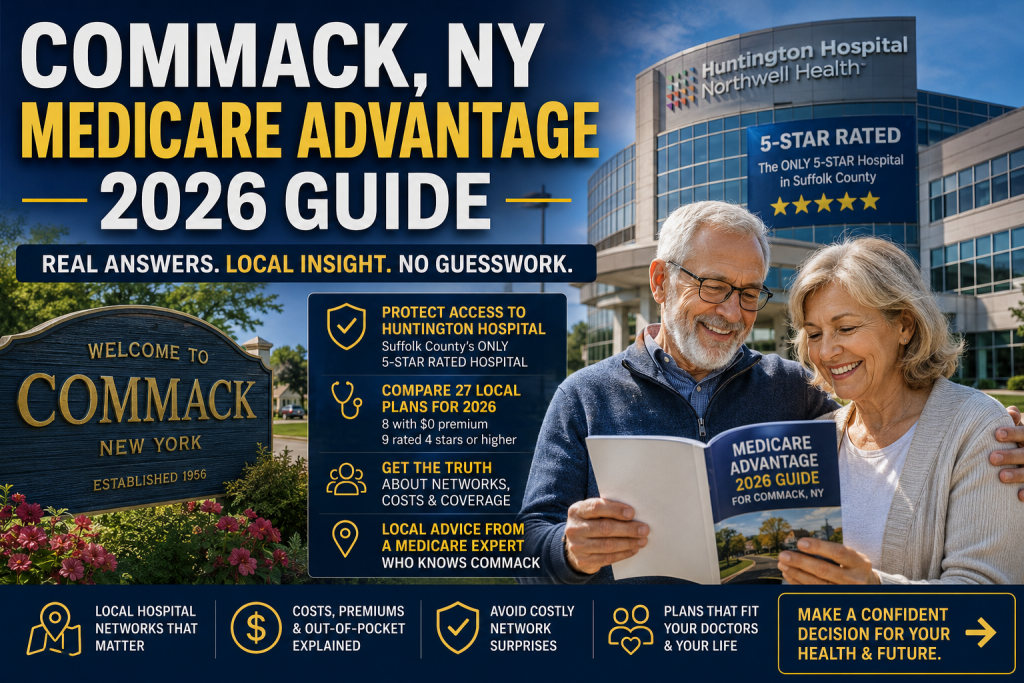
The hospital that anchors your community — Huntington Hospital — is the only 5-star CMS-rated hospital in all of Suffolk County and one of only two on Long Island. It has achieved Magnet nursing status five consecutive times — the only hospital on Long Island to do so, and one of only 55 hospitals in the entire country with this distinction. If your doctors have admitting privileges there, or if that’s where you’d go in a cardiac event or a serious medical situation, your plan needs to cover it — at in-network rates, without restriction.
Not every plan does.
I’ve been helping Commack and Suffolk County residents navigate Medicare from my Melville office for 18 years. This guide gives you what the automated comparison sites can’t: real local hospital network intelligence, honest carrier assessments, specific plan data from CMS, and the kind of straight talk you’d get from a friend who knows this market cold.
2026 Medicare Advantage Fast Facts for Commack (ZIP 11725)
For a full comparison of Medicare Advantage vs. Medigap for Suffolk County residents, see our Medigap vs. Medicare Advantage guide.
Fact | 2026 Figure |
Total Medicare Advantage plans available | 27 (per Connie Health ZIP-level data, July 2026) |
Plans with $0 monthly premium | 8 |
Average premium (plans with a premium) | $52.18/month |
Average out-of-pocket maximum | $8,722/year |
Average Part D Rx deductible | $505.23/year |
Plans rated 4 stars or higher | 9 |
Plan types available | HMO, PPO, HMO-POS |
Carriers offering plans | 8 |
Suffolk County MA enrollment rate | ~29.8% of Medicare beneficiaries |
Suffolk County beneficiaries enrolled | 99,586 of 334,422 eligible |
Source: CMS Medicare Advantage Enrollment Data 2026; Connie Health/Medicare.gov plan data, July 2026
The Hospitals That Matter Most for Commack Residents
Before we look at a single carrier or premium, we need to talk about your healthcare geography. Commack sits in western Suffolk County — and your hospital relationships determine which plans are actually worth your time.
Huntington Hospital (270 Park Ave, Huntington, NY 11743 — approx. 8 miles from Commack) This is the anchor hospital for Commack and western Suffolk County. What makes it extraordinary: Huntington Hospital is the only 5-star CMS-rated hospital in all of Suffolk County — and one of only two on Long Island — the highest recognition from the national governing body for healthcare quality. It is a verified Level III Trauma Center by the American College of Surgeons. It has achieved Magnet nursing status five consecutive times — the only hospital on Long Island to do so, and one of only 55 hospitals in the entire country with this distinction. If you live in Commack, this is almost certainly where your doctors have privileges and where you’d go in a serious medical situation. Your plan must cover it in-network.
Northwell Health — Commack (directly in Commack, 631-635-5100) Northwell operates a facility directly in Commack. If you see Northwell-affiliated physicians here or at any Northwell location, network status for Wellcare and HealthSpring matters to you directly — and both have terminated their Northwell contracts in 2026.
NYU Langone Huntington Medical Group — Commack NYU Langone operates a medical group directly in Commack offering internal medicine, family medicine, cardiology, OB-GYN, and specialty care. If you see any NYU Langone-affiliated physicians, your plan needs to cover their network.
St. Catherine of Siena Medical Center (Smithtown — western Suffolk) A Catholic Health facility serving western and central Suffolk County residents. Relevant for Commack residents who use Smithtown-area specialists.
Stony Brook University Hospital (Stony Brook — central Suffolk) Major academic medical center for complex cases, cancer care, and specialty surgery. Some Commack residents use Stony Brook specialists for conditions requiring academic-level care.
Which of these facilities your plan covers — and at what cost-sharing level — matters more than the monthly premium. I verify every provider before any Commack client enrolls.
Critical 2026 Network Warnings for Commack Residents
❌ WELLCARE — Northwell Out of Network as of July 1, 2026
Wellcare chose not to renew its contract with Northwell Health. Effective July 1, 2026, all Northwell hospitals, physician groups, ancillary facilities, and their clinically integrated network are out-of-network for Wellcare Medicare Advantage members. The Northwell facility in Commack directly, and Huntington Hospital which is a Northwell facility, are both affected.
Established Wellcare patients may continue Northwell care through August 29, 2026 with Wellcare’s authorization — but after that date, Northwell is fully out-of-network. Emergency services remain covered at in-network rates by federal law regardless of network status.
If you are currently on a Wellcare plan and see any Northwell provider — call me immediately at 631-358-5793.
❌ HEALTHSPRING (formerly Cigna Medicare) — Northwell Out of Network since January 1, 2026
HealthSpring terminated its entire relationship with Northwell effective December 31, 2025. This covers all Northwell hospitals, ancillary facilities, provider groups, and their clinically integrated network. This is not a future risk — it has already happened. Every Northwell visit you’ve had in 2026 on a HealthSpring plan has been processed at out-of-network rates.
I received direct written notification from HealthSpring as a broker partner: “Despite negotiations in good faith, Northwell Health will be leaving our Medicare Advantage network in New York effective December 31, 2025. This termination includes all Northwell Health hospitals, ancillaries, and provider groups, as well as their clinically integrated network.”
The 27 Plans Available in Commack — Full Data Table
These are the actual 2026 Medicare Advantage plans available in ZIP 11725, with premiums, out-of-pocket maximums, Rx deductibles, and CMS star ratings.
Plan Name | Type | Monthly Premium | Max OOP | Rx Deductible | Stars |
Anthem Medicare Advantage 3 (HMO-POS) | HMO-POS | $70.00 | $9,250 | $275 | ⭐⭐⭐⭐⭐ 5.0 |
Anthem Veteran 2 (HMO-POS) | HMO-POS | VA only | $6,800 | N/A | ⭐⭐⭐⭐⭐ 5.0 |
Healthfirst Increased Benefits Plan (HMO) | HMO | $24.20 | $9,250 | $615 | ⭐⭐⭐⭐½ 4.5 |
Aetna Medicare Elite (PPO) | PPO | $0 | $9,250 | $615 | ⭐⭐⭐⭐½ 4.5 |
Aetna Medicare Eagle Giveback (PPO) | PPO | Giveback | $9,250 | N/A | ⭐⭐⭐⭐½ 4.5 |
Aetna Medicare Enhanced (PPO) | PPO | $134.00 | $6,750 | $615 | ⭐⭐⭐⭐½ 4.5 |
Aetna Medicare Elite Extra (PPO) | PPO | $54.00 | $9,250 | $615 | ⭐⭐⭐⭐½ 4.5 |
EmblemHealth VIP Gold (HMO) | HMO | $175.00 | $9,250 | $200 | ⭐⭐⭐⭐ 4.0 |
EmblemHealth VIP Gold Plus (HMO) | HMO | $252.00 | $9,250 | $200 | ⭐⭐⭐⭐ 4.0 |
VNS Health EasyCare (HMO) | HMO | $25.00 | $9,250 | $500 | ⭐⭐⭐½ 3.5 |
Anthem Medicare Advantage (HMO) | HMO | $90.00 | $9,250 | $100 | ⭐⭐⭐½ 3.5 |
Wellcare Simple Open (PPO) | PPO | $0 | $9,250 | $615 | ⭐⭐⭐ 3.0 |
Wellcare Giveback Open (PPO) | PPO | $0 | $9,250 | $615 | ⭐⭐⭐ 3.0 |
Wellcare Assist Open (PPO) | PPO | $58.80 | $9,250 | $530 | ⭐⭐⭐ 3.0 |
Aetna Medicare Enhanced (HMO) | HMO | $94.00 | $9,250 | $615 | ⭐⭐⭐ 3.0 |
Humana Gold Plus Giveback H3533-027 (HMO) | HMO | $0 | $9,250 | $615 | ⭐⭐⭐ 3.0 |
Wellcare Patriot Simple (HMO-POS) | HMO-POS | Veterans | $6,700 | N/A | ⭐⭐⭐ 3.0 |
Wellcare Assist (HMO-POS) | HMO-POS | $51.40 | $9,250 | $590 | ⭐⭐⭐ 3.0 |
Wellcare Simple (HMO-POS) | HMO-POS | $0 | $9,250 | $615 | ⭐⭐⭐ 3.0 |
Wellcare Fidelis Assist (HMO-POS) | HMO-POS | $32.50 | $9,250 | $615 | ⭐⭐⭐ 3.0 |
Wellcare Fidelis Simple (HMO-POS) | HMO-POS | $0 | $9,250 | $615 | ⭐⭐⭐ 3.0 |
Wellcare Fidelis Patriot Simple (HMO-POS) | HMO-POS | Veterans | $9,250 | N/A | ⭐⭐⭐ 3.0 |
Humana USAA Honor Giveback (PPO) | PPO | Veterans | $4,950 | N/A | ⭐⭐⭐ 3.0 |
HumanaChoice H5970-029 (PPO) | PPO | $32.00 | $9,250 | $615 | ⭐⭐⭐ 3.0 |
Humana Direct Choice Giveback (PPO) | PPO | $0 | $9,250 | $475 | ⭐⭐⭐ 3.0 |
HealthSpring True Choice (PPO) | PPO | $0 | $6,800 | $250 | ⭐⭐⭐ 3.0 |
Healthfirst Signature (PPO) | PPO | $55.00 | $9,250 | $615 | ⭐⭐⭐ 3.0 |
Source: CMS Medicare Plan Data 2026, ZIP 11725. Star ratings reflect CMS 2026 Annual Star Ratings.
What stands out in this data:
Two plans in Commack carry a 5-star CMS rating — both from Anthem. Only 9 of 27 plans (33%) are rated 4 stars or higher. That means two-thirds of what’s available in your mailbox carries a 3-star or below rating. This is the reality behind the marketing.
The Aetna Medicare Elite PPO at $0 premium with a 4.5-star rating is typically the strongest starting point for Commack residents who want PPO flexibility without a premium.
The Anthem Medicare Advantage 3 HMO-POS at $70/month carries the only 5-star rating available to standard enrollees in this ZIP — but the Mount Sinai/Anthem situation we’ll discuss below requires careful provider verification.
Paul's Take: Honest Carrier Assessment for Commack 2026
AETNA — The strongest broad-access option for most Commack residents. Multiple PPO plans with 4.5-star ratings, strong Northwell relationships, and a PPO structure that lets you see Northwell, NYU Langone Huntington Medical Group, and Huntington Hospital without a referral. The $0 premium Aetna Medicare Elite PPO is typically the first plan I pull up for a Commack client who wants quality and flexibility. For 2026, Aetna has taken some rate adjustments nationally but remains the most enrolled plan in the Long Island market.
ANTHEM BLUE CROSS BLUE SHIELD — The 5-star rating on the Anthem Medicare Advantage 3 HMO-POS is real and meaningful. But there is an important 2026 caveat every Commack resident must know: Mount Sinai Health System went out of network for Anthem Medicare Advantage effective January 1, 2026, and a partial April 2026 agreement explicitly excluded Medicare Advantage plans. If any of your Commack-area doctors are affiliated with Mount Sinai, verify their network status before enrolling in any Anthem MA plan. For Northwell-affiliated providers at Huntington Hospital, Anthem’s network relationship is generally stable — but individual provider verification remains essential.
WELLCARE — With Northwell now out of network for Wellcare effective July 1, 2026, I cannot recommend any Wellcare plan for a Commack resident who has Northwell providers. The $0 premium plans look attractive. The network gap is a serious problem. Five Wellcare plans appear in the Commack plan table — I’d encourage most Commack clients to look past all of them until the Northwell contract situation is resolved.
HEALTHSPRING (formerly Cigna) — Same Northwell issue as Wellcare, but already in effect since January 1, 2026. The HealthSpring True Choice PPO at $0 premium and a $6,800 MOOP is one of the lower out-of-pocket maximums in the Commack market — but with Northwell fully out of network, it’s unsuitable for anyone with Northwell-affiliated providers in Commack or at Huntington Hospital.
HEALTHFIRST — Two plans in the Commack market, including the Increased Benefits Plan HMO at $24.20/month with a 4.5-star rating. Healthfirst has genuine Long Island roots and competitive pricing. Their HMO structure works well for Commack residents whose care is consolidated within a stable local network. However, Healthfirst’s network is considerably stronger in the five boroughs than in Suffolk County. Verify each specific provider before enrolling — not just the hospital system.
HUMANA — Three plans in the Commack market, all rated 3 stars. Humana has struggled in the New York market specifically over the past several years. Their plans in this area are not competitively positioned for most Commack clients in 2026. The $0 Humana Gold Plus Giveback HMO is worth checking if your specific provider relationships are confirmed in-network — but their declining star ratings and limited NY network depth are real concerns.
EMBLEMHEALTH — Two HMO plans at $175 and $252/month with 4-star ratings. EmblemHealth has strong New York roots and reasonable star ratings. Their premiums are higher than the Aetna or $0 alternatives for comparable coverage. For some clients with specific EmblemHealth provider relationships, these plans are worth a look — but most Commack clients will find better value elsewhere.
VNS HEALTH — The EasyCare HMO at $25/month with a 3.5-star rating. VNS Health has a meaningful presence in New York and reached a new agreement with Mount Sinai for 2026 — a positive for any Commack residents with Mount Sinai-affiliated providers. Worth considering for the right client profile.
HMO vs. PPO vs. HMO-POS: What It Means for Commack Residents
HMO (Health Maintenance Organization) Requires you to use in-network providers, requires a primary care physician to coordinate referrals, typically lowest premiums. Of 27 Commack plans, 10 are HMOs with premiums ranging from $0 to $252/month.
Best for Commack residents who: see the same doctors consistently within one system, live locally year-round, and want to minimize monthly costs. The catch: with Wellcare and HealthSpring both losing Northwell network access, HMO plan selection in 2026 requires extra careful provider verification. An HMO that doesn’t cover your doctor offers zero flexibility to go outside the network.
PPO (Preferred Provider Organization) See any Medicare-accepting provider in or out of network, no referrals required. 12 PPO plans available in Commack for 2026. The Aetna Medicare Elite PPO at $0 is the standout value.
Best for Commack residents who: have specialists at multiple systems (Northwell AND NYU Langone, for example), travel or spend part of the year out of state, or want the security of being able to go out-of-network if a carrier-hospital dispute erupts mid-year. Given the network instability in the 2026 Long Island market, PPO’s built-in flexibility has genuine value beyond the numbers.
HMO-POS (Point of Service) HMO pricing with limited out-of-network capability for select services. 5 HMO-POS plans in Commack. The 5-star Anthem Medicare Advantage 3 HMO-POS is the most notable.
Best for: People who want HMO-like pricing with occasional flexibility. Requires network verification given the Anthem/Mount Sinai situation.
The Number That Matters More Than the Premium
Everyone notices the $0 plans first. That’s natural. But there’s a number that matters more — and most people only discover it when something goes wrong.
The out-of-pocket maximum.
In Commack, the average Medicare Advantage out-of-pocket maximum is $8,722 per year. That’s the most you’d pay for in-network covered services in a calendar year. If you have a hospitalization, a major surgery, or a complex treatment course, you could owe up to that amount before your plan pays 100%.
Now compare that to a Medigap Plan G. After a single $283 Part B deductible, your out-of-pocket on covered services is essentially zero for the rest of the year. But Plan G on Long Island runs approximately $372.50/month through UHC — meaning your minimum annual commitment (premium + Part B deductible + Part D plan) exceeds $5,000 before you use a medical service.
Neither path is automatically right. The right answer depends on your health, your providers, your medications, and your financial situation. That’s the conversation I have with every Commack client before we look at a single plan.
For the full comparison, see: Medicare Supplement vs. Medicare Advantage: The Honest Side-by-Side
My 5-Step Process for Commack Residents
Step 1: List your providers. Every physician, specialist, and facility you currently use. For Commack residents in 2026, I pay specific attention to Northwell affiliations, NYU Langone Huntington Medical Group relationships, and Huntington Hospital admitting privileges before recommending any plan.
Step 2: List your medications. Name and dosage for every prescription. Under 2026 rules, the annual out-of-pocket cap on covered drugs is $2,100. How you get there — and what you pay within that cap — depends on how your drugs are tiered in each plan’s formulary.
Step 3: Look at your total annual cost picture. Premium + deductible + realistic copay exposure + MOOP. A $0 plan that takes your Northwell cardiologist out-of-network isn’t a deal. It’s a financial and medical risk.
Step 4: Consider your lifestyle. Do you travel? Winter in Florida or Arizona? Split time between New York and another state? PPO or Medigap. Stay local year-round with predictable provider relationships? A well-chosen HMO can work beautifully — as long as the network holds.
Step 5: Talk to an independent broker. My Melville office is a short drive from Commack. I know this market. I know these hospital systems. I’ll verify every provider before any enrollment, show you all 27 plans side by side, and give you my honest take on which fits your situation — not which one pays me the most.
2026 Commack Enrollment Deadlines
For full enrollment rules, visit Medicare.gov or our Original Medicare Explained guide.
Initial Enrollment Period (IEP): Seven months — starts 3 months before your 65th birthday, includes your birth month, ends 3 months after. Miss this window and you may face permanent penalties.
Annual Enrollment Period (AEP): October 15 – December 7. Changes take effect January 1. This is when the Wellcare/Northwell situation should prompt every current Wellcare enrollee in Commack to review their options.
Medicare Advantage Open Enrollment Period (OEP): January 1 – March 31. Switch MA plans or return to Original Medicare.
Special Enrollment Periods (SEPs): Triggered by specific life events including significant plan network changes. If your Wellcare or HealthSpring plan has dropped your Northwell providers, you may qualify for an SEP to change plans outside the normal window. Call me to review your specific eligibility.
Quick Reference: Network Status for Commack-Area Providers
Carrier | Huntington Hospital / Northwell | NYU Langone Huntington | Notes |
Aetna | ✅ In-Network | ✅ Generally in-network | Strongest broad-access option |
Anthem BCBS | ✅ Northwell in-network | Verify | ⚠️ Mount Sinai system out of network for MA |
Healthfirst | ✅ Generally (verify each provider) | Verify | Stronger in boroughs than Suffolk |
VNS Health | ✅ Generally | Verify | New Mount Sinai agreement for 2026 |
EmblemHealth | ✅ Generally | Verify | Higher premiums for comparable coverage |
Wellcare | ❌ Northwell out of network July 1, 2026 | Verify | Do not enroll if you have Northwell providers |
HealthSpring | ❌ Northwell out of network Jan 1, 2026 | Verify | Already out of network — check all 2026 claims |
Humana | Verify | Verify | 3-star ratings, limited NY network depth |
Medigap (any) | ✅ Always covered | ✅ Always covered | No network restrictions |
Network status as of July 2026. Always verify your specific providers before enrollment.
Frequently Asked Questions: Medicare Advantage in Commack, NY
There are 27 Medicare Advantage plans available to Commack residents in ZIP 11725 for 2026, from 8 insurance carriers, including HMO, PPO, and HMO-POS plan types.
Huntington Hospital — the only 5-star CMS-rated hospital in Suffolk County and one of only two on Long Island — is in-network for most major Medicare Advantage plans, including Aetna and Anthem. However, Wellcare lost its Northwell Health contract effective July 1, 2026, and HealthSpring lost its Northwell contract effective December 31, 2025. Huntington Hospital is part of Northwell Health. If you are on either of these carriers, Huntington Hospital is currently out-of-network for non-emergency care.
Yes. Northwell Health operates a General Internal Medicine facility directly in Commack (631-635-5100). If you see any Northwell-affiliated providers in Commack or at any Northwell facility, the Wellcare and HealthSpring network terminations affect you directly.
Yes — 8 of the 27 plans available in the 11725 ZIP code have $0 monthly premiums. However, the average out-of-pocket maximum in Commack is $8,722/year. A $0 premium plan with a carrier that doesn’t cover your hospital is not a deal. Always look at the complete cost picture.
Two plans carry a 5-star CMS rating for 2026: Anthem Medicare Advantage 3 (HMO-POS) at $70/month and Anthem Veteran 2 (HMO-POS) for veterans. The top-rated non-premium plans are from Aetna (4.5 stars) and Healthfirst (4.5 stars).
Yes. A PPO plan — particularly Aetna’s PPO options — generally provides access to both Northwell-affiliated providers at Huntington Hospital and NYU Langone Huntington Medical Group in Commack. PPO flexibility is particularly valuable when your care spans multiple systems.
You may qualify for a Special Enrollment Period if your plan made a significant mid-year network change affecting your access to care. The eligibility depends on your specific situation. Call me at 631-358-5793 — I’ll review your circumstances at no charge and walk you through your options.
Commack (ZIP 11725) is in Suffolk County. This is important because plan availability, premiums, and network access differ between Nassau and Suffolk Counties. Always use your exact ZIP code when comparing plans.
Paul Barrett of The Modern Medicare Agency has served Commack and Suffolk County residents from his Melville office since 2007 — minutes from Commack. He is an independent broker representing 40+ carriers licensed in 34 states. Consultations are always free. Call 631-358-5793 or visit paulbinsurance.com.
Ready to Compare Your 2026 Options?
I serve Commack, Huntington, Melville, Dix Hills, Kings Park, Smithtown, and all of western Suffolk County. If you’re on a Wellcare or HealthSpring plan and concerned about your Northwell access, if you’re turning 65 and trying to make sense of 27 plan options, or if you simply haven’t reviewed your coverage in a year or more — call me.
No scripts. No pressure. No disappearing after enrollment.
Just honest guidance from someone who knows the Commack market and will be here year-round when questions come up.
Paul Barrett, CMIP The Modern Medicare Agency 📞 631-358-5793 ✉️ medicare@paulbinsurance.com 🌐 paulbinsurance.com 📍 445 Broad Hollow Rd, Melville, NY 11747
Just minutes from Commack | Licensed in 34 states | 40+ carriers | 18+ years Medicare-exclusive experience
Related guides:
- Medicare Advantage Plans in Farmingdale, NY: Your Honest 2026 Local Guide
- Northwell Health and Medicare in Farmingdale: Which Plans Cover Your Doctors in 2026
- Medicare Supplement Plans in Farmingdale, NY: 2026 Rates and Your Real Options
- Medicare Supplement vs. Medicare Advantage: The Honest Side-by-Side
- Medicare for Dummies 2026: The Simple No-Stress Guide
- Original Medicare Explained: Your 2026 Coverage Guide
Primary sources:
- CMS Medicare Advantage Enrollment Data 2026
- Medicare.gov Plan Finder
- Huntington Hospital — About (5-Star CMS Rating, Magnet Status)
- Northwell Health General Internal Medicine — Commack Location
- NYU Langone Huntington Medical Group — Commack
- Northwell Health — Wellcare Network Update
- [HealthSpring Broker Communication — Northwell Termination Effective December 31, 2025]
- CMS 2026 Medicare Advantage Star Ratings
Disclaimer: The Modern Medicare Agency is not connected with or endorsed by the United States government or the federal Medicare program. Plan data reflects CMS-published figures for 2026. Provider network information is subject to change — always verify your specific physicians’ network status before enrolling. We do not offer every plan available in your area. Contact Medicare.gov or 1-800-MEDICARE to get information on all of your options.