
If you’re on Social Security Disability Insurance (SSDI), your Medicare Part B premium is the same as everyone else’s. There is no separate disability rate. The Social Security Administration confirms that Medicare coverage for disabled individuals is identical, in all respects, to coverage for aged enrollees. The Centers for Medicare & Medicaid Services (CMS) sets one standard premium that applies across the board.
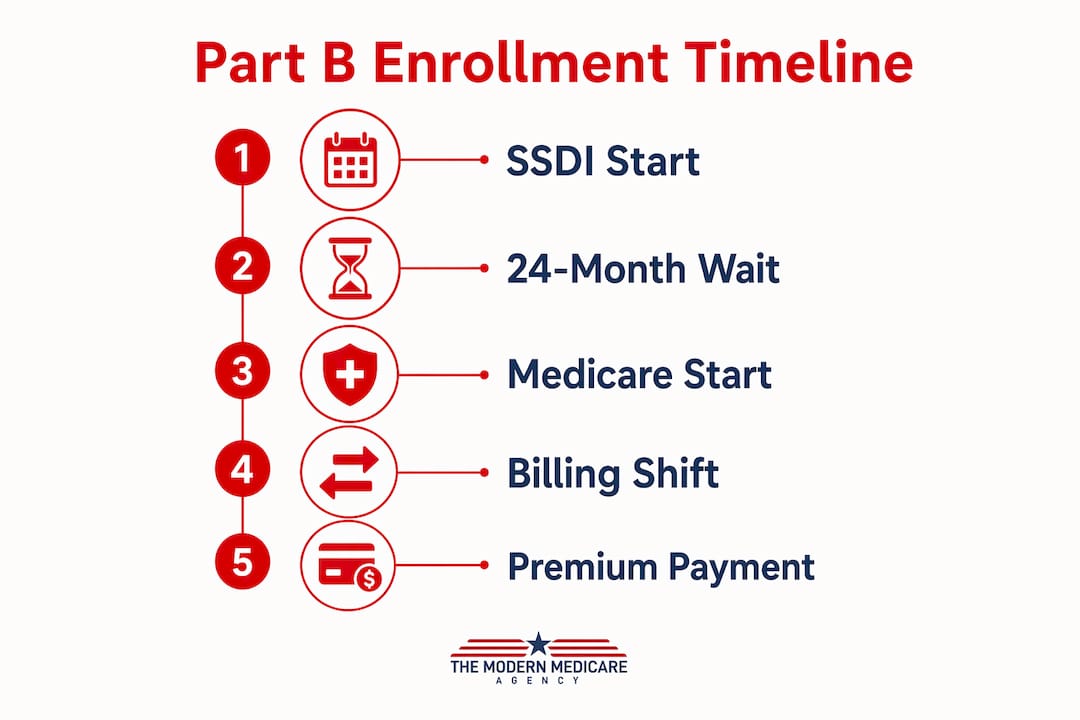
The 2026 standard monthly Part B premium is $202.90, with a $283 annual deductible. Most SSDI recipients have this premium deducted automatically from their monthly benefit check. If your income is above certain thresholds, IRMAA (the income-related monthly adjustment amount) can increase that figure.
Quick facts:
- The standard Part B premium is set annually and is the same for all enrollees, regardless of whether you qualify through disability or age.
- Medicare entitlement for SSDI recipients typically begins on the first day of the 25th month of disability benefit entitlement.
- During the 24-month waiting period, COBRA, Marketplace plans, and Medicaid are your main coverage options.
- IRMAA applies to disability enrollees the same way it applies to age-based enrollees.
For a deeper look at Medicare eligibility under 65, Paulbinsurance has a full guide covering the timelines in detail.
Table of Contents
- How Part B premiums are calculated and funded
- What actually differs for SSDI recipients: timing and billing
- How to cover the 24-month gap before Medicare begins
- How IRMAA affects your Part B premium on disability
- Exactly how Part B premiums get billed and paid
- Current Part B costs and where to verify official rates
- Your step-by-step checklist for Part B on disability
- Key Takeaways
- What I’ve learned helping disabled clients navigate Part B
- How Paulbinsurance helps you plan for Part B on disability
- Authoritative sources to verify current rules and rates
How Part B premiums are calculated and funded
CMS sets the standard premium each year by estimating total Part B spending and enrollment. The math is straightforward: enrollee premiums cover about 25% of Part B program costs, with the federal government funding the remaining 75% through general revenue. That funding split is why the premium feels relatively modest compared to what the program actually spends per beneficiary.
Stat to know: Your $202.90 monthly premium covers roughly one-quarter of what Medicare Part B actually costs to run. Federal general revenue picks up the rest.
Because CMS must re-estimate spending and enrollment every year, premiums can shift. Recent increases reflect projected price changes and utilization trends, as explained by CMS. One nuance worth knowing: the hold-harmless rule protects most Social Security recipients from premium increases that would reduce their net benefit check. Beneficiaries who pay via direct billing don’t have that protection and can see different year-to-year changes.
What this means for you:
- Premiums rise when Medicare spending rises, not because of your health status.
- If you’re billed directly (not via SSDI deduction), budget for potential annual increases.
What actually differs for SSDI recipients: timing and billing
The premium amount is identical, but two things genuinely differ for people on disability: when Medicare starts and how you get billed.

Medicare entitlement begins on the first day of your 25th month of disability benefit entitlement. That means a full two-year wait from when SSDI payments begin before Part B coverage kicks in. Your Initial Enrollment Period (IEP) opens three months before that 25th month and closes three months after.
Billing works differently depending on your benefit status. While you’re receiving SSDI cash benefits, SSA deducts Part B premiums automatically from your monthly check. If you return to work and your SSDI cash benefits stop, billing shifts to direct quarterly invoices. Critically, you remain eligible for Part B for at least 8.5 years after SSDI stops, as long as you still meet disability rules. Missing a quarterly bill during that period is one of the most common reasons people accidentally lose Part B coverage.
Key billing facts:
- Automatic deduction from SSDI check while receiving cash benefits.
- Quarterly direct billing when SSDI cash stops (return to work or other reasons).
- Keep your mailing address and contact info current with SSA to avoid missed bills.
Pro Tip: Set a calendar reminder for the month your SSDI status changes. That’s when billing shifts, and a missed quarterly bill can trigger a coverage lapse.
How to cover the 24-month gap before Medicare begins
The coverage cliff is the main practical problem for younger disabled beneficiaries. You’re approved for SSDI, but Medicare won’t start for two years. Here are your realistic options:
| Option | Best for | Key tradeoff |
|---|---|---|
| COBRA continuation | Recently lost employer coverage | Expensive; higher than standard premium |
| Spouse/employer group plan | Those with a working spouse or new employer | Best value if available |
| ACA Marketplace plan | Most SSDI recipients | Income-based subsidies available; SSDI counts as income |
| Medicaid | Lower-income individuals | Free or very low cost; eligibility varies by state |
| Short-term private coverage | Bridging a short gap only | Limited benefits; not a long-term solution |
SSDI recipients often use COBRA, Marketplace, or Medicaid during the waiting period. The right choice depends heavily on your income, state, and whether you have access to a group plan.
Numbered action steps for the coverage gap:
- Contact HR or your former employer within 60 days of losing coverage to elect COBRA.
- Check Marketplace eligibility at Healthcare.gov; SSDI income qualifies for subsidies.
- Apply for Medicaid through your state agency if income is limited.
- Confirm your Medicare entitlement start date with SSA so you know exactly when to transition.
- Review Medigap options for under-65 enrollees before your Medicare start date.
Pro Tip: Medigap guaranteed-issue rights for under-65 enrollees vary by state. Some states require carriers to offer Medigap to disabled beneficiaries; most don’t. An independent broker can identify which options exist in your state before your Medicare start date.
How IRMAA affects your Part B premium on disability
IRMAA is purely income-based. It applies equally to disability and age-based enrollees. SSA uses your Modified Adjusted Gross Income (MAGI) from your IRS tax return two years prior to determine whether a surcharge applies. For 2026, individuals with MAGI above $109,000 (or $218,000 for joint filers) pay more than the standard $202.90.
The 2026 IRMAA brackets for full Part B coverage:
| Individual MAGI | Joint MAGI | Total Monthly Premium |
|---|---|---|
| Up to $109,000 | Up to $218,000 | $202.90 |
| Above $109,000 | Above $218,000 | — |
If your income dropped due to retirement, disability onset, divorce, or another qualifying life event, you can appeal the IRMAA determination directly with SSA using Form SSA-44. Successful appeals require documentation: tax returns, a separation agreement, a termination letter, or similar proof. For Part D IRMAA, the same income thresholds apply; see Paulbinsurance’s Part D IRMAA guide for details.
Pro Tip: Pull your most recent tax return before calling SSA about IRMAA. The agent will ask for your MAGI figure. Having it ready cuts the call time significantly.
Exactly how Part B premiums get billed and paid
Three billing scenarios cover almost every SSDI recipient:
- Automatic SSDI deduction: SSA deducts the premium before depositing your benefit. No action needed; you’ll see it on your benefit statement.
- Direct quarterly billing: When SSDI cash stops, CMS bills you every three months. Missing one bill can trigger a Part B termination notice.
- Medicare Easy Pay: An automatic bank-draft option available through Medicare. You authorize a recurring debit, and premiums are pulled on a set schedule.
Setting up Medicare Easy Pay is the single best way to prevent accidental lapses when billing shifts from SSDI deduction to direct billing. Call 1-800-MEDICARE or visit Medicare.gov to enroll.
Pro Tip: Update your address with SSA any time you move. Quarterly bills go to your address of record. A returned bill doesn’t pause the clock on your payment deadline.
Current Part B costs and where to verify official rates
The two figures every SSDI recipient should know for 2026:
| Cost item | 2026 amount |
|---|---|
| Standard monthly Part B premium | $202.90 |
| Annual Part B deductible | $283 |
These figures come directly from CMS’s 2026 premium fact sheet. The standard premium rose $17.90 from $185.00 in 2025. For the most current rates in future years, check Medicare.gov or CMS.gov directly; rates are announced each fall for the following year.
Beneficiaries who are dually eligible for both Medicare and Medicaid may have their Part B premium paid by their state Medicaid program. If you think you qualify, contact your state Medicaid office.
Your step-by-step checklist for Part B on disability
- Confirm your SSDI entitlement date. Call SSA at 1-800-772-1213 or log into your My Social Security account. Your Medicare start date is the first day of month 25.
- Identify your billing method. Are you currently receiving SSDI cash? If yes, premiums will be deducted automatically. If not, set up Medicare Easy Pay.
- Pull your most recent tax return. Check your MAGI. If it exceeds $109,000 (individual) or $218,000 (joint), expect an IRMAA notice.
- Plan stopgap coverage if you’re still in the 24-month wait. Decide between COBRA, Marketplace, or Medicaid based on your income and state.
- Research Medigap availability in your state before your Medicare start date. Options for under-65 enrollees are limited; start early.
- File an IRMAA appeal if your income dropped. Use Form SSA-44 and attach documentation of the life-changing event.
- Keep SSA contact info current. Address, phone, and bank details should be updated immediately after any change.
Documents to have ready: Two most recent tax returns, SSDI award letter, proof of any life-changing event (termination letter, divorce decree, etc.), and your Medicare card or entitlement notice.
Pro Tip: When calling SSA, ask specifically for your “Medicare entitlement date” and your “current billing method.” Those two data points answer 80% of the questions in this checklist.
Key Takeaways
People on SSDI pay the same standard Part B premium as age-based enrollees, face a 24-month wait before Medicare begins, and must plan proactively for billing changes and IRMAA exposure.
| Point | Details |
|---|---|
| Premium parity | SSDI recipients pay the same $202.90 standard monthly premium as age-based enrollees in 2026. |
| 24-month waiting period | Medicare Part B entitlement begins the first day of the 25th month of disability benefit entitlement. |
| IRMAA is income-based | Individuals with MAGI above $109,000 pay surcharges; appeal with SSA if income dropped. |
| Billing can shift | Premiums deduct from SSDI automatically; when SSDI cash stops, quarterly direct billing begins. |
| Paulbinsurance | Independent agents at Paulbinsurance help SSDI recipients compare Medigap, Advantage, and coverage-gap options at no cost. |
What I’ve learned helping disabled clients navigate Part B
Most people on SSDI come to us expecting a discount or a separate premium structure. Clearing that up early saves a lot of frustration. The real complexity isn’t the premium amount; it’s the timing and the billing shift.
The 24-month wait catches people off guard more than anything else. Someone gets approved for SSDI, assumes Medicare starts soon, and skips COBRA. Two years later they’ve had a coverage gap, possibly a denied claim, and now they’re scrambling. The fix is simple: treat the Medicare start date as a hard deadline and work backward from it.
IRMAA is the other blind spot. Disability doesn’t exempt you from income-based surcharges. A beneficiary who had a high-income year two years before their Medicare start date can owe hundreds more per month. The appeal process works when income genuinely dropped, but the documentation has to be clean. Tax returns, award letters, and any proof of the triggering event. Agents who handle this regularly know exactly what SSA wants to see.
For Medigap under 65, the honest answer is that most states don’t require carriers to offer it. A handful do. Knowing which states and which carriers requires someone who works these cases regularly, not a quick Google search.
How Paulbinsurance helps you plan for Part B on disability
Sorting through the 24-month wait, IRMAA exposure, and Medigap availability on your own is genuinely difficult. Paulbinsurance’s independent agents do this work every day for SSDI recipients who need a clear picture of their costs and options before Medicare starts.

A consultation with Paulbinsurance covers your Medicare entitlement date, current billing method, IRMAA exposure based on your tax return, and a comparison of Medicare Supplement and Advantage options available in your state. For under-65 enrollees, agents identify which Medigap carriers operate in your state and whether Medigap for disabled beneficiaries is a realistic option. No obligation, no pressure. Call Paulbinsurance or visit paulbinsurance.com to schedule a free review.
This article is general information, not professional legal, medical, or financial advice. Verify current rates and rules with CMS, SSA, or a licensed Medicare advisor for your specific situation.
Authoritative sources to verify current rules and rates
- Social Security Administration (SSA): IRMAA determinations, billing methods, appeals, and SSDI eligibility rules.
- CMS / Medicare.gov: Official annual premium and deductible tables; updated each fall for the following year.
- MedPAC: Funding context and premium policy analysis; useful for understanding why premiums change.
- State Medicaid office: Check whether your state pays Part B premiums for dually eligible beneficiaries and what Medigap rules apply to under-65 enrollees.
- HealthCare.gov: Marketplace options and subsidy eligibility during the 24-month SSDI waiting period.
Keep your two most recent tax returns accessible. SSA and CMS both reference prior-year MAGI for IRMAA, and having those returns on hand speeds up any appeal or enrollment question significantly. For senior transition resources and local support, Divine Transitions for Seniors offers practical guidance that complements Medicare planning.
Recommended
- Understanding Your Medicare Part B Premium: Key Factors and Tips – The Modern Medicare Agency
- Medicare Disability Benefits Explained: A Clear Guide to Eligibility, Coverage, and Enrollment – The Modern Medicare Agency
- What Is the Medicare Part B Premium in 2026? A Clear Guide to Your Costs
- How Much Does Medicare Part B Cost Monthly? Understanding Your Expenses – The Modern Medicare Agency