




What if the insurance policy you never use is actually the one that gives your family the greatest gift of all? It’s a question many of our clients ask as they look at the rising costs of care in 2026. You’ve worked hard for your retirement. The thought of those savings disappearing into monthly premiums that might never pay out is understandably stressful. You want to be certain that your spouse is protected and that you’ll never become a burden to your children, but the complex terms often make it feel like you’re walking through a fog. Comparing long-term care insurance vs hybrid policies doesn’t have to be a source of anxiety.
We agree that your money should work as hard as you do. This guide clears the air by looking at your options through a lens of simplicity and truth. You’ll discover the clear differences between traditional and hybrid options so you can protect your savings and your family’s future with total confidence. We’ll walk through how 2026 inflation protections work, explain the reality of current premium trends, and help you decide which path leads to your ultimate peace of mind.
Key Takeaways
- Understand why planning is essential in 2026 to keep your retirement savings safe from the rising costs of professional care.
- Learn the core differences between long-term care insurance vs hybrid policies, including how traditional models compare to plans that guarantee a payout.
- Discover how hybrid policies can protect your family’s legacy by providing a death benefit if you never actually need to use the care features.
- Find out how to look at your cash flow to decide between ongoing premium payments or repositioning assets into a single lump sum.
- See how an independent expert with access to 40+ carriers helps you find the right fit without the pressure of a single company’s limited options.
Understanding the Long-Term Care Challenge in 2026
Thinking about the future often brings up a mix of hope and worry. You’ve spent decades building a life and a retirement nest egg. In 2026, the reality of aging has shifted significantly. People are living longer, which is a blessing, but it also means the likelihood of needing some form of help grows every year. The rising demand for professional care and labor shortages have made these services more expensive than ever. Without a clear strategy, the cost of home health aides or assisted living can quickly impact a standard retirement portfolio, leaving less for your spouse or your children’s inheritance.
The Rising Need for a Plan
Life expectancy in 2026 continues to rise, but our “healthspan” doesn’t always keep pace. Many of us will eventually face a period where we’re physically healthy but need help with the basics. Long-term care is assistance with daily living, not just medical treatment. The emotional toll of being unprepared is heavy. When there’s no plan in place, the burden of care often falls on adult children who are already balancing their own careers and families. This creates a state of distress for everyone involved. Taking the time to compare long-term care insurance vs hybrid policies now is the best way to move from uncertainty to a place of absolute certainty.
Medicare vs. Long-Term Care Insurance
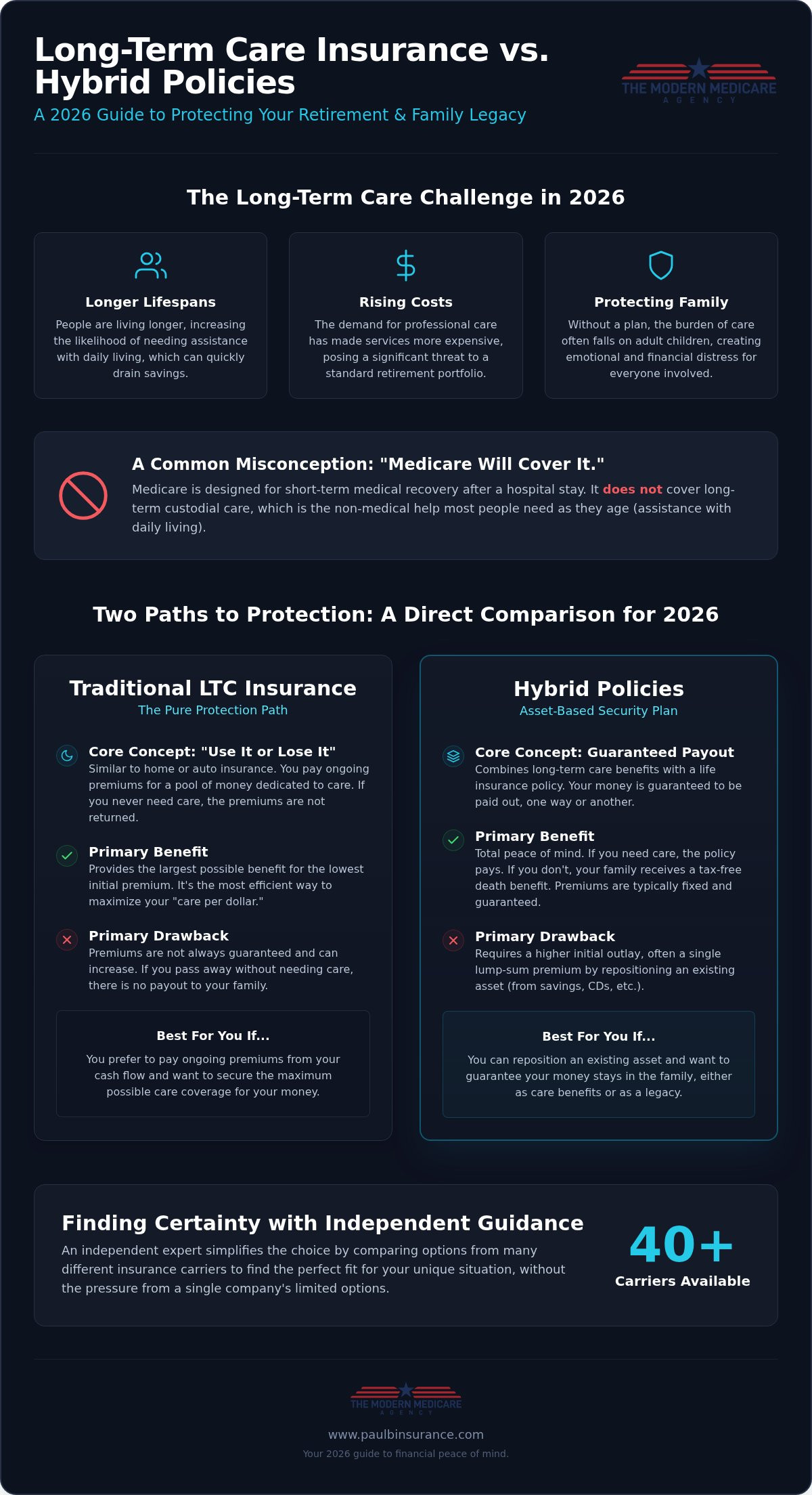
A common misconception we hear is that Medicare will handle everything. It’s an easy mistake to make, but it can be a costly one. Medicare Part A and B are designed for medical recovery, such as short stays in skilled nursing after a hospital visit. While Medicare Supplement Insurance is a vital tool for your health costs, it doesn’t cover custodial care, which is the type of help most people need as they age.
To find a real solution, you have to look at the foundation of Long-term care insurance. Without this specific protection, you might fall into the “Medicaid spend-down” trap. This is a systemic problem where individuals are forced to deplete nearly all their assets just to qualify for government help. It’s a heartbreaking process that we want to help you avoid. Choosing between long-term care insurance vs hybrid policies is about more than just numbers; it’s about deciding whether you want a pure protection model or an asset-based security plan that keeps your money within your family’s reach.
Traditional Long-Term Care Insurance: The Pure Protection Path
Think of traditional long-term care insurance as being similar to your homeowners or auto insurance. You pay a premium to protect yourself against a “what if” scenario. If you never have a fire, you don’t get your home insurance premiums back; you simply enjoyed the protection while you had it. This is the pure protection model. When evaluating long-term care insurance vs hybrid policies, it’s helpful to remember that traditional plans are designed solely to provide a pool of money for care. They use a risk-pooling model where the premiums of many people pay for the care of those who eventually need it.
In the 2026 market, these policies offer significant tax advantages. If you own a small business or are self-employed, your premiums may be tax-deductible as a business expense. Even for individuals, “Tax-Qualified” policies can often be paid for using pre-tax dollars from a Health Savings Account. This makes the pure protection path a very efficient way to guard your retirement assets, especially when integrated with professional tax preparation from Timothy Roberts & Associates, LLC.
Setting up a traditional policy involves making a few key choices. You’ll decide on a daily benefit amount and how long those benefits should last, known as the benefit period. You also choose an “Elimination Period,” which is essentially the insurance version of a deductible. It’s the number of days you’ll pay for care out of your own pocket before the insurance company starts sending checks. Traditional policies offer the most “care per dollar” if you actually need the services. They provide the largest possible benefit for the lowest initial premium outlay.
The Pros and Cons of Pure LTC
The primary benefit of this path is the lower initial cost. It allows you to secure a large amount of coverage without tying up a lot of cash. However, there’s the “Use It or Lose It” reality. If you pass away without ever needing care, the insurance company keeps the premiums. This can lead to a feeling of anxiety for some, who worry they might be “wasting” money.
Another factor in 2026 is premium flexibility. Unlike some other plans, traditional policy premiums aren’t always guaranteed. While insurers can’t single you out for a rate hike, they can raise prices for an entire group of policyholders if care costs rise faster than expected. To combat this, most people include a 2026-standard inflation rider to ensure their benefit pool grows as the cost of care increases. If you’re feeling a bit lost in these details, you can always connect with an independent expert who can help you weigh these trade-offs with total clarity.
Hybrid Policies: Combining Life Insurance with Care Security
Hybrid policies represent a significant shift in how people approach future security in 2026. While traditional plans focus only on care, hybrids are a marriage of life insurance and long-term care. This combination addresses the biggest fear many of our clients face: the worry that they’ll pay premiums for years and get nothing back. It’s a solution that values your money whether you need care or not.
The core appeal is the “Live, Die, or Quit” guarantee. If you live and need care, the policy pays for your services. If you pass away without ever needing help, your beneficiaries receive a death benefit. Even if you change your mind and decide to cancel the policy, most plans allow you to walk away with a portion of your premiums. This certainty is why the debate of long-term care insurance vs hybrid policies often leans toward the hybrid side for those with available assets.
Premium stability is another major draw. In the 2026 market, many traditional policies still carry the risk of future rate increases. Hybrid plans, however, typically offer “locked-in” rates. You know exactly what you’ll pay from day one. This removes the anxiety of a surprise bill during your retirement years and allows for more accurate budgeting.
The Asset-Based Approach
These plans are often funded differently than monthly insurance bills. Hybrid policies are essentially ‘repositioning’ an existing asset like a CD or savings account. You might choose to move a single lump sum into the policy or use a 10-year pay plan to fully fund the coverage. If you use some care benefits but pass away before the pool is empty, the remaining balance is paid out as a death benefit. It’s a methodical way to ensure your money stays in your family’s hands.
Why Hybrid is Trending in 2026
The psychological comfort of these plans is hard to overstate. Knowing your money isn’t “wasted” if you stay healthy provides immense peace of mind. These strategies often work hand-in-hand with broader Life Insurance planning. By choosing a hybrid path, you’re not just buying a product; you’re creating a legacy that protects your spouse while ensuring your children aren’t burdened by the rising costs of care. To ensure your assets are fully protected through professional estate planning, check out Law Offices of Robert P. Bergman. It’s a journey from distress to total certainty.
Deciding on a path to protect your future comes down to two things: your current cash flow and your goals for your family. In 2026, we see two very different financial personalities emerge. Some people prefer to pay as they go, keeping their extra savings liquid for other uses. Others have “lazy money” sitting in low-interest accounts and want to put it to work. When you compare long-term care insurance vs hybrid policies, you’re really deciding how you want your capital to behave over the next twenty years.
Traditional policies generally provide the most “care per dollar” because they’re designed for one job only. They’re often the best fit for the budget-conscious retiree who wants the highest possible monthly benefit for the lowest annual cost. Hybrid policies, however, win on legacy impact. They’re for the person who says, “I want to know my family gets something back if I stay healthy.” Both options in 2026 offer robust inflation protection, though traditional plans often allow for more customization in how that benefit pool grows to meet rising care costs.
Which Policy Fits Your Financial Personality?
Your financial goals dictate the right choice. If you’re legacy-focused, you’ll likely appreciate how a hybrid plan keeps your money within your estate. If you’re strictly looking for the most efficient way to pay for a nursing home or home health care, the traditional route is often more powerful. Here is how the three main options in 2026 compare at a glance:
| Feature | Traditional LTC | Hybrid Life | Hybrid Annuity |
|---|---|---|---|
| Payment Type | Annual Premiums | Lump Sum or 10-Pay | Asset Transfer |
| Death Benefit | None | Included | Account Balance |
| Premium Stability | Can Change | Guaranteed Locked | Guaranteed Locked |
The 2026 Underwriting Landscape
Getting approved for coverage is different than it was a decade ago. In 2026, insurance companies use integrated digital medical records to make decisions much faster. Traditional policies still usually require a more detailed health history because the insurance company is taking on more risk. Hybrid plans, especially those built on annuities, often have more lenient “simplified issue” standards. This makes them a great option for those with minor health hiccups. It’s vital to remember that you buy insurance with your health, not just your money. If you’re ready to see how these numbers look for your specific situation, you can request a personalized comparison from our team to find your best fit.
Finding Certainty: How an Independent Broker Simplifies the Choice
The journey to securing your future can feel like walking through a thick fog. Many people start by talking to a “captive” agent. These are representatives who work for just one insurance company. Their job is to sell you that company’s specific product, whether it’s the best fit for you or not. This is a systemic problem that often leads to retirees choosing a plan that doesn’t actually align with their goals. We believe you deserve better than a one size fits all answer.
At The Modern Medicare Agency, we take a different path. Paul Barrett and our team function as independent advocates. We don’t work for the insurance companies; we work for you. Because we have access to 40+ carriers across 34+ states, we can objectively compare long-term care insurance vs hybrid policies from the entire market. This independence is the key to finding a plan that protects the retirement you worked so hard for. We move you from a state of distress to one of absolute certainty by showing you every available option.
The Independent Advantage
Choosing a policy isn’t just about the lowest price. It’s about finding a carrier that has a strong history of reliability and fair claims processing in 2026. We provide unbiased education instead of high-pressure sales tactics. Our goal is to simplify the complex so you can make a choice with confidence. We also provide year-round support long after your policy is in force. If your needs change or you have questions about your coverage, we are here to help.
One detail most people miss is how their care plan interacts with their health insurance. Your strategy must talk to your Medicare Advantage Plan. While Medicare doesn’t pay for long-term custodial care, your health plan choice affects your out of pocket costs for medical treatments while you are receiving care. We look at the whole picture to ensure there are no gaps in your safety net. This holistic approach is why our clients feel so much more secure.
Your Next Steps Toward Peace of Mind
You don’t have to figure this out alone. The right plan is the one that lets you sleep at night, knowing your spouse is protected and your savings are secure. We invite you to have a personal conversation where we look at your specific numbers without the stress or the jargon. It’s a simple, methodical process that puts you back in control of your family’s future. Schedule your simple, no-pressure consultation with Paul Barrett today and take the first step toward true peace of mind.
Your Path to a Certain Future
Choosing between long-term care insurance vs hybrid policies doesn’t have to be a source of stress. You now understand that traditional plans offer the most efficient protection for your care, while hybrid options provide a guarantee that your assets stay with your loved ones. The right choice for your 2026 retirement plan depends entirely on your personal goals and cash flow needs. Whether you prioritize pure protection or a lasting legacy, there’s a solution that fits your life perfectly.
You don’t have to navigate these complex systems alone. As an independent broker with access to 40+ carriers, we provide the jargon-free guidance you need to feel confident. We offer personalized support across 34+ states to ensure your journey leads to total peace of mind. Let Paul Barrett guide you to the right choice; click here for a free, simple comparison of your LTC options. You’ve worked hard for your savings; it’s time to make sure they’re protected for the years ahead.
Frequently Asked Questions
Is long-term care insurance worth it in 2026?
Long-term care planning is essential in 2026 because living longer shouldn’t mean losing your savings. With the rising costs of professional care, having a plan ensures your spouse stays protected. Whether you choose long-term care insurance vs hybrid policies, the value lies in the certainty that you won’t be a burden to your children. It’s about protecting the retirement you worked hard for and maintaining your independence as you age.
Can I use a hybrid policy to pay for home health care?
Yes, hybrid policies are very flexible and typically cover home health care services. Many people prefer to receive help in the comfort of their own home rather than in a facility. These plans allow you to pay for professional caregivers who assist with daily activities like dressing or meal preparation. This versatility makes hybrids a popular choice for those who want to maintain their current lifestyle while ensuring they have professional support.
What is the average cost of a hybrid long-term care policy?
The cost of a hybrid policy depends on your age, health, and the benefit amount you choose. Research from the American Association for Long-Term Care Insurance shows that premiums can vary by over 56% between different insurers for comparable protection. Because these plans combine life insurance with care coverage, they often require a larger upfront payment than traditional options. We recommend comparing quotes from the 40+ carriers we work with to find a plan that fits your specific budget.
Does Medicare Part D cover any long-term care costs?
Medicare Part D is designed specifically for prescription drug coverage and does not pay for long-term care services. While it might help cover the cost of medications you take while receiving care, it won’t pay for a home health aide or a stay in an assisted living facility. Understanding these gaps in Medicare is a vital part of the journey from confusion to a finalized, secure plan for your future.
How do I know if I’ll qualify for LTC insurance with a pre-existing condition?
Qualification depends on the specific rules of each insurance carrier. In 2026, companies use digital medical records to review your history quickly. If you have a pre-existing condition, an independent broker can help by shopping your application across 40+ different carriers. This gives you a much better chance of finding a company with lenient underwriting for your health profile. It’s always best to apply while you’re healthy to secure the best possible rates.
What happens to my hybrid policy if I decide I don’t want it anymore?
One of the biggest benefits of a hybrid policy is the return of premium feature. If your situation changes and you decide you no longer need the coverage, many plans allow you to cancel and receive a portion of your premiums back. This removes the fear of wasting money on a policy you might not use. It’s a key part of the guarantee that provides such immense peace of mind for our clients.
Can I use my 401(k) or IRA to fund a hybrid long-term care plan?
You can use retirement funds to pay for your plan, but it’s important to understand the tax rules. Withdrawing money from a 401(k) or IRA to pay premiums is generally treated as taxable income. However, some people choose to reposition these assets because they want the leverage that insurance provides. We can help you look at how these payments impact your overall strategy and ensure your spouse remains protected without creating an unnecessary tax burden.

Article by
Paul Barrett
Paul Barrett, CMIP is the founder of The Modern Medicare Agency, an independent Medicare-only brokerage based in Melville, NY. With 18 years of Medicare-exclusive experience, a CMIP designation, and more than 5,000 clients served across 37 states, Paul is one of the most credentialed independent Medicare specialists on Long Island — and one of the most direct.
He represents 40+ carriers with no quotas and no allegiances, which means his recommendations are based entirely on what fits each client's specific situation. He is the author of Medicare Mastery Unlocked and host of the Wise Guys Retirement Talk podcast. His content is grounded in primary sources, real carrier intelligence, and 18 years of watching what happens when people get Medicare right — and when they don't.
📞 631-358-5793 | paulbinsurance.com