
Yes, an annuity for long term care can work, either as a standalone LTC rider on a deferred annuity or as a hybrid annuity-LTC product that pays out multiple times your original premium if you need care. These contracts combine income or death-benefit protection with a dedicated care fund. But tax rules and Medicaid asset limits can undo the benefit if the contract is structured wrong, so this is not a decision to make without a licensed agent or elder-law planner.
TL;DR:
- Annuities for long-term care are complex products that can offer significant benefits but require careful structuring to avoid tax and Medicaid eligibility issues.
- Hybrid annuity-LTC products often provide a benefit multiplier of two to three times the premium, with remaining value passing to beneficiaries if care is not needed.
- Immediate annuities are suitable for those needing quick care funding, while deferred annuities fit healthier individuals planning for future needs before age 75 or 80.
- Properly structured products can maximize care funds and inheritance benefits, but poor design may lead to reduced payouts or Medicaid disqualification.
- Consulting with a qualified professional and reviewing detailed illustrations ensures the product matches your health, savings, and Medicaid planning needs.
Table of Contents
- How Annuities and LTC Riders Actually Work
- Types of Annuities Used to Fund Long-Term Care
- Weighing the Pros and Cons Before You Buy
- Tax Rules, Medicaid, and What Medicare Won’t Cover
- What to Ask Before You Sign Anything
- What the Numbers Actually Look Like
- An Education-First Take on Annuity-Funded Care
- How Paulbinsurance Can Help You Sort This Out
- Sources
- FAQ
How Annuities and LTC Riders Actually Work
An annuity is a contract with an insurance company where you hand over money, either as a lump sum or over time, in exchange for future payments. Immediate annuities convert that lump sum into guaranteed income right away, usually starting within a year. Deferred annuities let the money grow first, with income (or care benefits) triggered later, often years down the road. The Administration for Community Living explains both structures as legitimate tools for covering long-term care costs.
An LTC rider is an add-on to an annuity or life insurance policy. It does not replace standalone long-term care insurance, but it activates a stream of care-designated money once you meet the contract’s definition of needing help. Most riders trigger when you cannot perform two or more activities of daily living without assistance, things like bathing, dressing, or eating, or when a doctor certifies you as chronically ill.
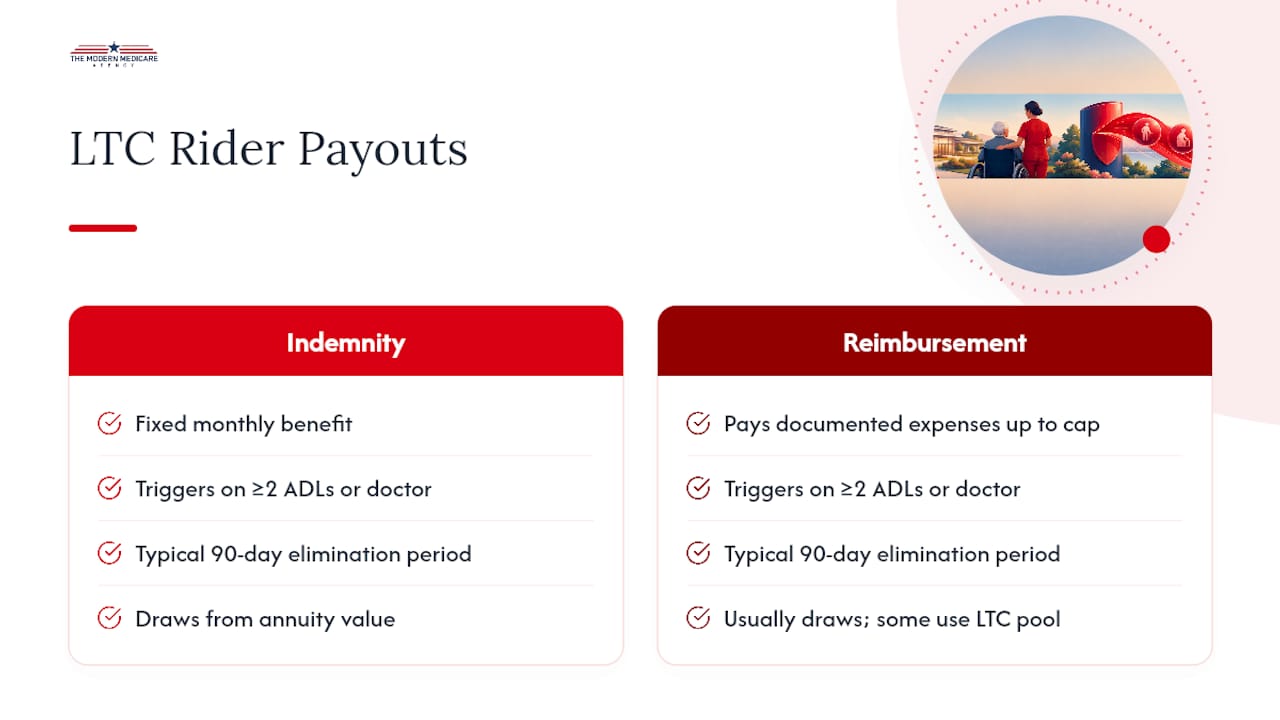
Once triggered, payouts fall into two camps. Indemnity payouts hand you a set monthly amount regardless of your actual care bills. Reimbursement payouts only cover documented expenses up to the cap. Either way, most contracts apply a monthly or daily benefit cap, and nearly all have an elimination period, typically 90 days, during which you pay out of pocket before benefits kick in.
As benefits get paid, the annuity’s account value usually depletes accordingly, though some hybrid designs draw from a separate LTC pool that extends well beyond the base contract value. Inflation riders exist on some products to increase that monthly cap over time, but they add cost and are not universal. Read the rider language carefully. Two products with the same headline multiplier can pay out very differently once you factor in caps, waiting periods, and how account value gets drawn down.
Types of Annuities Used to Fund Long-Term Care
Immediate annuities with LTC features work best for people who already need care or expect to soon. You hand over a lump sum, and the insurer starts paying out right away, sometimes with a boosted, tax-favored payment specifically because you qualify as chronically ill. This suits someone in their late 70s or 80s who has cash sitting in a CD or savings account and wants to convert it into guaranteed income before a health event forces the issue.
Deferred annuities with LTC riders fit a different buyer, usually someone in their 60s who is still healthy but wants to lock in future care coverage while underwriting is easier. Age limits typically cap new applicants somewhere between 75 and 80, and underwriting for the rider itself is often simplified compared to standalone long-term care insurance, sometimes just a health questionnaire rather than a full medical exam.
Hybrid annuity-LTC products are where most of the market has moved. These contracts commonly offer a benefit multiplier, often two to three times the base contract value, that only activates if you need qualifying care. If you never need care, the remaining account value typically passes to your beneficiaries as a death benefit instead of vanishing, which is the single biggest structural difference from standalone LTC insurance, where unused premiums are gone.
Standalone long-term care insurance policies, by contrast, are pure risk products. Premiums are usually lower per dollar of coverage, but there is no cash value and no death benefit if you never file a claim. The National Association of Insurance Commissioners has flagged that hybrid products, while attractive for their leverage and fallback death benefit, come with real complexity that standalone policies do not carry.
Weighing the Pros and Cons Before You Buy
An annuity-based LTC strategy earns its place for some buyers and misses the mark for others, depending on health, cash position, and how much flexibility matters to you.
The case for it:
- If you never need care, the money (or a death benefit) usually goes to your heirs instead of disappearing, unlike a lapsed LTC insurance premium.
- Your premium is typically locked in at purchase, with no future rate increases the way standalone LTC policies are known for.
- Underwriting is often simpler than qualifying for a fully underwritten LTC policy, which matters if you have a manageable health condition.
- Many contracts pair the LTC rider with guaranteed lifetime income, so you get retirement income and care protection in one product.
The case against it:
- Surrender charges can run for 7 to 10 years or longer, so this is not money you can access penalty-free if your plans change.
- Because a portion of your premium funds the death-benefit guarantee, the growth rate on the underlying annuity is often lower than a pure investment allocation.
- Benefit triggers are contractual and specific. If your situation does not meet the exact ADL or chronic-illness definition, the rider will not pay.
- Monthly caps and total benefit duration limits mean a severe, long-lasting care need can outlast what the contract provides.
Someone with $100,000 to $300,000 in liquid, non-essential savings and a family history of cognitive decline is often a strong candidate. Someone who needs every dollar liquid for other goals, or who is uninsurable for reasons unrelated to LTC risk, may be better served by comparing standalone long-term care insurance against Medicare directly.
Pro Tip: Ask the carrier to run an illustration assuming you never file a claim. If the guaranteed death benefit and cash value look weak in that scenario, the product is leaning too hard on the LTC multiplier to justify its cost.
Tax Rules, Medicaid, and What Medicare Won’t Cover
Get this part wrong and the tax or eligibility consequences can erase the benefit you thought you were buying.
The Pension Protection Act changed how the IRS treats combination annuity-LTC contracts. Since 2010, you can generally move money from an existing annuity into a qualified LTC contract or rider through a §1035 exchange without triggering immediate tax on the gain, provided the LTC portion meets the requirements under Internal Revenue Code §7702B. That is a meaningful shift from older rules, where LTC benefits paid from a nonqualified annuity’s gains could be taxed as ordinary income.
An IRS private letter ruling confirms the Service has recognized certain LTC riders as qualifying insurance features under §7702B, meaning benefits paid out can be excludable from gross income under §104(a)(3) when the contract is structured correctly. Private rulings apply to the specific taxpayer who requested them, not as a blanket rule for every product, but they show the IRS’s general direction on how these hybrids get treated.
Medicaid is the bigger landmine. Annuities are typically counted as an available asset for Medicaid eligibility purposes unless they meet strict state and federal structuring rules, things like being irrevocable, non-assignable, and actuarially sound. Buy the wrong product, or buy the right product the wrong way, and you can inadvertently disqualify yourself or a spouse from Medicaid coverage for months. This is exactly the kind of situation where coordinating with an elder-law attorney on Medicaid-aware trust planning alongside your insurance agent pays for itself.

It is also worth restating plainly: Medicare does not pay for long-term custodial care. It covers short-term skilled nursing after a hospital stay, not ongoing help with bathing, dressing, or eating at home or in a facility. That gap is precisely why annuities, LTC insurance, and Medicaid planning exist as separate conversations from your Medicare enrollment decisions, even though they often need to happen in the same year.
What to Ask Before You Sign Anything
Getting a clear answer on how any product actually pays out means asking the right questions and reading the right documents, not just trusting a colorful brochure.
- What is the exact benefit multiplier, and does it apply to the full premium or only a portion of it?
- What is the monthly or daily benefit cap, and how does that compare to average care costs in your state?
- How long is the elimination period, and can you use other coverage (like a Medicare Supplement plan) to bridge that gap?
- Is there an inflation option, and what does it cost annually against the base premium?
- What is the full surrender charge schedule, not just the headline number for year one?
- How does a paid claim affect the death benefit left for your beneficiaries?
- What are the underwriting limits by age, and does your current health disqualify you from certain riders?
Require the carrier to hand over the complete policy illustration and the full rider text, not a summary sheet. If an agent hesitates to provide either, or pushes you toward a decision before you have reviewed both documents with a second set of eyes, treat that as a red flag. The NAIC has specifically called out unclear disclosures around surrender periods and interest-crediting as a recurring consumer problem in this product category.
Pro Tip: Run the illustration twice: once assuming average interest crediting, once assuming the minimum guaranteed rate. If the LTC benefit shrinks dramatically under the guaranteed scenario, you are relying on optimistic assumptions that may not hold.
What the Numbers Actually Look Like
A single premium of a moderate amount into a hybrid product with a typical LTC multiplier could create a total care-eligible fund several times the initial premium. If the contract caps monthly benefits at a set limit, that fund could stretch for several years, assuming maximum use and no inflation adjustment.
Larger premiums under the same multiplier structure can generate substantially larger care funds. However, a higher premium does not always lead to a proportionally higher monthly cap because some carriers cap monthly benefits at a fixed percentage of the total pool. This often results in a higher monthly cap but a similar total benefit duration compared to smaller premiums.
When you read any illustration, focus on these lines specifically:
- The monthly or daily benefit cap in dollars, not just the multiplier percentage
- The elimination period in days before any benefit begins paying
- Whether the payout is indemnity (fixed amount) or reimbursement (receipts required)
- How claims paid reduce the remaining death benefit and account value
- Whether nonforfeiture protections exist if you stop paying premiums early
For a deeper walkthrough of these calculations with more scenarios, Paulbinsurance’s guide on using an annuity to fund long-term care breaks down several premium tiers side by side.
An Education-First Take on Annuity-Funded Care
Paul Barrett has helped Medicare consumers navigate exactly these kinds of decisions since 2007, and the pattern he sees most often is people buying an LTC rider in isolation, without ever checking how it interacts with their Medicare Supplement plan or their Medicaid contingency plan. That is backwards. Annuities, Medicare, and Medicaid are three separate systems with three separate rulebooks, and a good decision on one can quietly wreck your standing on another.
The education-first approach means walking through the full picture before recommending a product: your current Medicare coverage, your health trajectory, your family’s care history, and your actual liquid assets, not just the one contract an agent happens to sell that month. A rider that looks generous on a sales brochure can look very different once you factor in what it does to your Medicaid eligibility five years from now.
— Paul
How Paulbinsurance Can Help You Sort This Out
An independent brokerage with access to multiple carriers can provide annuity or long-term care recommendations not limited to a single insurance company’s products.

That independence matters most in a category this complicated, where the “best” product depends entirely on your age, health, existing coverage, and Medicaid contingency, not on a one-size-fits-all pitch. A consultation typically starts with a review of your current Medicare Supplement or Medicare Advantage coverage, your income sources, and any existing life insurance or annuity contracts you already hold, so bring recent statements and policy documents if you have them. From there, Paulbinsurance can walk you through annuity options built around long-term care and show you how they line up against your Medicare Supplement plan rather than against it. If you are still early in the process and want the full range of Medicare and long-term care coverage options laid out clearly, start with a conversation about your current plan and go from there.
This article is general information, not a substitute for advice from a qualified financial advisor. Consult a qualified financial professional about your own circumstances before acting on anything here.
Sources
- Annuities | Administration for Community Living
- IRS Notice N-11-68 (Interim guidance on PPA amendments affecting LTC and annuities)
- NAIC consumer and policy brief on long-term care insurance and hybrid products
FAQ
Which Annuity Is Best for Long-Term Care Coverage?
There is no single best annuity for long-term care; the right choice depends on your age, health, and whether you want a death-benefit fallback. Hybrid annuity-LTC products with a 2x to 3x multiplier fit people who want leverage and inheritance protection, while immediate annuities with LTC features often suit those who need care funding right away.
Are Long-Term Care Annuities a Good Idea?
They can be, especially for people with $100,000 or more in liquid savings who want care protection without the “use it or lose it” nature of standalone LTC insurance. They are less ideal for anyone who needs full liquidity or who cannot pass underwriting even at the simplified level these riders often require.
How Much Will a $100,000 Annuity Pay Monthly for Care?
It depends entirely on the contract’s multiplier and monthly cap, not a fixed formula. A $100,000 premium with a 3x multiplier and a $5,000 monthly cap could fund benefits for roughly five years before the pool is exhausted, though caps and durations vary significantly by carrier and product design.
How Much Will a $500,000 Annuity Pay Per Month?
Again, this hinges on the specific product’s payout structure rather than the premium alone. A larger premium under the same multiplier structure can generate substantially larger care funds, often with a higher monthly cap, but actual amounts vary and require an illustration to know for certain.
Can Paulbinsurance Help Me Compare Annuity and Long-Term Care Insurance Options?
Yes. Paulbinsurance works with multiple carriers and can walk you through both annuity-based LTC products and standalone long-term care insurance so you see how each fits your existing Medicare coverage and overall financial picture.