
Could two providers leave you with different bills for the same Medicare-covered service? If you’ve been wondering what is medicare assignment and why does it matter, start with whether your provider agrees to accept Medicare’s approved amount as full payment. That agreement can affect how a claim is handled and whether you may owe more than your deductible or coinsurance. Medicare billing terms can feel like a language of their own, but a few focused questions can help clarify what to expect.
In this guide, you’ll learn what accepting assignment means under Original Medicare, how a provider who doesn’t accept it may affect your costs, and what to confirm before care. You’ll also see why Medicare Advantage works differently: these plans typically use their own provider networks and cost-sharing rules, so assignment may not be the main question. By the end, you’ll have practical questions to ask and a clearer way to understand which billing rules apply to your coverage in 2026.
Key Takeaways
- Learn what is medicare assignment and why does it matter, including how a provider’s billing choice can affect what you may owe.
- Understand the difference between participating and non-participating providers, and ask about assignment for the specific service you need.
- Use a checklist to clarify coverage, claim handling, and possible costs before scheduling or receiving care.
- Know why Medicare Advantage members should check their plan’s provider network and cost-sharing rules.
- Remember that accepting assignment can clarify a bill, but doesn’t necessarily mean you’ll owe nothing.
What Is Medicare Assignment and Why Does It Matter? A Plain-English Definition
Medicare billing terms can sound confusing, especially when you’re trying to understand what a visit might cost. Here’s the clear answer: Medicare assignment is an agreement by a provider to accept the Medicare-approved amount as full payment for a covered service. That is the amount Medicare recognizes for the service. You may still owe your share under your coverage rules.
If you’re asking what is medicare assignment and why does it matter, separate two questions: how the provider bills Medicare, and whether Medicare covers the service. Assignment helps explain the first. It doesn’t decide the second, and it doesn’t automatically make care free.
What does accepting assignment mean for a Medicare bill?
With Original Medicare, a provider who accepts assignment agrees to accept the Medicare-approved amount for a covered service and submits the claim to Medicare under that arrangement. The approved amount may differ from the provider’s usual charge. It is the amount Medicare recognizes for that service when it processes the claim.
After the claim is processed, your share depends on applicable coverage rules. You may owe a deductible or coinsurance, for example. The amount can also depend on whether the service is covered and on the details of your coverage. Assignment clarifies the provider’s billing arrangement, but it doesn’t determine your final balance by itself.
Does Medicare assignment mean care is free?
No. Accepting assignment doesn’t remove patient cost-sharing or make a service Medicare covers. A provider may accept assignment for a covered service while you still owe an applicable deductible or coinsurance. If a service isn’t covered, assignment alone doesn’t establish that Medicare will pay for it.
Before care, ask whether the specific service is expected to be covered, whether the provider accepts assignment for it, and what you may owe. These are separate questions, and clear answers can help you avoid surprises. For a broader overview of the Medicare program and its parts, see this background reference. In 2026, the practical takeaway remains simple: confirm both coverage and billing arrangements before care whenever you can.
How Medicare Assignment Works With Participating and Non-Participating Providers
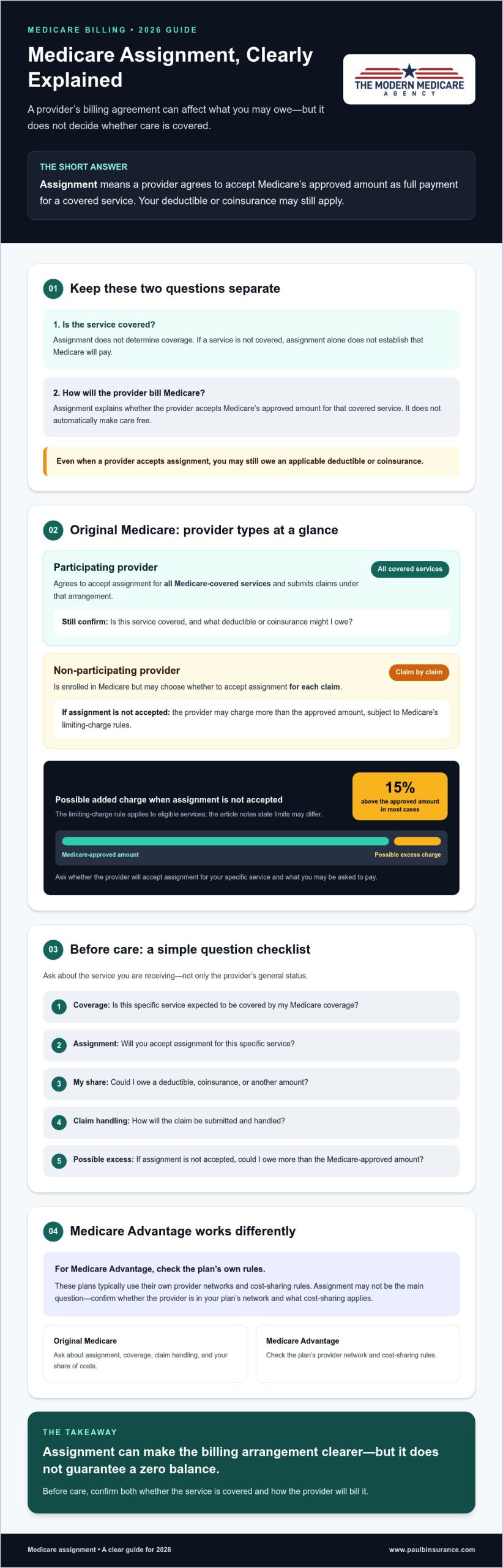
Provider labels are a useful starting point, but they don’t tell you everything about a particular bill. Under Original Medicare, a participating provider agrees to accept assignment for all Medicare-covered services. A non-participating provider is enrolled in Medicare but may decide whether to accept assignment separately for each claim. Ask about the service you’re receiving, not just the provider’s general status.
How participating providers handle assignment
For a covered service, a participating provider accepts the Medicare-approved amount as full payment and submits the claim to Medicare under that arrangement. This gives you a clearer reference point for the provider’s charge. It doesn’t mean you owe nothing: coverage rules, your deductible, and any coinsurance can still affect your share.
What to know about non-participating providers
A non-participating provider may accept assignment for one claim and not another. If they don’t accept it, the provider may charge more than Medicare’s approved amount for a covered service, subject to Medicare’s limiting-charge rules. In most cases, the limit is 15% above the approved amount, though some states may have different limits. Ask whether assignment applies to your specific service and what you may be asked to pay.
| Provider type | Assignment and claim handling | What to ask |
|---|---|---|
| Participating | Agrees to accept assignment for all Medicare-covered services and submits claims under that arrangement. | Is this service covered, and what deductible or coinsurance might I owe? |
| Non-participating | May accept assignment claim by claim. If not, the provider may charge an allowed excess amount under applicable limits. | Will you accept assignment for this specific service? Could I owe more than the Medicare-approved amount? |
This distinction helps answer what is medicare assignment and why does it matter: assignment can affect how a provider bills Medicare and which charges you should clarify before care. It doesn’t determine whether the service is covered or remove your share of covered costs.
If you’re reviewing how coverage choices may relate to your out-of-pocket costs, explore Medicare Supplement (Medigap) plans.
Why Medicare Assignment Matters for Your Bills and Care Decisions
A bill can feel unpredictable when you’re unsure what Medicare will recognize, what the provider may charge, or what part may be yours. Assignment clarifies one part of the picture: how the provider agrees to bill for a covered service. That can help you ask more useful questions before care, but it can’t guarantee a zero balance or tell you the final amount on its own.
Can accepting assignment reduce billing uncertainty?
When a provider accepts assignment, the Medicare-approved amount gives you a clearer reference for the provider’s charge for a covered service. That can make it easier to discuss the bill in advance. It doesn’t necessarily mean you’ll pay less in every situation, and it can’t establish your final responsibility without details about the service and your coverage.
Before an appointment or procedure, confirm:
- Whether the specific service is covered under your Medicare coverage.
- Whether the provider accepts assignment for that service.
- Whether a deductible or coinsurance may apply, and what you may owe.
- Whether you need to check additional rules with Medicare or your plan.
Providers can explain their billing arrangements and share information about expected charges. For coverage questions, confirm with Medicare or your plan, especially if the service is more involved or your coverage has specific conditions. Ask for the service name and billing details in writing when that would help you keep track.
What assignment does not tell you
Assignment is a billing arrangement, not a coverage decision. A provider’s agreement to accept the Medicare-approved amount doesn’t, on its own, prove that Medicare covers the service or that it meets applicable coverage requirements. Check coverage separately before proceeding, particularly if the provider says the service may not be covered.
Even when a service is covered, you may owe a deductible or coinsurance. If you have other coverage, including a Medicare Advantage plan, its cost-sharing and provider rules may also matter. Don’t assume assignment determines whether a provider is in your plan’s network or how your plan handles payment.
In short: assignment explains how a provider bills for a covered service; it doesn’t determine coverage or erase your share of the bill. That distinction answers the heart of what is medicare assignment and why does it matter. Use it as a starting point, then confirm coverage, provider billing, and possible costs before care.
What to Ask a Provider Before a Medicare-Covered Service
A few direct questions can make Medicare billing easier to understand before care, whether you’re scheduling a test, treatment, or office visit. Don’t rely on a provider’s general billing status alone. Confirm how they’ll handle the specific service and what they can tell you about your likely share. Keep notes, too. Clear records can help if a bill later differs from what you expected.
A simple pre-appointment Medicare assignment checklist
Use these questions when you call the provider’s office. If the office can’t confirm an answer, ask who can, or check with Medicare before the service.
- Do you accept Original Medicare? Confirm that the provider accepts Medicare for the care you’re planning to receive.
- Will you accept assignment for this specific service? Ask about the exact visit, test, or procedure, since assignment may depend on the claim.
- Is the service expected to be covered? Ask what the estimate is based on and whether any coverage conditions may apply.
- How will you submit the claim? Ask whether the provider will submit it to Medicare or whether you’ll need to take any steps yourself.
- What might I owe? Ask whether a deductible, coinsurance, or other patient responsibility may apply, and request an estimate in writing if available.
An estimate can help you plan, but it may not be a final bill. Coverage and the amount you owe depend on the service and your circumstances. If you still have questions about coverage or billing, contact Medicare before care when possible. Save the date, the name of the person you spoke with, and their explanation.
What to do if a bill seems unexpected
Start by comparing the provider’s bill with your Medicare Summary Notice when it’s available. Check that the service, dates, and amounts appear to match. A difference doesn’t automatically mean there’s an error, so contact the provider’s billing office and Medicare to ask how the claim was processed and what the amount represents.
Keep copies of the bill, the notice, any written estimate, and notes from calls. These records give you a reference if you need to follow up. Understanding what is medicare assignment and why does it matter can help you ask the right billing questions, but the details of your coverage and claim still matter.
If you’d like help understanding how your Medicare plan type affects provider and cost questions, explore personalized Medicare plan guidance.
Does Medicare Assignment Apply to Medicare Advantage? Know the Difference
Your plan type changes which billing questions to ask. Medicare assignment is principally an Original Medicare billing concept, especially for Part B services. Medicare Advantage plans are offered by private insurers and generally use their own provider networks and cost-sharing rules. Don’t assume Original Medicare assignment rules explain how a Medicare Advantage provider will bill you.
How Original Medicare and Medicare Advantage differ here
With Original Medicare, assignment describes a provider’s agreement to accept the Medicare-approved amount for a covered service. With Medicare Advantage, start with your plan’s rules instead. Check whether the provider is in network, whether the service is covered under your plan, and what cost-sharing may apply. Out-of-network care may be treated differently, depending on the plan.
For example, before an appointment, a Medicare Advantage member should ask the provider whether they work with the specific plan, then confirm coverage and expected costs with the plan. A provider’s general statement that they “take Medicare” may not answer those plan-specific questions. You can find broader context in this Medicare Advantage guide.
If you have Original Medicare with supplemental coverage, review how your coverage works together before assuming it will pay a particular amount. Medicare Supplement (Medigap) plans can help with certain out-of-pocket costs, but benefits depend on the plan and situation. The assignment arrangement and your supplemental benefits are separate questions.
When personalized Medicare guidance may help
Provider access can be just as important as a plan’s cost-sharing. As you compare options, list the doctors and facilities you want to keep, then check how each plan treats those providers and the care you expect to use. Confirm details with the plan or provider before scheduling, since networks and coverage rules can vary.
That’s the practical answer to what is medicare assignment and why does it matter: assignment helps explain billing under Original Medicare, while Medicare Advantage members need to check their plan’s network and payment rules. If you’d like help comparing Medicare Advantage, Medigap, or Part D options, an independent brokerage can help you review plan choices and questions to ask. The Modern Medicare Agency provides guidance on Medicare plan options.
Take the Next Step With More Confidence
Medicare assignment can help explain how a provider bills for a covered service, but it doesn’t guarantee that you’ll owe nothing. Your provider’s participation status, the service’s coverage rules, and your plan type all matter. Before care, ask whether the provider accepts assignment for that specific service, whether it’s expected to be covered, and what costs may apply.
Still wondering what is medicare assignment and why does it matter for your situation? The answer can depend on whether you have Original Medicare or Medicare Advantage. Start by confirming your plan type, then ask focused questions about provider billing, coverage, and possible costs.
If you’d like help comparing Medicare Advantage, Medigap, or Part D plans, The Modern Medicare Agency is an independent brokerage led by Paul Barrett. It compares plans from more than 40 carriers and provides year-round support across more than 34 states. Talk with an independent Medicare guide about your questions.
You can take this one step at a time. With the right questions, you can move forward with greater clarity and confidence.
Frequently Asked Questions
What does it mean when a doctor accepts Medicare assignment?
It means the doctor agrees to accept Medicare’s approved amount as full payment for a covered service and submits the claim to Medicare under that arrangement. You may still owe your share, such as an applicable deductible or coinsurance. Assignment doesn’t establish whether a service is covered. Before care, confirm both coverage and whether the doctor accepts assignment for the specific service.
Does accepting Medicare assignment mean I will not get a bill?
No. Accepting assignment doesn’t mean care is free or that you won’t receive a bill. If Medicare covers the service, you may still owe a deductible or coinsurance. You could also be responsible for a service that isn’t covered. Ask the provider what they expect you may owe, and check coverage with Medicare or your plan if you’re unsure.
Can a non-participating provider accept Medicare assignment?
Yes. A non-participating provider may accept assignment for an individual claim, even if they don’t accept it for every claim. Ask about your specific appointment, test, or procedure. Confirm whether assignment will apply to that service and whether you may owe a deductible, coinsurance, or another amount under your coverage.
What happens if my doctor does not accept Medicare assignment?
If a non-participating doctor doesn’t accept assignment for a claim, they may charge more than Medicare’s approved amount for a covered service, subject to applicable limiting-charge rules. The general limit is up to 15% above the approved amount, though some states may have different limits. Ask the doctor’s office what they will charge and confirm how Medicare may process the claim.
Does Medicare assignment apply to Medicare Advantage plans?
Assignment is principally an Original Medicare billing concept, especially for Part B claims. Medicare Advantage plans have their own provider networks and cost-sharing rules, so don’t assume Original Medicare assignment rules explain your bill. Check whether the provider is in your plan’s network, whether the service is covered, and what you may owe. Contact your plan if the provider’s answer isn’t clear.
What is the difference between accepting Medicare and accepting assignment?
“Accepting Medicare” can be unclear. It may mean a provider is enrolled in Medicare or is willing to treat Medicare patients, but it doesn’t necessarily tell you how they’ll handle a particular claim. Accepting assignment means agreeing to accept Medicare’s approved amount as full payment for a covered service. Ask directly whether the provider accepts Medicare and assignment for your specific service.
How can I check whether a provider accepts Medicare assignment?
Call the provider’s billing office before care and ask whether they accept Original Medicare and assignment for the specific service you need. Also ask whether the service is expected to be covered, how the claim will be submitted, and what costs may apply. If you’re still unsure, contact Medicare. Keep notes of the answers and any written estimate for reference.

Article by
Paul Barrett
Paul Barrett, CMIP is the founder of The Modern Medicare Agency, an independent Medicare-only brokerage based in Melville, NY. With 18 years of Medicare-exclusive experience, a CMIP designation, and more than 5,000 clients served across 37 states, Paul is one of the most credentialed independent Medicare specialists on Long Island — and one of the most direct.
He represents 40+ carriers with no quotas and no allegiances, which means his recommendations are based entirely on what fits each client's specific situation. He is the author of Medicare Mastery Unlocked and host of the Wise Guys Retirement Talk podcast. His content is grounded in primary sources, real carrier intelligence, and 18 years of watching what happens when people get Medicare right — and when they don't.
📞 631-358-5793 | paulbinsurance.com