
What if the answer to “does medicare pay for long-term care” depends on the kind of help you need? In 2026, Medicare may cover certain short-term skilled nursing or rehabilitation services when its rules are met, but it generally doesn’t pay for ongoing help with daily activities such as bathing, dressing, or eating.
If you’re planning for a parent, spouse, or yourself, that distinction can be confusing. Medicare coverage and Medicaid eligibility are separate questions. Medicaid may help pay for long-term care for people who meet their state’s financial and other requirements, but those rules vary by state.
This guide explains what Medicare may cover, how long-term custodial care differs from skilled care, and what the Medicaid look-back period generally reviews. You’ll also learn why gifts or asset transfers can affect an application, where to check your state’s current rules, and which qualified professionals may help you understand your options. Use it as a starting point for organizing questions and making more informed decisions.
Key Takeaways
- Understand what “does medicare pay for long-term care” means for ongoing help with everyday activities versus short-term skilled care.
- Learn what the Medicaid look-back period may review, and why you should check your state’s current rules before making assumptions.
- Use a preparation sequence to organize care and financial records before applying for Medicaid long-term care.
- Know where to verify Medicare coverage and Medicaid eligibility, since the programs have different rules.
- Explore long-term care insurance as a separate planning option, and learn what to ask before deciding whether it fits your needs.
Does Medicare pay for long-term care? Start with what it covers
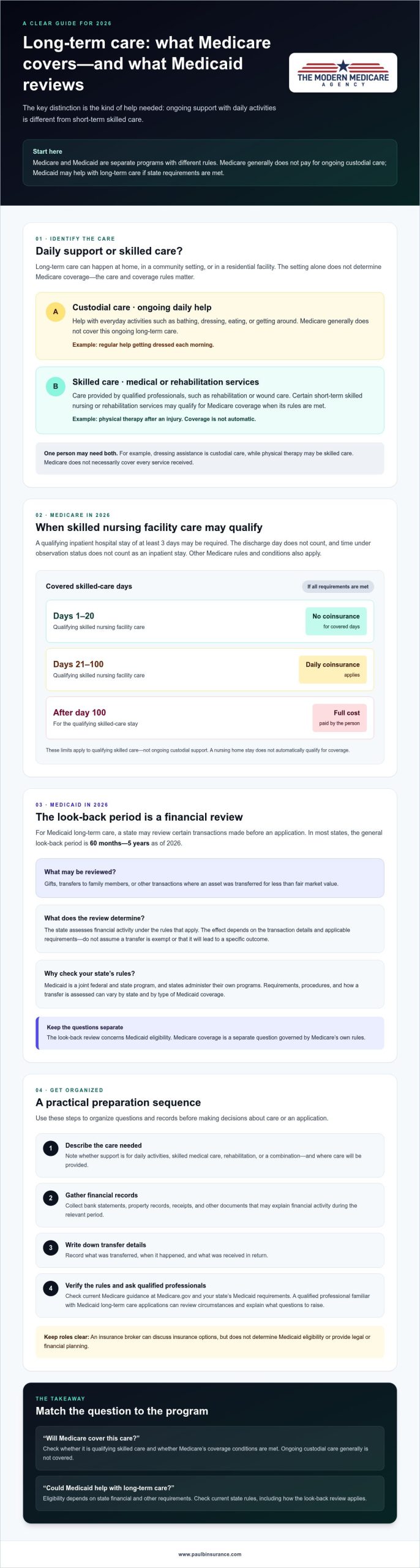
Generally, no. In 2026, Medicare doesn’t pay for ongoing custodial long-term care, meaning regular help with everyday activities such as bathing, dressing, eating, or getting around. That differs from skilled care, which involves medical or rehabilitation services provided by qualified professionals. To answer “does medicare pay for long-term care” in a specific situation, identify the care needed, where it will be provided, and whether Medicare’s coverage rules are met.
What does long-term care mean?
Long-term care is ongoing support for someone who needs help with daily life because of illness, disability, or changes related to aging. The amount and type of help can differ from person to person. It may be provided at home, in a community setting, or in a residential facility. The Long-term care overview describes the range of services and settings. Custodial help focuses on daily needs; medical treatment, such as wound care or rehabilitation, requires trained health professionals.
For example, someone might need help getting dressed each morning and physical therapy after an injury. The dressing assistance is custodial care. The therapy may be skilled care, but that doesn’t mean Medicare covers every service the person receives.
What care might Medicare cover instead?
Medicare may cover certain short-term skilled nursing or rehabilitation care when the person’s circumstances and the services meet its requirements. For example, in 2026, qualifying skilled nursing facility care may be covered after a qualifying inpatient hospital stay of at least three days, not counting the day of discharge. Time under “observation” status doesn’t count as an inpatient stay. Other Medicare rules and conditions also apply.
A nursing home stay doesn’t automatically qualify for coverage. For qualifying skilled nursing facility care, Medicare includes no coinsurance for covered days 1 through 20, then daily coinsurance for days 21 through 100. After day 100, the person pays the full cost. These limits apply to qualifying skilled care, not ongoing custodial support.
Before making care or payment decisions, check current 2026 coverage conditions in official Medicare guidance at Medicare.gov. For a broader overview of Medicare choices, see our Medicare Advantage coverage guide. A Medicare plan guide can explain plan options, but it doesn’t determine whether a particular long-term care service is covered.
What is the Medicaid look-back period, and how does it work?
The Medicaid look-back period is a review of certain financial transactions made before someone applies for Medicaid long-term care. In most states, the general look-back period is 60 months, or five years, as of 2026. The state reviews transactions during that timeframe to see whether assets were given away or transferred for less than fair market value. The exact rules and review process depend on the state and the type of Medicaid coverage involved.
This review concerns Medicaid eligibility, not Medicare coverage. The question “does medicare pay for long-term care” is separate and depends on Medicare’s coverage rules. For Medicare, Medicare does not provide coverage for ongoing custodial care, although certain skilled services may qualify under specific conditions.
What financial transfers may Medicaid review?
A state may review gifts, transfers to family members, or other transactions in which an asset was transferred for less than its fair value. The purpose is to assess the applicant’s financial history under that state’s rules. The effect of a transaction depends on its details and applicable requirements, so don’t assume a particular gift or transfer is automatically exempt or will lead to a specific outcome.
If you’re helping a family member prepare, start gathering bank statements, property records, receipts, and other documents that may help explain financial activity during the relevant period. Record what was transferred, when it happened, and what was received in return. A qualified professional familiar with Medicaid long-term care applications can review the circumstances and explain what questions to raise. An insurance broker can discuss insurance options, but doesn’t determine Medicaid eligibility or provide legal or financial planning.
Why does the rule differ by state?
Medicaid is a joint federal and state program, and states administer their own Medicaid programs. Requirements, procedures, and the way a transfer is assessed can therefore vary. The five-year period is a common general rule in most states as of 2026, not a guarantee that the same rule applies to every person or service.
Before making financial decisions or submitting an application in 2026, contact your state Medicaid agency for current guidance. Ask which look-back rules apply to the care being considered and what records the application requires. Because timing and transfer rules can be complicated, seek qualified advice before acting on assumptions. If you’re also exploring long-term care insurance as a separate option, you can ask about long-term care insurance. An insurance conversation can help you understand insurance options, but it won’t answer Medicaid eligibility questions.
Medicare vs. Medicaid: which program may help with long-term care?
Medicare and Medicaid are separate programs with different coverage and eligibility rules. Medicare is health coverage for people who qualify, including most adults aged 65 and older and some younger people with disabilities. Medicaid is a joint federal and state program, administered by states, that may help eligible people pay for certain long-term care services. Whether Medicaid can help depends on state rules, the person’s eligibility, and the care setting.
| Program | Relevant care question | Where to verify |
|---|---|---|
| Medicare | Does the service qualify under Medicare’s rules for covered medical or skilled care? | Medicare.gov or the person’s Medicare plan |
| Medicaid | Does the person meet state eligibility rules, and does the program cover this type of care in this setting? | The state Medicaid agency |
How does Medicare differ from Medicaid?
Medicare coverage focuses on eligible health services. Medicaid eligibility and long-term care coverage depend on state requirements, which can vary. If you’re wondering, “does medicare pay for long-term care,” remember that a Medicare Advantage plan doesn’t replace Medicaid’s eligibility process or remove state Medicaid look-back rules. Having a Medicare plan alone doesn’t determine whether someone qualifies for Medicaid. For an overview of the kinds of support long-term care can involve, see the National Institute on Aging’s What Is Long-Term Care?
Can someone have both Medicare and Medicaid?
Yes. Some people may qualify for both programs, sometimes called being “dual eligible.” That doesn’t combine the programs or make their rules interchangeable. Medicare may cover eligible medical services, while Medicaid may help with certain costs or long-term care services if the person meets state requirements. The details depend on the individual and the care involved.
For a specific situation, check Medicare.gov or contact the person’s Medicare plan about Medicare coverage. Ask the state Medicaid agency about financial eligibility, look-back requirements, covered services, and care settings. A Medicare Advantage plan doesn’t decide Medicaid eligibility, and enrollment in either program doesn’t automatically establish eligibility for the other.
What should you do before applying for Medicaid long-term care?
Preparing for a Medicaid long-term care application can feel like a lot, especially while arranging care for someone you love. Getting organized can make it easier to answer questions and locate records. It can’t guarantee approval, but these steps can help you prepare and identify where you need state-specific guidance in 2026.
- Contact your state Medicaid agency. Ask which application process applies to the care being considered, what documents are currently required, and how the state reviews financial transfers. Requirements vary, so use the agency’s current checklist rather than assuming a list from another state applies.
- Organize identity and financial information. Gather the records the agency requests about identity, income, assets, and accounts. Keep documents together by type and date, and ask the agency whether it needs originals, copies, or a particular format.
- Collect care-related records. File information about the care being sought, such as provider or facility details and any records the state requests to understand the person’s needs. Confirm which care documents are relevant before sending them.
- Review transfer history and get advice before acting. Locate available records for gifts, asset transfers, and other transactions within the period the state asks about. Don’t rush to give away or move assets based on general online information. The effect of a transaction depends on its facts and the state’s rules.
Which information should you gather?
There isn’t one universal document list for every Medicaid long-term care application. Depending on the state’s instructions, useful records may relate to identity, income, assets, care needs, and financial transfers. Keep a simple timeline of transactions you’re asked to explain, noting dates, amounts, and relevant paperwork. If something is missing or unclear, note that and ask the agency how to proceed instead of guessing.
Who can answer case-specific questions?
The state Medicaid agency is the right place to confirm application steps, required records, and eligibility questions. For legal questions about asset transfers, planning, or complicated family circumstances, consider speaking with an elder-law attorney. An insurance professional can discuss insurance options, but doesn’t provide legal advice or decide Medicaid eligibility.
These are separate questions from does medicare pay for long-term care. If you’re also considering insurance as part of future care planning, you can explore long-term care insurance options. That discussion won’t replace state Medicaid guidance or legal advice, but it may help you understand a separate coverage option.
How can you plan for long-term care with clearer expectations?
Start by separating three questions: What care might Medicare cover in 2026? Could you qualify for Medicaid under your state’s rules? Would private insurance fit your needs and budget? These questions are related, but the answers come from different programs and policies. Sorting them out can help you plan without assuming one type of coverage will pay for every kind of care.
A practical first step is to describe the care you may want to plan for. Would support at home, help with daily activities, or care in another setting be relevant? Needs can change, so treat this as a starting point, not a prediction. Then check Medicare coverage through Medicare.gov or your plan, and direct Medicaid eligibility questions to your state Medicaid agency.
What role might long-term care insurance play?
Long-term care insurance is a separate option to explore. Coverage depends on the policy, so don’t assume it will cover a particular service or situation. Before considering a policy, ask about eligibility requirements, covered services, exclusions, and other terms. Review the details carefully and consider how they relate to the type of care you’re planning for.
The Modern Medicare Agency offers long-term care and short-term care insurance. These are options to consider, not a promise that a policy will cover future care or that coverage will be available or suitable for every person. Medicare Advantage is also not a substitute for long-term care insurance.
How can an insurance conversation help?
An independent insurance broker can discuss relevant insurance options and compare available plans. That conversation may help you understand which questions to ask and whether insurance deserves a closer look. It won’t determine Medicaid eligibility or replace advice from an elder-law attorney or another qualified professional on legal or financial matters.
For a clearer next step, write down the care you’re concerned about and your questions about coverage. Check program rules with the appropriate government source and, if you wish, talk through insurance options with a broker. If you’d like to explore whether long-term or short-term care insurance may merit consideration, the agency can discuss those options with you. That conversation isn’t a decision about Medicaid or a guarantee of future coverage.
Take your next planning step with confidence
So, does medicare pay for long-term care? In 2026, Medicare generally doesn’t cover ongoing custodial help with daily activities, though some skilled care may qualify under specific rules. Medicaid is a separate program, and its long-term care eligibility requirements, including look-back rules, depend on the state. Private long-term care insurance is another option to explore, but coverage depends on the policy’s terms.
A helpful next step is to confirm Medicare coverage through official Medicare sources and ask your state Medicaid agency about its current rules. For insurance questions, The Modern Medicare Agency is an independent brokerage representing more than 40 insurance carriers, with personalized guidance and year-round support across more than 34 states. A conversation with an insurance broker can help you compare relevant options, but it doesn’t determine Medicaid eligibility or replace legal or financial advice.
If you’d like to explore whether long-term care or short-term care insurance may fit your needs, talk through your insurance options with a caring guide. You don’t have to figure out every part of the process at once. Start with one clear question and take the next step from there.
Frequently Asked Questions
Does Medicare pay for long-term care in a nursing home?
Generally, Medicare doesn’t pay for ongoing custodial care in a nursing home, such as continued help with bathing, dressing, or eating. In 2026, Medicare may cover qualifying short-term skilled nursing facility care under specific conditions, including a qualifying inpatient hospital stay of at least three days. A nursing home stay alone doesn’t establish coverage. Check current Medicare guidance to confirm the requirements for a particular person and service.
What is the Medicaid look-back period for long-term care?
The Medicaid look-back period is the time before an application during which a state may review certain financial transfers. As of 2026, the commonly described period in most states is 60 months, or five years, but rules and procedures can vary. The review may include gifts or transfers for less than fair market value. Contact the state Medicaid agency to confirm the current rules that apply to the person and type of care.
Does the Medicare look-back period apply to everyone?
There isn’t a Medicare look-back period for long-term care eligibility. This question usually refers to Medicaid, which may review financial transfers when someone applies for certain long-term care coverage. Whether a review applies, which period is relevant, and how transactions are assessed depend on the state and circumstances. Ask the state Medicaid agency about current requirements. Medicare coverage is separate and depends on Medicare’s rules for the care and service.
Can I give away assets before applying for Medicaid?
Don’t assume that giving away or transferring assets before applying is harmless. A state may review transfers made for less than fair market value during its applicable look-back period, and the effect depends on the transaction and state rules. Before making a transfer, gather relevant records and speak with an elder-law attorney about your circumstances. The state Medicaid agency can explain its application requirements, but general information can’t predict an eligibility decision.
Can you have Medicare and Medicaid at the same time?
Yes, some people may qualify for both Medicare and Medicaid. This is often called being dual eligible, but enrollment in one program doesn’t automatically establish eligibility for the other. Each program has its own coverage and eligibility rules. Medicare may cover eligible medical services, while Medicaid may help with certain costs or long-term care services if state requirements are met. Check individual Medicare coverage with Medicare or the plan, and ask the state Medicaid agency about Medicaid eligibility.
Does Medicare Advantage cover long-term care?
A Medicare Advantage plan doesn’t replace long-term care coverage or make someone exempt from Medicaid rules. Like other Medicare coverage, it generally doesn’t pay for ongoing custodial care, such as regular assistance with everyday activities. It may cover eligible medical or skilled services according to the plan’s terms and Medicare requirements. Review the plan documents and confirm coverage directly with the plan. For Medicaid long-term care eligibility, contact the state Medicaid agency.
Who can help me understand Medicaid long-term care eligibility?
Your state Medicaid agency can explain current eligibility requirements, application steps, and the records it requests. For legal questions about asset transfers, planning, or complex family circumstances, consider consulting an elder-law attorney. An insurance broker can discuss insurance options, including long-term care insurance, but doesn’t determine Medicaid eligibility or provide legal or financial planning. Keeping these roles clear can help you direct each question to the right source.

Article by
Paul Barrett
Paul Barrett, CMIP is the founder of The Modern Medicare Agency, an independent Medicare-only brokerage based in Melville, NY. With 18 years of Medicare-exclusive experience, a CMIP designation, and more than 5,000 clients served across 37 states, Paul is one of the most credentialed independent Medicare specialists on Long Island — and one of the most direct.
He represents 40+ carriers with no quotas and no allegiances, which means his recommendations are based entirely on what fits each client's specific situation. He is the author of Medicare Mastery Unlocked and host of the Wise Guys Retirement Talk podcast. His content is grounded in primary sources, real carrier intelligence, and 18 years of watching what happens when people get Medicare right — and when they don't.
📞 631-358-5793 | paulbinsurance.com